Jason Kruger with Citrin Cooperman
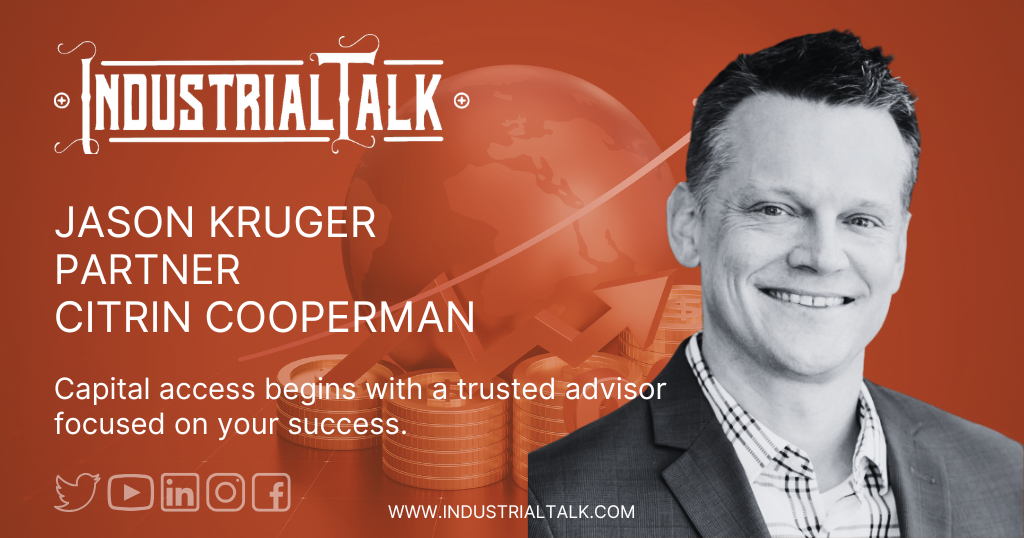
Industrial Talk is talking to Jason Kruger, Partner at Citrin Cooperman about “Capital access starts with a trusted advisor focused on your success”.
Scott Mackenzie hosts the Industrial Talk podcast, featuring industry professionals like Jason Kruger from Citrin Cooperman. The conversation covers the importance of podcasting for business, emphasizing its role in building authority, trust, and engagement. Jason discusses his firm's services, focusing on outsourced accounting and CFO advisory, and their unique approach to client support. He highlights the impact of tariffs on manufacturing profitability and the necessity of accurate financial reporting for accessing capital. Jason also touches on the role of AI in enhancing efficiency and decision-making in financial processes. The discussion underscores the value of human connection and strategic financial planning in business success.
Action Items
- [ ] Publish the guest's contact information on the Industrial Talk website and episode page so listeners can reach the guest
- [ ] Provide placement of a guest's podcast on the Industrial Talk platform upon the guest's request (listener must ask to proceed)
Outline
Introduction and Purpose of the Podcast
- Scott welcomes listeners and highlights the importance of celebrating innovators and problem solvers in the industry.
- The podcast aims to tell the stories of industry professionals and discuss topics like access to capital and financial strategies.
- Scott shares his passion for finance and the importance of financial conversations in every organization.
The Value of Podcasting
- Scott expresses frustration with companies that do not see the value in podcasting.
- He shares his personal journey into podcasting, inspired by the widespread popularity of podcasts.
- Podcasting is presented as a way to create human connections, build authority, and improve engagement.
- Speaker 2 emphasizes the tangible financial rewards and SEO benefits of podcasting.
Challenges and Opportunities in Podcasting
- Scott discusses common objections to starting a podcast, such as lack of personnel or time.
- He encourages companies to prioritize creating content and human connections through podcasting.
- The podcasting process is described as relatively inexpensive and straightforward.
- Scott offers to help companies distribute their podcasts on the Industrial Talk platform for greater exposure.
Introduction of Jason Kruger
- Scott introduces Jason Kruger, a partner at Citrin Cooperman, and sets the stage for a discussion on financial topics.
- Jason Kruger joins the conversation, mentioning his location in San Diego, California.
- Scott and Jason share personal anecdotes about San Diego and their experiences there.
- Jason provides a brief overview of his background and his current role at Citrin Cooperman.
Citrin Cooperman's Services and Approach
- Jason explains that Citrin Cooperman is a top 15 national CPA firm, specializing in tax, financial statement audits, and advisory services.
- He highlights his focus on outsourced accounting and CFO advisory services, as well as valuation work and mergers and acquisitions.
- Jason shares his experience at Deloitte and the inspiration behind starting Signature Analytics in 2008.
- The company was acquired by Citrin Cooperman a year ago, and Jason continues to support clients in a partner role.
Differentiating Citrin Cooperman
- Jason discusses how Citrin Cooperman differentiates itself from other CPA firms by focusing on the client's specific needs and pain points.
- The firm does not just provide bodies but offers a tailored approach to address the client's financial environment and infrastructure.
- Jason emphasizes the importance of understanding the client's short-term and long-term goals and providing leadership and support.
- The goal is to make clients feel like Citrin Cooperman is part of their team, even if they are not physically present.
Focus on Mid-Market Clients
- Jason explains that Citrin Cooperman focuses on mid-market clients with revenues between $10 million and $100 million.
- The firm provides more resources and support than local CPA firms while still offering personalized service.
- Jason highlights the significant need for good talent in the mid-market space and the success Citrin Cooperman has had in this area.
- The firm's growth is attributed to the high demand for quality financial services in the mid-market sector.
Navigating Capital Markets
- Jason discusses the challenges and opportunities in the capital markets, particularly in the context of tariffs and their impact on manufacturing.
- He explains how tariffs have created uncertainty and affected the profitability of manufacturing companies.
- The importance of providing credible and confident financial information to capital providers is emphasized.
- Jason advises clients to build long-term relationships with bankers to secure better financing terms in the future.
Strategic Financial Planning
- Jason highlights the importance of having a strategic financial plan and understanding market trends.
- He explains the need for accurate financial reporting and forecasting to make informed decisions.
- The cash flow cycle in manufacturing is critical for understanding capital needs and planning for the future.
- Jason emphasizes the importance of having a reliable financial infrastructure to support strategic planning and decision-making.
Leveraging Technology and AI
- Jason discusses the role of technology and AI in improving efficiency and providing real-time financial insights.
- He mentions the use of generative AI tools like Copilot and the security measures in place to protect client data.
- The firm also leverages AI capabilities built into systems like NetSuite and Sage to enhance reporting and analysis.
- Jason believes that AI will help clients make better decisions and achieve their business goals more effectively.
Future of Financial Services
- Jason predicts that the mid-market will eventually catch up to the larger firms in terms of technology and AI adoption.
- He sees an opportunity for smaller companies to invest in technology to gain a competitive advantage.
- Jason emphasizes the importance of being forward-thinking and leveraging technology to stay ahead of competitors.
- He believes that the small and mid-market companies have an advantage in terms of agility and the ability to pivot quickly.
Contact Information and Final Thoughts
- Jason provides his contact information, encouraging listeners to reach out on LinkedIn or via email.
- He expresses his willingness to help business owners and provide advice on financial and entrepreneurial topics.
- Scott wraps up the conversation, emphasizing the importance of connecting with Jason and leveraging his expertise.
- The podcast concludes with a reminder of the benefits of podcasting and the importance of human connection in business.
If interested in being on the Industrial Talk show, simply contact us and let's have a quick conversation.
Finally, get your exclusive free access to the Industrial Academy and a series on “Why You Need To Podcast” for Greater Success in 2026. All links designed for keeping you current in this rapidly changing Industrial Market. Learn! Grow! Enjoy!
JASON KRUGER'S CONTACT INFORMATION:
Personal LinkedIn: https://www.linkedin.com/in/jason-kruger-a0b159b/
Company LinkedIn: https://www.linkedin.com/company/citrin-cooperman/
Company Website: https://www.citrincooperman.com/
PODCAST VIDEO:
THE STRATEGIC REASON “WHY YOU NEED TO PODCAST”:
OTHER GREAT INDUSTRIAL RESOURCES:
NEOM: https://www.neom.com/en-us
Hexagon: https://hexagon.com/
Arduino: https://www.arduino.cc/
Fictiv: https://www.fictiv.com/
Hitachi Vantara: https://www.hitachivantara.com/en-us/home.html
Industrial Marketing Solutions: https://industrialtalk.com/industrial-marketing/
Industrial Academy: https://industrialtalk.com/industrial-academy/
Industrial Dojo: https://industrialtalk.com/industrial_dojo/
We the 15: https://www.wethe15.org/
YOUR INDUSTRIAL DIGITAL TOOLBOX:
LifterLMS: Get One Month Free for $1 – https://lifterlms.com/
Active Campaign: Active Campaign Link
Social Jukebox: https://www.socialjukebox.com/
Industrial Academy (One Month Free Access And One Free License For Future Industrial Leader):

Business Beatitude the Book

Do you desire a more joy-filled, deeply-enduring sense of accomplishment and success? Live your business the way you want to live with the BUSINESS BEATITUDES…The Bridge connecting sacrifice to success. YOU NEED THE BUSINESS BEATITUDES!
TAP INTO YOUR INDUSTRIAL SOUL, RESERVE YOUR COPY NOW! BE BOLD. BE BRAVE. DARE GREATLY AND CHANGE THE WORLD. GET THE BUSINESS BEATITUDES!
Reserve My Copy and My 25% Discount
Transcript
SUMMARY KEYWORDS
Industrial Talk, access to capital, financial advisory, outsourced accounting, CFO advisory, Citrin Cooperman, mid-market focus, financial reporting, cash flow, ERP systems, AI integration, business expansion, podcasting, human connection, business strategy.
Scott, welcome to the Industrial Talk podcast with Scott Mackenzie. Scott is a passionate industry professional dedicated to transferring cutting edge industry focused innovations and trends while highlighting the men and women who keep the world moving. So put on your hard hat, grab your work boots and let's go
all right once again. Welcome to Industrial Talk. Thank you very much for joining me in celebrating you because you're bold, you're brave, you're there greatly, you innovate, you collaborate, you are solving problems each and every day. That's why Industrial Talk celebrates you, tells your story as best that we can so anyway, thank you for joining. Thank you for what you're doing. In the hot seat, we have a gentleman by the name of Jason Kruger Citrin Cooperman is the organization, and we're going to be talking about money. We're going to be talking about access to capital. We're going to be talking about all that, because we again, what you succeed. Let's get
cracking it taps
that you need to consider for:you have to succeed. You just have to.
It's important. All right, let's get going with the conversation. I'm winded. All right. Jason Kruger, Citrin Cooperman is the company this is a must connect. Make sure you happen here he is, Jason, Jason, welcome to Industrial Talk. Thank you very much for finding time in your busy schedule. How you doing today?
Great. Thank you, Scott for having me on, yeah, San
Diego, California, that's where he's calling in from. Is it got the marine layer happening today?
You know, actually, no, it's, it's, it's pretty nice. It's nice and sunny, and not a, really a cloud in the sky right now. So it's, it's doing well, yeah, now, if you came back in, you know, May, June timeframe. I'm sure that would not be the case. It's doing great right now.
I used to hang out the hotel Dell all the time, yeah, yeah. Go in a galaxy, far, far away. That's what I used to love. That area. I went to Tijuana once,
okay, yep, yep. It's, it's changed years from from, you know, bad to good to bad. And, you know,
I haven't been down there recently.
I had this bright idea that I am going to do the bike ride Tijuana to the sea. Okay, so you go over there, across the border, got your bike feeling pretty good. You know, the tight shorts happening, you're looking like you got all the gear. And then you get on the bike ride. You're with a bunch of other people. You make it to the sea hours later, or whatever, or whatever it was, you know what the biggest problem was? What's that getting back? Yeah, you're not even near the border because you've been riding a bike to the sea,
yep, yep, you got it right back. Yeah, you're not
in the best shape. They're saying I don't want to go back because, you know, you got to go pills and all that stuff. So you get a taxi and then you just throw all your bikes on a taxi. Yeah, that's great. Let the law sort of shake it out. But anyways, yeah, there it is. Well, very good, man. For the listeners out there, Jason, give us a little 411 on who you are. And then we're going to talk a little bit about Citrin Cooperman, name that I heard before, but now I have, which is pretty doggone cool. And then we're gonna talk a little bit about, I want to sort of dive into those capital markets. And see how we can help out some industrial folks. So absolutely,
start, yeah, absolutely, yeah. So I'm currently a partner at Citrin Cooperman citron. Cooperman is a top 15 national CPA firm, so our core services are on the tax side and financial statement audit, but we also have significant, what we call advisory services, and that's what I fall under. So my my specialty is on the outsourced accounting and CFO advisory side. We also offer valuation work. We help companies with mergers and acquisitions and the due diligence process and everything goes along with that. Along with we have a digital team as well. But before Citrin Cooperman, I, I, you know, started my career and with the big, big firms, Deloitte being my the most prevalent
Price Waterhouse right here. Price water really?
Yeah, yep, great, yeah, spent,
not the not the finance
Yeah, I know I that was the more fun, more fun side, yeah. So I spent time in the financial statement audit, and what I saw, a lot, what I saw with a lot of our clients, even at Deloitte, was that they deserved better as it relates to their accounting and financial environment and infrastructure.
And did you just say that heresy?
called signature analytics in:How do you, and I understand that that's all good. How do you differentiate your business model, meaning, you know, when you say, you know, CPA firm, financial advisory solutions, things like that. How do you in a bloody ocean, in a bloody ocean world, how do you, how do you differentiate from the all the other talking heads out there that are saying sort of similar stuff,
yeah, I mean, in, specifically in what we do on the outsourced accounting and CFO advisory. I mean, it's really, it's pretty simple. It's how we approach things. It's our model. It's we don't just throw bodies at you. We're not a staffing or recruiting firm
sausage making factory,
no, right? Not exactly, yeah, not, not at all, yeah. And we're not going to just come in and say, Hey, we're just going to take over everything and do accounting. We're going to our process is what sets us apart. And it's really about understanding the current environment, where the pain points are, where the business owner what they're trying to accomplish in the short term and the long term, there's usually a pain point, meaning they're not able to close their books on time. We're able to make sure they have a good solution, leveraging their current team, filling in the gaps and providing the leadership. So we're not an outsourced bookkeeping firm. It's not like, hey, just throw everything over. We want our clients to feel like we're part of the team. We just don't happen to be sitting in the office next to them, you know, five days a week.
So fitchrin Cooperman, what do you find? I mean, what businesses? What's verticals? Do you guys sort of focus in on?
Yeah, our focus is, you know, even though, you know, in some cases we might compete with the larger firms like the Big Four, our focus really is that mid market, our core clients are 10 million to 100 million. We have clients, you know, we have clients even smaller than that, you know, 5 million to 100 million and so on. So that's really our focus. Is that mid market space, the mid market historically, has been serviced by individual, local CPA firms. And so what we're able. To do is really support that space, but also have more resources and support based on what's happening, you know, with our clients. So that's a big part of it.
s taking place, especially in:Yeah, absolutely. I mean, as you know, it's been a crazy year with the tariff situation.
The tariff created a lot of uncertainty
ere's a lot of excitement for:Yeah, see, and I think that that's an important component that should not be overlooked. I think that once you begin to proceed forward, do we really have my I mean, banking, finance, I think there's other ways of being able to access capital, but that is a relationship. It's not one and done. It's not just, Hey, thank you for the money. Now pay me. You know, whatever the
yep, that's so true. I mean, you know, Scott, is that bankers want a relationship, right? They're turned off by business owners who come in and say, I just, just give me the money, you know, I just want the money and and I'm out, you know, it's if, if you're looking and that's where the long term approach is so important, which is, Hey, maybe I can get a little bit of capital now build that relationship, and then a year or two, I can get that much more that I wouldn't have gotten otherwise. So building that relationship with your banker early on, even if you're not, even if you're not even getting any financing from them, is critical, because that will build that trust, and they'll go to bat for you the.
The solutions that are provided by your firm. Do you help companies paint a strategic picture? See, there's this demand for capital today, but what does that look like going forward? Do I understand what the market is, where it's going? What I mean? I do need that, because here I am as a manufacturer, I'm stuck in the business, and I'm doing today's business, right? Yep. Do I have the capacity, the bandwidth, to say, Oh, now let me be strategic and be able to see what the market is, how it's trending, and they even want this widget anymore, or whatever, and be a little proactive. You guys help?
Yeah, absolutely. I mean, that's, that's what I would call the fun stuff, right? Like, you know, making sure, but, but you can't do the fun stuff without the right infrastructure in place. You gotta, you gotta have processes to invoice, gotta processes to pay bills, to collect cash, yeah, closing the books every month and then producing monthly, good, monthly financial reporting that you can trust and that's accurate. And once you have that, then you can start to, you know, get into that fun stuff, which is looking into the future. So forecasting that that out and in manufacturing, especially the cash flow cycle, is critical because, as we all know, we got to buy inventory today, we got to pay for it, then we got to spend the time to manufacture we got to pay our team, we got to incur all these other costs, then we might sell it, but then we still won't get paid at best in another 30 days. So that's cash cycle is critical, and that's a big part of forecasting out what your capital needs will be in the future is, hey, we need to not only understand what your revenue growth might be, or your net bottom line might be, we need to track your cash flow, and that will allow us to then understand when we might need to go to market, when we might need to start, you know, get a line of credit, whatever that might be to and we'll have better visibility and a timeline. The worst thing to do is to say, well, I'm going to be out of cash next month. I need to scramble, and I need financing, right? Well, you're going to get a bad deal, right? You're not going to get the best terms, you're not going to get what you want, you're just taking whatever you can get. And to be able to plan in advance is critical.
You know, it's interesting, because I've owned businesses, and when I went to school, did I truly understand cash flow? No, I wasn't living the pain of cash flow, right? All of a sudden you're now, you're owning a business, and then you realize it comes slapping you across the head, and say, Oh, so that's what the professor was telling me about,
yeah, I got to make payroll next week. Oh yeah, I got to pay my employees on Friday.
Yeah, yeah, yeah. It's that to me, is probably the Well, one of many, but, but that's very critical. Being able to have that, that structure in place to properly deal with that goes a long way without that, you know, taking care of that frustration, that fear, that anxiety, and
that's the first thing when we talk to our clients, the first thing we do is we look into their cash flow situation, and we start to forecast that out. So you have when you're budgeting or forecasting long term, you can do that on a monthly basis, maybe, but we look at it from a 13 week cash flow perspective. And 13 weeks is basically one quarter of the year. And so we're always, we're updating every week, and we're looking out forward 13 weeks so that we have confidence that, hey, we can make payroll next week, or we have the flexibility to move some payments around based on when the cat some in cash flow is coming in, and so giving them that visibility allows our clients to sleep better at night.
Yeah, as I look down, I'm writing, I'm writing a note. Now let me ask you this, do you guys specialize in any ERP systems like, yeah, we're, we're great with filling the wine or No, we're fine with all of them because they all look the same anyway.
Yeah, we're fairly we're pretty agnostic. I mean, we don't force our clients. We work off of their system. That being said, we certainly know when our clients are not either leveraging the system they're on effectively or might be in a position to transition up right. So most clients companies will probably start with something like a QuickBooks. There's other systems in the manufacturing space. You know our lot, we have a number of clients on different sage products. We have clients on NetSuite. We are a NetSuite implementer as well, so we certainly help and support that process. We have our our team is well versed in number of different systems. Yes. So our goal isn't to come in and try to, you know, change everything that they're doing. It's, it's, how do we leverage their system to be effective and and make recommendations on, on the future based on kind of where they're at.
How do you do you go in and, and this is, this is real life, you know, hey, this was the evolution of our, ERP, we've got NetSuite. Somebody came in, sold it, we implemented and then all of a sudden, the data starts to be questionable. And then then you have the conversation of, well, do I trust the numbers? How do I point where I can clean up the numbers and make it more relevant? But I guess that goes down to your point of, well, that's the process. We want to get you to a point where you have trusted, you know, financials on a monthly, weekly, whatever, whatever the timeframe is that, Yep, absolutely.
I mean, the first thing we don't just come in and say, Hey, we're just going to do accounting Right? Like, what is that? Right? It's, let's make sure that we we understand, we assess the environment. And so the four areas we'll look at is, is the people, the processes, what you talked about, which is the technology. So are we leveraging the technology effectively? And then what's most important, once you have the foundational stuff, is the reporting side of things. So let's assess that. Let's make sure we're aligned with the business and management, the CEO and the executive team, on what their goals are. Let's make sure we're aligned on priorities. And then let's make sure we have a plan that we can execute off of to get to a point where they have confidence in how they're using their technology, the roles and responsibilities of their people and their processes. And then ultimately, like let's make sure you have good reporting, you can use historical and future looking, forward looking, so that you can make decisions to improve your business. And with manufacturing, it's all about, I mean, so much of it is about margin. Understand your margin, and how do we get an extra point or two right? When I hear a client say, when I ask them what their margin is, and they say somewhere between 40 and 50% Well, that's a huge difference. If you're a $10 million company. One 1% is 100 grand, and that goes right to the bottom line. So let's dig. Let's get to that one percentage point
makes sense to me. Okay, here's the elephant in the room, AI, how is your organization? How is, how is your, how is that helping you and helping the clients solve their problems from a financial perspective?
Yeah, I think it's it's allowing us together to be more efficient in in a number of ways. Now. So there's generative AI, which is like your chat GPT. So obviously we use copilot. It's, it's part of our kind of technology stack and infrastructure. And it's very the security around, you know, how we're structured with that is, you know, probably the most secure thing I've ever seen, because, you know, we're dealing with clients financial information and data, so there's parameters that protect that, the security around that. But the reality too, is We're also leveraging, in a lot of cases, the AI that's built into the systems that we're working off of. So there's a lot of investment in NetSuite and their AI capabilities and how things are done. I talked about the sage projects, Project products, SAP other systems and reporting tools that we're leveraging, that is able to, you know, provide more real time information, analyze the information, provide trend analysis, those types of things that give us information that's really, you know, more real time than having to spend the extra time to do that, and I think that's where there's tremendous value is in getting the blocking and tackling we want to use technology for, and then what we want to be for our clients is okay now that we have the information, how do we help you make the right decisions to achieve the goals that you have as a business? How do we help you understand what these numbers mean and communicate that to you in a way that you can make decisions.
Yeah, I think it's a no brainer. I think
that if I'm crunching numbers, if I'm looking at trends, if I'm if I want some tactical insights into the future, I think that AI doesn't have to be, you know, large language model. It doesn't have to be this one thing. It could be right there, leveraging the data that I have, whatever pulling in. I think we're scratching the surface, but I believe that there is tremendous value, tremendous opportunity to be able to provide me, as a business, greater insights on things that I can take advantage of, or I. Red Light, be careful. Yeah, just, I think it's, I think it's and, and from, from a market intelligence perspective, there's some interesting stuff going on there. You know, pricing, whatever it might be, efficiencies, I don't
know, yeah, absolutely, it's all about efficiency. It's about efficiency, but it's also about getting the user the information in the right manner to be able to make decisions and to move faster, right. And that is ultimately what we want to be doing, and it can obviously help create efficiencies in the work environment and and how we do things, how our clients do things as well.
Yeah, I think it's a no brainer. Where do you think things are going like you put your future hat on there, Jason. And you know, are we? Are we transitioning from the the old and stodgy financial conversations with, you know, to something that's where do you see it going?
Yeah, well, it's interesting. I you know that I look at in two areas. So one, you got the fortune 500 the bigger companies, they're all investing heavily in technology, AI, etc, the the mid, small and mid market is probably five to 10 years behind, depending on who they are, because they don't have that the resources to invest, they don't have the sophistication to understand what AI even means, or, you know, technology, they're stuck. They're leveraging like a QuickBooks, and they're doing things that, you know, they're doing things in that manner. So what I'm interested to see is, how can we as a country elevate the small, mid market to bring that up closer to the level that some of these larger firms are? That's where we'll really see the impact of technology in the world, I think, or in our space, and when we see and that's where I also think there's a lot of advantages for smaller companies, if they can invest to get ahead of their competitors, if they're forward thinking in that manner. Yeah, I agree with that 100%
I believe that whole small, midsize market, they're nimble, they're able to pivot quickly. They're able to respond faster. I think that that's a that's an advantage over that big, lumbering company that has, you know, an army of people. I just, I'm bullish on that. I believe I agree with you 100% on on that ability. Yeah, but you were wonderful. Wrap it up. I enjoyed this conversation. That man, great. Thank you. How do people get a hold of you? Jason, what's the best way? Yes, you're supposed to say LinkedIn, the other So, how do people get a hold of you? Yeah, well,
obviously, as you mentioned, LinkedIn, if you LinkedIn, is easy. I do, you know, I just really enjoy talking to business owners. Yeah, and you know, anything related to business as a whole? I've been an entrepreneur. I built a business from myself and a computer to 75 people and had an exit. But I also have hair. You still have hair.
I have hair. It's more gray than it was.
Yeah, but so the entrepreneurial ride, and what that means to be an entrepreneur, and what are things to be that are important to ensure that you can scale and grow to achieve the goals you have. Then also on the financial side of things is critical, and so reaching out LinkedIn, as you mentioned, anyone can email me directly to the letter J. Kruger, so it's J, K, R, U, G, E, R, Citroen, Superman Comm, I'm always happy to talk to business owners if I can provide some nuggets of advice or thoughts. Happy to do that. If I don't know the answer, I usually know somebody who does, who I'd be happy to introduce them to.
Sounds like a winning strategy. You're a wonderful I enjoyed that quite a bit. All right, we're gonna have all the contact information for Jason out on Industrial Talk. So fear not. This is a must connect. So stay tuned. We will be right back.
You're listening to the Industrial Talk podcast network
guy, right? That was Jason. Got to reach out to him. Yep, you need money. Need to figure that out. You need people to help you with that journey. You need trusted individuals to help out with that journey. Yeah. Jason Citron Cooperman, I always have to look down at the name, because I just need to, because I don't want to screw it up. Jason. Jason, all his contact information out on Industrial Talk. All right, here's a stat for you. We'll throw this out at you, because I've been on a on a terror with podcasting. Why you need to? Don't come to me and say you don't want to do a podcast. 42% Americans trust podcast information more than traditional media. Here's the big 150. 6% say host endorsement influences purchase decision.
Get out on Industrial Talk. Let me
help you succeed. It's easy. There's a big blue button on my website says, Let's chat. Let's chat. All right, people, be brave. Dare greatly hang out with Jason. Change the world. We're going to have another great conversation shortly. So stay tuned.