Seth Ratner with East Hills Instruments
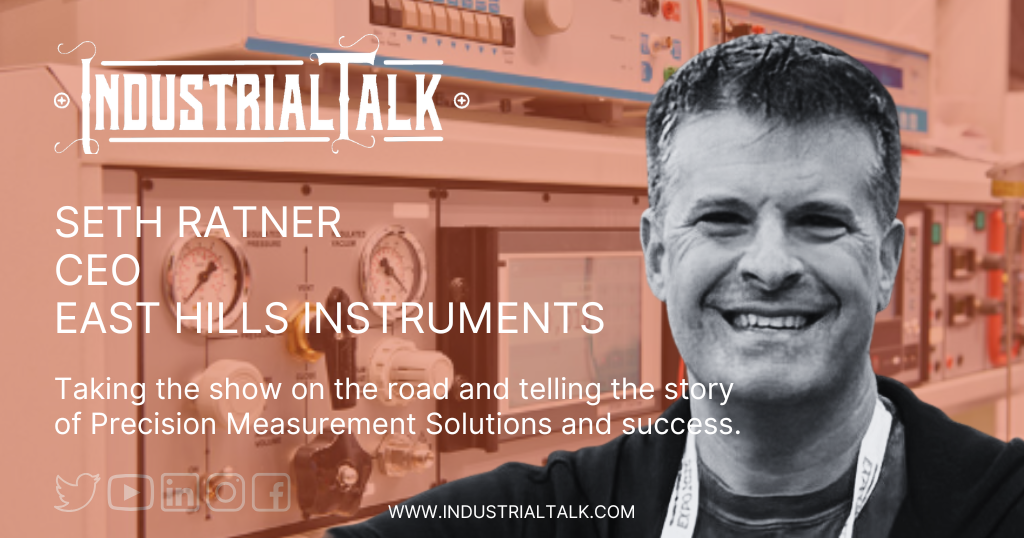
Industrial Talk is talking to Seth Ratner, CEO at East Hills Instruments about “Telling the story of advanced precision measurement solutions”.
Scott Mackenzie promotes Wildcat Generation's unmatched power generation expertise on the Industrial Talk Podcast. Seth Ratner from East Hill Instruments discusses his journey of promoting his company through an RV tour, emphasizing the importance of storytelling in business. Seth's company manufactures handheld test and measurement equipment for pressure and vacuum, highlighting their unique auto-ranging technology that eliminates the need for multiple devices. Despite challenges from large distributors, Seth's direct approach and innovative products are gaining traction. He encourages proactive asset maintenance and offers his contact details for further engagement.
Outline
Introduction to Wildcat Generation and Industrial Talk Podcast
- Scott reiterates the importance of celebrating industry professionals and introduces Seth Ratner from East Hill Instruments, who is sharing his journey of promoting his company through an RV tour.
- Scott praises Seth for his efforts in telling his story and emphasizes the importance of companies telling their stories to connect with their audience.
Seth Ratner's Journey and the Importance of Storytelling
- Scott discusses the significance of storytelling in today's fast-paced technology landscape, urging companies to find their voice and connect with their audience.
- Scott offers support and resources to help companies create content and tell their stories, emphasizing the importance of human connection in building trust.
- Scott introduces Seth Ratner, who is on the road promoting his company, and highlights the value of Seth's approach in creating a personal connection with his audience.
- Seth Ratner, expresses his gratitude for being on the show and shares his background, including his family and career in the gas and oil industry.
Background of East Hill Instruments and Testing Equipment
- Seth Ratner provides a brief history of East Hill Instruments, mentioning its origins in East Hills, Long Island, and its current location in Westbury, Long Island.
- Seth explains the focus of East Hill Instruments on handheld test and measurement equipment for gas, oil, nuclear, pharmaceutical, and wastewater treatment industries.
- Seth describes the specific equipment they manufacture, including pressure and vacuum measurement tools, and their unique features like ergonomic design and patented technologies.
- Scott, who works with various testing equipment companies, asks for clarification on the specific focus of East Hill Instruments, and Seth explains their niche in pressure and vacuum measurement.
Details of East Hill Instruments' Products and Solutions
- Seth explains the two main components of their solution: a portable source of pressure or vacuum and a digital gage that auto-ranges and auto-calibrates.
- Seth highlights the advanced features of their digital gage, such as high-resolution color screens, rechargeable batteries, and data logging capabilities.
- Seth discusses the importance of metrology and calibration work, emphasizing the need for patience, methodical approach, and attention to detail.
- Seth explains how their equipment helps technicians verify the accuracy of pressure and vacuum measurements, and the importance of maintaining equipment within specification.
Challenges and Opportunities in the Industry
- Seth shares the challenges his company faces, including competition from large corporations and the difficulty of gaining access to large distributors.
- Seth describes his strategy of going direct to customers and launching a reality show called “On Site and Off the Grid” to promote his products and educate the industry.
- Seth discusses the positive feedback he has received from customers and the importance of shedding light on the industry and its critical role in keeping the world running.
- Seth emphasizes the need for proactive insights into the health of assets and the importance of efficient and reliable tools for maintenance professionals.
Conclusion and Contact Information
- Seth provides details about his current road trip and the locations he will be visiting, encouraging listeners to reach out and share their experiences.
- Seth shares contact information for East Hill Instruments, including their website, YouTube channel, and LinkedIn profile, inviting listeners to connect and learn more about their products.
- Scott wraps up the conversation, expressing admiration for Seth's journey and emphasizing the importance of storytelling for companies in the industry.
- Scott encourages listeners to reach out to Seth and take advantage of the resources available on the Industrial Talk Podcast to tell their own stories and connect with their audience.
If interested in being on the Industrial Talk show, simply contact us and let's have a quick conversation.
Finally, get your exclusive free access to the Industrial Academy and a series on “Why You Need To Podcast” for Greater Success in 2026. All links designed for keeping you current in this rapidly changing Industrial Market. Learn! Grow! Enjoy!
SETH RATNER'S CONTACT INFORMATION:
Personal LinkedIn: https://www.linkedin.com/in/seth-ratner-595738aa/
Company LinkedIn: https://www.linkedin.com/company/east-hills-instruments/
Company Website: https://easthillsinstruments.com/
PODCAST VIDEO:
THE STRATEGIC REASON “WHY YOU NEED TO PODCAST”:
OTHER GREAT INDUSTRIAL RESOURCES:
NEOM: https://www.neom.com/en-us
Hexagon: https://hexagon.com/
Arduino: https://www.arduino.cc/
Fictiv: https://www.fictiv.com/
Hitachi Vantara: https://www.hitachivantara.com/en-us/home.html
Industrial Marketing Solutions: https://industrialtalk.com/industrial-marketing/
Industrial Academy: https://industrialtalk.com/industrial-academy/
Industrial Dojo: https://industrialtalk.com/industrial_dojo/
We the 15: https://www.wethe15.org/
YOUR INDUSTRIAL DIGITAL TOOLBOX:
LifterLMS: Get One Month Free for $1 – https://lifterlms.com/
Active Campaign: Active Campaign Link
Social Jukebox: https://www.socialjukebox.com/
Industrial Academy (One Month Free Access And One Free License For Future Industrial Leader):

Business Beatitude the Book
Do you desire a more joy-filled, deeply-enduring sense of accomplishment and success? Live your business the way you want to live with the BUSINESS BEATITUDES…The Bridge connecting sacrifice to success. YOU NEED THE BUSINESS BEATITUDES!
TAP INTO YOUR INDUSTRIAL SOUL, RESERVE YOUR COPY NOW! BE BOLD. BE BRAVE. DARE GREATLY AND CHANGE THE WORLD. GET THE BUSINESS BEATITUDES!
Reserve My Copy and My 25% Discount
Transcript
SUMMARY KEYWORDS
Industrial Talk, Seth Ratner, East Hill Instruments, RV tour, test and measurement, pressure and vacuum, calibration, metrology, digital gage, auto ranging technology, customer engagement, industry challenges, proactive insights, resource constraints, AI in calibration.
Hey, industrial professional Scott Mackenzie here, let me tell you about a company you need to know, Wildcat generation. These folks are the real deal. They bring unmatched expertise to power generation, from advanced technologies to boots on the ground. If you're looking to improve reliability, boost efficiency or modernize your plant for the future. Wildcat generation is the partner that delivers no hype, just results. Wildcat generation powering industry with purpose and precision.
Welcome to the Industrial Talk podcast with Scott Mackenzie. Scott is a passionate industry professional dedicated to transferring cutting edge industry focused innovations and trends while highlighting the men and women who keep the world moving. So put on your hard hat, grab your work boots, and let's go all right
once again. Welcome to Industrial Talk. Thank you for your continued support of this platform that celebrates you, industry professionals all around the world, yes, all around the world, you're bold, you're brave, you dare greatly, I say it all the time. You innovate, you You never stop helping people succeed. That's why we celebrate you on Industrial Talk. They're the heroes in this story. We have a gentleman by the name of Seth Ratner. The company is East Hill instruments, and we're gonna be talking about his journey, his journey on taking his company and telling his story the old fashioned way, in an RV. And He's taken his story to all the industry and industrial companies, and they telling the story, let's get cracking.
Yeah, so here's Seth. Seth goes, Hey, Scott,
I'm going to be jumping in and in an RV, cool, and then I'm going to be going around to all my industrial customers. Well, that's, that's cool, too. And then we're going to be talking about what we do, and and, and just capturing, and I say it all the time, capturing the story. You got to tell your story. Here's Seth, he's putting himself out there that you gotta, gotta hand it to him. I don't know where he is on his journey. I hope he's safe, but I just can really appreciate and respect what he's doing. Because, you know why? Is because here at Industrial Talk, we want you to succeed. I think it's vitally important that you succeed, that your company succeeds, that the people within your organization succeeds. And you know how you do that. You've got to tell your story, especially today, especially with all the technology that exists out there, especially because it's going at such a fast pace, it's, it's vitally important that you find your voice to tell your story and bring out that human side. I said it now, here's the problem. The problem is one you're gonna say to yourself, I don't do that. Well, yeah, you do. I mean, I if I can do it, you can do it. That's one two. I don't know how to do it. You know what? If you're listening to this, you have somebody in your corner that can help you do that. It's me, and you go out to Industrial Talk, and you say, Scott, let's let's have a conversation. And then I say, Great, let's have a conversation. But I believe in my heart, I'm adamant about it, that you have to figure out how to tell your story. We all depend on you. We all depend on your solution, and, and, and in this rapidly changing market, yeah, you got to buckle in and just do that, and, and the reality is, is that I'm not going anywhere all hell. I will open the doors to all my automation, all my strategies for you, and I'll even say, hey, put it out on Industrial Talk. You can just talk, and we take care of the rest, and then we also just are there to support and and whenever you feel warm and fuzzy, to just move on there, but you're doing it. You have to do it. And I'll just one last parting shot before we get into the conversation. The companies that do this and venture into telling their story are the ones that people will listen to. I they'll say, Oh, I'm there. I know who they are. I see that face, I feel comfortable with them. And then it's, know, like and trust, just it is what it is. So if you're a company that says, No, we don't need to do it, be mindful, because there's going to be a company out there, couple of companies, more than a couple, they're going to be able to tell their story. They're going to create that human connection. They're going to be able to do it and do it effectively, and they're going to commit to it. And one last part and Chuck before we get into the conversation, I lied the last time the you struggle. You struggle with, how do I create content? I've got the social platform out there, but it's, it's some heavy lifting to come up with creative ways to be able to create content. And here is, here's a podcast. We're creating content as we speak, literally as we speak. And the way things are going is that, hey, there's an AI platform that says, hey, let me just cut it up a little bit for you. Boom, done. You want to create a blog. Boom, done, you want to add you say, Hey, I've invested a lot of time, energy and effort in this block. So you're saying I need to bring a human face to it. There it is. It's undeniable. So be able to just you just got to do it. Let's get on with conversation. My dog is barking in the background, and I'm tired of it. All right. Seth Ratner, the company is East Hills instruments, and he's on the road telling his story. Yeah, he's telling the story. He sees the value of it. He's going to separate himself. He's got a solution. You know why he's got a solution? He's going to tell you about that solution. So here's Seth, Steph, welcome to Industrial Talk.
How are you doing today? My friend, fantastic.
It's an absolute honor to be on your show, Scott, I'm
I'm looking forward to this conversation as I look forward to all the conversations I have on Industrial Talk, just because it's because industry is
cool and and I want to bring back cool. I don't know if I can, you know, but I'm trying.
But anyway, I think you're doing a great job. Scott, I love the show. Oh, thank you very much.
That's kind words coming from a kind man. All right, so before we get into this whole conversation about your business, what it's about, you know, some, some roadblocks, things like that, we need to know who Seth is. So give us a little background on Seth, and then we'll just sort of dive into your company.
All right, in short, I'm a Family Guy. I've got four kids, step kids, two natural kids, been involved in the gas and oil industry since I was a kid with test and measurement. My father helped launch the first drive block calibrator in the United States. He was involved with the industry as a whole, with Jafra and amatec, and I would always see this equipment lying around the house, and it was very intriguing. So for the past 30 years, I've I've been dedicated my career in the world of test and measurement equipment focused around gas, oil, nuclear, pharmaceutical, wastewater treatment.
Let me ask you this just so that we're all on the same page when we start talking about testing equipment, what, what do you mean by that
handheld test and measurement equipment that would be used primarily our equipment in pressure and vacuum so if you have a line with transmitters and transducers. They have these hard working guys, typically, their title is Inc instrumentation, control or maintenance. They go up and down the line to verify accuracy. So it's all about metrology, calibration work. So we make handheld test and measurement equipment that would be used for verifying its accuracy.
See, that's an interesting we're going to get into that because I work with a number of companies that also provide testing equipment, not from a from your perspective, but others vibration, you know, infrared, things like that, and ultrasonic, all of that, those type of piece or that equipment
so that, so that we understand, you're talking specifically around the world of pressure management, pressure and vacuum. So there's,
there's humidity, ultrasonic. When we we get together at a trade show, we make any you know, collectively, we are one, but each one of these companies focuses in a different segment, and ours is focused primarily pressure and vacuum.
Okay, so here we go. Your company, East hills, instruments, right? Did I get that? Right? Easter, that's correct. Yep. Um. Know why East Hills I got the instruments.
I would like to tell you, there's a whole lot of creativity behind it, but it was the town that I grew up in and where the company was founded, which is East Hills, Long Island, and it was in the house that we grew up in. And, you know, we've moved to a few locations since, but 30 years ago, that's where it started. What do you call home? Now? Westbury, Long Island, we're in more of an we went from being in a residential neighborhood to a industrial neighborhood,
which is cool. What was
interesting is people would look at our equipment early on and say, East hills or Roslyn, New York, that's where it's manufactured. It would say, you know, made. And a lot of people were perplexed, because a most common answer would be China, and then, if it is in the United States, not a residential area.
So when you say you you manufacture this, this test equipment.
That's correct. We not only make it in America, but 50 yards from my desk. We We manufacture everything right here in the US.
I like that,
yeah, okay, so that we all understand.
And then we're going to continue to dive deeper into it. I want to make sure that we lay the foundation when using your solution, when using your tool, you you you have a maintenance professional, some individual using it at each specific location within the operation, within the process, that's correct and and
the tool itself is it,
is It connected? Because, I mean, if I go, if I go to a specific asset, and I'm looking at that asset, I don't have, how do you use it on that asset? Do you have devices that sit on that asset communicate? So how does that work?
Scott, great question. So there's two components. You need a source, a portable source of pressure or vacuum to brought onto the field. And we we created a hand pump that there are others that have one, but this one's rather robust. It's ergonomic, so it contours the hand. And there's a number of patented designs, both design and utility, built in and incorporated that really separate us from everyone else. So we have a device that can create, in this one particular up to 600 pounds of pressure, and then we would have a device that would actually do the readings. So this is a digital Gage, but this one is rather unique. It actually auto ranges, which I can get into a little further if you'd like. It's Oh,
absolutely and, and, for clarification, if you're out on the video, you're seeing it. If you're not, and you're listening to the podcast, and it's just audio, Seth is showing the tools and all that on the video. You can always go out to Industrial Talk, the YouTube channel, find out more. Get a little get a little example, and you get to see his lovely face.
So there are two components, but it has evolved quite a bit over the years and become more and more advanced with data logging, the ability to do temperature and we've able to incorporate a lot of the great things that that are readily available in today's modern time, which for example, rechargeable batteries, high res, color screen,
just things that were just were not available a decade ago.
And so when I go out to that asset, I am I am putting under pressure the the asset itself, and then I'm able to sort of link the display from that from that tool, that hand pump tool, and be able to say, yeah, good pressure, good vacuum, good whatever, good results. Move on. Is that
how calibration and metrology is all about comparing numbers and making sure it's within spec. If you took speed for a moment, you know the an officer pulls you over, you get clocked doing 65 but if you were doing 63 it's significantly less points than if you were doing 65 so those two miles make a big difference. And the common question attorney would ask is, when was the last time that radar gun was calibrated? And that's really the essence of it, but that that's when you apply it to speed. This is applied towards pressure
and the same thing and and does your solution take into consideration the asset itself, the make model, whatever it might be, and what is normal,
normal parameters, or a healthy asset versus a you need to look at this. Does that hang in?
It absolutely. So the next step of the process would be to use a communicator to bring that transmitter back into spec. So if they see that it is slightly over, slightly under, you could then communicate with the device and bring it back with. Spec, or the technician might just need to remove it and decommission it.
Yeah, and I would imagine that there is sometimes the asset, correct me, if I'm wrong, might not be the device itself. It might be the asset and there's a leak or something that is not helping you, not not maintaining that vacuum or that pressure?
Well, one thing I could tell you about metrology and measurement, it requires an individual with a zen like personality, requires patience, because one thing that could develop really fast is frustration, and that's not what you need. What you need to be very patient, understanding and methodical. When doing calibration work,
yeah, so what you're saying is that one it could be see, every time I have these conversations, I always look and say, Hey, there's a problem here. Then that it begets a SEP another. A number of steps to resolve the challenge, resolve, resolve the problem. Does? Does the solution, the in the data and the timing? Let's say I'm a I'm a maintenance professional out on there. I'm testing it. Does that data reside in a system of record like a CMS.
Oh, most definitely. Not only do you have to be methodical and careful with your work and but detail oriented. And it's all about records. One of the nice things about our gage in particular is that on the display will actually, I don't think you could see it, and the people listening can't see it, but on the display will actually have the calibration due date, and I'll give you a notification by blinking when it's coming due. Other devices, almost everyone in the industry except for us, offers a sticker to be applied to the rear of the gage. The issue with the sticker is greasy fingers, greasy hands, bye bye sticker, and then no one's quite sure when that device needs to be recalibrated. So it creates a world of uncertainty. The feedback we've gotten, which has been tremendous, is they really like having the calibration due date encoded onto the device, so that you can't have any kind of oops, it fell off.
So what's interesting? So I'm in my CMS, I'm pulling up that a pump, guys doing pumps, and
what would be the gage? The Gage is really where the data and the records will come. The pump is just a source,
yeah, but from a system of record, I have a pump, and then all of the ancillary things that attach to that pump are a part of the sub sub hierarchy or whatever that is correct, yeah. And so being able to know that that particular asset has that particular gage and and being able to proactively say, hey, it's coming due, that's a
good digitally, there will be a record of the serial number on the display, and also the calibration due date, which, just to the best of my knowledge, everyone in the industry that offers digital gages requires a sticker to be applied to the back with that information, we're the only ones that have it readily available on the display.
How do you ensure that the technician doesn't just pencil whip the data? Is there a digital connection? There's a yes. Okay, continue.
You, Scott, your boy, you're good. So the next generation, if I may, now offers extremely little difficult but a high res color touchscreen. But on the side, unfortunately, people are listening, can't see it. There's a little rubber door, and on the rubber door there's a USB you can connect it to your computer. And the best part about this is the data is then downloaded in Excel. And the reason why we've opted to have Excel is a lot of these technicians that are out in the field, they find it frustrating that the computer that they have might be an older one or might not be compatible, even if they have an apple to E, there's Word and Excel. So the beauty of it coming down in Excel is the data is there. It's for you to make graphs charts, but it is a much better way of logging everything than writing it down, because a three could look like an eight and eight could look like a nine. This way, everything is digitally coded.
Yeah, yeah. You want, you want good data going in, that's for sure. And speaking of data, yes, you're, you must have a history, a significant history, of data, of
instruments, different types, different brain and then be able to know exactly you understand the parameters of this particular instrument, or here's a new one, and and you need to include it, right?
So with the data, do?
Are you able and are you thinking about the with any any data conversation? It's the the how do I effectively analyze this tsunami of data to be able to come up with tactical insights? Are you considering AI as a tool to be able to do
AI. AI is great, but it has to be applied.
How should I say I guess carefully, because there's it still has ways to go before it is perfected. Let's just leave it that way. And with that being said, there is a certain, certain level of human actor interaction that that is absolutely necessary in order to be able to do the calibration work on the field. It's almost like a feel for it. I I tell people when they we calibrate our gages. I could tell you what you have to do and how long you have to run it for, and give you all the recipe, but yet they don't come out right. Our metrologist are like cooks in a restaurant, yeah, three scoops of sugar, but it just doesn't taste right. There's a certain human interaction that just makes it right. And you could follow the steps, but there's more to it.
It's sort of similar to that of vibration. There are a lot of skilled individuals, but it's really gets down to the the person and their and you know, you can, you can take AI to a certain point, but it always says, Hey, I see it. There's some interesting challenges here, but let me send it to a person who has this depth of knowledge, being able to really interpret it in in an effective way. And I guess that's they almost
have to have a feel for it. It's, yeah, it's one of those things that I've seen it before. Will bring someone in, and you can tell them the steps to do the calibration of metrology, but it just doesn't, it just doesn't land right. You have to be the right person.
Yeah, you need a metrology doctor? Yeah, exactly.
I call it a chef.
I'll go with Chef, and that's great too. All right, how is your product? How is your solution disrupting the industry?
an go from absolute vacuum to:I've heard of it, yeah, where you flip the piece over?
Well, I'm flipping them over one by one by one. It's a long, challenging road, but quite rewarding. And the reward is the joy and happiness that I see with my customers when they get our equipment in their hands. So it'll be interesting. It's going to be a challenging year or two or three, but I have an expression, I'm a man on a mission, and I'm not stopping.
So how long is your your road trip? How long are you planning?
So right now, it's going to be running for two weeks. We're going to be dry, starting off in Houston, heading to Corpus Christi, going around a lot of the gas and oil down south if and so far, we're getting a tremendous amount. I get maybe six to 12 DM direct messages and emails every day from people from all over the world, Dubai, Abu Dhabi, Saudi Arabia, raving about the concept. And the concept is not just to make it about my company and my products. It's about a few things. One, shedding light on the industry, which is why I love your show. It's really the only one of the only streams out there to get the word out that there's a whole other world out there that that no one's even aware of, which is critical to keep the world running. And so that aspect, the second one is, is to show the twists and turns and the waters that a small company has to go through in competing against a large corporation. I consider it David versus Goliath. And the feedback we've been getting is, I get, let's go, keep going. We're cheering for you. So that only fuel fires me up even more. And the third aspect, yes, is to educate and inform the audience and people watching, not only in our industry outside the industry, about test and measurement equipment, about safety, about concerns that go on in the industry that just just goes without any recognition.
Yeah, I agree with you 100% on all that. I think that
if I'm a if I'm an operation, and I want to keep my asset up and running, that is a conversation around proactive insights into the health of my assets. That's one. So I got to do it. I got to do a better job. I got to have that insight. That's one, two. I'm still, I'm still challenged me operation, Scott, whatever it might be, challenged by resource constraints. I just can't find anybody. I mean, these are, these are unique skills that you've mentioned that I need to have internally to be able to achieve my resilient business. I would, for me, operation, Scott, would probably want efficiencies in my tools. I don't want inefficiencies. I don't want headaches, I don't want frustration. And to your point, if I could just pick up your tool, pick up your solution, pick up your your technology, and be able to achieve what I need to achieve. And it's, it's fits on a video. I'm all good about that. I don't want something that that can create headaches for me. I already have headaches.
No, absolutely. The you know, technology that we have implemented, it is designed to save money, save time and aggravation, those are the three
gonna hit? I mean, I'm all in,
unless you're, unless you're a competitor or a distributor, a large distributor in the United States, they don't want it because it's, it's, it's the cell phone versus the pay phone,
yeah, yeah. And they want, I would imagine, a level of inefficiencies, level a level of complexity, and that just sort of smacks of maybe more money, more time, whatever it might be if I, if I look at it that correctly, if, if not,
you'll be see, you'll see me traveling down the road. I have a big RV wrap with the company logo, so if any of your listeners are out there want to toot their horn and give me a thumbs up, oh, I'll make note of that
as we wrap this up. When, where can they find these videos?
So we're exclusively on YouTube, so if you go. To on site and off the grid. Just go into your search engine and go into YouTube and type in on site and off the grid, you'll see an RV and some test and measurement equipment that's us. Just click like and subscribe, so that way you'll be notified when it goes live. Love the comments. It really helps tweak the show and give direction. Also, you know, if we're missing something informative or suggestion, great. I've also been receiving a lot of comments, hey, swing by my plant, my facility. I have something to share the industry. So if any of your listeners would like me to stop over for now, I'm going to be primarily in the south of Texas in the next couple weeks, where it goes from there will be determined,
outstanding. What a what a journey. Yeah,
well, you know it's gonna be, it's gonna be something.
What it is, Scott, I'm not quite sure, but I'm going,
did you have any other questions make it happen? Captain, I'd say that's, that's the American spirit that we like. That's, that's wonderful. How do people if they want to get a hold of you? Seth, how do people get a hold of you? What's the best way?
Well, you could contact our company. We are a family business. We are accessible, which is, our website is easthills instruments.com there's an S on hills and an s on instruments. They're plural. Or if you go to the YouTube channel and you post a comment, I get notified on my emails, they pop up, and we are extremely responsive. So if you want to get hold of me through the website or through YouTube, I welcome it.
Are you out on LinkedIn? Sure,
if you look up Seth Ratner on LinkedIn and then the company is East Hills instruments, yeah, pop up.
Outstanding, man, you were great. I love this conversation.
Listen, The pleasure was on my side. It was
really an honor to be here. Oh, well, it's wonderful. All right, we're gonna have all the contact information for Seth out on Industrial Talk. Reach out to him. We'll have his YouTube channel. We you know, we'll have his link to the website and, as well, his LinkedIn stat card out on Industrial Talk. So fear not. Reach out to him. He's got a great solution. All right, we're gonna wrap it up on the other side. Stay tuned. We will be right back.
You're listening to the Industrial Talk Podcast Network.
How about that for an inspiring conversation cool tech, yeah, taking it on the road in an RV saying, Hey, this is what we can do for you. Hey, we make your life better. That's what he's doing. That's what you need to do. Of course, I was on my soapbox in the intro, but it still doesn't change. You need to tell your story. Industrial Talk is here for you, because Industrial Talk wants you to succeed and believes in its heart, me, Scott heart, that you need to tell your story, and you need to do it more than ever before, because it's changing so rapidly. You need to create those relationships. You go out to Industrial Talk. Click Connect with there the button, and it's me, let's have a conversation. All right, be bold. And I mean, be bold. Be brave. Dare greatly. Hang out with Seth, and you're gonna change the world. We're gonna have another great conversation shortly. So stay tuned.

About the author, Scott
I am Scott MacKenzie, husband, father, and passionate industry educator. From humble beginnings as a lathing contractor and certified journeyman/lineman to an Undergraduate and Master’s Degree in Business Administration, I have applied every aspect of my education and training to lead and influence. I believe in serving and adding value wherever I am called.
