
Dr. Paul Lynch with Penn State METAL Program
Industrial Talk is onsite at Penn State and talking to Dr. Paul Lynch, Associate Professor of Industrial Engineering with Penn State about “Educating the Future Industrial Leaders”.
Scott Mackenzie hosts the Industrial Talk podcast, celebrating industry professionals and their contributions. In this episode, he interviews Dr. Paul Lynch, who oversees the Metallurgical Engineering Trade Apprenticeship and Learning (METAL) program at Penn State Erie. Dr. Lynch discusses the importance of manufacturing in Erie, Pennsylvania, and the METAL program’s role in training the next generation of skilled workers. He emphasizes the need for hands-on training and collaboration between industry and academia to address the workforce shortage. The program aims to inspire interest in manufacturing careers and provide practical skills through boot camps and apprenticeships. Dr. Lynch also highlights the upcoming new center for manufacturing competitiveness at Penn State Erie.
Jan Bendier with Harro Hoefliger
Industrial Talk is onsite at MD&M West and talking to Jan Bendier, Business Development Manager at Harro Hoefliger about “From lab to production”.
The conversation features Scott MacKenzie from the Industrial Talk podcast, discussing the MD&M West event in Anaheim, California, with Jan from Harro. Jan, originally from Germany, has been with Harro for 10 years and is currently based in California. Harro specializes in automation equipment for the pharma, medical, and biotech industries, focusing on custom applications and the “from lab to production” approach. They have been in business since 1975 and maintain a strong presence in the US market. Jan highlights the trend towards self-administration in healthcare and Harro’s use of AI for predictive maintenance. Listeners are encouraged to connect with Jan on LinkedIn and attend MD&M West 2027.
Massimiliano “Max” Moruzzi with Xaba, Inc.
Industrial Talk is talking to Massimiliano “Max” Moruzzi, CEO at Xaba, Inc. about “xCognition – Brining brains to your bots”.
Massimiliano “Max” Moruzzi, founder of Xaba, discussed his company’s innovative approach to industrial automation through physics AI. Xaba’s technology, xCognition, emulates a human brain’s perception, deep side, and core layers to create a synthetic brain for machines. This allows for dynamic, time-series data analysis, unlike traditional AI which relies on static data. Max emphasized the importance of physics AI in advancing industries like quantum computing and energy efficiency. He highlighted a project where temperature variations significantly impacted material properties, underscoring the need for adaptive AI. Max also shared his background in aerospace and automotive engineering, linking his expertise to Xaba’s mission.
Alex Mecl with Realhand
Industrial Talk is onsite at MD&M West and talking to Alex Mecl, Co-Founder Real Hand, Inc. about “Next level automation with hand dexterity”.
The conversation features Scott MacKenzie from the Industrial Talk podcast discussing the MDNM West event with Alex Mecl, CMO and co-founder of Real Hand. Real Hand offers robotic hands with human-like dexterity to solve the final 10% of automation tasks that require human interaction. They can mimic up to 21 degrees of freedom (DOF) and incorporate pressure and tactile sensors. A use case involves sorting plastic bags, which can be learned by the robotic hand in 3-6 months. The company aims to enhance physical intelligence in robots, potentially revolutionizing fields like sign language translation. Listeners are encouraged to connect with Alex Meckel on LinkedIn.
Matthew Garcia with Kawasaki Robotics
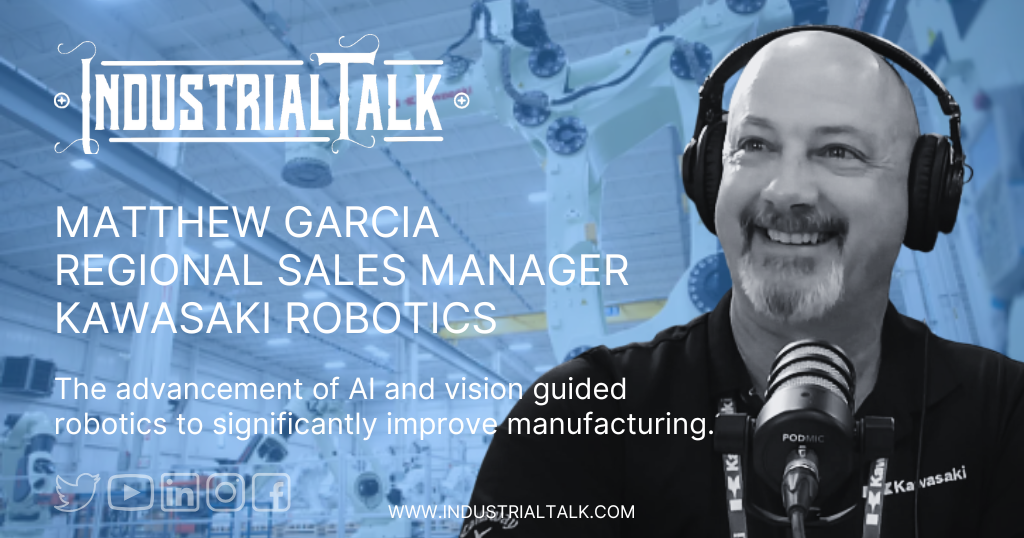
Industrial Talk is onsite at MD&M West and talking to Matthew Garcia, Regional Sales Manager with with Kawasaki Robotics about “AI and Vision guided robots”.
Matthew Garcia, Regional Sales Manager at Kawasaki Robotics, discussed the company’s history and innovations at MD&M West. Kawasaki, a $15 billion company with roots in shipbuilding, introduced the first hydraulic robot in the late 60s. They now offer robots from 3 kg to 1500 kg, catering to various industries like food and beverage, automotive, and aerospace. Garcia emphasized Kawasaki’s focus on partner support and personalized attention. He highlighted recent advancements in AI and vision-guided robots. Despite tariffs, Kawasaki’s Japanese manufacturing and shipping line help maintain competitiveness. Garcia provided his contact information for further inquiries.
