
Clay Martin with Isla Talent
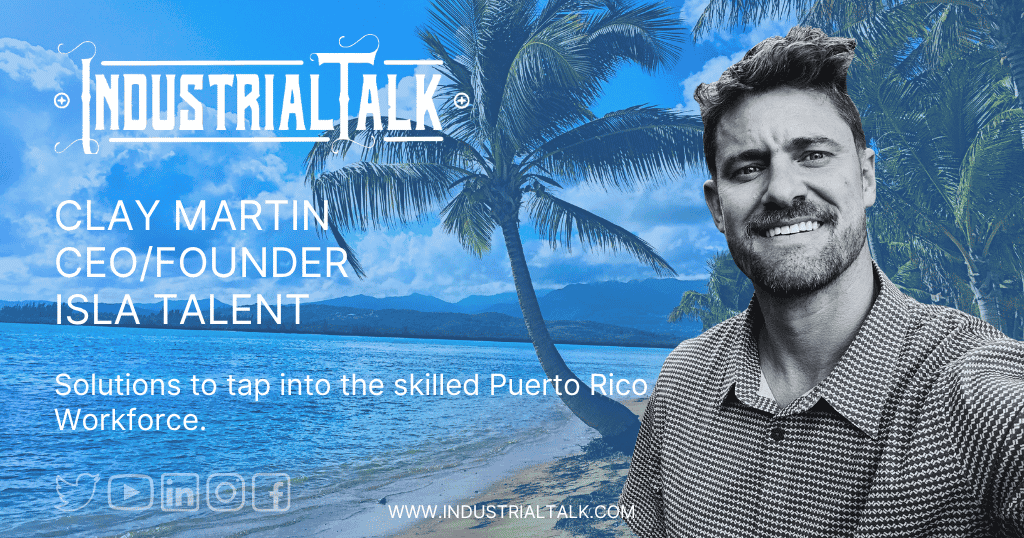
Industrial Talk is talking to Clay Martin, CEO/Founder at Isla Talent about “Solutions to tap into the skilled Puerto Rico workforce”.
Overview
Scott Mackenzie discusses the Barcelona Cybersecurity Congress, scheduled for November 3-5, 2023, and emphasizes the importance of cybersecurity. He then introduces Clay Martin from Isla Talent, a recruiting firm based in Puerto Rico, which helps companies find skilled workers. Clay explains his process of recruiting from Puerto Rico, including auditing client needs, creating job descriptions, and ensuring quality through tests and interviews. He highlights the benefits of recruiting from Puerto Rico, such as no visa requirements and the availability of a skilled workforce. Clay's firm has placed over 500 workers in the past decade and offers a 45-day replacement guarantee.
Outline
Barcelona Cybersecurity Congress Announcement
- Scott introduces the Barcelona Cybersecurity Congress, emphasizing its importance for cybersecurity professionals.
- The event is scheduled for November 3-5 in Barcelona, with networking opportunities and expert discussions.
- Scott mentions their own participation and encourages listeners to mark their calendars.
- The event aims to provide valuable insights and connections in the cybersecurity field.
Introduction to Industrial Talk Podcast
- Scott expresses gratitude to listeners and emphasizes the platform's dedication to celebrating industry success.
- The conversation will focus on finding skilled individuals and creating resilient businesses in the industry.
- Scott introduces Clay Martin from Isla Talent, a recruiting firm based in Puerto Rico, to discuss talent acquisition challenges.
Challenges in Finding Skilled Individuals
- Scott discusses the ongoing challenge of finding skilled individuals in the industry, emphasizing the importance of people over technology.
- Clay Martin introduces Isla Talent, a recruiting firm based in Puerto Rico, and its unique solution for labor shortages.
- Clay shares his background, including his time in the Peace Corps and his transition to recruiting.
- The conversation highlights the benefits of recruiting from Puerto Rico, including language skills and cultural fit.
Clay Martin's Recruiting Model
- Clay explains the process of recruiting from Puerto Rico, including auditing client needs and creating job descriptions.
- He discusses the importance of matching job requirements with the skills of potential recruits.
- Clay mentions the use of word-of-mouth and social media to build a talent pool in Puerto Rico.
- The conversation covers the logistics of housing and supporting recruits in the United States.
Quality Assurance and Client Consultation
- Clay emphasizes the importance of quality assurance in recruiting, including testing and interviewing potential recruits.
- He discusses the role of his partner in Puerto Rico in conducting welding tests and other skill assessments.
- Clay explains the process of consulting with clients to ensure a smooth transition for recruits.
- The conversation highlights the importance of maintaining communication and support for both clients and recruits.
Impact of Puerto Rico's Economic Conditions
- Clay discusses the economic conditions in Puerto Rico, including high costs and limited resources, driving people to seek better opportunities in the United States.
- He shares insights into the cultural and economic challenges faced by Puerto Ricans.
- The conversation touches on the impact of tourism on Puerto Rico's economy and the resulting economic pressures.
- Clay highlights the potential for recruiting from other countries in Latin America if visa issues can be resolved.
Visa and Legal Challenges
- Clay explains the challenges of dealing with visas, including the H-2B visa program and its unreliability.
- He discusses the costs and complexities of obtaining visas for temporary workers.
- The conversation highlights the advantages of recruiting from Puerto Rico, where no visas are needed.
- Clay emphasizes the importance of transparency and clear communication with clients regarding visa requirements.
Client Engagement and Support
- Clay describes the typical timeline for recruiting and placing workers, ranging from one to two weeks for small groups.
- He discusses the typical contract duration for recruits, usually eight to nine months.
- The conversation covers the process of consulting with clients to create attractive job packages for recruits.
- Clay explains his role in facilitating the transition and support for recruits, including housing and work environment assessments.
Case Studies and Success Stories
- Clay shares success stories of clients who have benefited from his recruiting services, including a client who hired 100 workers.
- He discusses the long-term sustainability of his recruiting model and the positive impact on clients' operations.
- The conversation highlights the importance of creating a supportive and inclusive environment for recruits.
- Clay emphasizes the value of his personal involvement and commitment to the success of his clients.
Contact Information and Final Thoughts
- Clay provides his contact information, including his website and LinkedIn profile.
- Scott encourages listeners to reach out to Clay for recruiting needs and to share their stories on Industrial Talk.
- The conversation concludes with a reminder of the importance of inspiring the next generation of industry leaders.
- Scott reiterates the value of the Barcelona Cybersecurity Congress and the need for cybersecurity protection in a connected world.
If interested in being on the Industrial Talk show, simply contact us and let's have a quick conversation.
Finally, get your exclusive free access to the Industrial Academy and a series on “Why You Need To Podcast” for Greater Success in 2026. All links designed for keeping you current in this rapidly changing Industrial Market. Learn! Grow! Enjoy!
CLAY MARTIN'S CONTACT INFORMATION:
Personal LinkedIn: https://www.linkedin.com/in/clay-martin-7788b179/
Company LinkedIn: https://www.linkedin.com/company/isla-talent-recruiting-from-puerto-rico/
Company Website: https://www.recruitingpuertorico.com/
PODCAST VIDEO:
THE STRATEGIC REASON “WHY YOU NEED TO PODCAST”:
OTHER GREAT INDUSTRIAL RESOURCES:
NEOM: https://www.neom.com/en-us
Hexagon: https://hexagon.com/
Arduino: https://www.arduino.cc/
Fictiv: https://www.fictiv.com/
Hitachi Vantara: https://www.hitachivantara.com/en-us/home.html
Industrial Marketing Solutions: https://industrialtalk.com/industrial-marketing/
Industrial Academy: https://industrialtalk.com/industrial-academy/
Industrial Dojo: https://industrialtalk.com/industrial_dojo/
We the 15: https://www.wethe15.org/
YOUR INDUSTRIAL DIGITAL TOOLBOX:
LifterLMS: Get One Month Free for $1 – https://lifterlms.com/
Active Campaign: Active Campaign Link
Social Jukebox: https://www.socialjukebox.com/
Industrial Academy (One Month Free Access And One Free License For Future Industrial Leader):

Business Beatitude the Book

Do you desire a more joy-filled, deeply-enduring sense of accomplishment and success? Live your business the way you want to live with the BUSINESS BEATITUDES…The Bridge connecting sacrifice to success. YOU NEED THE BUSINESS BEATITUDES!
TAP INTO YOUR INDUSTRIAL SOUL, RESERVE YOUR COPY NOW! BE BOLD. BE BRAVE. DARE GREATLY AND CHANGE THE WORLD. GET THE BUSINESS BEATITUDES!
Reserve My Copy and My 25% Discount
Transcript
SUMMARY KEYWORDS
Barcelona Cybersecurity Congress, industrial professionals, recruiting firm, Puerto Rico, skilled individuals, manufacturing, labor shortages, workforce solutions, H-2B visa, talent pool, job descriptions, workforce housing, cultural integration, technology skills, workforce sustainability.
All right, before we get into the conversation, I want you to be aware of a conference that you need to put on your calendar, and you have time. It is the Barcelona Cyber Security Congress. It is necessary. You need to up your cybersecurity game. You're connected, you need to make sure that you're protected. Right here, this event, Barcelona Cybersecurity Congress. It is November 3 through the.. you have time, November 3 through the fifth this year in Barcelona. And I'm telling you right now, the team at Farah who put this particular Congress on the best. You will not be disappointed, and you know what else you get to do. You get to network with some of the best cybersecurity professionals from around the world. You need to do this. You need to put this one on your calendar. All of the contact, all of the information is out on Industrial Talk. I'm going to be there, I'm going to be broadcasting, I'm going to be talking cybersecurity with the best in the world, so be there. Put this one on your calendar, that is November 3 through the fifth. I'll see you there.
Welcome to the Industrial Talk Podcast with Scott Mackenzie. Scott is a passionate industry professional dedicated to transferring cutting-edge industry-focused innovations and trends, while highlighting the men and women who keep the world moving. So, put on your hard hat, grab your work boots, and let's go. Hi
there, and welcome again to Industrial Talk. Thank you very much for joining this platform that celebrates industry professionals all around the world, and I'm pointing at you in the video. You're bold, you're brave, you dare greatly, you innovate, you collaborate, you are solving problems each and every day. That's why we celebrate you on Industrial Talk. This platform is dedicated to you and your success. Bottom line, that's what we're passionate about, that's our purpose, that's what we want to provide for you, so that you can succeed. All right, in the hot seat, we have a conversation. The conversation is around how to find people, how to satisfy that requirement, and that is a big time challenge, specifically in the world of industry, and being able to find them. We're talking to Clay, Clay Martin Isla Talent. It is a recruiting firm out of Puerto Rico. Yes, you're saying Puerto Rico. Yes, there's some benefits associated with that. Let's get a cracking, you yeah. Okay, so I go to, I go to shows, you know that I go to shows, and I talk to people, talk to a lot of people, you know, that industrial talk, it's in the name, and every time, every time we talk about people, talk about finding people, talk about finding skilled individuals trying to figure out how to create that business that is resilient. Not today is like, okay, we're working, we're doing great, we've got people, everything's fine. How do you continue to move forward your operations, and it's a people equation. It just is finding skilled people. Yeah, I think that's the challenge of our time. I don't think it's technology, because technology is blistering fast, and it's all about, and you can only automate so much. You just can. You can only automate so much. There is that human side, finding those people to be able to do what you need to get done. That's that was always on my mind when I was running that industrial maintenance company, people safety too, but, but people, and here's Clay, his solution, finding resources, definitely down, definitely down in Puerto Rico, absolutely an incredible, incredible solution. I truly highly recommend that you contact Clay. Speaking of the next generation, so here's industrial talk. We've had a lot of conversations with the leaders in industry, and when I say industry, I want to maintain it's part of manufacturing, it's part of oil and gas, it's part of of everything that exists today, and warehousing, you name it, industry at the top, we can talk about it all, but the reality is, is what do we do, what do you do, what do, how do we you. Inspire that next generation. I see a lot of pain out there. I see a lot of challenges out there, but we can get it done. We can make it happen. You need to tell your story. You just, you just do so. You go out to industrial talk, you need to tell your story. You get it. You come and talk to me about it, and we make you look great, that's what that, that's what it's about, because it is always going to be that human equation technology. Yes, fantastic stuff. Absolutely, me geeking out on it. Oh, yeah, yeah, big time. But again, we can't, we can't automate ourselves out of people or AI our stuff ourselves out of people. It's just there's going to have to be that right balance, and the only way that I know is that one, we tell the story, two we market, three we do the the PR that is associated with what you do. We do it from an industrial perspective, you know. Just go out to industrial talk, talk to me. Let's make you a success. You need to succeed. Everyone on this podcast needs to succeed. Take that to the bank. All right, Clay Clay Martin, and I'm sure I'm saying it right, but it's I S L A talent, ISL talent. I hope I got that right. Recruiting from Puerto Rico, pretty cool conversation, pretty cool solution. So, here's Clay. Clay, welcome to Industrial Talk. How are you doing today?
Great, Scott, thanks for having me.
Where are you calling from?
I'm calling from Denver, Colorado, the Mile High City.
Okay, well, that, that my first note, I told, told Clay that I reached out, and I now I gotta, I gotta, I gotta, we'll find you got plans for the weekend.
Oh yeah, I'm training for a big mountain bike race in Aspen. So tomorrow I've got a big training ride, it's a mountain bike race, so I'll be out in the 95 degree heat for about five hours.
Well, I didn't, I didn't see that one coming. That was not on my bingo card. I was gonna say, yeah, we're gonna go out for breakfast, that's on
Sunday with the girlfriend. So,
yeah. Oh, well, that's pretty doggone cool. All right, before we get into the your business, let us talk a little bit about who Clay is. Give us a little background on who you are.
Sure. Originally from Cincinnati, Ohio, shortly after college,
terminal there, a bulk liquid terminal on the Ohio River, right there. Okay, there it is.
After college, I spent about half my 20s in the Peace Corps, so I lived in Ecuador and Panama with indigenous tribes, no electricity, no running water. That was a huge, huge part of my life, very formative, and kind of created a lot of my values. So after the Peace Corps, I eventually got into the recruiting game, and I love the outdoors, and that's that's kind of me in a nutshell,
interesting, and what I want to, again, I'm looking down on my notes, and I, I have to, how did you know I'm gonna, I'm gonna switch gears, Peace Corps again, that was not on my bingo card, you need to expand a little bit about that. Why? What was, you know,
I.. I always enjoyed Spanish. I always enjoyed helping people. And when I was in college, I
baby..
yeah. Thank you. Yeah, I was in college and studied abroad in Mexico, and I kind of got the travel fever, and I knew after college I didn't want to go the traditional route and just get a job and get an apartment and start my career, and the Peace Corps was calling and adventure and all that kind of stuff, so I was two years in Ecuador and two years in Panama, indigenous tribes, body paint, shamans, machetes, parasites, all the good things.
There you have it now. Yeah, let's talk a little bit about your business. Just because now I understand how you speak Spanish. Now it's recruiting. It's now I understand you can live in Denver, but still be able to recruit, definitely from Puerto Rico, I get it. Okay, got it. Why, what was that brain child? What was it? Yeah, so
I bought a one-way ticket in:How do we, or how do you assess the skills, and I'm writing this down because you know manufacturing is getting more advanced and skilled. It's not just, it's not just hiring bodies anymore. There has to be some sort of depth and capabilities there. How do you, how do you, your organization do that?
then I go to my talent pool.:Again, how do you, how do you ensure quality? How you're gonna.. I'm a, I'm a company here in the United States. I need welders, and I need welders. I need welders need to have specific capabilities and qualities, and you know, standard stuff with them.
Yeah, I mean, I have a partner partnership in Puerto Rico with a guy, and he can help me do those welding tests. So, if there is a client that needs, for example, welders, then we perform these welding tests in Puerto Rico, before they come over, that's not super common, but I do have the ability to do that. I mean, the biggest thing is providing a job description to the worker, and then listening to them talk about it, and see if they really understand the concepts when they're reading about it, looking at it, and if they can make any comparisons to jobs that they've done in the past, and talk intelligently about
it. So, I'm La Sam, I'm in the, in the world of manufacturing, and I need individuals, you, I would imagine Clay would have to understand my manufacturing capabilities. I mean, I'm, I'm building manufacturing, whatever it might be, and I have this specific requirement. Do you take that back, and then you then look at your pool, or how do you, how do you promote in Puerto Rico, saying, hey, we're looking for manufacturing people that have this sort
of, yeah, so I mean, of course, as everyone should know, Puerto Rico is a US territory. There's no visas needed. So, for almost 10 years, I've just been creating a talent pool, so I can go and type in manufacturing or landscaping, and certain skill sets people pop up, and you know, I, a lot of it's word of mouth, everyone just kind of knows to reach out to me, but I also do Facebook ads and things like that. But honestly, the biggest thing for me is his word of mouth. People trust me on the island, and it's hard to gain trust in Puerto Rico. I've been doing it for a long time, and you know, the workers come to me for their next best opportunity here in the states,
so I again, I'll use myself as the muse of needing resources. How do you help that talent pool find a home? And right,
so
I kind of established, or getting them, yeah,
there's a lot of, a lot of that is a little bit of red tape, but not a ton. So, I help consult on that with my clients, and basically, when I say clients, I'm referring to the manufacturing companies. They are responsible for providing housing for the workers at a reasonable cost, so you know, the client and the companies will go out and find maybe an apartment or a house, and then let me know this is what we have. Then I'll check out, check it out, look at the videos, pictures, or links, make sure that it's adequate, it's appropriate. And then I present it to the workers to see, to make sure that they agree as well.
But it's up to me to find those places, and then be able to fit, and it's up to my me Scott Mackenzie and the contract I have with you and that to be able to afford it, I'm not,
yeah, yeah, so I kind of, I kind of help also consult on what's going to be the best package deal for the workers, so when I say package deal, I'm talking about hourly rate, how much are they charging for housing? Some clients give, get some clients give free housing. Are there bonuses? Is there overtime? How nice is the housing? How nice is the work environment? All these factors come together to decide how attractive a job is going to be for my workforce. From Puerto Rico, and I am a direct hire company, so these are. Not my employees, I'm not a, they're not my employees, I'm not a staffing company. These would be your employees.
Oh, I see. And then, yeah, okay. Then, then the, the, the time commitment is all geared. It's me. If Joe does well from Puerto Rico, and we have them, Joe living, and how does Joe.. does Joe have a family? Is that also a part of it? Possibly. No,
I don't. I don't allow. I mean, I like when workers do want to relocate with their family, that makes it a more sustainable opportunity, but the housing is only for workforce, and so you know, if someone's okay, we bring, can I bring my kids? No, the housing is only for the workforce. I've brought couples over before, and sometimes they share a room. There's a lot of different scenarios. I've seen it all, and I just kind of give my expertise to clients to make sure it's going to work, because I want to be transparent, and I don't want to waste people's time if it's not going to work out.
What's the typical timeline and extent of the say engagement,
the recruiting timeline?
Yeah, so I need people, I go to you, you say I validate, boom, go.
I would say I usually can recruit and place 15 people within about one to two weeks,
but how long is that engagement? How long do I normally these individuals say, "Yeah, I want to go to the United States. Is it for six months? Or
okay, yeah, that now I understand your question. Typically it's typically like eight to nine month contracts, you know, most, most of my clients, you know, want people to come from like March until November, you know, the workforce, they do kind of want to go back to Puerto Rico, typically, and spend Christmas or spend the holidays in a few months, but but some of my work workforces, like I want to move there permanently. Do you have jobs year round? It just really depends.
So, you do. There are clients that, hey, we just need, we need people, we need skilled individuals, we have whatever, we just have this need, and we're really to, we're having a hard time finding them here. Let's pursue other areas, and that could be a full-time,
yeah, absolutely, exactly,
huh. And again, the you're in the hospitality, you're in the definitely the
landscape,
landscaping, and then manufacturing, the thing with the manufacturing sort of intrigues me, and the reason for that is that how to give me a typical manufacturing request, because all I know is like run this machine, watch this, do manufacturing stuff, you have to have certain skill levels, how do you.. how do you.. that to me is just sort of interesting.
I mean, every client's different, you know. I've had clients that are metal metal factory companies, I've had worked with clients that build fire trucks, I've worked with clients that are food and beverage, pretty much everything, electronics, I mean, I've worked with Fortune 500 companies before that utilize my services to recruit from Puerto Rico, so it's kind of a mix of everything, and usually like a typical request would be like a small number of recruits, like 20, you know, hey, we need 20 employees, and but I do, the minimum is like four, the most I've done for a client before, I think, was around 100 employees, and they, they literally bought an Air Force base to house these people, they bought an old Air Force base in a motel for the housing for 100 and again,
if I came to you and let's say I need 100 what, what's the time timeline that you need to fulfill that, because you need to need to make sure that they meet the requirements that, as I special,
if someone came to me right now and said, "Hey, we need 100 workers, I probably say, "Let's roll that out, you know, and try to do it in 10, around 10 groups of 10 over the next two months,
yeah,
you know, two to three months would be realistic for that amount of people. I mean, I could probably do it quicker, but I mean, I don't know, a couple of months ago I recruited 20 people and it took me one week, so it really depends
with the demand that's taking place. If I had a nickel every time somebody's talking about I need people, I mean, I skilled it's happening all the time, and I can't find them, it's the same stuff. Are you seeing an uptick or in in this opportunity to be able to find people to. Fulfill the demands of the market here in the United States.
Yeah, I mean, a lot of people from Puerto Rico are just looking for better opportunities. Obviously, there's a workforce shortage here, and so a lot of, a lot of people in Puerto Rico want to take advantage of our needs for the workforce and labor shortages, workforce shortages, and people in Puerto Rico, you know, the economy is not doing so great there. Inflation, it's getting very expensive. A lot of, a lot of mainland Americans are moving to Puerto Rico for tax benefits, and so real estate's expensive, food's expensive. So a lot of people there just this are looking for better opportunities. I mean, it's once you get there, you'll really like see it and understand, because it's, it's, you know, I don't know if you know much about Bad Bunny, but he, you know,
Super Bowl thingy,
yeah, yeah, and he's from Puerto Rico, and he has a song that basically translates to, like, I don't want to happen here, what happened in Hawaii, and it's kind of like talking about how Hawaii used to be, you know, island culture and native people, native people, and not super expensive, and now it's like just all tourism, and so that's kind of what's happening in Puerto Rico, it's getting a little bit more, it's very touristy, and the island runs on tourism, and so things are expensive, and so with that, people in Puerto Rico are looking for better opportunities on the mainland,
and plus I would imagine Puerto Rico doesn't have any real natural resources, like oil, they all, everything, there's a lot of imports, you gotta, you gotta, yeah, I mean, the islands,
the island is so small that
the
agriculture that they do have is basically just for families, I mean, there's a lot of people don't really realize it, but, but I think only I read a statistic one time that only like 5% of Puerto Rico is rural. I mean, it's like it's, it's a, you know, you drive around and it's just buildings everywhere. I'm sure you get into some open spaces when you get towards the west side, but it's a lot of people and a lot of concrete there.
Wow, there's a lot of conversation that's wrapped around technology. Is there any, any way of being able to sort of apply the similar model to skilled individuals in the world of technology?
I mean, yeah, I get all different types of resumes, and whenever I see people that you know might be a, you know, CNC expert or anything with technology, I get excited, but I don't have a lot of clients that request those skill sets, but I see all different types of knowledge and experience from people from Puerto Rico, and I love helping them, and I love doing what I do, and it's the island is beautiful. I mean, it's a beautiful place. I believe in the people of Puerto Rico. I believe in the island of Puerto Rico, and the culture,
because you're there. Yeah, good thing.
Yeah,
is there.. is there any possibility of venturing into other areas and other countries, yeah, that's
not this is my model, mainly because of the visa, you know, I don't want to deal with visas. If I had an opportunity to utilize my Spanish and my cultural skill sets and recruit people from other countries, Central and South America, I would love to, because I know they're hardworking people, I've worked side by side a lot of people from different countries in Latin America, but you know visas are a huge issue, and I just don't want to deal with that red tape.
It sort of helped us understand a little bit about that red tape. What does it normally, or what's the pain point there?
Well, a lot of clients, at least in the manufacturing industry, well, a lot of the clients in manufacturing are year round, they're not seasonal, but some clients can be considered seasonal. And so there's a program in the United States called the H B Visa Program, and the H B Visa Program sounds like you know what it is, but if your listeners don't, it's a temporary, it's a temporary work visa, and it.. I'm not.. I mean, I've heard anywhere that it costs a client anywhere between five and $7,000 There's lawyer fees, visa fees, flights, busses, and the thing about the H B Visa program is it's. it's kind of unreliable and erratic in the sense that you might invest all of this money in the visa program, and then not even know if you're going to get your visa workers, because
it's a lot, it's a
lottery system, you know, it's a lottery system. So, if, if someone reaches out to me in November and they, they said, 'Hey, it's November and March, I need 20 workers. I said, "Great, I'll have you 20 workers by March. But if someone needs 20 workers by March, do H2B, there's no guarantee.
Yeah, that's that. That's risky. I understand. That's, that's sort of, yeah. And that's
kind of why my tag. Line is recruiting from Puerto Rico, no visas needed, no red tape.
Oh, it seems like a great solution.
Yeah, yeah, yeah. I mean, it's not. I always tell people, hey, you know, I love, I love my business model, but don't put all your eggs in one basket. And the island of Puerto Rico, so small that this isn't like going to be able to fix the labor shortage of an entire city or country, obviously, but it for, for a, for a company, it absolutely can, and it has. I mean, I've seen clients, you know, start, you know, I have a client that I partner with, and they have 70 people from Puerto Rico, and every year most of them come back, some of them are moving their family there. This company is literally helping people get houses, like not paying for their houses, but with the process, because they recognize that hey, if we can help assist people to come here, this is a sustainable workforce option.
How often do you go down to Puerto Rico?
It really depends on the season, like it depends on the needs of my, my business and my clients. I'd say anywhere between two and four times a year I'll go down there, and sometimes it's for a week, sometimes it's for a month. It just really depends. I mean, like we just gave the example of 100 workers. If a client said, "I need 100 workers, I'm flying to Puerto Rico and getting a one-way ticket.
Yeah, well, that makes sense. And when you do something like that, one last question here, when you do something like that, you don't just dump it in the lap of the requesting client, you help with the facilitation and and and a movement, and there's a lot more to it.
Yeah, I'm glad you reckon. Yeah, here's
this, I mean, yeah, Jose's
showing up. Good luck. No, yeah, I appreciate you recognizing that, Scott. I mean, it's the term that I use, is there's a human aspect to this, so a lot of my services revolve around consulting and trying to teach my clients best practices based on my experience, based on the culture, and help facilitate, you know, a productive orientation, a productive transition, because it's a huge transition for everyone, not just Puerto Ricans, but the workforce there, and so I have documents in English and in Spanish that explain the entire process, rules in English and Spanish, and best practices. And so, after the workers are placed, I maintain contact with the workers and my client to make sure that, you know, I'm kind of the middleman for a while, and I'm not anyone's manager, I'm not really their translator, but you know the workforce will come to me with issues, and then I'll go back to the client, say, 'Hey, this is what's going on, or the client will say, 'Hey, we're having an issue, how would you handle this? And yeah, maintain a lot of contact,
ou're not going to be batting:yeah,
in all the time, and there has to be probably. I would imagine just not a good fit,
exactly.
And, and the client, me, if I was to the client, I would say it's not a good fit. We still need this skill set. Clay, please help facilitate that.
Yeah,
that's sort of the way you're not leaving me alone with somebody that's not a good fit.
Yeah, yeah, exactly. I have a replacement guarantee, 45 days, so if someone quits or gets fired, I replace them at no charge. But I like to coach, I like to coach everyone and try to get people to stick around, you know. I believe in giving people guidance and second chances, and all that kind of stuff, all within reason.
I like it.
Yeah,
great conversation. I enjoyed it.
Yeah, thank you. Thank you.
If somebody says I'm looking for, I need help, I'm looking for people, and I need.. I don't want headaches, I want.. I want solutions, because I have a demand for my operations, or whatever it might be. What would be the best way to get a hold of Clay?
Yeah, Recruiting Puerto rico.com So you know, my business name is Isla Talent, but for SEO purposes, I chose the website Recruiting Puerto rico.com so that's where people can contact me.
And are you out on LinkedIn?
I am on LinkedIn. Yeah, I can send you that. Send you that.
Oh, you don't have to. I have it all. Yes, yeah, I can. I can grab that link, of course. Absolutely. Well, you were just absolutely wonderful, Clay. Yeah, thanks, guys. Really appreciate your time. I just never.. everybody's talking about the need for people.
There you go. Exactly, I feel like your listeners are going to be sharing. Yeah,
no, all good. All right. Thank you very much. For being on Industrial Talk, we're going to have all the contact information for Clay out on Industrial Talk. As you know, reach out to him if you're struggling. You need.. Can I just contact you, Clay, and ask you questions?
Sure.
Yeah, there you go. Not, not me. If I was just somebody, I'm, I'm kicking the tires right now.
Yeah, call me, text me, email me, whatever. It all works, LinkedIn. Yeah, anything.
You got it. Thank you very much. All right, we're gonna wrap it up on the other side. Stay tuned. We will be right back.
You're listening to the Industrial Talk Podcast Network, you. It
there, he is Stat Card LinkedIn, right there to my right, to your.. I guess you're right, no, your left, whatever it is, it's right there, his Stat Card Clay Martin is La Talon, recruited from Puerto Rico, right there, it is a solution. It is an opportunity. He knows what he's doing, and you need, you need sherpas, you need individuals to be able to help you along on that journey, and, and remove that frustration, that friction, that pain, that whatever it might be. There's, there's you, you want to move forward, and you need individuals to help you to do that quickly and easy and without frustration. Play right there, make it happen. All right, once again, at the beginning, at the beginning of the podcast, there is a great show, the Barcelona Cybersecurity Congress. It is in the first part of November of this year, year in the world, we're connected, we're connected, and we need to have those connected assets protected, and it's always, always going to be a challenge, and you need to be a part of this cybersecurity commerce to Barcelona. What's bad about that now, theme do great people, great organization, great great Congress. So, anyway, put that on your calendar again. We have all the contact information for Clay out there. We need solutions, you need to tell your story, we need to inspire that next generation of industrial leaders. You just do, and it comes from you, and that is your responsibility, and it's my responsibility too. But we have to have the passion to be able to do that, just because, well, we need them, we need people, we need people to just really get into what, what you're doing in industry, because it is cool. It is cool, so nothing short of cool, you're cool. I said cool a lot, because you are, anyway. You have that passion, if you have that desire, if you have that need to tell your story, let us do it. We're, we're pretty good at it. So, anyway, go out to Industrial Talk, click, connect, there. That's it. Speaking of no friction, there it is. Click, you connect, you're with me, you talk to me. Let's have a conversation. We need to have that conversation. Okay. So, anyway, be bold, be brave, dare greatly hang out with Clay, figure out your, your talent requirements, and you will, you will succeed. We're gonna have another great conversation shortly. So, as always, stay tuned.