Paul Crocker with ReliabilityX
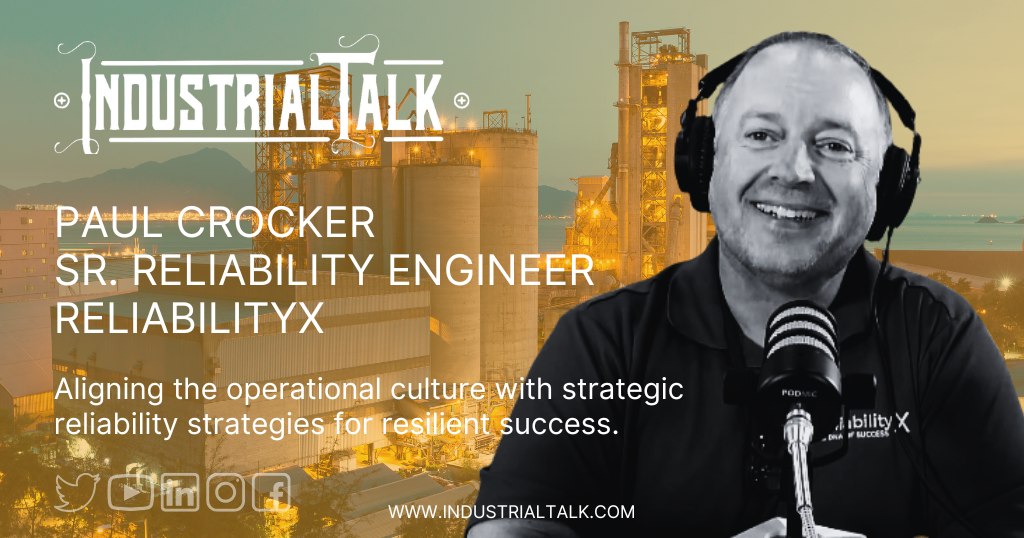
Industrial Talk is onsite at SMRP 2025 and talking to Paul Crocker, Sr. Reliability Engineer at ReliabilityX about “Cultural alignment with your reliability strategy”.
Paul Crocker emphasizes the importance of storytelling and podcasting for creating human connections in business, especially in the context of AI. He suggests using Industrial Talk as a platform to amplify voices and build resilient businesses. Crocker discusses his career journey, starting with the Board of Public Utilities in Kansas City, Kansas, and his role in implementing Maximo systems for reliability and maintenance. He highlights the need for effective training and cultural alignment between operations and maintenance. Crocker also touches on the challenges of sustaining success and the potential of AI to assist in maintenance processes.
Outline
Podcasting as a Marketing Strategy
- Scott emphasizes the importance of storytelling and podcasting to create a human connection with the market.
- Podcasting is recommended as a marketing platform to open doors and create long-term relationships.
- Industrial Talk is suggested as a platform to amplify voices and promote business resilience.
- Scott encourages businesses to consider podcasting to tell their story and build trust with their audience.
Introduction to Industrial Talk Podcast
- Scott humorously questions the year and the background noise, setting a casual tone for the podcast.
- The podcast is broadcasting on-site at SMRP, with Speaker 1 mentioning the reliability and asset management focus.
- Scott humorously comments on the lack of carpet and the constant backing up of forklifts, adding to the informal atmosphere.
Paul Crocker's Background and Career Journey
- Scott introduces Paul Crocker, who has been in the hot seat 27 times, and comments on his changing appearance.
- Paul Crocker shares his career journey, starting with the Board of Public Utilities in Kansas City, Kansas.
- He describes his transition from administrative services to power generation, working with heavy equipment.
- Paul pursued a Bachelor of Science in Network and Communication Management and later took over the maintenance department.
Transition to ReliabilityX and Maximo Implementation
- Paul discusses his role at ReliabilityX, focusing on training and assessments, particularly EAM implementation.
- He mentions the Maximo mass nine rollout for half of the utilities plants in Missouri, with plans to expand to Kansas.
- Paul highlights the importance of training and the support from top management in ensuring the success of the training programs.
- He emphasizes the need for a culture shift and proper training to avoid pushback from the crafts.
Challenges and Solutions in Training and Implementation
- Scott and Paul discuss the different types of training, including system training and reliability training.
- Paul explains the importance of integrating system training with reliability training to ensure practical application.
- He shares his approach to training, focusing on the day-to-day life of maintenance supervisors and crafts.
- Paul emphasizes the need for basic pieces like work initiation and asset location hierarchy to be right before adding more complex features.
Addressing Resistance and Sustaining Success
- Scott and Paul discuss how to address resistance and sustain success in training and implementation.
- Paul mentions the importance of having supervisors who can identify and engage problematic individuals.
- He highlights the need for top management support and the role of supervisors in ensuring the system works well.
- Paul shares his experience with user acceptance testing and the visual cues that indicate successful training.
The Role of AI and Future of ReliabilityX
- Scott and Paul discuss the potential of AI in improving reliability and maintenance processes.
- Paul views AI as an assistant that can provide better answers than Google but acknowledges its limitations.
- They discuss the importance of understanding operations and maintenance working together and the challenges of disconnected management.
- Paul emphasizes the need for passionate doers in the organization and the role of leadership in fostering a culture of innovation and improvement.
Passion and Innovation in Manufacturing
- Scott and Paul discuss the importance of passion and innovation in manufacturing and industry.
- Paul shares his experience in the water and utilities sector, highlighting the complexity and importance of water systems.
- They discuss the need for better public perception of the value of water and the challenges faced by water and wastewater treatment plants.
- Paul emphasizes the importance of accurate and reliable operations in water systems to ensure public health and safety.
Conclusion and Contact Information
- Scott wraps up the conversation, highlighting the importance of storytelling and human connection in business.
- Paul provides his contact information, including his email and LinkedIn profile, for those interested in learning more about ReliabilityX.
- Scott encourages listeners to reach out to Paul and to consider podcasting on Industrial Talk to amplify their voices.
- The podcast ends with a plug for the SMRP event and the importance of attending industry events to network and learn.
If interested in being on the Industrial Talk show, simply contact us and let's have a quick conversation.
Finally, get your exclusive free access to the Industrial Academy and a series on “Why You Need To Podcast” for Greater Success in 2026. All links designed for keeping you current in this rapidly changing Industrial Market. Learn! Grow! Enjoy!
PAUL CROCKER'S CONTACT INFORMATION:
Personal LinkedIn: https://www.linkedin.com/in/pcrockerkck/
Company LinkedIn: https://www.linkedin.com/company/reliabilityx/posts/?feedView=all
Company Website: https://reliabilityx.com/
PODCAST VIDEO:
THE STRATEGIC REASON “WHY YOU NEED TO PODCAST”:
OTHER GREAT INDUSTRIAL RESOURCES:
NEOM: https://www.neom.com/en-us
Hexagon: https://hexagon.com/
Arduino: https://www.arduino.cc/
Fictiv: https://www.fictiv.com/
Hitachi Vantara: https://www.hitachivantara.com/en-us/home.html
Industrial Marketing Solutions: https://industrialtalk.com/industrial-marketing/
Industrial Academy: https://industrialtalk.com/industrial-academy/
Industrial Dojo: https://industrialtalk.com/industrial_dojo/
We the 15: https://www.wethe15.org/
YOUR INDUSTRIAL DIGITAL TOOLBOX:
LifterLMS: Get One Month Free for $1 – https://lifterlms.com/
Active Campaign: Active Campaign Link
Social Jukebox: https://www.socialjukebox.com/
Industrial Academy (One Month Free Access And One Free License For Future Industrial Leader):

Business Beatitude the Book
Do you desire a more joy-filled, deeply-enduring sense of accomplishment and success? Live your business the way you want to live with the BUSINESS BEATITUDES…The Bridge connecting sacrifice to success. YOU NEED THE BUSINESS BEATITUDES!
TAP INTO YOUR INDUSTRIAL SOUL, RESERVE YOUR COPY NOW! BE BOLD. BE BRAVE. DARE GREATLY AND CHANGE THE WORLD. GET THE BUSINESS BEATITUDES!
Reserve My Copy and My 25% Discount
Transcript
SUMMARY KEYWORDS
Podcasting, human connection, AI impact, Industrial Talk, ReliabilityX, asset management, maintenance training, Maximo system, EAM implementation, operational efficiency, cultural shift, leadership, innovation, manufacturing passion, water utilities.
Hey, there. I have a question. Are you telling your story? Are you a company that is in a position to tell your story, to create that human bond, that connection with your market, that that image of who you are, both personally and professionally? Do you have that in place. I'm telling you right now, if you say no to that and you're it's not a part of your conversation you're having internally, I highly recommend that you figure out how to podcast and the reason why, and I'll, I'll share with you quickly the reason why I podcast was to open doors to be able to create that human to human connection. And I believe, specifically today, given AI and all the stuff that's taking place, I think the market is craving more human to human connection. And that means you need to tell your story. That means people will want to do business with you because they know you, yes, like you, because you've communicated that, and they trust you because you have that you know, great skill set that that follows you. But you have to do it, you have to consider, you know, podcasting as a marketing platform. That's what I did for my other company. It worked well, it opened doors, it created relationships. It created friendships, long term friendships. And I asked that you consider podcasting, then you have to ask the question, Well, where do I put it? You put it on Industrial Talk, because Industrial Talk is the ESPN of industry. Your voice can be amplified on Industrial Talk. You just put your podcast on Industrial Talk. It's that simple. And then we promote it. Then we move it around, we we give you the attention that you need to help your business be resilient and successful going forward. I believe that we're at a sort of a crossing point right now, and I believe that the market is poised for a Renaissance, and you need to be able to tell your story, and you need to be able to commit to that. So if that's something that you are looking into, all you have to do is go out to Industrial Talk. And if you have my email, just email me and say, Scott, we are ready to do podcasting. Please help. That's all we're asking. We want you to succeed. Industrial Talk is here for you. And why not include your voice, your podcast on Industrial Talk? Why not do it? We can help you anyway. Let's get on with the conversation.
Welcome to the Industrial Talk podcast with Scott Mackenzie. Scott is a passionate industry professional dedicated to transferring cutting edge industry focused innovations and trends while highlighting the men and women who keep the world moving. So put on your hard hat, grab your work boots, and let's go all
What? What? What year is it?:don't know, I don't either it's, it's, it's in the 30s.
That makes sense, and it is absolutely a trick question. No, I was, I was looking for a lifeline, and you didn't provide it. No, so I'm pretty I'm pretty pathetic. Anyway, we are here on site, here on the floor. It is what you're going to hear. Apparent every piece of equipment backing up because apparently they don't move forward, they back up all the time. So you might hear that in the background, but it's all okay, because we are here to capture the reliability and asset management and maintenance story here on Industrial Talking number one industrial related podcasts in the universe that celebrates you. You know that. And in the hot seat, he's been in the hot seat for about 27 times. I remember him when he had hair.
Hey, Paul, how are you doing?
Paul, it's doing good. Yeah, it's been going on. I miss my hair,
yeah, yeah, talk to the hand, yeah, yeah. Well, you haven't even started. They're still they're still running around. I know it's they haven't even laid all the carpet. No, no, but you being the who you are, you're just saying. I got to get on the schedule and I can eat to get going. One, yeah. Need to get cracking with the conversation, ReliabilityX How long you been
with them? I want to, I want to say it'll be three years in January. Yeah. I want three, maybe four.
At this point, the time goes by fast. Man, that's no doubt. So for we always have to level set we got, we got to just say, Give us background. Do that. You know why you're such an incredible professional. Can you do that for us? And then we're just going to dive into what ReliabilityX you are doing and all that stuff.
Yeah, so I don't know. I
I got on with the Board of Public Utilities in Kansas City, Kansas, probably 21 I was probably the youngest employee at the utility at the time, and worked in sort of Administrative Services for about a year, and then bid out to power generation. Took a job bid as a fuel handler at the coal plant. And what, what I liked about it, it was a heavy equipment. They had a yard engine to pull coal trains around and skid steers and big cat d9 end dozers and, like, this is some big fun stuff. I don't know how to run any of it, so I signed up for it and did that. Did that side of the utility for about 15 years, and went to college, got a Bachelor of Science and network and communication management, and one of the goat it didn't have anything open, but they had
some openings in the waterside.
en we bought the plant new in:point Maximo. But that, that whole water involvement, that that was a new water plant, was
that a new was a new plant? Was it a new water the previous plant was close to 100 years old? Yeah, it was really, wasn't nothing wrong with it, but it was in a flood, flood zone, and there was a, there was a big flood, 93 that had cracked some of the foundations and the filter buildings, yeah. So they got a big grant state, federal to build a new plant about 200 feet above the floodplain. And so they did that, paid for a lot of it, you know, out of external funds. So that was a good thing.
Okay, now you're with the reliability acts. And I, know I knew them when they were pups, too. I feel old. You make me feel old. Yeah, that's what you do. Because I I've seen you guys evolve over time, and you've seen a lot of changes and taking place within the reliability and maintenance space. No doubt about it, it's it's been an and I think it's more important today than it has ever been tell us what ReliabilityX is doing nowadays. As we begin this incredible journey into more reliability and asset management maintenance
stuff, we're doing a lot of training and a lot of assessments. That's That's what we've been doing lately. I've, I just came off of EAM implementation. We were doing a Maximo mass nine rollout for half, half of the utilities plants on one side of Missouri. And this next year, they're doing the Kansas side. So kind of getting that some of them are older, legacy. Somewhere, other systems getting them trained into the new Maximo mass nine, manage. And so that's what I've been focusing on really the most over the last six months, is
just, do you find that that in that training, that focus in training, are you?
Are these individuals getting it?
I think so. And the reason I think so is because it's been really pushed good from the top, very top management, management under them, all the way down to the supervisors. And supervisors want to make sure that it works good. They've been in sort of all the train, the trainer and end user for the pre stuff before end user training, to make sure that their guys are getting and if they see some stuff we're wanting to train, and, you know, they might perceive at, you know, a culture shift from it, they're trying to head that off and maybe redirect how we present something, or make sure that they understand it in a certain way, so they don't have a pushback so much from the crafts,
do you also? Because when I, when I think about training, right, there's the Yeah, you're welcome. There you get the voice. There it is. But when I think of training, there's a couple of types of training. I. And they're multiple but I'm going to sort of broad brush this. There's the system training on how to use the tool, how to use the technology effectively and get the most out of that, that product. And then there's the the reliability, the real nuts and bolts of of asset management, maintenance and reliability, right? And so those should, do you try to marry the two together or and because I
don't think, yeah, it's not going to be successful unless you do otherwise. It's just monkeys pushing buttons and like, why are you doing it? What's it? What's in it? For me, how does this improve my job? And but they did a really good job this time of trying to build that piece into it. What's the day of the life of maintenance supervisor, or electrical supervisor, an operations supervisor, using Maximo with their craft and crew. So they had that sort of storyline built out, so you could see that what's in it for me, and even as a craft level, they've got a lot of problems, sort of cause remedy against the assets in there, yeah. And so when there's a corrective stuff, there's a feedback for the planners, or whatever. So they have a some influence on, hey, this. Pm didn't have this. It should have had this. Well, we're doing this Pm, and we don't really think it's necessary. So they actually have a chance to improve, improve how the system works. So I think, I think they're pretty good in the reliability and maintenance overall.
Again, with training, and you have a system like Maximo and and you're training these individuals, not only from the profession of asset management, right? All of that stuff, doing it, building that culture is Maximo. After that, everybody's thinking, hey, it would be great if our system did XYZ. And let's, let's do a little customization here, just because, because we were, this is what we're all about. And now we know we're much smarter because of reliability. Action do you guys take?
I never push. I never push on. Hey, add as much to it. It's not a buffet bar to me. If you don't, if you can't get the the work initiation piece, the part that gets a work started. Hey, I've got a defect here. Let's this is not working right, and it's, it gets triaged and then eventually to a work order if you can't get those basic pieces right, if you can't get your asset location hierarchy right, if you can't get your inventory right, the rest of it all, all the other fancy stuff again or can't do is just disable because people aren't going to trust the data in it.
You know, yeah, how you're absolutely spot on. I agree with you 100% how,
how do you know
mastery, that they are learning what you are teaching them, and that they will succeed? Ta da, I've got him speech. Liz, that's what I got. Well, I don't know
I'd say when you can see them come into a to a session, whether it's user acceptance testing or something that happens before the end user training, where they're seeing it for the first time and they're liking the functionality, and you can see it on their faces, you know, that's a good thing. But when you're looking at them and they're, like, struggling to understand the screen, and so there can be that's just kind of, I look at visual I try to look at people and say they're getting this and, you know, well,
I would imagine, yeah, you'd have the visual cues, you know, you're going to have the little side conversations. And in those side conversations are going to be something like, Hey, that's great, but we this that, and we've got this gap, and how do we bridge it? That's when the real conversations, you got the training happening, and then you've got the sidebars that, you know they're saying, hey, that's great, and, I'll add to another thing, what about the the feeling, and as a feeling that there's not good support from the top down, because you've been in training, you know exactly what that's all about. And then when people are saying, Yeah, this is all fine. But, you know, come next week, we're going to be back in the trenches, and we're going to be reactionary. How do you guys, how do you guys address that,
for the for the project that I've been on, they can try to handle that internally with their with their folks. Yeah, they'll have supervisors in there, and so they think they know who they're. Sort of problem people are that don't really want to get on the bus and go down the road. They want to just sit there. And I'm already invested in this not working, yeah, you know, so they were, they're trying to get those folks on the bus. And you. Down the road, but I haven't had any bad interactions with them, not on the projects.
I've been no because you're Paul. I'm always trying to talk
about how well it does something, how good it can make your job. At the end of the day, if you trust the data, that goes like, don't just say broke, fixed on a work order, you know, put some effort into writing notes in the work order for the next guy that's got to touch the work and so.
So let's put your future hat on. Let's talk about the future we know, as well as everybody else that's going to be at this conference, which is not started yet, because Paul scheduled it before everything started, because he's that efficient. But when, when we talk about sustaining, right, sustaining that, that focus, that success, because it's important, we have to, we have to achieve this. We have to be efficient, and we have to, have to be successful at it. How do you go past the fact that? One, we need to sustain it. Two, everything changes so drastically, like last year, AI versus this year, AI, you know, it's the same, go. Help me. Help you.
Yeah, I think AI is definitely going to help things, but it's only like, to me, it's an assistant. It's better than just Googling something. You can put in a sentence and ask it a question, if it's in its training, hopefully it'll give you a good answer, but more often than not, it's not a great answer, but I think it can point you down the road. I think where we're at now will probably be a lot better in four or five years. Like, no, I agree with that. Yeah, totally. Hope so. Yeah.
But how do you, how do you, how do you train to the fact that
industry has changed so drastically. When we first spoke, it was a different conversation than it is right now. Right How do you How does ReliabilityX ensure clients that they stay current, that you ReliabilityX, you Paul, stay current as well.
Well, I think for us, it's about understanding operations and maintenance work together. A lot of times we've been in some clients where operations doesn't even talk to maintenance, maintenance doesn't talk to operations. And I'm like, which How do you even function as a company? Why are they still doing that? I was seen, I know one company that was like that and like, mind boggling. But we see a lot of disconnects with management. Upper man, upper upper management. Yeah, they're just like in their little world. They don't come out on the shop floor. They have meetings all day, and meetings all day, and meetings about meetings and meetings about those meetings. But then the day, they're not moving the needle on profit, the floor suffering. There's no leadership out there. They're not getting their leadership any direction out on the floor. So it's more just, you know, if the operators can't get a machine going, they just give up and go to the next machine. And they do that until that until that machine doesn't work, and like, and then nothing, nothing's getting produced, so they're losing money by the second Yeah. And like, there's no connection between that and what's happening in the office. They think, Oh, more technology, more systems. We'll get this figured out if we can make lights blink over here and show some data up here. And it's like, you're missing the whole culture piece, these people are disengaged because you're disengaged with them.
Yeah, here's the deal. Been in business for a long time. I've had these conversations for a number of years. I've been living it, living the dream in that particular challenging culture, and that was years ago, and I mean, many years ago, and I still can't believe that we are still talking about the same challenges. I don't care what it is, it's the same and I do not know that little nugget of success that will forever change the culture of an organization so that they're on the path of success. It's the same thing. How about that being on a jeez, Paul, like what you did to me, I tell you,
I think it's the I think it's the doers in in the organization, there's not a lot of doers, because you can't teach passion. You can't teach Hey, I really want to learn this. I want to be good at my job. And you might only have one out of 20 or 30 people, and that's not enough to keep it going for but and rest of the people are just there for a paycheck. They don't care if they don't they do a good job, you know? So to me, like, how do you, how do you pick those, more of those people when you're hiring, yeah, and not the ones that are always looking for a way to get out of work.
Okay, here, here's, here's the other 10,000 No, it's inflation there. Here's the million dollar question. You. Is, how do you inspire, find those individuals and build that team that is passionate about what you do? And I'll give you a case of or an example. I'm always dazzled by SpaceX. You know, they were firing off a rocket. They have everybody there, and there's like, and you can just tell that they're rowing in the same direction, and they're passionate about what they do. Are they having difficulty finding people? No, I highly doubt, right? You know, that's that's where we got to get to in industry. We've got to create that same type of passion.
I agree. Totally okay. I totally agree. Without it, it's hard to improve, like it really is, you know, because you don't have, you don't have it in management, sometimes they got promoted. They just want to do their job. They want to fit within the parameters of their job. Don't, don't try and improve anything. Make sure nobody below you makes you look bad, you know. So stifle innovation and improvement from below you, because if it gets around you, then you're going to look bad in front of your boss. So you got a lot of blocking at the supervisor and above levels, because they don't want to look bad. So but I think when everybody's more on the same page, they know the mission and the vision, and they can feel it in their maybe their pocketbook, or some feel goods about, hey, we launched a rocket. Check this out. We've 500 now in the last year, whatever. Yeah, you know, then there's some excitement. Everybody's getting more on board. But maybe that's hard to, hard to sustain in a sort of a run of the mill manufacturing company.
I don't know. I know I'm gonna, I'm going to draw the line in the sand. And I'll say no, because manufacturing, and the people in manufacturing, the people in industry itself, they do incredible work that is something worth celebrating each and every day, and and, and I'll give you another analogy. So somebody is popping in, just walking in at the same time. And I go, Hey, what do you do? And he goes, I work for this company. Of course, I can't remember what the company's name, but anyway, I work for this company. Well, what do you do? Because we manufacture pasta. And I was just like, I want to know that. I want to, I want to go there, and I want to see that. And I think that that level of passion, that curiosity, needs to be available. I think that that that can be achieved because manufacturing pasta is cool. Absolutely.
That's why I got into water. When I did water and utilities, yeah, at first, I never really thought about it. You know, turn on tap. Water is there? Yeah. My first question is, why does the water work when the power doesn't. I finally got that answer when I went
to water, whoa, didn't know what? Why have you ever wondered that? No, I just now all of a sudden, I do. You didn't tell me, but answer, come on,
it's one of those things that most people just take for granted. Yeah, you know. How does it work? Why do I always have water when I don't have electricity? Well, one, the pump station is probably in another area. It's not serviced by whatever. Okay, by whatever okay, it's caused that's one but usually water is stored at an elevation above where you're at, so you have the head pressure in the tank, even when the pumps aren't running, to keep the system hydraulically pressurized. So you have, you have water, plus there's storage capacity there for certain amount of time and for firefighting. I'm glad,
because I never thought of that, because here in Louisiana, we have power outages and and yet I can still drink water.
Yep. So there's been a lot of good engineering in that, in in that space, thinking about those things over you know, we have the best water in the world, in the United States, especially if it's on a public system, and it's a well funded system, and people run it are running it the right way and meet EPA standards and all that.
Yeah, yeah, but I do
it, but there's so much, there's so much that goes into it, that average person has no idea, no idea, and it's the most, to me, it's the most under you should be paying a lot more for that service, that you're getting that water than what you do. I mean, they're really the amount of money that the plants come in, yeah, to keep those systems running and operators trained, and the plant, you know, these are 100 plus year assets, yeah, oh, yeah. You know, you got to keep them up, or they'll fall apart. And same thing for the distribution system. But, but the amount of money you get in, people have the perception that falls in the sky. So it must be free. Well, that part, yeah, it is free. But you have to get it from the ground or lake. You have to remove the contamination, yeah, make it to where it's not gonna make anybody sick, no matter you know what their health is.
You have to be accurate 100% of the time. Always, there is no you know, give or take, yep.
And the waste in the wastewater guys, you know, they they have it even worse, because they don't get to treat. They treat theirs more with bacteria and oxygen and flocculent all kinds of stuff. And it's, you know, their their product that goes back out, and the environment needs to be in good order. So when we get it, we, you know, send it back in. So, but they get even less. A less good treatment than the drinking water side does.
You were popping here.
You're hot. You were on all cylinders, Paul, that's the most. That's the most passion I've seen out of you. And well, since the last time, I guess, hey, how do people get a hold of you? They're saying, I like Paul's passion. I want to know
more reliabilityx.com or LinkedIn. Look up Paul crocker@reliabilityx.com
it's two good ways to find me.
You're awesome. He's the first one out of the gate. He's the one that persevered in this environment of well, backing up forklifts and lack of carpet on the floor. It's but we persevere because we want to tell this story. We're storytellers because it's cool, all right. Once again, we're broadcasting from SMRP. We don't know what is it? 35th or 34th and of course, I get the math wrong, because we had a hurricane last year when I don't know which one, where that was, so I fall on that sword, but not knowing. But after this conversation, I will know, and it'll be in my notes. All right, again, we're gonna have all the contact information for Paul out on Industrial Talk. Just go out there and reach out. You will not be so disappointed. He never disappoints. All right, stay tuned. We will be right back
you're listening to the Industrial Talk Podcast Network,
that one on your calendar for: