Bridget Youngs with Terminus Industrials
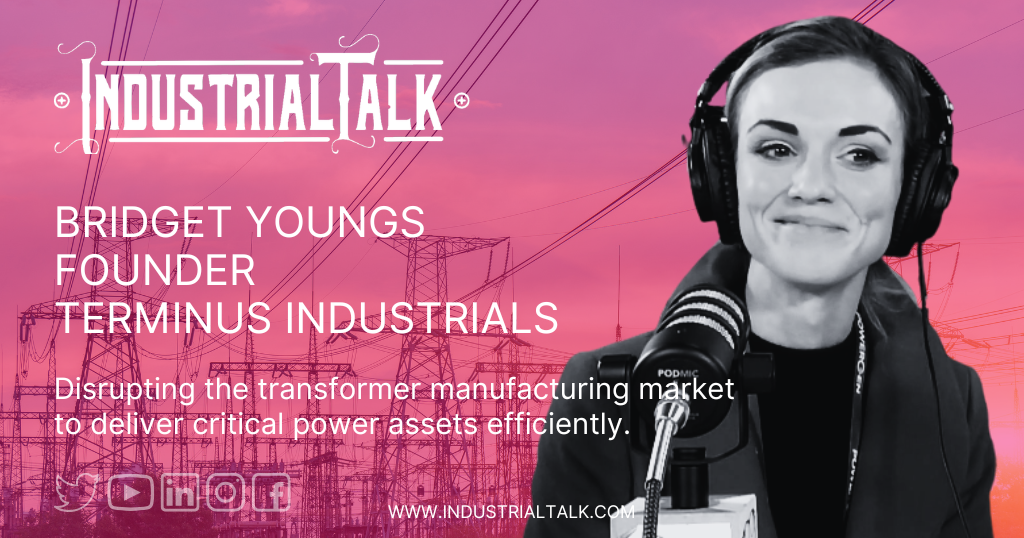
Industrial Talk is onsite at PowerGen and talking to Bridget Youngs, Founder at Terminus Industrials about “Disrupting the transformer manufacturing market”.
Bridget Youngs, founder of Terminus, discussed her company's innovative approach to transformer manufacturing. Terminus aims to reduce production time from months to under two weeks by automating processes and using AI and robotics. They focus on 138-34.5 kV transformers, a critical need in the ERCOT territory. Bridget highlighted the challenges of standardizing equipment across 1,700 utilities and the inefficiencies in current manufacturing. Terminus plans to launch products in Q3 2027, leveraging a team with expertise from companies like GE and Tesla to streamline design and manufacturing.
Outline
Introduction and Welcome to Industrial Talk
- Scott introduces the episode of Industrial Talk, sponsored by the Propane Education and Research Council, focusing on safety, training, and innovative propane power technology.
- Scott thanks listeners for joining the top industrial podcast, celebrating industry professionals who solve problems daily.
- The podcast is broadcasting live from Power Gen in San Antonio, focusing on asset management and power generation.
Introduction of Bridget Youngs
- Scott introduces Bridget Youngs, who is in the “hot seat” to discuss transformers.
- Bridget thanks Scott for having her and mentions the presence of many interested buyers and sellers at the event.
- Bridget shares her background in power development, including 10 years in oil and gas, renewables, and working for the federal government.
- She explains her decision to start Terminus, a company manufacturing large power transformers.
Challenges and Opportunities in Transformer Manufacturing
- Bridget discusses the long lead times for interconnection with utilities, which can take 2 to 5 years.
- She highlights the shift in the longest lead time item from bureaucratic processes to equipment availability, particularly power transformers.
- Bridget explains her work on automating shipbuilding and how similar principles can be applied to power transformers.
- Terminus is focused on retooling and engineering equipment to quickly manufacture dynamic assets, reducing labor costs and production time.
Specifics of Terminus' Transformer Manufacturing
- Bridget details the size range of transformers Terminus is focusing on, starting with 138 to 34.5 KV.
- She explains the demand for these transformers in the ERCOT territory, which has the longest 138 KV line.
- Bridget discusses the challenges of standardizing transmission voltage and the variations among different utility territories.
- She emphasizes the need for engineering order due to the different standards and safety measures required for equipment.
Manufacturing Process and Innovations
- Bridget outlines the five major steps in transformer manufacturing: cutting and stacking cores, winding coils, drying in an autoclave, assembling the tank, and testing.
- She describes Terminus' approach to setting up a manufacturing line that can handle different sizes of transformers efficiently.
- Bridget highlights the team's mix of experienced engineers and robotics experts from companies like Tesla and John Deere.
- She discusses the importance of iterating quickly and carefully to avoid catastrophic failures in the deployed assets.
Future Plans and Market Impact
- Bridget mentions that Terminus plans to start rolling out products in Q3 2027, primarily focusing on 138 to 34.5 KV transformers.
- She explains the design process, which involves pairing experienced engineers with software engineers to streamline the design and manufacturing process.
- Bridget emphasizes the importance of automation in reducing downtime and costs, despite higher labor and material costs in the US.
- She highlights the potential for delivering cheaper, safer, and more reliable assets to users on the grid and developers.
Conclusion and Call to Action
- Scott praises Bridget's innovative approach to transformer manufacturing and the potential impact on the market.
- Bridget provides contact information for Terminus, encouraging listeners to reach out on LinkedIn or through the company's website.
- Scott encourages listeners to connect with Bridget and other problem solvers at events like Power Gen.
- The podcast concludes with a call to be bold, brave, and disruptive in the industry, inspired by Bridget's story.
If interested in being on the Industrial Talk show, simply contact us and let's have a quick conversation.
Finally, get your exclusive free access to the Industrial Academy and a series on “Why You Need To Podcast” for Greater Success in 2026. All links designed for keeping you current in this rapidly changing Industrial Market. Learn! Grow! Enjoy!
BRIDGET YOUNGS' CONTACT INFORMATION:
Personal LinkedIn: https://www.linkedin.com/in/bridget-youngs/
Company LinkedIn: https://www.linkedin.com/company/terminusindustrials/
Company Website: https://www.terminusindustrials.com/
PODCAST VIDEO:
THE STRATEGIC REASON “WHY YOU NEED TO PODCAST”:
OTHER GREAT INDUSTRIAL RESOURCES:
NEOM: https://www.neom.com/en-us
Hexagon: https://hexagon.com/
Arduino: https://www.arduino.cc/
Fictiv: https://www.fictiv.com/
Hitachi Vantara: https://www.hitachivantara.com/en-us/home.html
Industrial Marketing Solutions: https://industrialtalk.com/industrial-marketing/
Industrial Academy: https://industrialtalk.com/industrial-academy/
Industrial Dojo: https://industrialtalk.com/industrial_dojo/
We the 15: https://www.wethe15.org/
YOUR INDUSTRIAL DIGITAL TOOLBOX:
LifterLMS: Get One Month Free for $1 – https://lifterlms.com/
Active Campaign: Active Campaign Link
Social Jukebox: https://www.socialjukebox.com/
Industrial Academy (One Month Free Access And One Free License For Future Industrial Leader):

Business Beatitude the Book

Do you desire a more joy-filled, deeply-enduring sense of accomplishment and success? Live your business the way you want to live with the BUSINESS BEATITUDES…The Bridge connecting sacrifice to success. YOU NEED THE BUSINESS BEATITUDES!
TAP INTO YOUR INDUSTRIAL SOUL, RESERVE YOUR COPY NOW! BE BOLD. BE BRAVE. DARE GREATLY AND CHANGE THE WORLD. GET THE BUSINESS BEATITUDES!
Reserve My Copy and My 25% Discount
Transcript
SUMMARY KEYWORDS
Propane Education Research Council, industrial talk podcast, power generation, asset management, power transformers, Terminus Industrials, manufacturing efficiency, automation, power electronics, high voltage, transmission lines, utility standards, innovation, supply chain, robotics.
This episode of industrial Talk is brought to you by the Propane Education and Research Council committed to advancing safety training and innovative Propane power technology across industries. Learn more Propane.com
-:The Propane Education Research Council leading the way in cleaner, safer and more efficient energy future.
Welcome to the industrial talk podcast with Scott MacKenzie. Scott is a passionate industry professional dedicated to transferring cutting-edge industry focused innovations and trends while highlighting the men and women who keep the world moving. So put on your hard hat, grab your work boots, and let's go
put that on your calendar for:Bridget, well, Scott, thanks for thanks for having me here. Oh, heck, yeah.
Why wouldn't I? You guys are talking transformers, but we're not gonna get into that, just right, Josh, we're
just not you have a good show. Absolutely. Why? Lots
of great folks here, lots of people interested in buying from us and selling to us. So transformers are a big problem. So they
are. How long has Terminus been in business?
So I found a terminus in August.
Whoa, that's just slapped upside my head. I didn't see that one coming. You founded it? Yes, sir. Why come on.
So my background is in power development. It's like 10 years oil and gas renewables, so looking at solar, battery and some CCG plants, had the opportunity to work for the federal government from January until August, and it was time for me to leave. It's like, obviously, I had to start a company manufacturing large power transformers.
I'm just, I don't even know where to go. You just made now I'm speechless, and I'm not, I'm not normally speechless, but I'm How does somebody decide they want to create a transformer business? Well, so I get the generation, I get all the other stuff, but nobody says the transformer business.
nt side, probably around like:Locally, locally, locally.
No kidding, yeah.
Give me a size range. What are you guys focused on? What's what you know what is.
So we're building our first facilities, the ability to test up to 765, KV, but our initial unit will be 138, to 34.5 KV. Step down. And the reason for that is we're building an encore territory, and that's the 138 kV line is the longest, the highest mileage on the low end of the transmission side. So you've got a lot of substations, especially looking at private developers, so the data centers, and then industrial development that needs to pull a substation off of a 138 kV line. And so that's where we're seeing a lot of demand.
I didn't know. I didn't know that the 135 are the longest. I used to work in transmission. It was always for Southern California. Edison was 66 220, and we went out to, I want to say three, 365, I don't know, and then 500
yep, yep, so, and this is a great example of one of the issues with the transmission business is that you
because they haven't expanded, and it's a it's the grid is a problem, and nobody, yeah, outside of all of that,
all of that. But is so it was like 138, is the standard Low End transmission rating for encore. But it's like you move into other utility territories, and for that same grade of transmission, some of them might be 122 some of them might be 115 and that's why it's like EQ has to be engineered order, because transmission voltage is standardized.
See, this is so interesting because I had the same beef, because in in in Southern California, their service narrative, it's 66 but then when you go out there outside of that, it's 69 Yes. And then it just and we're supposed to be somehow living the magic of being interconnected and having a grand time. And it's just doesn't
,:side. Don't get me talking about ERCOT.
Oh, ERCOT. ERCOT is great. It's like, lowest cost of power.
Well, I got it, but they're on island. You can't, they're you can't just wheel power into ERCOT. True, true. True. They're just an island, right? You know, right? Not to say that you can wheel power. I mean, all these interconnected it's, it's just an interesting, challenging, but I'm not complaining.
Well, I mean, don't hate me. It's an interesting experiment, because you see is like on on the regulated side, where power is more stable but also more expensive. Yeah.
So here we are. You're going to manufacture transformers. You're going to try to, in the best way possible, do it as efficient and quickly as possible, because the demand, especially in the power generation world, is going through the roof. And these are long lead time items, correct? So where are you getting your, you know, shall I say, feed stock? Where you were you sourcing your stuff to be able to manufacture in the Transformers, right?
So there's only, there's one mill in the US that makes green, orange electric steel. It's the AK steel plant, so now it's operated by Cleveland Clifton, Pittsburgh. There's, there are higher grades of steel you can purchase, but those like aren't, aren't used in large power transformers. It's like, we'll have secondary suppliers in Europe, but a lot of the US Steel suppliers that have Grain Oriented steel mills have transitioned to making non Grain Oriented steel, which is what's used in batteries. So it was like battery demand has been higher, and a lot of transformer manufacturing has gone, has gone offshore, looking around at this conference that the big guys are not, are not US manufacturing.
They're not. They're not. And in fact, I think, I think that because of that, there's a risk. Just, I think you need to have that critical asset that that manufacturing capability, states on Correct, correct, you know? So with that said, Okay, you're doing all this stuff that's pretty doggone. Cool. Yeah. I think you can sort of let me share. I digress. So there I have a friend, and she's wonderful, and she's in asset management, and I remember the first time I sat down with her just say, Hey, I've seen you out on, you know, LinkedIn. It's just, it's cool. Hey, would you like to get on the podcast? Yeah, sure. And then I sat down with her, and she said, the first thing, I said, Hey, give us a little background. Well, I created the catapult systems for the
for these aircraft carriers.
And she and she said, Yeah, and I used to land on him. And I was, I was just, I couldn't, I didn't know what to say. He caught me off guard. You caught me off guard with
doing transformers? What the what? Well, you know, as like, if
somebody, if anybody else, wants to do it, I'm like, happy, happy to yield the seat for them. But you know, somebody's got to be willing to spend the next 25 years of their life building this. And I think it's important is like, when you're selling as like, an asset that has the risk of catastrophic failure to a institutionalized customer base. There's not a lot of room and incentives for innovation. And I think you see it on the generation slide. So we haven't seen a new generation technology as like in in decades.
When we start talking about, Is there room for transformer innovation outside of the the realities that we can manufacture them. But isn't that just, isn't it sort of proven technology? That's like, I mean, how much more innovation can you apply? Right? So we
great question. So transformers, the engineering is very mature, and there's very low losses from power losses, yeah, they are not very efficient. From a material standpoint. It's like, you're still looking at as, like, a lot of copper and a lot of steel and a very heavy asset that's challenging to move. And it's like, currently very labor intensive. So you're looking at about 55% of the cost materials, most of that is copper and steel, and then the remainder being labor power electronics. So what they call solid state transformers, which are DC to DC, and you can control voltage more carefully through power electronics monitoring. That technology has not been proven at the high voltage scale. So once you go over like 70 KV is like power electronics just fry. There are companies like Heron power that is doing data center connections. This is mid voltage, so they're in taking 34.5 KV, and they've got a DC to DC connection, which is great for data center applications, yeah. But once, when you step into the high voltage space, it's like, the innovation that we're chasing down is mostly on the manufacturing side. So how do you product? Yeah, to make it more manufacturable, yeah? But it's like sticking with because
there's so much inefficient in that particular part of the manufacturing. It's just inefficient there's there's so much room for optimization, absolutely.
But isn't it an interesting time that we live in? Fascinating.
I just, I think that
it's hard for me to focus on something when everything else is, you know, trying to capture my attention. It's like, it's just busy. Everything's like, hey, we could do this. We could do that. We just like, it's like, man, you're all over the place, and it's hard. And in the case when you just sort of started to talk about transformers, the types of transformers, where they can be applied, and all that stuff. I don't you, you have to. I like the fact that you're, you're focused on the manufacturing, correct, and that that's, that's key, that's focused, and you don't have to worry about all the other just let the market do what they do.
Let the market do what they do is like, set up, set up a manufacturing line that can cut, can cut in stack cores can can wrap coils that are insulated, can dry them in an autoclave, assemble the tank and test so it's like, really, you've got five, five major steps interest for manufacturing. You can set up a line that's sized to do that for your largest units, but on the same equipment, you can do it with your smaller units. And that's where it's like, our team is a mix of and call it old school, new school, but taking as like, the institutional knowledge. So hiring engineers from like, shouldn't say any names too loud, but Virginia transformer and General Electric, and pairing them with, like, our robotics team, which is a lot of former Tesla, former John Deere, and it's like taking that knowledge base together to engineer a new because you said Doge, happy to talk about it.
Did you meet Elon? See now that that's like, I wanted him on my podcast, just because I'll just there and geek
out on it, like whatever. I mean, he's done it. He has done he has innovated in industries where everyone said it was
impossible, yes, yes, it's, it's fascinating to me to see that,
yes, I think there's. And, you know, it's interesting, because looking at, like, the roadmap that we've got in front of us, it is, I think let's iterating quickly and feeling carefully, yeah, it's like, because you can't fail on an asset that's deployed, that's, that's, that is catastrophic. Yeah. But it's like taking taking risk in house, so within the confines of what you're in control of, in managing cash. Because it's like, you know, look at these are very there's a $500 million capital moat around transformer manufacturing, which is why a lot of people haven't done it. It's like, but there's an opportunity to deliver, it's like, a cheaper, safer, more reliable asset to it's like, I mean users on the grid, but also developers and heavy industrials, if, if you're able to break that hurdle. So that's where it's like we're looking at investing heavily in is like our team that's done it before, both on the design side and on and on the manufacturing side. And it's like mixing those two skill sets to deliver. I love it.
Yep. When do you think?
When do you think you're gonna start rolling out actual product?
So we're looking at is like:so you're going to be able to design it in such a way that you can retool quickly again, because it's all about speed and and be able to to produce other
types of transformers, correct? And that's where it's like automation. So it's like, from our design process, so we're building as like our so this is kind of the beauty of pairing an experienced, 35 year transformer engineer with a brilliant software engineer who's writing shotgun. And it's like, as they're doing their design, this guy is writing the code in the platform so that he doesn't have to design from scratch over and over again. And then it's like, from there is like, that plugs into what call it the PLC, the programs that robotics, which is really just equipment, right? Yep. And so it's like, there's like, you don't actually have to resize, resize these machines, because they know and they're set to, it's like, Are you moving? It's like, out three feet or in. Okay, great. So they know when to stop on your stacking this you see and see your installation, and then your foil wraps around that. So it's like the downtime is very low in between units.
See what makes this brilliant. I've listened. I've had the opportunity and work with Arizona public service, and they called me because they had a catastrophic 500 KV transformer failure in summertime, right? And so here you have a transformer that failed and you just can't find them. I mean, they're not just sort of roaming around having a great time go to Home Depot and pick one up. So they were in a pickle. So they worked through it. They were doing some, you know, rolling brownouts, but, but it really communicated the fact that we just don't do a good job at manufacturing. We got to be better at that. Yeah, and, and then, of course, you don't want to just have inventory, just for the sake of inventory. That makes no sense either. So it I like what you guys
are doing. Thank you. Thank you. It's challenging for because it labor is more expensive in the US and materials are more expensive, but like we think that there's a lot of room to compress costs with automation.
That's brilliant. Absolutely freaking.
Absolutely. How do people get
LinkedIn? Terminusindustrials.com?
I like it a lot. Bridget is her name. She's amazing. That is, that's a fantastic conversation. Reach out to her. We're going to have all the contact information of Bridget out on industrial talk. So fear not be and put this as a high priority connection. She thinks differently. And I like that. I like it a lot. All right, once again, we're broadcasting from power Gen here in San Antonio, and you get great people like Bridget she's she's delivering on some solutions. She's a problem solver. And you get to find other problem solvers with no problem. Here, it's a problem a couple of times here at
power Gen. So stay tuned. We will be
right back. You're listening to the industrial talk Podcast Network, one
word, one word with Bridget Terminus industrial that's not the one word, but disrupting. They are disrupting the transformer market that was power Gen, and their story is gripping, not I can truly appreciate the fact that they're looking at a market that's been around forever, right since the beginning of power, and now they're saying, We can do a better job. We can manufacture transformers more efficiently, meeting the needs of the market quickly, and doing it stateside. Right here, they're doing it here. For Austin, it's an amazing time. Terminus industrials, yeah, we've got all the contact information for Bridget and team. Terminus out on industrial talk. That's a must connect. We've got to look at these challenges that are taking place in the market and think differently, be disruptive, and do it with speed and focus, and fail fast, and do all of the stuff that you need to do make it happen. And here's Terminus Bridget excellent conversation. Yeah, that's a that's a must. I get excited about people that are looking at today's challenges from a different perspective. I just think it's exciting. All right, industrial talk, once again, is here for you. This is what we're doing because we're inspired by Bridget we need to be disruptive in the way we in industry communicate are who we are. You need to tell your story, but you need to do it in such a way that inspires the next generation of industrial leaders. We are looking, we are actively looking for an advisory group that is Youngs, and the reason for that is that I'm trying to search for a different perspective on how to be able to communicate and inspire that next generation. You follow that category, go out to Intel's real talk. Click. Good luck. That's me, and then we'll have a conversation. Would love to be able to hear you and be able to have that conversation. All right, be bold, be brave. Dare greatly disrupt what you're doing. Hang out with Bridget and you will be changing the world. We're gonna have another great conversation coming from Power Change shortly. So stay tuned.