David Dickert and Frank Moyer with ANA, Inc.
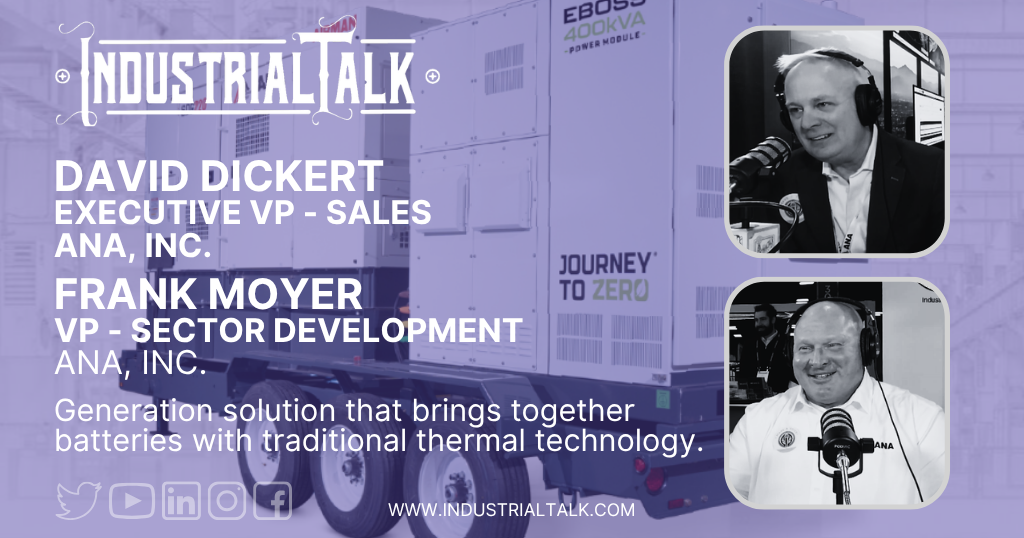
Industrial Talk is onsite at PowerGen and talking to David Dickert and Frank Moyer with ANA, Inc. about “Traditional generation with battery technology”.
David Dickert and Frank Moyer discussed their roles and innovations at ANA, a company specializing in power solutions. David, with 38 years in the industry, leads sales, while Frank is the sector leader for North America data centers. They highlighted their E-Boss technology, a hybrid system combining diesel or natural gas generators with lithium titanate oxide (LTO) batteries, which offers 80,000 cycles compared to LFP's 6,000-7,000 cycles. E-BOSS can scale from 25 kVA to 50 MW, with a small footprint and high efficiency. They also introduced new extended battery packs for longer run times.
Outline
Introduction and Welcome
- Scott welcomes listeners to the number one industrial podcast, celebrating industry professionals.
- The podcast is broadcasting live from Power Gen in San Antonio, Texas.
- Scott introduces the guests, Frank and David, and sets the stage for the conversation.
Backgrounds of Frank and David
- Frank Moyer introduces himself as the sector leader for North America data centers.
- David Dickert shares his background, leading sales at ANA and his extensive experience in the power industry.
- Both guests discuss their roles and the importance of their work in the industry.
- The conversation touches on the significance of data centers and their rapid growth.
Introduction to E-BOSS Technology
- David explains the E-Boss technology, a hybrid system combining internal combustion and battery solutions.
- The E-Boss system makes diesel and natural gas generators 80% more efficient.
- Frank discusses the life expectancy of the battery component, highlighting the use of LTO technology.
- The E-Boss system is designed to optimize existing generators rather than replace them.
Details of E-Boss Technology and Applications
- David elaborates on the E-Boss system's ability to parallel unlimited power systems.
- The system can scale from 25 kVA to 50 MW, with a small footprint.
- The E-Boss system is used in various applications, including data centers and construction sites.
- Frank emphasizes the safety and efficiency of the LTO technology, which is resistant to thermal runaway.
Market Position and Future Plans
- David discusses the market position of ANA and their focus on data centers.
- The company is introducing new technologies, including extended battery packs, to meet growing demand.
- Frank highlights the unique inverter system that sets ANA's technology apart from competitors.
- The conversation concludes with a call to action for listeners to connect with ANA and explore their solutions.
If interested in being on the Industrial Talk show, simply contact us and let's have a quick conversation.
Finally, get your exclusive free access to the Industrial Academy and a series on “Why You Need To Podcast” for Greater Success in 2026. All links designed for keeping you current in this rapidly changing Industrial Market. Learn! Grow! Enjoy!
DAVID DICKERT'S CONTACT INFORMATION:
Personal LinkedIn: https://www.linkedin.com/in/david-dickert-8516a5/
Company LinkedIn: https://www.linkedin.com/company/anainc/
Company Website: https://anacorp.com/
FRANK MOYER'S CONTACT INFORMATION:
Personal LinkedIn: https://www.linkedin.com/in/frank-moyer-a06981284/
PODCAST VIDEO:
THE STRATEGIC REASON “WHY YOU NEED TO PODCAST”:
OTHER GREAT INDUSTRIAL RESOURCES:
NEOM: https://www.neom.com/en-us
Hexagon: https://hexagon.com/
Arduino: https://www.arduino.cc/
Fictiv: https://www.fictiv.com/
Hitachi Vantara: https://www.hitachivantara.com/en-us/home.html
Industrial Marketing Solutions: https://industrialtalk.com/industrial-marketing/
Industrial Academy: https://industrialtalk.com/industrial-academy/
Industrial Dojo: https://industrialtalk.com/industrial_dojo/
We the 15: https://www.wethe15.org/
YOUR INDUSTRIAL DIGITAL TOOLBOX:
LifterLMS: Get One Month Free for $1 – https://lifterlms.com/
Active Campaign: Active Campaign Link
Social Jukebox: https://www.socialjukebox.com/
Industrial Academy (One Month Free Access And One Free License For Future Industrial Leader):

Business Beatitude the Book

Do you desire a more joy-filled, deeply-enduring sense of accomplishment and success? Live your business the way you want to live with the BUSINESS BEATITUDES…The Bridge connecting sacrifice to success. YOU NEED THE BUSINESS BEATITUDES!
TAP INTO YOUR INDUSTRIAL SOUL, RESERVE YOUR COPY NOW! BE BOLD. BE BRAVE. DARE GREATLY AND CHANGE THE WORLD. GET THE BUSINESS BEATITUDES!
Reserve My Copy and My 25% Discount
Transcript
SUMMARY KEYWORDS
Data centers, power generation, battery hybrid system, E BOSS technology, efficiency, temporary power, rental industry, load spikes, inverter system, extended battery pack, power modules, construction, utility solutions, Industrial Talk podcast.
Scott, welcome to the Industrial Talk podcast with Scott MacKenzie. Scott is a passionate industry professional dedicated to transferring cutting edge industry focused innovations and trends while highlighting the men and women who keep the world moving. So put on your hard hat, grab your work boots, and let's go all right,
once again. Welcome to Industrial Talk.
Thank you very much for joining the number one industrial
related podcast that celebrates you industry professionals all around the world. You're bold, you're brave, you dare greatly, you innovate, you collaborate. You are solving problems each and every day. That's why we celebrate you. You are the heroes in this story. We are broadcasting on site. This is numero uno. This is the number one podcast conversation
at power Gen. We're in San
Antonio, Texas, and ANA is in the hot seat. Can't wait for this conversation. One's called tank, and the other one's called Frank. Tank is David, but
we got it going, so let's get cracking there.
How's that? I'm a little bit different on, love
it nominal.
Well, you guys, it's, it's, I geek out on anything industry, right? And, and what you guys, you go to your booth. Come on. That's pretty cool.
I'll tell you, we have stuff. We have an awesome marketing team. We feel like we've got the best booth here. We're it's great. We have a good position, and we have an awesome marketing team.
It is a good it's good. It's It's cracking All right, before we get into this particular conversation, we need to know a little bit about you, Frank and you
David tank, so you started with Frank, see,
but hold it right there. See, he's so your guy is photo bombing me, right, live, all right,
Frank, give us a little background on who you are.
My name is Frank Moyer.
Watch that. See.
Thank you very much. I appreciate it. I messed
it up. David, I knew that that's okay.
No, no, this is the first one of the day. We rocking and rolling. Man, it's not
all right, because I needed to have my little Starbucks and
I didn't have my star. That's
okay. I have mine right here, all right, I have mine right here.
Frank tank. Frank the tank. Go for it.
Yeah. My name is Frank Moyer, and I am the sector leader for North America, for data center,
for ANA, if that's not a topic, right? Data centers, data centers,
tegy more sector specific, in:versus just kind of going for everything, yeah,
come on. You know that that's the hot topic. You know that is, it's it's happening, right? It just
is, whether you like it or not, it's happening.
We need to have that.
If you don't like data centers, then we can stop using our cell phones and our streaming services and all of those great
things, pretty much just life in general. This podcast, this podcast, absolutely is stuck out there on some sort of server. All right, David, hello.
Background, so I'm David Dickert. I lead Sales here at ANA, and I've been in the industry for power, industry for, wow, it makes me feel really old when I say about 38 years I spent quite a bit of time. Yeah, no, I've spent about 30 years with a Greco, which is a very large, global temporary power business. Spent a few years in the gas turbine, steam turbine space with ethos, energy independent service provider, another global piece, and been here at ANA for about two years. About two years.
You guys out there on LinkedIn? Yes, sir, absolutely. Yeah. You don't have any issues with, you know, connecting on LinkedIn.
No, Frank, doesn't. Nobody wants to connect because it's
your team is on it.
Team bringing little models by it's, we have an awesome marketing team.
It is, look at this, look, look, we have to, we have to
Sure, there you go. We'll talk about that in a minute. That's our battery hybrid system. We call it E BOSS.
And remember we talked about that last time when we were chirping, weren't we there?
Yeah, there you go check All right, let's, let's, let's dive into that technology. So we've got a hybrid combination, sort of an internal combustion solution with a battery solution.
David, give us a little sort of
why? Okay, on that.
So our battery system. Them is a it's a generator optimizer. So a lot of battery systems you see
in the interrupt, I have to interrupt, yes. Do you guys watch
f1 yes.
See they have a battery combustion engine combo, and they do it as a way of optimizing.
That's it. So we take the use of a diesel or a natural gas generator and we make it 80% more efficient with this system. A lot of battery systems out in the space today, they're seeking to replace a generator, and there's nothing wrong with that. Our technology says that we're going to be running diesel and natural gas generators for a long time to come. Why not build an engineer system that makes them more efficient? And that's exactly what this does,
Frank real quick, the battery component I understand the the traditional approach to generation that internal combustion, your multi fuel, I would imagine, right fueling now, in a sense, your multi fuel, propane, natural gas on the generators, yes, yeah, yeah. From a battery side, what's, what's the life expectancy of that battery component?
s, where, in LFP, it's six to:What do you get? The components of your battery? I I'm going to focus on that, just because there's a lot of conversation around mining, around the pursuit of those inputs into those batteries, both domestically and internationally. What if that's new technology, where we get
it? Yeah,
clearly I don't want you after me. Tank so yeah.
So I'll say this cautiously. Obviously, we have a lot of IP to protect. Oh, yeah. But we, we are, we're an assembler, so we are buying the componentry globally, yeah, and we bring it in and we assemble it here in the United States. Our, I think I can say our batteries are coming from Japan, yeah, from a major manufacturer. Yeah. And then it's assembled here with our inverters, and all of the other components
are inside of the system. Yeah, one of the, one of the interesting things about our battery system is, in Japan, it's used in the bullet trains, and it's been used in the bullet trains for years. Yeah, it's a it's a somewhat of an old, older technology. And the reason they use them in the bullet trains is because they can charge and discharge at a very fast rate. Within that application, they're seeing 60 to 80,000 cycles on the battery, which means that Frank and I will long be retired before you have to replace the batteries in a system that that we're selling and manufacturing. Yeah. The other thing about the batteries is extremely safe. No, no thermal runaway. No thermal runaway.
Yeah, I was getting ready to approach that. You please expand upon that, because I was getting ready to say, hey, there's some real volatility that can't exist within the battery technology. Talk to us
exactly Frank. You want to let it rip on that?
Yes, so the LTO technology, obviously, it's a derivative of lithium. It's nearly impossible to catch on fire. Now, I'm I'm not smart enough to tell you exactly the the chemistry behind or the physics behind it, why it's not but the you know, when you hear about a battery fire, a Tesla catches on fire, a cell phone catches on fire, that's LFP. That's lithium phosphate. Yeah, that's what 99% of other. People are using right to David's point. They're using that in the fast trains. You can imagine the heat generation on the bottom of those trains. So they needed to create a technology that wouldn't catch on fire. And I'll tell you, we are trying to catch our battery on fire to see at what heat point it will catch on fire. There's certain certifications in our industry that require you to literally catch it on fire, and then you can get certain certifications. We haven't found a way to catch it on fire, that's right. It's so resilient, that's right. And you would think that that may say to the to the people that give out these certifications, wow, we can't catch it on fire. Nope. We're still trying to catch it on fire. Yeah, if you have any ideas, we'll take some suggestions.
Yeah, you're right about that.
I know. I don't have any ideas. I have some ideas.
That's you. That's, yeah, that's way above my pay grade. Yeah, all right, let's, let's, let's venture in your technology, the demand for power the data center demand for power
from an ANA perspective,
David, what tell us
what size limitations can be brought to that solution.
Perfect. So our E BOSS technology
is able to parallel unlimited so we can construct any size, kilowatt to megawatt based on the paralleling of our product. We parallel at the grid inverter level, so we're able to connect as many of these systems together as you need to build a power system. We have, at the very most, smallest scale, a 25 KVA system. Yeah. We also have 50 megawatts. No, no, shut the door, 50 megawatts. So we rain sizes, single sizes, from a 25 Kba all the way up to a 625 Kba
parallel. Them
together. But then that
starts talking about footprint. That starts saying, Hey, I have a footprint of X amount of square feet, sure. So then you're driven
by that, right? That's correct. And you could take our 500 KW system and build a multi megawatt system very easily. With that our footprint is relatively small, so our 500 KW system, think of it as about 10 foot by eight foot, and we'll put a 500 KW system within that space, and then we can scale out, like I said, we just don't, don't put a
carpet underneath. They're going to charge you 400 bucks for a 10 by 10
and to vacuum that carpet. Have you seen how much it is to vacuum the carpet here? Yeah, so. But anyway, you can parallel these together. We have 50 plus megawatt systems operating today. In the field, we operate at a data center level, from the construction space all the way to the operating so once they bring that system online, we can actually power that Frank,
your your technology outside of the E BOSS got it, but you're, you're not limited to just you can come up with your, your traditional type of generation solution, right? Reciprocating. You're not bound your your agnostic to a certain extent of the fuel. You can, you can, you know, depending on what you want, you can be propane, you can be natural gas, you could be what, I don't know, what else, diesel.
There. Thank you very much. There you go. Yeah. So you're,
Does, does ANA dive into other technologies, not just your typical reciprocating engine type of solutions?
Well, we have, we have our diesel generator and we have our air compressor, if that's what you're talking about. Okay, they can run off of those fuels. But our our catalog right now, our air compressors, diesel generators, e BOSS batteries and then a hybrid with the diesel generator, yeah, any fuel generator and the E BOSS.
The interesting thing about our E BOSS system
is outside of the battery
you this is the battery module. Here. You can connect any generator or power source to it that you want. You don't you don't need a hybrid system, no. So you can just take the power module, the battery power module parallel. These units together, any power source, utility, a turbine, natural gas, a diesel generator, and all you're using that generator for is the charge circuit. So this system will cycle, so as it operates on a battery, and it depletes over time, it just cycles. And we'll charge the full battery scheme within 30 minutes, and we'll shut that power generator. Migration system down.
So let's say I have a I have a demand, I have a power demand, and let's say I am using traditional utility solutions. Here it is. It's snapped in. Oh, the
utility goes out. How quickly
can that thing snap into use?
You're on battery power all the time. So you don't you see a blip. There is no blip. You don't lose power. All you're using the generator or utility for is just the charge the battery. It's not connected to the load. The battery is connected to the load. So anything can happen on the charge circuit. You never see it. You'll never see it. You sit
there and you you've got really sensitive equipment, and I'm not worried about it, you know, doing what it needs to do, you know, causing issues.
And that's where this will fit into the data center set. Yeah, yeah. You can't have an interruption now. You cannot to David's point. You have your E BOSS, and then everything else behind it. Yeah, the data centers here, you're powering the data center, yeah, who cares what happens back here. Yeah, the data center owners don't care what happened. They want I need power. I need balance power, and I need clean power, yeah, and our E BOSS provides that, and that's why we're going to make a tremendous mark in the industry.
Yeah, yeah. How? Let's say I have a let's say the utility says don't have power, whatever, whatever the utility say, and you don't have power. Now I'm working off that battery. How long can that battery stay and make sure that I'm okay?
It depends on the load. It depends, of course, depends on the load. So up up to 10 hours, 15 hours, no way or data center, or it depends on the load, depends on the load depends on course. Or it could be a half an hour or an hour, similar to the generator at your house. You know, let's not overthink this. If you have a generator at your house, power goes out. How long can it run for on a tank of fuel? What depends how much, how many circuits you have? Yeah, okay, so it just depends on the load that it's the million dollar question. It's probably the number one solution.
Yeah, I'm not that brilliant. I understand.
Yeah, I'll give you, okay, I'll give you a little bit of the background on the design and why it's designed the way it is. So ANA has been around for a little over eight years, and we started in North America as the airman distributor, which is very high quality generator, compressor manufacturer out of Japan, and we continue to support that line. About three years ago, we went on a journey to develop the E BOSS, and here's the research that we did. It was our belief that most of the generators operating in the rental space run at sub 30% of their rating, which means they're operating very inefficient. Yeah, oh, yeah. So we did a ton of surprise we did a ton of studies, and what we found was they're running sub 5% no way. So you have a, let's just think about it. You have 150 kW generator sitting on whatever sites you want to sit. And on average, that package produces maybe five kW, 10 kW on average. Yeah, so it's very that engine operates very inefficient at that rate. So we went on a journey and said, Look, what can we build that takes efficiency to the highest level possible within these types of load that happened every single day all across the world within that particular space. And the E BOSS was born from that. So the system is designed to cycle. It's designed to cycle. It's designed to carry those small loads over long periods of time, and when peak loads hit, the system is designed to be able to take those peak loads at capacity. And so instead of putting 150 kW generator on that space, you put 150k VA, e BOSS on that space, and you run off of the battery for those lower cycles, and you have a generator that size that it's so much like a like a capacitor bag Exactly, exactly. So you have a smaller generator that discharges the battery. And look, we, we support the National rental companies in a big, big way with this technology, because it is purposely designed to do that application, and it does it extremely well.
And if I kind of piggyback on that piggy bank away, somebody might say, Well, why don't you just find the right size generator, and it won't let stack that's pretty much impossible to do in temporary applications. In permanent installs, when you can mANAge the loads and the voltage and the amperage, you can put a generator in there that won't wet stack for the most part. Yeah, to David's point, we're working in the rental industry, because construction things loads increase go down the back. Battery is a great solution for that. And then not only solution for for, you know, the the end user, in terms of the of the owner of the project, but it increases the life of the diesel generator. Yeah, because you're putting less hours, it's like a boat, right? A boat less hours, you're saving them fuel. You're saving them maintenance, longer lifestyle. So everybody, everybody wins.
Oh, geez. All right, here's the, here's the final, final question, final, I'm popping it to you, and this is, this is going to, let's say, David, where do we go? What do you see? I know the demand for data centers. I know all of that stuff. How do you keep up with that demand? When I know that data centers, I mean when people are talking about it, how do you do that? I mean and, and you got a lot of solutions around here Zed, how do we how do we respond to that?
Well, so we're introducing two brand new technologies here at power Gen, the first one. The first one is an extended battery pack that plugs right in to these power modules to give you longer run time on the batteries. So it's a 350 kW or a 500 KW battery pack. So it's 350 kWh, 500 KW H. And you know, if you had a 70 kVA, or if you wanted to parallel these together, you could build whatever capacity system you wanted and customize your kW H behind that with these 10 foot by eight foot containers that contain 500 KW H per container. So you'll be able to scale that out,
because that's it. Because you're dealing with, you're dealing with a data center, that's right, and today's data center is going to be different than tomorrow's data correct, and I'm going to add more whatever demand on that data center. In fact, it's going
to be the continent of Australia.
It's going to be the you know, the unique thing about the data centers is we have these, these very, very, very fast load spikes. And they put either gas turbines or they put reciprocating generators, and they're struggling to take those fast load spikes. They're not peaker units, exactly. You put these battery systems in front of the generator deals with it. It deals with it.
100% takes it away. It takes it away. And if I
can piggyback real quick again, another piggyback
coming from Frank, the tank coming from Frank.
We have a unique IP in our system, in our inverter system? Yeah, that is no one else has. The battery technology is great, but the way that we do it is through our inverters, and that's why you need to reach out to us and ask for a demonstration.
Look at tank Sally delivering it. Yeah, all right,
David, give us a little 411 on how people can get a hold of you. What's the best
way ANA corp.com
or reach out to Frank the tank on LinkedIn, or you can find myself on LinkedIn, reach out to us. We're happy to collaborate.
I like that. Say that was a of course, I screwed up the names right off the beginning, and then I got photobombed. But that's okay. That makes that makes podcast fun.
Anyway, once again, we're broadcasting from, thank you guys, by the way,
right into the
spiel of closing this Thank you. Oh, Shut the front door.
Just to piggyback, one more thing,
another piggyback, coming from Frank the tank. All right, we're broadcasting from power Gen, once again here in San Antonio, because
we can, and you get great
companies like ANA, sort of dishing out some solutions. All right, we're gonna wrap it up on the other side. Stay tuned. We will be right back.
You're listening to the Industrial Talk Podcast Network. You is,
yeah, that was power Gen, David
and Frank ANA.
It was a spectacular event they have. So it's an exciting time to be in the world of power generation. It is, put this one on your calendar. Let's just say you just gonna look around, right? You You go there and you just wander the hot it's everywhere. It's an
amazing event that you need to put on
your calendar for next year, 27 I
can't believe I'm talking about that right now. But anyway, it is. Thank you to David. Thank you to Frank. Thank you for Team ANA for being on Industrial Talk and sharing
your incredible solution.
Really loved it. It was a great time. Great conversation. All right, I'm going to go back on and I'm going to be on a soapbox real quick, just real quick, nothing big, just real quick. The soapbox is we have to and, you know, inspire that next generation. We need people to work for ANA. We need people to be in the world of power generation. And the only way that we we have available is, of course, to tell your story. Industrial Talk is here for you to tell your story, we need to inspire that next generation. It's important. I think it's it's strategic, and it is critical. And that goes across all industries. We need to be able to inspire that next generation of those leaders and and that comes with telling your story. Industrial Talk wants you to succeed. Without a doubt. I want you to succeed. All you have to do. We've got to come up with your story and inspire and tell that story and get past and get past that that I don't feel comfortable. We got to do it. It's just the way it is right now. It's just undeniable. So go out to Industrial Talk. Click Connect. I'm there. Have a conversation. Let's see what we can do to help you tell your story. All right, people, be brave here greatly. Hang out with David and Frank, and you will be changing the world.
We're gonna now have another great conversation shortly.
So stay tuned. You.