Julian Knabe with Fluke
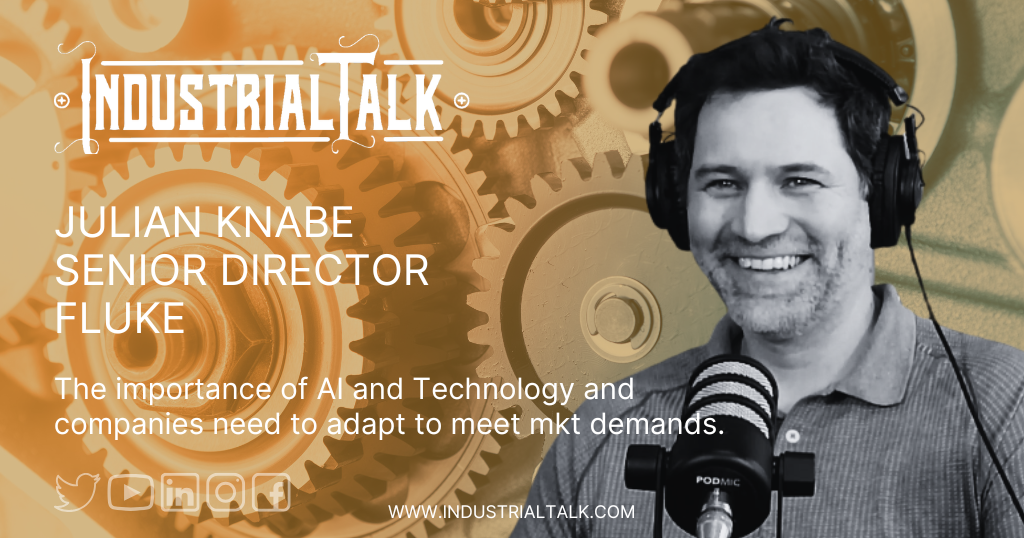
Industrial Talk is onsite at Xcelerate 2026 and talking to Julian Knabe, Senior Director with Fluke about “Leverage AI and Technology to adapt and evolve to market demands”.
The conversation features Scott Mackenzie from the Industrial Talk podcast discussing the Fluke Xcelerate event in Austin, Texas, with Julian Knabe, a finance professional at Fluke. Julian shares his experience transitioning from cost-cutting to strategic finance, focusing on growth and customer impact. He highlights Fluke's extensive product portfolio, including over 50,000 SKUs, and identifies high-growth markets like data centers, distributed energy, renewables, and defense. The discussion emphasizes the importance of AI and technology in enhancing efficiency and customer workflows, and the need for companies to adapt and innovate to meet evolving market demands.
Outline
Fluke Xcelerate Event Overview
- Scott introduces the Industrial Talk podcast, highlighting the Fluke Xcelerate event in Austin, Texas.
- The event focused on reliability, predictive maintenance tools, and AI diagnostics.
- Fluke's commitment to smarter, faster, and reliable operations was emphasized.
- Listeners are encouraged to visit fluke.com for more information.
Introduction to Julian Knabe
- Scott welcomes listeners to the Industrial Talk podcast and celebrates industry professionals.
- Julian Knabe, a finance professional from Fluke, is introduced as the guest for the podcast.
- Julian shares his background, including his recent move to Fluke and his previous roles in Europe and the US.
- Julian discusses his transition from cost-cutting to strategic finance at Fluke.
Market Landscape and Growth Areas
- Julian explains Fluke's extensive product portfolio with over 50,000 SKUs.
- He identifies high-growth markets such as data centers, distributed energy, renewables, and defense.
- The importance of innovation and the need for fast customer support in these markets are discussed.
- Julian highlights the role of Fluke's tools in helping customers maintain smooth operations.
Challenges and Solutions in Data Center Maintenance
- Scott and Julian discuss the challenges of maintaining data centers, including power needs and cooling capabilities.
- Julian emphasizes the importance of preventing disruptions to ensure smooth operations.
- Fluke's portfolio of devices and solutions play a crucial role in maintaining data center reliability.
- The conversation touches on the evolving nature of the data center market and the need for continuous innovation.
Fluke's Adaptability and Innovation
- Julian credits Fluke's teams for their ability to adapt to rapid changes and maintain high operational speed.
- The company's flexibility and adaptability, especially during the COVID-19 pandemic, are highlighted.
- Fluke's brand recognition and reputation for reliability are discussed.
- The increasing role of software in Fluke's product offerings is noted.
AI and Technology Integration
- Scott and Julian discuss the integration of AI and technology in Fluke's solutions.
- The importance of understanding customer workflows and simplifying their processes is emphasized.
- Fluke's AI innovations, including AR and AI offerings, are mentioned.
- The conversation highlights the role of AI in enhancing efficiency and learning within the industry.
Future of Work and Talent Retention
- Julian discusses the importance of attracting and retaining talent in the industry.
- The role of technology in making work more efficient and accessible for younger professionals is highlighted.
- The conversation touches on the need for companies to invest in and support the development of new skills.
- The potential for AI to bridge the knowledge gap between older and younger technicians is discussed.
Distributed Energy and Market Trends
- Julian shares insights on the growth and challenges of the distributed energy market.
- The importance of flexibility and competitive advantages in the energy market are discussed.
- The conversation touches on the impact of global events, such as the crisis in the Gulf region, on the energy market.
- The role of new technologies, such as small nuclear power plants and fusion energy, in the future of energy is highlighted.
Fluke's Market Presence and Customer Satisfaction
- Julian discusses Fluke's presence in various markets, including oil and gas, manufacturing, and defense.
- The company's reputation for reliable products and customer satisfaction is emphasized.
- The conversation highlights the importance of listening to market needs and continuously innovating.
- Julian shares his pride in working for a company that makes customers happy and proud of their products.
Closing Remarks and Future Plans
- Scott and Julian discuss the importance of inspiring the next generation of industrial leaders.
- The conversation emphasizes the need for consistent communication and storytelling within the industry.
- Julian shares his excitement about the future and the potential for exponential growth in technology.
- The podcast concludes with a call to action for listeners to connect with Julian and stay tuned for future updates from Fluke.
If interested in being on the Industrial Talk show, simply contact us and let's have a quick conversation.
Finally, get your exclusive free access to the Industrial Academy and a series on “Why You Need To Podcast” for Greater Success in 2026. All links designed for keeping you current in this rapidly changing Industrial Market. Learn! Grow! Enjoy!
JULIAN KNABE'S CONTACT INFORMATION:
Personal LinkedIn: https://www.linkedin.com/in/julianknabe/
Company LinkedIn: https://www.linkedin.com/company/fluke-corporation/
Company Website: https://www.fluke.com/
PODCAST VIDEO:
THE STRATEGIC REASON “WHY YOU NEED TO PODCAST”:
OTHER GREAT INDUSTRIAL RESOURCES:
NEOM: https://www.neom.com/en-us
Hexagon: https://hexagon.com/
Arduino: https://www.arduino.cc/
Fictiv: https://www.fictiv.com/
Hitachi Vantara: https://www.hitachivantara.com/en-us/home.html
Industrial Marketing Solutions: https://industrialtalk.com/industrial-marketing/
Industrial Academy: https://industrialtalk.com/industrial-academy/
Industrial Dojo: https://industrialtalk.com/industrial_dojo/
We the 15: https://www.wethe15.org/
YOUR INDUSTRIAL DIGITAL TOOLBOX:
LifterLMS: Get One Month Free for $1 – https://lifterlms.com/
Active Campaign: Active Campaign Link
Social Jukebox: https://www.socialjukebox.com/
Industrial Academy (One Month Free Access And One Free License For Future Industrial Leader):

Business Beatitude the Book

Do you desire a more joy-filled, deeply-enduring sense of accomplishment and success? Live your business the way you want to live with the BUSINESS BEATITUDES…The Bridge connecting sacrifice to success. YOU NEED THE BUSINESS BEATITUDES!
TAP INTO YOUR INDUSTRIAL SOUL, RESERVE YOUR COPY NOW! BE BOLD. BE BRAVE. DARE GREATLY AND CHANGE THE WORLD. GET THE BUSINESS BEATITUDES!
Reserve My Copy and My 25% Discount
Transcript
SUMMARY KEYWORDS
Fluke Xcelerate, predictive maintenance, AI diagnostics, Industrial Talk, strategic finance, data centers, distributed energy, renewables, defense, customer innovation, AI tools, workflow efficiency, talent retention, technology integration, industry trends.
Industrial Talk is brought to you by Fluke. We were on site at Flukes Xcelerate event where reliability reimagined came to life from high energy keynotes to hands on predictive maintenance tools to break through AI diagnostic the event delivered real world strategies teams can use today. Xcelerate once again, proved why it is the launch pad for smarter, faster, reliable operations go out to Fluke.com to find out more.
Welcome to the Industrial Talk podcast with Scott MacKenzie. Scott is a passionate industry professional dedicated to transferring cutting edge industry focused innovations and trends while highlighting the men and women who keep the world moving. So put on your hard hat, grab your work boots, and
in, Texas, and it's Xcelerate:reluctance, a strong word. What's that reluctance? A strong word?
Oh, I'm sorry. I didn't mean to you weren't related. Yeah, you're nice, you're all good. So anyway, you having a good conference? Yeah, I'm
having a great conference. You know, I'm in in finance, so I don't get to see customers face to face on a daily basis, like maybe, yeah, a lot of my other colleagues get to do so for me to get out to a conference, have a lot of face to face conversations and learn from our customers where we can do better, but also where we're doing well, is really valuable. So it's a great insight.
Source. How long you been with Fluke? With Fluke,
specifically, only since middle of last year. But I've been with Ford of the mothership seven years now. So it's been quite a while. Started up in in Europe. So I was in Switzerland first, and then moved across that didn't stink, no, it was, it was beautiful. I had a good time. It was a good place to be during covid as well. And then came across the US. Then we bought a company in Germany. They sent me across there. I was CFO there for a year. Company split into two pieces, so we one part of the company was spun off. And so I had to choose which side of the fence I was on and then I got a call from from Luke, and they said, Hey, we have this interesting position. As a finance person, you're used to doing a lot of cost cutting, and this role is the exact opposite. It's Hey, we're looking for someone who can lead Strategic Finance and decide where do we deploy
our capital,
where do we place our capital to grow, to support our customers and to really make an impact. And that's been, it's been,
that's pretty cool. Yeah, that's, yeah, you're absolutely right. It's, it's typically like, Okay, we gotta, that's, why are we doing that? Why are we spending money over here? Why try to tighten up those finances? That's good. So with that, you've had to sort of look into the market. You're looking at the market landscape you're saying, Okay, I see what's going on. Can you share with us, just sort of, generally speaking, what that looks like?
Oh, yeah. I mean, we spend a lot of time trying to decide, where do we want to spend more time? I mean, obviously we service, you know, Fluke has over 50,000 SKUs. So we service a lot of different markets, a lot of different end customers.
Everybody knows Fluke, right? Well, Dad had
come on, it's a that's a heck of a brand, right? And so we're looking, you know, where can we Xcelerate as well, and where can we serve, maybe some new customers, and where we're seeing especially high growth is data centers. Probably everyone's mentioning to you, yeah. Dr, so that's distributed energy, and renewables know it all well, right? And then defense is obviously also, yeah, right now, not just, is it? Is it growing, but it's, it's evolving very quickly. And so our customers there, you know, they need to innovate fast. Our tools help them do that. And and that's where we really want to play.
Matt, you touched on three just vibrant markets, right? Three of them, and you're looking at something like, you know, when we start talking, I was at a conference power, General Power Gen and and, yes, how do we satisfy the power needs for those data centers? But it's not only that. And how do we deal with the cooling capabilities? You. And ensure, just like we always have, ensure that they don't go down right? That's, that's, that's like poison. You don't do that.
There's so much work that goes into the maintenance. And obviously, you know, emailed is one part of that solution, but we have so many devices across our portfolio that play different roles within that ecosystem. So, you know, we're really excited to connect with our customers and be able to give them solutions that help them keep keep running everything, have no disruptions and and be successful. Because, I mean, at the speed at which these things are being built out, you know, you can't do that if you're constantly being pulled back by disruptions in one of your existing data centers. So you need to have smooth operations, and that's where we play an important role.
How does, how does flu keep up with that velocity? I mean, it's, I got to tell you, there's one day I was talking about, you know, the the conversation all around and it's it. This became the miscellaneous file, IoT, IIoT. What we're able to do is we're able to collect data off of that asset, and then, and nobody knew what to do with it, right? All of a sudden, and then AI hits it just just makes it just go blistering fast. And then I was just, it just never, how do, how does, how does Fluke keep up with that? I don't know. I mean, you want to strap yourself in. It's like a roller coaster.
Yeah, I think, I mean, the simple answer is, we have great teams. I don't think it's new to us in terms of being able to adapt to a lot of change. I mean, we've seen a lot of change already, before data centers were around, and I think one thing we've always been good at is redeploying, reassessing situations and being flexible and adaptable to these new situations. And our operations teams are amazing in terms of the speed at which they can ramp up our supply chain. Teams, you know, the same thing. I mean, I remember during covid, we had competitors partially coming to us, asking for parts because they couldn't get them in the market chain. Teams were that good, that they were that they were able to provide that to them. So again, you have a tremendous
just one name recognition, the brand, but, but you've been around, you have a lot of street cred out there. So, yeah, I can imagine that, that, you know, that pedigree just shot, just was amazing.
And I think, to your to your point, around, you know the change, if you look at the speed of innovation that we've shown already over the last I mean, 50,000 SKUs don't come from nowhere. Yeah, that's been a lot of innovation. And I think we see that speeding up. Obviously software is playing a bigger and bigger role as well. Most people think Fluke. They think a device, maybe a handheld, but you know that portfolio is growing and evolving, and software is playing
a more important role as well. Yeah, you can't help but be that, you know, here's the technology, here's the device. It's, it's, it's intertwined, you know, beforehand, before all this wonderful quote, technology was just happening. It, yeah, I can see it, but now it's it. You can't have, you can't have a solution or device over here and not have it connect to your technology, right, and not have it communicate and not have it, you know, be able to sort of present to you solutions of what's your next step right? Because you're compressing that time to identification and to action, right?
And I think the key there is understanding your customers workflows right? And then being able to offer them that offering across the board, simplify their work. And I mean, we presented a number of AI innovations here as well at the conference, right? And it's not about, you know, one of the fears that you keep hearing from people is it's not about replacing people. It's really giving them tools to to to work through that work process and that workflow in a more efficient way, and, yeah, accelerating their work. And so, you know, I think it's more about or at Fluke, it's about putting your customer first and really thinking about, how do we make their lives better? Not how do we replace our customers? We don't want that, right? But how do we make them more efficient?
Yeah, I don't think you will. I think it will always be a human equation. I just, I can't you just maybe change the way you approach work. You look at you look at AI, right? AI is just another tool in your toolbox to be able to make you achieve greater success, right, in whatever you do one, yeah?
And one of the things we'd mentioned in our AR AI offering was, was around learning as well, right? And we had some students here from from Technical College, yeah, Texas, whatever, really, really, great group of people. And one of the things that they, they had mentioned as well, was this barrier of some of the older technicians not sharing their knowledge with them as younger as younger colleagues. And one of the things this technology is doing is it's giving them some of that learning, and access to that learning in a quicker and more efficient way, and also in a way that's more digestible to them and that they like to learn in. So there's so many upsides to this technology, if applied. Correctly it
is, and you touch on a really interesting component, I think, I think success, whatever that looks like in the future, will be driven by the young, nimble professional that gets it, that can use the technology to their advantage, and they just naturally get it so I'm on my phone and and they're used to saying, Well, why does it have to be this? It needs to be simplified. I need that information. Why am I taking all this time to find this answer? That's ridiculous. I don't need to do that, right? That's going to, I believe, move industry forward to a better spot just is, and I think you cannot decouple technology and the the inspiration of young leaders going forward you you need to have that, yeah, they're
gonna, they're looking, I agree, and I think that's going to be an important factor in being able to attract and retain the talent in the first place, Right is like what companies are willing to to go along that journey, and who's telling you? Know, we've always done it that way. That's not going to be attractive for people. They're going to look for Hey, I'm bringing this new skill set, who recognize that, who's willing to invest in me and Xcelerate me on that journey. And I think that's that's going to be a big differentiator in the next years.
And you better have an answer, and you better, because I know that that that young thinking will always think a little bit more strategic and going forward, and you better have some sort of an answer of saying, Yeah, we're here today, right tomorrow, we're going to be there. And this is the roadmap, this is how we do it, and this is what we're talking about. I think that's exciting.
It's super exciting. I think I always try to remind myself, this is where we're at today in terms of what the technology can do, but we're really in the inflection point of that exponential curve where what we're going to see in the next couple of years is just fascinating.
Here's the funny thing, you know, here's one day we I worked with some companies, and we were talking about how to create guardrails around. Ai, so there's standards, right? Guardrails. Ai, ai, wasn't there. It was just, it's coming, it's doing it, but let's create some guardrails, right? So we did that, and it was like a light switch is like, you know, yesterday it wasn't there. Today, it's here. And everybody's like, whoa. They're just rifling on it right, and it's, it's amazing. And then from there, because it's because we're humans, we just say, Well, what if we do this? What if we do this? What are we doing? And it just keeps on going,
No, it's fascinating. I think the important piece, though, there is also to stay on top of it. What I do see a lot of, as well as people have tried some of these technologies to two years back when, you know when chat GPT or three years, I think at this point when chat GPT really launched for the first time, and people tried it, they gave a prompt. It didn't seem like it was a perfect answer, and they kind of said, I don't think this is going to do what it needs to do. And we've moved so far in the last three years. So I think for people to stay on top all the time and be aware of what the technology can do, and also, importantly, think ahead about like, what do you need it to do? So that when that, when that point in time comes, you can shift immediately, and you don't have to start planning for, oh, wait now, what do I do with this? You need to have a plan already up front. So see, it's
already changing the way you think like, it's like,
my prompts, I started out going,
and now it's, it's like, you think differently. You're saying, I've got to create a prompt and I don't like that problem. Let me, let me modify it. Just keep on going. And it's the same thing existing within industry and the solutions that you're providing. Maybe I don't want that. Maybe I want to refine maybe. How do you How are you looking at the distributive energy world? Because that right?
I think it's gotten a lot of bad press in the last I would call it year, maybe year and a half, in terms of in terms of headwinds coming its way. But what we're really seeing in the market is it continues to Xcelerate. And I mean, you look at what's going on with a crisis in the Gulf region right now, right and or in the Middle East, and I mean distributed energy, different energy sources are going to become more and more important, because having that flexibility, not being dependent on one energy source is a is a competitive advantage. And so, you know, we see that market continue to grow. It's super successful. So excited to be part
of it. I cut my teeth in industry when I was with Southern California, Edison, right, and my my view of the model was generation, transmission, substation, distribution, step down, very linear, right to the end user, whatever that end user was doing. Now with distributive, and I don't know how system operators deal with this, don't because it was easy, the old way, where, hey, here's the load, here's the here's the Jay. I can, I can match it right now, it's on the it's on the distributive side. This channel. Generation, and then it's coming flowing back, right? And I don't know.
And I mean, to close the loop with the data centers, they're one of the largest, one of the largest, yeah, need yes of that. And keep in mind they are not located in places where, necessarily, a power plant is naturally located, so suddenly you're building all these energies generation. That's it in the area. Stand by just sort
of sitting there. And then if, if I do have a utility, they're gonna feed it, then there's a utility challenge, because we don't have the capacity. So I need this capacity on and I'm gonna spin and I it's just, yeah, that's way above my pay grade.
It's a, it's a fast evolving space. And also, even there, the technologies that are being used. I mean, you know, renewables have been around for for a longer time, but some of the new technologies you see coming in there, with these small nuclear power plants, or even with Fusion Energy nowadays, starting to, starting to become commercialized, it's really exciting. And you know, again, for for for me, as somebody working at Fluke it's always great for for me to see we play in all of these markets, and we get to touch customers and interact with everything, learn from them. So when you
look at, let's just say, you look at the market out there, right, here's oil and gas Flukes are, here's manufacturing Flukes there, right, here's here. You're across. You're in defense, there, there you are, right? And it's a beautiful thing. You're not, you're not, you're not in beholden to one, right? You know, one.
And I will say Fluke in itself is special as well, because usually when I talk to customers, it's not a, oh, and this device doesn't do this. You know, there's, there's certain companies. When you work for them, everyone has them, but there's always a complaint on their mind with Fluke devices. Usually what I get is, I've had this for advice forever, right?
I know the that yellow, and that's
just a great place to work, as well as one where you can be proud of the products that we make. And there's a lot of work that goes into that. Obviously, it's not a given, but no, it's, it's really fun. We're happy. We can make our customers happy. That's really, this
is a whole nother conversation, because you are a manufacturer, and you're manufacturing these devices, and you're and you have all of that, that, the years of of pedigree that went into it, you know, all of the successes and failures. I mean, you just continue to hone that solution over time and and what fascinates me, which I can't answer, the question we're not going down that road, is how Fluke the company, the manufacturing side, listens to the market, modifies existing skews, whatever it might be to satisfy, to deal with the technology that we have out there today, right, the innovation incorporated into these devices, right? And give a thumbs up and say, yeah, there we go.
Yeah, no, it's, I mean, it's a very complex process. To your point. We could, we could do a whole separate podcast on that alone, so
and and I would imagine, I would imagine, that maybe the manufacturing of these Fluke devices uses Ebay.
I hope so.
All right. Julian, how do people get a hold of you? I'm on LinkedIn. You can find me there. It is very simple.
e broadcasting from Xcelerate:right back. You're listening to the Industrial Talk Podcast Network.
Yeah, as you can tell by the conversation with Julian, they have big plans at Luke it's exciting. You need to be involved in industry. You need to be a part of, you know, the reliability, asset management, maintenance world, the technology, the bright minds that are thinking through the whole thing, yeah, big stuff happening at Luke, it was great. It was such an honor to be able to broadcast from their user conference Xcelerate and see all of the energy it really is. It's an exciting time. Reach out to Julian. All His contact information is out on Industrial Talk. Just start picking his brain. I'm looking at his stat card, and yeah, I. He's got mad skills. Mad Skills. Yeah, that's a must connect. Reach out to him. All right. Once again, there are two things that I want you to put in your mind. This is a must one. We need to inspire the next generation of industrial leaders. We just do you need to be able to have that flow of individuals coming into your organization and to create that business that is resilient, that's a people equation. What I recommend, strongly recommend, is that you be able to tell your story, bring that human component into that conversation, and do it consistently. You must do it industrial. Talk is here for you. We have the platform, we have the ears, we have the eyeballs. You need to tell your story, and you need to begin communicating consistently to that next generation of leaders and then two in doing so, you create that culture. You create that visibility within that organization, your organization of where you stand and why you're passionate and why it's important and why the purpose of your organization is important in the world of industry. Yeah, comes through the voice, and you might be concerned that, hey, I don't like talking about it. We depend on you to succeed. The world depends on you. That's how I look at it. The world depends on you to succeed. Industrial Talk is here for you. I make it easy. Go out to Industrial Talk.com. Click Connect with me. It's me. Just connect with me. Let's have a conversation. Let's see what we can do and be able to sort of amplify your message so that you can attract the next generation of industrial leaders and inspire your existing workforce, again, Xcelerate a must attend event. You get to meet people like Julian, and they have big plans at Fluke, so we're going to have more conversations coming from this event. So stay.