Alex Mecl with Realhand
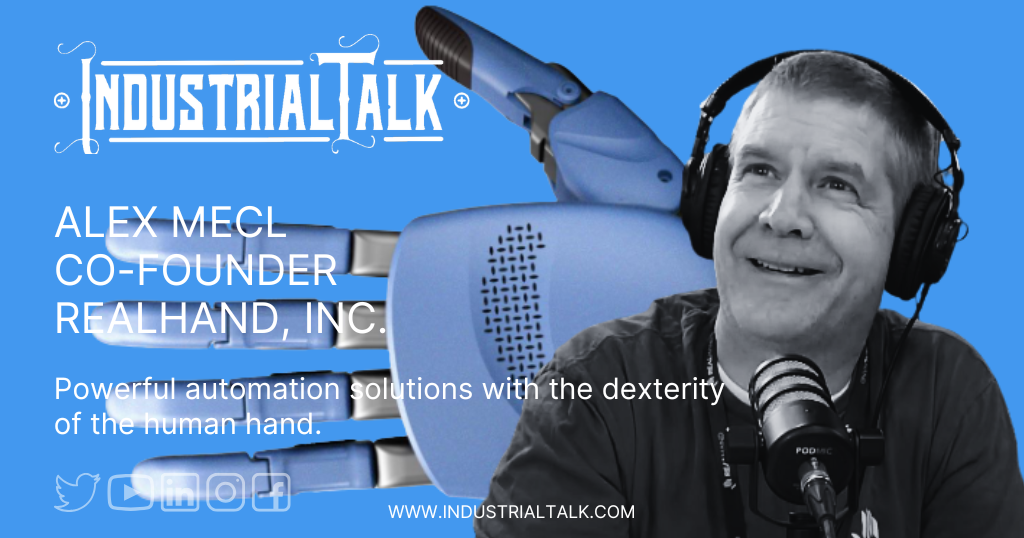
Industrial Talk is onsite at MD&M West and talking to Alex Mecl, Co-Founder Real Hand, Inc. about “Next level automation with hand dexterity”.
The conversation features Scott MacKenzie from the Industrial Talk podcast discussing the MDNM West event with Alex Mecl, CMO and co-founder of Real Hand. Real Hand offers robotic hands with human-like dexterity to solve the final 10% of automation tasks that require human interaction. They can mimic up to 21 degrees of freedom (DOF) and incorporate pressure and tactile sensors. A use case involves sorting plastic bags, which can be learned by the robotic hand in 3-6 months. The company aims to enhance physical intelligence in robots, potentially revolutionizing fields like sign language translation. Listeners are encouraged to connect with Alex Meckel on LinkedIn.
Action Items
- [ ] Visit the Real Hand booth at MD&M West to record an on-site Industrial Talk segment and take a photo if time allows.
- [ ] Publish Alex Meckel’s contact information on the Industrial Talk platform so listeners can reach out to him.
Outline
Introduction to Industrial Talk Podcast
- Scott introduces the episode of Industrial Talk, sponsored by MD&M West and the News and Brews team.
- Scott thanks the audience for their support and celebrates industry professionals for their boldness and innovation.
- The podcast aims to celebrate industry professionals worldwide, emphasizing their daily problem-solving and collaboration in manufacturing.
Introduction of Alex Mecl and Real Hand
- Scott introduces Alex Mecl, co-founder and CMO of Real Hand, a company focused on dexterity in automation.
- Alex Mecl explains the concept of Real Hand, which aims to provide human-like dexterity in automation processes.
- The company's tagline, “The Future of Dexterity,” is highlighted.
- Scott describes the booth at MD&M West, showcasing real hands moving, which attracted attention.
Feedback and Demonstrations at MD&M West
- Alex Mecl shares positive feedback from the MD&M West event, mentioning the piano demo that attracted many visitors.
- The tele-ops demo also received significant attention, highlighting the company's innovative solutions.
- Scott expresses interest in visiting the booth for an on-site demonstration.
- Alex Meckel discusses the importance of having real hands in the booth to attract attention and facilitate discussions.
Background and Market Opportunity
- Alex Mecl provides his background, including his experience in software integration and AI robotics.
- The company's focus on solving the remaining 10% of automation processes that require human dexterity is explained.
- The goal is to make production lines more efficient, safer, and collaborative by integrating human-like dexterity in robots.
- The company aims to replace or enhance human involvement in automated processes, not to replace humans entirely.
Technical Details and Applications
- Scott inquires about the technical aspects of integrating human-like dexterity in robots.
- Alex Mecl explains the concept of Degrees of Freedom (DOF) and how Real Hand's hands mimic human dexterity.
- The company's hands can range from DOF 11 to DOF 21, depending on the required dexterity.
- The importance of software solutions and algorithms to train robotic hands is emphasized.
Use Cases and Real-World Applications
- Alex Mecl provides a use case involving a company that produces medical bags and struggles with stacking and sorting them.
- The company's automated process can produce 6000 bags per hour, but manual sorting is required at the end.
- Real Hand's solution involves training the robotic hand to identify and sort the bags, potentially reducing the time required from three to six months.
- The company's hands incorporate pressure sensors and tactile sensors to mimic human dexterity.
Future of Physical Intelligence
- Alex Mecl discusses the concept of physical intelligence, where robotic hands are enhanced with additional sensors and software.
- The goal is to create a hand that can perform complex tasks, similar to how a mouse revolutionized computer interaction.
- Real Hand's future plans include integrating the hand with cameras and other sensors to achieve physical intelligence.
- An example of physical intelligence is provided, where a robot can translate sign language in real-time, benefiting the deaf community.
Conclusion and Contact Information
- Scott expresses amazement at the rapid advancements in robotics and automation.
- Alex Mecl provides his contact information, encouraging listeners to reach out on LinkedIn.
- The importance of attending events like MD&M West to stay updated with the latest innovations is emphasized.
- Scott wraps up the episode, encouraging listeners to connect with Alex Meckel and explore the possibilities of Real Hand.
If interested in being on the Industrial Talk show, simply contact us and let's have a quick conversation.
Finally, get your exclusive free access to the Industrial Academy and a series on “Why You Need To Podcast” for Greater Success in 2026. All links designed for keeping you current in this rapidly changing Industrial Market. Learn! Grow! Enjoy!
ALEX MECL'S CONTACT INFORMATION:
Personal LinkedIn: https://www.linkedin.com/in/alexmecl/
Company LinkedIn: https://www.linkedin.com/company/realhand-inc/
Company Website: https://www.realhand.com/
PODCAST VIDEO:
THE STRATEGIC REASON “WHY YOU NEED TO PODCAST”:
OTHER GREAT INDUSTRIAL RESOURCES:
NEOM: https://www.neom.com/en-us
Hexagon: https://hexagon.com/
Arduino: https://www.arduino.cc/
Fictiv: https://www.fictiv.com/
Hitachi Vantara: https://www.hitachivantara.com/en-us/home.html
Industrial Marketing Solutions: https://industrialtalk.com/industrial-marketing/
Industrial Academy: https://industrialtalk.com/industrial-academy/
Industrial Dojo: https://industrialtalk.com/industrial_dojo/
We the 15: https://www.wethe15.org/
YOUR INDUSTRIAL DIGITAL TOOLBOX:
LifterLMS: Get One Month Free for $1 – https://lifterlms.com/
Active Campaign: Active Campaign Link
Social Jukebox: https://www.socialjukebox.com/
Industrial Academy (One Month Free Access And One Free License For Future Industrial Leader):

Business Beatitude the Book
Do you desire a more joy-filled, deeply-enduring sense of accomplishment and success? Live your business the way you want to live with the BUSINESS BEATITUDES…The Bridge connecting sacrifice to success. YOU NEED THE BUSINESS BEATITUDES!
TAP INTO YOUR INDUSTRIAL SOUL, RESERVE YOUR COPY NOW! BE BOLD. BE BRAVE. DARE GREATLY AND CHANGE THE WORLD. GET THE BUSINESS BEATITUDES!
Reserve My Copy and My 25% Discount
Transcript
SUMMARY KEYWORDS
MD&M West, industrial innovation, automation, robotics, dexterity, Real Hand, AI integration, manufacturing, production efficiency, human-robot collaboration, physical intelligence, sign language translation, optical recognition, tactile sensors, software algorithms.
Hey, this episode of industrial talk is proudly brought to you by MD&M West and the incredible news and brews team. MD&M West delivered big medtech automation, packaging, plastics and design all came together under one roof, the innovation, the energy, the conversation, it was everything that makes this industry extraordinary. I was on the floor, capturing the stories, the breakthroughs and the leaders who are shaping the future. Thanks for tuning in and celebrating the people driving industrial innovation. Industrial talk powered by MD&M West and the news and brews team.
Welcome to the industrial talk podcast with Scott Mackenzie. Scott is a passionate industry professional dedicated to transferring cutting edge industry focused innovations and trends while highlighting the men and women who keep the world moving. So put on your hard hat, grab your work boots, and let's
go all right once again. Welcome to industrial talk. Thank you for your continued support of this platform, this number one industrial related podcast in the universe that celebrates industry professionals all around the world. You know it. I know it. You are bold, brave, you dare greatly, you innovate, you collaborate, you solve problems each and every day. And in the world of manufacturing, that is a big deal. That's why we celebrate you on industrial talk. That's why we're here at MD&M West, here in Anaheim, part of the news and brews crew. We're telling the
story of these incredible
Solutions, and I'm telling you right now, we got a good one, because I have no idea where I'm gonna go with this, but I'm gonna go and I'm gonna have this conversation. His name
is and she's, I should have asked
this in the beginning, Alex, how do you say your
last name? It's Alex Mecl.
Mecl, yeah, I got it. There you go. Alex Mecl, Real Hand is the company, and it's the future of dexterity. That's their tagline. I kind of like it. Let's get cracking. I like it. So here I am. I'm walking through the the hall, and I'm looking at all of these great solutions, and then I come across Real Hand. And you know what they have? You know they have at their booth, hands, Real Hands, moving hands. They look like hands. So it's pretty cool. You have a good show.
It's been fabulous. I mean, first time here, but I think we got the right crowd. Has it been good? Oh, it's been absolutely fabulous.
What's sort of been the well, you know, sort of feedback and all of the chirpiness go.
It's amazing. I mean, just our piano demo has like, I mean, yeah, see, right, I forgot about that. Yeah, it's right there in part shoot,
hey, I need to come by and do a little on site. I wish I had time. I've just been stuck in the salt mine, but if I did, I would do a real on site thing to take a picture. We might still be able to do that.
Okay, continue. Yeah, no, it's been amazing. I mean, just having, you know, you've got medical device companies, automation companies, focusing on real problems, and we've got the Real Hands to help them. So I think having this piano demo there, which I don't think anyone expected, you'd expect some music in the background, maybe in your booth, if that so, no, that demo has really attracted a lot of eyeballs, brought people in it to have a good discussion with us. So check mark there. The tele ops, I think is another big one that has really attracted a lot of attention.
Don't know, don't, don't.
Let's, let's get into Alex. Then we're going to talk about the solutions. Because I have a I have a few questions to ask, give us a little background on Alex, then we'll get into the Real Hands Absolutely.
So I'm the CMO of the company. I'm also a co founder. I've been in the tech industry, specifically software integration and solutions. More recently, obviously, with the AI and robotics boom, shifting some of that expertise over there, and this opportunity came along, and I saw the market, and it's been a fun ride ever since.
All right, we and that's great. That's Alex, all right. And here we have it. What was the problem that Real Hand is solving? What is it? What what you're saying? It's human.
Hey, it's, I mean, the name says it all.
If you look at an automation process right now, we've got about 90% that's fully automated in most production lines. It's the remaining, the final 10% that people are trying to solve, and that requires human dexterity. So until now, robotics, especially if you look at grippers and these robotic arm extensions, the piece that was missing was the dexterity like human like dexterity component that we're bringing to the table. And what that allows manufacturers to do is finally take this final 10% say, Okay, from that final 10% where we still need that human person interacting with a with an automated process. Is, how do we take either that robot to collaborate with that human, or eliminate the human all to being? And the reason for that is not that we're trying to replace humans. It's that we're trying to make the production line more efficient and safer, sometimes more collaborative, and our our hands can help solve that problem.
How do you get it?
And I'm not, I'm not asking for you to, you know, divulge any secret sauce. The industry, from a automation robotics perspective, is pretty you know, clampy robotic arm, you know, we get it. Here's the application, here's the servo, all of that good stuff. How do you take that particular component and then be able to apply the hand absolutely and go ahead and,
ollowing a manual one through:It's one on this side of the mic doesn't know what you just you just were gibberish, right?
So DOF like, it's just as simple as what we do with our hand. Like, you're flexing your hand, you're creating a fist, you're moving, you're pulling, you're pushing. These are all dexterous functions that we use in a daily life. We shake hands, we brush our teeth. Right now, automated processes can't do that because that requires a certain human like dexterity. Our hands have that dexterity. So I can go as low as a DOF 11, which is probably a third of your dexterity in your hand that's probably just moving up and down, maybe sideways, maybe a wrist movement once you start to layer it with 360, rotation on your finger, cup four, four join it, sort of process where you're bending fingers that that's the kind of skill that a robot needs to be able to complete difficult tasks. That's where we've we've landed as a robotics company. That's where the world is heading right now, and we can do it. So what's the gap? The gap now is we have the mechanics to do it. We have the process to do it. What's missing is the bridge, which is the software solution, the algorithms that can learn how to do that task. Because back to the Lego set. Why do we label those sets with different age groups, because the dexterity required to complete the set just requires a certain intelligence of a human and experience in using its hands. Similar for a robot, the challenge on a robot is, when you give, if I give you the hand right now, there's nothing you can do with it. You don't have a model that has trained anything. So if you have that great you can just take that extension, put it on your arm, and then start moving it. If you have the learning, the models, the LLM models, to train these hands, it can learn any process that a human can in a very short period of time. The benefit is, once you've trained it, you can now multiply that across as many manufacturing and automated lines that you want. So you really can go from one person to a million to a billion in the in in seconds, because that robot has already learned that task. That's the beauty of you know, dexterity and robotics combined
give give us a
use case, given, it's just like a real use case of where your solution is part of that end of the process, like, what was the problem? Why is the solution? And then explain to because we take it for granted. See, my hands are moving fast, whatever. It's just happening. And then I want to pick up this card. I pick up the card, and there's a speed. There's this, how do you incorporate that? That That's
exactly right. So speed is one you mentioned speed, yeah, the biggest problem in automation is, how quick can it do it? You have, yeah, yeah, exactly right. You have a you have a conveyor belt running down, and you want to pick up an apple that's coming to. On the conveyor belt. First of all, how do you recognize, if you have different fruits on the table, which one is the apple? So you have optical recognition. So first of all, you have to use your vision. Once you have the vision, the brain sends the message to your to your hand, and says, I got to pick it up. Now, do you use a full hand? All five fingers? Do you use two fingers? That's a decision we make based on our experience. A robot has to learn that, right? So what happens is, we look at that, and we, literally, in the lab, will sit down, and we'll have this conveyor belt going down with a bunch of fruit, bananas, you know, whatever. And then you have to figure out, okay, first it has to identify, then it has to be able to pick it up fairly quick, because that conveyor belt is moving quick, and you have other fruit around it. So you want to make sure you're picking up the banana, and now that that when you touch the banana, that it doesn't get squished, right? So there's even sensitivity to the fabric, or in this case, the material that you're going to be touching that you don't break it. So these are all components that these sensors that are built into the hands, just like a human has nerves and sensors inside our hands that tell us to do that, how to do that, the robot needs that as well. So our hands incorporate pressure sensors, tactical sensors, all these things that humans have in our nerve system are essentially mechanically input into these robotic hands, and it can do it. It's just a matter of training.
It. That's amazing. Again. What about a use case? So is that use case, the banana use case? Or what's a really thing? What's a use case for this? So I'll give
very basic problem. You have:interesting, yeah, that that blew my mind in the sense that I wouldn't even know where to begin, how to begin, to programmatically take that, that solution and be able to achieve the objectives laid out by the customer. The the
hand got the hand looks like this. It's a hand.
What about this part of the hand? The forearm, the right elbow.
The beauty, the beauty of the hand, is just like in our human hands and bodies. Yeah, you know, as you say, we sort of take the hand for granted. No, it is, and yet it's the most important I show like I always talk about, it's terrible to lose a limb, but when you really think about it, at the end of the day, the most important limb is probably your hands. If you lose your hands, your life, I mean, you're going to need an assistant. If you lose a leg, you can still get around wheelchairs. We have proceeds. There's other ways to overcome that handicap. Hands really shut you down in a big way. You can't eat, you can't drink, you can't brush your teeth, you can't comb your hair, you can't take a shower, you you can't do anything. You're literally an invalid. So that's why the dexterity problem, the hand problem, we call and there was a whole article in the Wall Street Journal about the hand problem in robotics. That is exactly when you come back to what problem are we trying to solve? We've. Solved it. But having said that, we've solved the mechanical part of the hand, means we have a hand that mimics a real human hand, what we're still needing to do is figure out the solutions on the software and application side to build models that identify and learn these process so we can plug them in quickly. Back to the plastic bag, example. We don't have a model for that right now, so I have to go in with my lab and really, for the next three to six months, test different models on how this hand is going to learn this task of separating a simple two bags from each other. And it sounds simple, but no, it's not in electronics. It's an it's a huge accomplishment.
Yeah, future hat. Tell us a little bit about the future. You've got your you've got today's product. You got the today's sort of value of Real Hand. What's that next thing that says this is what
we're really shooting for? Yeah, so, and that's what we call physical intelligence. Remember when you when I give you the hand, you don't know much about the hand, what you can do with it. You start to plug in software. All of a sudden, that hand, compared to a mouse and a computer, when the mouse showed up, it was a huge revolution, going from a keyboard to a mouse. Yeah, right. You just had this thing. You plugged it in, and all of a sudden this little cursor was moving around on your screen. That's huge. Hand is no different. The hand is an extension. Think of it as the mouse. So you've got this, this, this automation line. Now you've added the hand, but we want to add other things, like, remember, in the cat, in the PC, we added the camera right like we're talking on a podcast right now we have microphones, yep, so being able to pick up sound, visual, other sensors that we layer this hand with, because then this had hand becomes more and more physical, intelligent, which physical intelligence is required to really accomplish some of the more difficult tasks? And I'll give you an example, real world again, people who are deaf, they talk, they use their hands. So we've solved the hand. Well, I can, I can mimic any sign language with our hand. The problem is, there are over 150 different sign languages in the world, depending on where you're from, you'd need 150 people in this conference if you wanted to attend or help the accessibility market in just helping deaf people come to this show. Our robot, we would need one robot right standing right at the front of the registration, and that robot can, with his hands, literally make all the movement, because all the 150 languages are programmed in it. And it can pick up the sound from the human being speaking to the deaf person. Translates that motion through the hand into sign language so he can understand it. He signals back in language, and the optical camera of the robot picks it up and translates it through a voice recognition back to you to understand what he's actually saying. That is the future.
Wow, that's exciting.
That's pretty, pretty fast. It's happening fast.
It's happening lightning speed.
All right, Alex, how do people get a hold of you?
Easy. Come to go to LinkedIn. Alex Mecl, A, M, E, C, l, and you'll find me under Real Hand.
There it is, man, it's a cool logo, by the way, just a boy. Oh, I'm glad you like it.
It's my design. Is it really? Yeah, Real Hand.
It pretty much explains the nature of your business. That's right. I like it. Well, thank you very much. I appreciate you being on industrial This was awesome. All right, we're going to be having all the contact information for Alex on industrial talk, so if you're not, you got to reach out. This is mad technology. It's fantastic. I love what's happening here. See, if you're not here at MD&M West, you would not even be able to be a part of this conversation. You need to reach out to Alex, contact. All right, we're part of the news and Bruce group. We're here. We're telling the story because there are a lot of individuals that have incredible solutions to solve your problems, be here or be square if not, put it on your calendar. Brought to you by those wonderful people at informa. Check them out. All right, we're gonna wrap it up on the other side. Stay tuned. We will
be right back. You're listening to the industrial talk Podcast Network. You it.
So you can tell we were at MD and M West, part of the news and brews crew. And you're walking around, you're part of this event and massive just FYI you need, if you're in the world of manufacturing, you need to be there. You just, it's an Anaheim. It's just one shiny object after another. And one of the shiny objects that really caught everybody's attention is, of course, Real Hand. So I had to have Alex on, yeah, walking by his booth. Now, you got these hands. Got the, you got to play in a piano. Yeah, Real Hands. It's in the name. And it's really pretty cool industry manufacturing as a whole, exciting. And you just, you just got to give it to a man. It's. Just inspiring, all of the stuff, the all of that, the the amazing thinking that is going on. It's phenomenal. So put MD&M on your calendar. You get to meet people like Alex. Hey. He was great. All His contact information is out on industrial talk as it should be. And yes, you need to reach out to him. It is a must. All right, industrial talk is here for you. You need to tell your story. You need to bring that human face to your company. That's you. I'm talking to you and and all you have to do is go out to industrial talk. Click, connect with me. Let's make it happen. You can be like Alex famous, Real Hands. But anyway, that's what industrial talk is all about. We are passionate about your success, and you need to succeed because we depend on you, and that means you need to tell that story, you need to amplify your message. You need to gain that attention. It's it's a story that's been told a ton of times, but industrial talk is here for you. Go out there. Let's connect. Let's have a conversation. All right, be bold, be brave. You're greatly I say it all the time. Hang out with Alex. You will be changing the world because it's Real Hands. All right. We're going to have another great
conversation shortly. So stay tuned.