Justin Semas with Arrow Engine and Compression Company
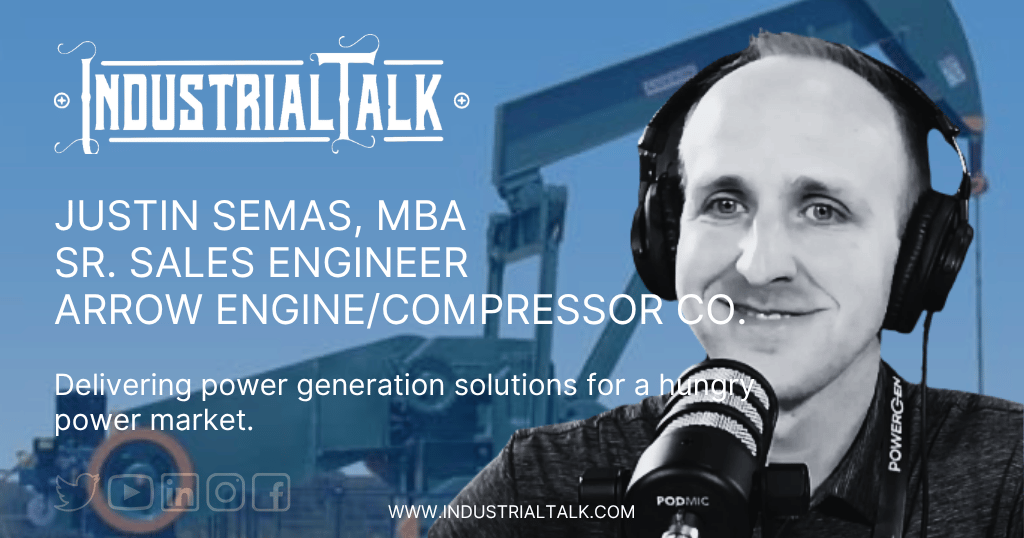
Industrial Talk is onsite at PowerGen and talking to Justin Semas, Senior Sales Engineering with Arrow Engine and Compression Company about “Market Power Demand”.
Overview
Justin Semas from Arrow Engine Company discussed their recent acquisition by IES, a holding company focusing on power generation and infrastructure. Arrow aims to expand its offerings from 10 kW to 1 MW natural gas and propane engines for both prime and standby power. They emphasize multi-fuel capabilities, including propane in vapor and liquid forms, and natural gas. Arrow's engines are known for their durability, with a 12-year unlimited hour warranty for prime use. They also highlighted their vendor network for maintenance and support. The company targets both large-scale data centers and remote locations with small power nodes.
Outline
Introduction and Welcome to Industrial Talk
- Scott welcomes listeners to the Industrial Talk podcast, celebrating industry professionals and their contributions.
- The podcast is broadcasting live from PowerGen in San Antonio, Texas, focusing on power generation.
- Scott introduces Justin Semas from Aero Engine Company, noting his previous appearances on the podcast.
Justin Semas's Background and Role at Arrow
- Justin Semas shares his background, mentioning his transition from applications engineering to sales at Arrow.
- Justin explains his current focus on sales and understanding the market better.
- Scott and Justin discuss the involvement of the Propane Council and other sponsors of Industrial Talk.
- Justin provides an overview of Arrow's recent acquisition by IES, a holding company with significant capital investment.
Arrow's Growth and Market Focus
- Justin outlines Arrow's growth strategy, aiming to offer natural gas and propane engines from 10 kW to 1 MW.
- The company plans to target both prime and standby power generation markets.
- Justin emphasizes the importance of data centers and the need for reliable power sources in remote locations.
- Arrow's multi-fuel engine capabilities, including propane, natural gas, and biofuel, are highlighted.
Engine Manufacturing and Warranty Policies
- Justin discusses Arrow's manufacturing processes, including custom-engineered applications and stock engines.
- The company offers a 12-year unlimited hour warranty for prime use engines and extended warranties for EPA-compliant equipment.
- Justin explains the maintenance intervals and the role of vendors in providing on-ground support.
- Arrow's warranty policy includes major overhauls at specific hour intervals, ensuring long-term reliability.
Future Outlook and Market Trends
- Justin predicts a future divide in the power market, with a focus on high-horsepower and small-kw ranges.
- The conversation touches on the challenges of managing power demand in remote locations.
- Justin highlights the importance of having durable, low-maintenance engines for remote applications.
- The discussion concludes with Justin providing contact information for listeners interested in Arrow's products and services.
If interested in being on the Industrial Talk show, simply contact us and let's have a quick conversation.
Finally, get your exclusive free access to the Industrial Academy and a series on “Why You Need To Podcast” for Greater Success in 2026. All links designed for keeping you current in this rapidly changing Industrial Market. Learn! Grow! Enjoy!
JUSTIN SEMAS' CONTACT INFORMATION:
Personal LinkedIn: https://www.linkedin.com/in/justin-semas-mba-1bb0b2a3/
Company LinkedIn: https://www.linkedin.com/company/arrow-engine-company/
Company Website: http://www.arrowengine.com/
PODCAST VIDEO:
THE STRATEGIC REASON “WHY YOU NEED TO PODCAST”:
OTHER GREAT INDUSTRIAL RESOURCES:
NEOM: https://www.neom.com/en-us
Hexagon: https://hexagon.com/
Arduino: https://www.arduino.cc/
Fictiv: https://www.fictiv.com/
Hitachi Vantara: https://www.hitachivantara.com/en-us/home.html
Industrial Marketing Solutions: https://industrialtalk.com/industrial-marketing/
Industrial Academy: https://industrialtalk.com/industrial-academy/
Industrial Dojo: https://industrialtalk.com/industrial_dojo/
We the 15: https://www.wethe15.org/
YOUR INDUSTRIAL DIGITAL TOOLBOX:
LifterLMS: Get One Month Free for $1 – https://lifterlms.com/
Active Campaign: Active Campaign Link
Social Jukebox: https://www.socialjukebox.com/
Industrial Academy (One Month Free Access And One Free License For Future Industrial Leader):

Business Beatitude the Book

Do you desire a more joy-filled, deeply-enduring sense of accomplishment and success? Live your business the way you want to live with the BUSINESS BEATITUDES…The Bridge connecting sacrifice to success. YOU NEED THE BUSINESS BEATITUDES!
TAP INTO YOUR INDUSTRIAL SOUL, RESERVE YOUR COPY NOW! BE BOLD. BE BRAVE. DARE GREATLY AND CHANGE THE WORLD. GET THE BUSINESS BEATITUDES!
Reserve My Copy and My 25% Discount
Transcript
SUMMARY KEYWORDS
Industrial Talk, Power Gen, Justin Semas, Arrow Engine, propane engines, natural gas, prime power, standby power, data centers, energy demand, multi-fuel, asset management, warranty policy, remote locations, power generation.
Scott, welcome to the Industrial Talk podcast with Scott Mackenzie. Scott is a passionate industry professional dedicated to transferring cutting-edge, industry-focused innovations and trends, while highlighting the men and women who keep the world moving. So, put on your hard hat, grab your work boots and let's go.
All right, once again, welcome to Industrial Talk. Thank you very much for joining and your continued support of this platform that celebrates industry professionals all around the world. Because you're bold, you're brave, you dare greatly, you innovate, you collaborate, you're solving today's problems each and every day. That's why we celebrate you on this podcast. We are broadcasting on site Power Gen San Antonio, Texas, and it is a collection of, well, a lot of people that have a lot of engines in there just generating power, because that is the topic of conversation. In the hot seat, we have a gentleman by the name of Justin Semas. He's been in the show before, he never disappoints Aero Engine company, right? Arrow engine, engine company. Let's get cracking. How are you? It's good to see you. It's good to see you know what's.. you know, it's interesting. I always get it's.. it's one of those things where you know, hey, there's a face. I know that face. I don't know.. I can't remember the name of the face, but I know face
faces remember them forever, names not so much,
negative, negative, but it was great to see you, man, you know, let me, I have to do this because, because I'm obligated, do you know who's sponsoring Industrial Talk?
No, I do not, this year,
Propane,
Propane council, the propane council is doing
that. You know who else is. We've got a company out here, we got some swag out here, IRISS, as well as Elevotec. This is a lot of companies that are sponsoring industrial talks. You know why?
Why is that?
Because they, they like industrial talk. I
love it, dude.
It's not much, all right. Let's level set a little bit. Let's get a little idea on who Justin is, just sort of make sure that we understand. And then we're going to dive into Arrow, and what, what, what's the latest and greatest happening with your company? Yeah, absolutely.
Background, so background for me, you know, been at Arrow for quite a while now. I was previously applications, you know, engineering role, and now I've moved a little bit more towards sales. Still do a lot of the engineering functionality, but focusing now more on sales, driving what we're doing, going more towards sales, so we can understand the market better, know what we're doing, and know what we're developing.
So you guys are always hanging with the propane council folks, and so clearly you could use propane in your solutions.
Absolutely, absolutely.
So, what is on sort of the radar with Arrow? What's what's what's the topic? What's the stuff that's bubbling?
I think the big thing, and the big news for Arrow now is that within this last year we have been acquired, so we have been.. I didn't
get the email.
Oh no. Well, I'll put you on it. No, we.. we have been acquired by IES, which is a holding company.
What does that mean? Well, you look like it was just sort of a.. what is it? A company that's just sort of hanging out in a parking lot that's just sort of, so they've been, they've
been great. They have an infrastructure division, which we're now a part of. They have great capital behind them. They have invested a tremendous amount of capital on us, and they have enticed us to grow. And so that is 100% what we're going after, is growing what we
do, so for clarification, ies, what has there been sort of core business?
The IES infrastructure has a couple different segments within it. Yeah, the big one is, you know, power generation market. As far as large scale data center stuff, they also have a home division, and then they have like circuit board, switchboard, switch gear, that kind of stuff as well, all segmented out.
See that, then, of course, Arrow fits right into that.
It
makes sense.
Yeah, we fit, we fit into a little bit of their niche, and so we're, we're excited to be here.
So, what does that mean? What does growth mean? I think, like, what, what is that? Our
growth, and what we're focused on is we want to have an offering of natural gas and propane engines from say 10 kw or 10 kilowatts all the way up to one megawatt and up, and we want that to be not only standby but prime as well. Arrow has always cut its teeth in prime power generation, and so we want to go prime in that node, and then we also want to do that in standby as well. Right now, we're not all the way there, but that's what our growth looks like. Is it
because this is a leading question, because. Apparently it's happening out there. Data centers, is that what's driving us? Is that what is creating the interest to be able to sort of, I think, on the what else
I think on the big end, data centers, obviously humongous topic. Data centers may be on the later end of our focus. I know on the bigger end, that's obviously going to be one of the prime places, but as far as one megawatt is concerned, I think that's still on the small end of data center stuff. We have some ideas of how we're going to go to market with that. We have some things I can't really talk about, but what we're targeting to do with data center stuff. But I think right now it's the big one is prime power for places that the grid has not caught up to, or is not going to catch up to, for the foreseeable feature, or the grid won't be able to keep up with that
paint. Paint a picture of what that looks like. What do you mean by the grid now? I understand, don't get me wrong, you go to the other sister conference, yeah, focuses on power generation, no, no, distribute tech, which is the sister, and of course the conversation is always around grid dealing with that. Oh yeah, how do you, how do you manage the power that wants to hammer on that grid? You name it, it happens.
Yeah, I mean, and I think we see this even more so in commonplace conversations now, of can the grid keep up, keep up with the data set exactly, can centers that are coming, can can we do it? No, so we know the grid is going to be limited, and we know that we have more and more and more power requirements, whether it be oil field, whether it be construction, whatever that may be, it's going to continue to grow, and if the grid can't keep up with that, somebody has to provide the power, and that's what we hope to do.
See, that's that's good. That now you painted a really interesting picture, because there's a lot of people here at this event talking about data centers, focusing on data centers. Don't get me wrong, that's happening, going to happen, but then that leaves that whole sort of gap that exists within the the energy demand market that needs it, and if I'm if I'm truly focused on on developing more energy sources, oil and you know natural gas, whatever, whatever it is, yeah, I'll need more power,
absolutely. And I think a big thing for us is having all of that range, so that way we're not - we don't want to exclude anybody, you know. And I'm not saying that to try and play nice, but we don't want to exclude everybody who needs power for all those ranges. We can't - we can't just not sell engines for telecom business. It's maybe 10 kw. We don't want to focus on one segment, we want to focus on all of it. And that's what we're hoping to do. From growth is
the solution multi fuel. It's not just propane, it's.. it can be natural gas. It could be
that's a big thing for us, is doing biofuel, or we'll call it trifuel. It's still going to be propane, but it's propane on two different accounts, so you can have vapor or liquid, and then natural gas, all running on the same engine. And then, when we need to switch over, we don't even have to turn the engine off, we don't have to unload the engine, we can do it on the fly while it's running under load.
That's pretty cool,
so it's kind of the same concept of what's in your car. Your car does not get told, "Hey, I put 87 in here. Oh, hey, Scott decided to go good today. We're going to run 91
Yeah,
you don't tell your car any of that. It understands what's doing from a closed loop system of all the sensors that are in that car. We're doing the same thing with our engines, so if we go through and we have it set up to where we can have an algorithm going on that you know we know what the BTU fuel content is, or the BTU content and fuel is coming out of the ground, coming out of the pipeline, whatever it is, the engine will run meet EPA regulations based on whatever that BTU content is, and then we can go ahead and we can switch over with the flip of the switch, or with a control board, or with a controller to run on propane, and it just flips solenoid valves and runs on the alternate fuel, or secondary alternate fuel, and we can set that up to run directly on the engine package.
So, how quickly is it? Are you capable of connecting, like, let's say, hey, I'm going to aero, I need a certain, you know, amount of size, whatever it might be, and how long can I'm an oil field, yeah, whatever, there it is, how quick,
um, you can call the 800 number and somebody's going to answer, yeah,
but then I want to connect it, yeah. How quick?
Oh, actually, connect an engine, yeah. We're pretty short lead time right now. If it's within the power nodes that we have out there in the market, I mean, I have stock,
no kidding.
Yeah, we build engines to stock, so
that just brings out another. So, are you guys vertically integrated when it comes to manual? Manufacturing your engines, sort of, how do you manufacture? We
go to market a lot of different ways, so we have, we'll say, some custom-engineered applications. So we have customers that come in and they want the whole kit and caboodle, you know, we want every option under the sun to put on that engine, and then we have again stock engines. When I look out my office window every day, we are rotating through stock equipment, and some of that stock is, we'll say, tailor-made to certain applications. Some of it is just cut and dry blank slate that we can bring back in, and we can accessorize if a customer is requesting it and they need it now.
So, if I was a customer, I approach Arrow, I snag one of your solutions. Great, from a, from a longevity, how does it, how does that work? Can I, can I just say, hey, this one's sort of weak, a little bit, I don't know. Can I get another one?
Yeah, so we have a very interesting warranty policy. Yeah,
there you go. So you cut right to the chase. I was sitting there being old.
me use, so that is, you know,:Yeah,
ot going to be able to get to:From a maintenance perspective, does does Arrow also provide that, where you know, boots on the ground, maintain it, you know, do what is necessary to keep that thing running. Run,
Arrow is not going to be servicing that. What we do is we have vendors, so Arrow has, you know a tremendous amount of vendors that we may send people to, if you're just going to buy one or two,
yeah. And
then that vendor will then have people with boots on the ground, you know. We have, I can't remember how many, but I think it's almost 500 and some vendors across the country. Ah, so if you call and you say, 'Hey, I need somebody in this region, we're probably going to be able to send somebody out to you to get you fixed up, the service interval on that is another thing we don't go by. If you called the 800 number, for instance, and you said, "Hey, what's the service interval on our 100 kw engine? We tell you it's one month. I don't, we don't give hours because we're so used and ingrain to that prime use, that yeah, somebody needs to go check on that engine once a month, and that's it, you know. We'll say it's 750 hours, but if you call the 800 number, they'll say, yeah, every month somebody needs to go make a big loop, go drive by that engine, make sure it's still running, you know, change of oil, check everything, kick it back on, yeah,
because there's that whole conversation around asset management, the reliability of that asset, doing it properly, keeping it up and running. Is it a critical asset? Do we need to have, you know, we can't, we can't. If I need to, does your organization allow me to say, hey, we've got, we've got a challenge with our existing asset out on that wherever it's out there, I can, you can say, hey, let's, let's swap it out,
we have done stuff like that in the past, some of our, we'll say our vendors really take that to heart, and so we have vendors, or sorry, distributors that we work with, not vendors, we have distributors that we work with, and they will have their own fleet of arrows, and so they will do that rotation within themselves, and so they'll even have like lease units, we have some prototype stuff that we put out like that, and then we've had some consignment stuff that we do like that as well, but some of our, some of our customers are just great, and they will have their own mini fleet to take care of their customers, and then you know, in turn, we take care of them.
You know what I'm trying to do, trying to poke holes, yeah, I don't. No, I'm trying to find that challenge, that yeah, arrow, but I'm having a hard time. Where do you see it going with all, with all the stuff going on? What put your future hat on? Yeah, with everything going on, where do you see it going?
I think our future is there will be a big divide. I think you're going to have a lot in the big, big horsepower range or big kw range, and I think you're gonna have a lot in the small kw range. I could see a future where there is, you know, this humongous hole in the middle, not for lack of nobody to produce it, just because there's not that need there. That's what I see.
See, that's interesting, because I view the market the same way, and maybe it's just me, but there's always, as you walk the floor, there's always big, the big gargantuans once, and it gets bigger every, and you know that they're sucking the, they're just, they're taking all that energy, and they're just bringing it in, and they're big. What do you suppose? But then there's the segment of the market that is, well, let's say small to mid, who needs some sort of ability to be nimble. And then I have a specific requirement, I don't need a big old thing, I need something that works for me.
Yeah, and we have engines that, you know, I have a couple distributors that we're working with actively, and they have needs for seven kw prime, and it's going to be a very remote location. Yeah, and so you can't put, you know, we'll say an air cooled, you went to the big box store and you bought a seven kw generator, you can't go put that out there and go access it every three days, because it's not viable to do with that kind of asset, and you can't afford to necessarily just rotate through one every one month or two months, because that's usually their life cycle, and so that's what we're targeting, is having that small power node with that same durability, the same cycle of maintenance and all that the Arrow is known for in even small packages, so that way they can be out in those remote locations.
Okay, let's wrap it up.
Yeah,
how do people get a hold of you? Well, why? And you know, of course, he's already out there on industrial talk, so all the contact information for Justin is out there, but we want to hear how he can, we can get a hold of it. Yeah,
the if you search Arrow Engine on the Google machine, that'll take you right,
or that AI. Yeah, do you just go to AI?
I don't go to AI, but I'm sure you probably could. The 800 number that's on there, if you want to call the 800 number, you'll get put to sales, say I want to talk to Justin, and we'll get you fixed up,
but you're out on LinkedIn.
I am out on LinkedIn. I am Justin Simus on LinkedIn. You can find me there. Yeah,
well, you're gonna have all that contact information. You are great. You're always great.
Thank you. It's great to be back.
So great to see you. You're, you're, you're fun. All right. Hey, what do you call home?
Tulsa, Oklahoma.
Okay, I just wanted to know, and I wanted everybody else to know where he calls home. All right, thank you very much again. All right, we're wrapping up on the other side. We're going to sort of just make sure that you have all the contact information for Justin. Now, on Industrial Talk, so fear not, reach out to him, he knows what he's talking about. He's, he's sage in generation.
Yeah,
that was sort of a stretch. Once again, we're broadcasting from Power Gen here in San Antonio, Texas. You get great people like Justin and others who are talking about really solving problems in the energy industry. Stay tuned, we will be right back.
You're listening to the Industrial Talk Podcast Network.
Yeah, PowerGen never ever ever disappoints. Love the conversations happening at Power Gen, Justice Simas. He's one of those individuals that are wandering the floor, and you know, adding insights and just wisdom to what's taking place. That is a must connect. As I point to Stat Card right there off to the right, if you're looking at me on the video. Yeah, it's an amazing aero engine and compression company. Yep, got that right. Yeah, the power industry is just bubbling with activity. It is an amazing time if you're not in the world of power generation utilities. I'm telling you, man, it's a great industry to be involved in. Connect with Justin, you will not be disappointed. We're going to have a lot of conversations coming from Power Gen. We've been having a lot. We just got a, we got a backlog. Everybody wanted to tell their story. Data centers right at the center of all of the conversations. We need power. We want to live this whole AI data analytics world and connected assets and all of that stuff. We need power. Yeah, it's just that simple. How do we do it? Yeah, Dr. Justin, he knows, he knows how to do it right. Industrial talk again. Here's what we do. This is industrial talk. We're a media company, you know that, because you're listening to it too. We're a marketing company, you know that, because well, we do it, and we're all centered around industry, power generation, manufacturing, oil and gas, asset management, technology. We're all centered around that, and we want you to succeed. We do, and we know how to amplify that message, and you need to tell your story. Don't just depend on AI. I did, but I mean it was more just writing an email, and then I realized that, well, that's not good for me. So I write my own email, so.. but anyway, you need to tell your story, and you need to make that a commitment, a strategic commitment. You always have to be able to sort of inspire that next generation. They're always going to be looking.. all of the platforms are available, you need to be doing that. Yes, you need to be focused on your technology, on your solutions, on how you're making people succeed. That comes through being able to message, go out to industrial talk, tell your story. We can help you succeed. All right, be bold, be brave. Derek greatly, hang out with Justin, and you will be changing the world. We have another great conversation shortly, and swell, and we're going to stay tuned.