Bruce Chaplin with Octave
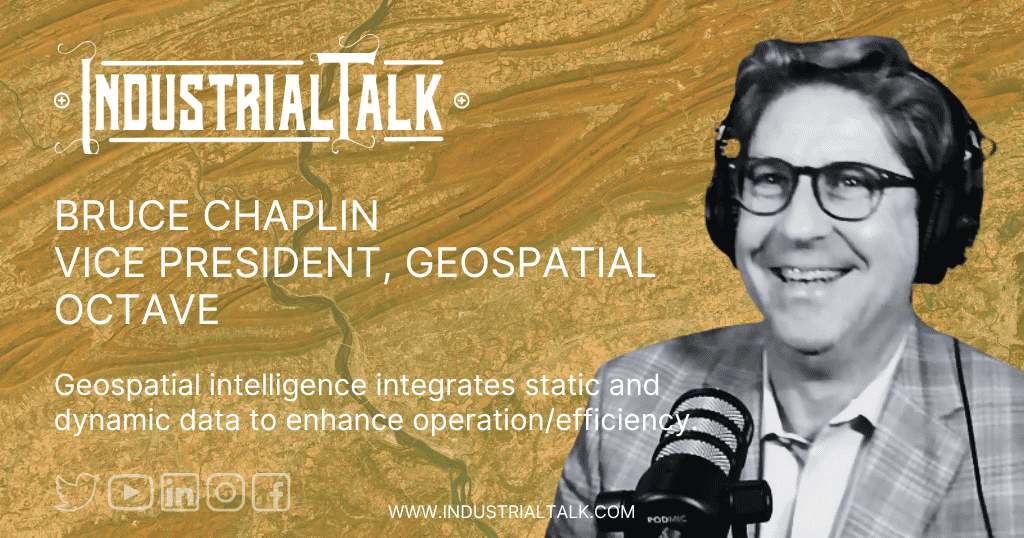
Industrial Talk is onsite at Octave Live and talking to Bruce Chaplin, Vice President, Geospatial at Octave about “Operational efficiency through geospatial intelligence.
The conversation highlights the importance of the Barcelona Cybersecurity Congress from November 3-5, 2023, and the Industrial Talk podcast with Scott Mackenzie. Bruce Chaplin, a 26-year veteran at Hexagon, discusses the evolution of geospatial technology, emphasizing its applications in industrial settings. He explains how geospatial intelligence integrates static and dynamic data to enhance operations, safety, and efficiency. Chaplin also touches on the use of lidar, 3D scans, and digital twins for real-time monitoring and decision-making. He encourages companies to start small with targeted geospatial solutions to address specific business problems.
Outline
Barcelona Cybersecurity Congress Announcement
- Scott introduces the Barcelona Cybersecurity Congress, emphasizing its importance for cybersecurity.
- The event is scheduled for November 3-5 in Barcelona, with a strong team from Farah organizing it.
- Scott highlights the opportunity to network with top cybersecurity professionals from around the world.
- Industrial Talk will be broadcasting live from the event, and Speaker 1 will be there to discuss cybersecurity with experts.
Introduction to Industrial Talk Podcast
- Scott is described as a passionate industry professional focused on transferring innovations and trends.
- The podcast aims to celebrate industry professionals who solve problems, innovate, and collaborate.
- Scott thanks listeners for their support and introduces the first Octave Live event in Austin, Texas.
Introduction of Bruce Chaplin and Octave Live
- Scott introduces Bruce Chaplin, a key figure at Octave, and mentions the importance of the Octave Live event.
- Bruce shares his positive experience at the conference, emphasizing new connections and the opportunity to tell the Octave story.
- Bruce provides a brief background on his 26-year tenure with Hexagon and his current role in sales for the geospatial business in North America.
- Speaker 1 and Bruce discuss the significant changes in technology and the reach of geospatial applications over the years.
Geospatial Technology in Industrial Settings
- Bruce explains how geospatial technology can be applied in industrial settings, from mapping to monitoring construction projects.
- He highlights the importance of geospatial technology in operating facilities and transportation, including asset tracking and perimeter security.
- Bruce describes the dynamic nature of geospatial intelligence, which combines static and dynamic data to provide real-time insights.
- Scott and Bruce discuss the potential for geospatial technology to enhance operational efficiency and safety in industrial facilities.
Use Cases and Deployment of Geospatial Solutions
- Bruce provides examples of how geospatial solutions can be deployed in specific industrial problems, such as managing contractors and optimizing maintenance procedures.
- He explains the importance of context-dependent solutions, tailored to different industries like defense and transportation.
- Bruce discusses the role of data analysis in geospatial solutions, including the use of lidar and other sensors to create digital twins and simulate outcomes.
- Speaker 1 and Bruce explore the potential for geospatial technology to enhance worker safety and efficiency in industrial settings.
Future of Geospatial Technology
- Bruce predicts that geospatial technology will become more integrated into various business solutions, moving beyond specialized applications.
- He emphasizes the importance of contextualizing data to provide actionable insights and improve decision-making.
- Speaker 1 and Bruce discuss the potential for geospatial technology to drive innovation and enhance operational efficiency in industry.
- Bruce shares his contact information and encourages listeners to reach out to him on LinkedIn for further discussions.
Conclusion and Call to Action
- Scott wraps up the conversation, highlighting the importance of connecting with industry professionals and telling their stories.
- He encourages listeners to visit the Industrial Talk website to connect with Bruce and other industry experts.
- Scott emphasizes the value of sharing information and building relationships within the industry to drive success.
- The podcast concludes with a reminder of the importance of innovation, collaboration, and storytelling in the industrial sector.
If interested in being on the Industrial Talk show, simply contact us and let's have a quick conversation.
Finally, get your exclusive free access to the Industrial Academy and a series on “Why You Need To Podcast” for Greater Success in 2026. All links designed for keeping you current in this rapidly changing Industrial Market. Learn! Grow! Enjoy!
BRUCE CHAPLIN'S CONTACT INFORMATION:
Personal LinkedIn: https://www.linkedin.com/in/bruceachaplin/
Company LinkedIn: https://www.linkedin.com/company/octaveintelligence/
Company Website: https://www.octave.com/
PODCAST VIDEO:
THE STRATEGIC REASON “WHY YOU NEED TO PODCAST”:
OTHER GREAT INDUSTRIAL RESOURCES:
NEOM: https://www.neom.com/en-us
Hexagon: https://hexagon.com/
Arduino: https://www.arduino.cc/
Fictiv: https://www.fictiv.com/
Hitachi Vantara: https://www.hitachivantara.com/en-us/home.html
Industrial Marketing Solutions: https://industrialtalk.com/industrial-marketing/
Industrial Academy: https://industrialtalk.com/industrial-academy/
Industrial Dojo: https://industrialtalk.com/industrial_dojo/
We the 15: https://www.wethe15.org/
YOUR INDUSTRIAL DIGITAL TOOLBOX:
LifterLMS: Get One Month Free for $1 – https://lifterlms.com/
Active Campaign: Active Campaign Link
Social Jukebox: https://www.socialjukebox.com/
Industrial Academy (One Month Free Access And One Free License For Future Industrial Leader):

Business Beatitude the Book
Do you desire a more joy-filled, deeply-enduring sense of accomplishment and success? Live your business the way you want to live with the BUSINESS BEATITUDES…The Bridge connecting sacrifice to success. YOU NEED THE BUSINESS BEATITUDES!
TAP INTO YOUR INDUSTRIAL SOUL, RESERVE YOUR COPY NOW! BE BOLD. BE BRAVE. DARE GREATLY AND CHANGE THE WORLD. GET THE BUSINESS BEATITUDES!
Reserve My Copy and My 25% Discount
Transcript
SUMMARY KEYWORDS
Barcelona Cybersecurity Congress, industrial innovation, geospatial technology, Octave Live, Bruce Chaplin, Hexagon, geospatial intelligence, lidar, 3D scans, industrial facilities, asset tracking, digital twin, passenger experience, security queues.
All right. Before we get into the conversation, I want you to be aware of a conference that you need to put on your calendar, and you have time. It is the Barcelona Cybersecurity Congress. It is necessary. You need to up your cybersecurity game. You're connected. You need to make sure that you're protected right here. This event, Barcelona Cybersecurity Congress. It is November 3 through the fifth. You have time, November 3 through the fifth this year in Barcelona. And I'm telling you right now, the team at Farah who put this particular Congress on the best. You will not be disappointed, and you know what else you get to do? You get to network with some of the best cybersecurity professionals from around the world. You need to do this. You need to put this one on your calendar. All of the contact, all of the information is out on Industrial Talk. I'm going to be there. I'm going to be broadcasting. I'm going to be talking cybersecurity with the best in the world. So be there. Put this one on your calendar. That is November 3 through the fifth. I'll see you there.
Welcome to the Industrial Talk podcast with Scott Mackenzie. Scott is a passionate industry professional dedicated to transferring cutting-edge, industry-focused innovations and trends while highlighting the men and women who keep the world moving. So put on your hard hat, grab your work boots, and let's go!
Naro, once again, welcome to Industrial Talk. Thank you again for your continued support of the number one industrial-related podcast in the universe that celebrates you, industry professionals all around the world. You're bold, brave. You dare greatly. You innovate. You collaborate. You're solving problems each and every day, and that's why we celebrate you. You are changing the world all the time. You're the heroes in this story. All right, we're broadcasting from Austin, Texas, Octave Live, the very first Octave Live, right now you're experiencing it. I'm right outside of the Octave Showcase, and as I look in there and I say, "Oh, the bad technology, all the solutions, it's an amazing time, and I mean, it's an amazing time. You know why? Outside of all of the technology that gets to be talked about here, and all of the solutions, you get to talk to great people. I have one in the hot seat, Bruce Chaplin. Did I
get that right? You did. Absolutely. Octav. We're going to be talking about well, Octave. Why not? All right, let's get cracking. All right, there you go, Bruce. Right off the bat, has it been a good conference for you? It's been a great conference. Yeah, yeah. First one with Octave, and yeah, numero uno. Exactly, and so just a lot of new connections. Obviously, being able to tell the Octave story through these different forums. Yeah, but also just connecting with people that I may have known their name, right? But now starting to meet in person is all the kind of the the building of weird come together. Yeah, like hey, I
know the name. I've seen you. Look at that. I've seen you. I've seen you on your LinkedIn post. You're standing next to a waterfall. You look different. Right. But give us a little 411 on who Bruce is.
All right. Currently with Octave, I've been now coming on. I think 26 years with us call it the Hexagon family of. Shut up! Seriously. Whoa.
That's pretty impressive.
Currently leads sales for our geospatial business in North America.
Yeah, your your your resume just go. It's yeah, you you've been here.
I've been here a while. Number of different roles. Kind of came up through an engineering background, engineering. Then it's a product. Then it's a kind of business development, and now part of the sales organization.
So, with all that said, you you've must have seen. I mean, the changes that have taken place, especially in the world of Hexagon, where you where you were and where it is now. I mean, it's it's pretty remarkable. I mean, upon you reflect upon your career. I just can only imagine.
Yeah, massive change in the technology. Obviously, yes. I think the reach of the technology, right? When I got into the industry, it was very, very, I'll say, specialized. Yeah. Right. So, geospatial back in the day was really, I mean, surveying, and it was, and now you look at the reach of geospatial. Right, you've got consumer-based apps, Google Maps, you know, Uber. It's basically a geospatial application, you know, for ride-sharing. So as you as the as the industry has progressed, just the reach of the technology across sectors. More and more consumer awareness, right, of spatial problems and and that sort of thing has been really interesting.
Give me a use case on how geospatial technology would be applied in an industrial setting.
So you probably have a few a few levels, right? Foundational level, you can think about just mapping. You know, again, back in the day, probably you started with just 2D maps. These days, you've got much richer information available through satellite imagery, through what we call reality capture, right? Lidar, 3D scans of the environment, right? All of that can be sort of input into into the planning process, and then you know as you go through kind of the build monitoring monitoring the build, getting more insight into progression of a major construction project, for example, geospatial can be applied right throughout that part of the life cycle. I think as you get into kind of operating a facility, operating transportation right location is is paramount. Knowing where your assets are, knowing where maybe people are in relation to those assets, and then you know the final, if we think about Octave, the final sort of pillar that we talk about is the protection, and you know that's also moving from if you think historically video management, right, you could sort of visually see what's going on. We're now bringing, I'll say, geospatial 3D capability through lidar and things like this into the perimeter security. For example, different sensors, and now you can get a much stronger view, much more accurate view of what's going on, maybe in an area of interest.
That that that image, that capability. It's not static. It's dynamic. What?
Yes.
It's dynamic.
Yes.
So, let me lay this scenario out. I have a processing facility.
Okay.
Pumps, motors, stuff on the floor, doing whatever they do.
Yep,
it's all around. I would think it would be beneficial for me to be able to sit in my cube and be able to accurately look at that facility from that perspective.
100% 100% Is
that what we're talking about? I'll suggest make it richer for me. Okay,
so if we think about an industrial facility, right? So, on one hand, having the ability to monitor my equipment, right through. I
can see it. I can hear it. I well, you're ready. I can. I got that stuff.
And I've got readings coming in. Yeah. Maybe I'll have my control center. I can sort of monitor the plant. Right. There are times probably where I need to send people or equipment out into the plant. Being able to know precisely where people are, right, at all times. How to navigate. Let's say I need to bring in heavy equipment, right, for a maintenance procedure or construction, knowing the exact route to get from A to B, accounting for constraints in equipment. The sorry, the words escaping me. The just the environment, right? How to navigate the environment. So a routing problem, but taken into account the constraints of of the of the facility is a geospatial problem. If I've got contractors coming in, right, they don't know the plant. So let's say I've got a contractor come in. I need to go and you know I'm going to perform work at a certain point. I need to be able to direct them. So some of the large plants, it's like a small city, right? And so navigating through that environment safely and with purpose, let's say, is all effectively where geospatial can can come to bear. I'll give you one more example. Yeah, I'm going to start doing work that maybe requires equipment to be shut down, right? And so now I'm losing. I've got sort of downtime to to account for. I'm being able to sequence the work appropriately, right? Where am I working? When? So now bring in the time component. Make sure I don't have collisions in the types of work that I'm doing. Is all done through geospatial.
Okay, so here, what that smacks of it's it's more than just a camera. You're talking. There's some intelligence associated with that. I'm not. I'm not sitting here. I to say, hey, contractor, you're in point A, and I have, from an operations perspective, I see. see in a real time what's taking place in that geospatial world. So what I need for you go this way. Yep. And and not even I just you go this way because the intelligence. Is laying that all out.
Yes. So in Octave, we actually talk about geospatial intelligence, right? It's it's
shoot. I was going to say you could use it, but coined a phrase.
No, very much so. I mean, it's it's taken into account combination, right? You've got static data, you've got dynamic data, that that you've got weather events, right? All of this sort of takes into account to say, okay, at this time, here's the optimal route, or here's the optimal action you need to take.
How do you deploy a system like that? I'm a company. You've came to me. Yep. So you need this. I say yes. I do. How do you begin to prioritize? How I don't even know. So you've got 70-five years with Hexagon. You know this stuff.
Our largest customers, I would say, started small, right, with a very targeted or specific problem they were trying to solve, and you solve that problem, and it just opens up new possibilities, right? And you start to build out from there. You grow from there.
What was the problem? What was it? How does a company come to you know that I need geospatial help? Tell me about that. I don't. I don't. What? What is that impetus?
I mean, I would say in general, companies aren't coming to say I need geospatial help, right? It's you know it might be we've got contractors on site and we're having problems, right? Getting contractors where they need to be safely, efficiently. That might be one. Maybe it starts. It's being. It's typically couched in kind of a business problem, and then you know geospatial becomes the vehicle to solve a problem, right? But it doesn't start off as you know, I need a geospatial solution.
What does a geospatial solution look like? Is it cameras? Is it light? Is it? It's a combination of everything, all all sort of forms of vision, whatever, brought into a system. What what does that look like?
So it's highly contextual, I would say. So we work sort of our let's call it the geospatial group, right? We work across a number of different industries. Defense is one. We work in transportation as another. We're starting to work more and more in, let's say, industrial facilities, and so very context dependent. Right, and for example, if you're doing, let's say, we're working in defense, as an example. You've got a few different components. One could be as just simple as foundational mapping, right? I need to know where everything is, and this is just a static view of the landscape. You know, building from there, I might have new data sources coming in that I would like to analyze and interpret to draw insights about what's happening on the ground, right? So now we still we're still talking about a geospatial solution. Let's say, if you're building up, you're eventually getting to fusing information from different data sources to build a common operating picture, right? And again, so that I can draw insights and make decisions in real time based on what I'm seeing happening on the ground. So that's sort of one context. If you think about, let's say, an airport, for example, right? I've got people arriving at the airport. They need to find their way safely and efficiently to their gate, for example. And if you think about how much goes on in an airport, right? Number one, I care about my passenger experience.
Yeah, do they? Yeah, just sort of love that softball to me. It's like, really? Okay.
They care about security, right? To be safe. Yeah, they do. They care about retail, right? They've got vendors in the airport environment, and so they care about passenger flow, and so now you start to think about okay, what what sensors, what data can I bring that helps me optimize that problem, right? And so it could be video cameras, it could be lidar sensors, right? If I start to see my security queues backing up, right? How how can I tell that? Can I start to simulate? Well, what happens if I open some additional blinds for security? Right? How quickly does my crowd dissipate? Now you're getting into kind of the digital twin type concepts and starting to be able to model and predict certain outcomes based on the things that I can do kind of in the real world.
Can I begin to layer because conversations here at Octave Live, a lot of it around operations, assets, you know, physical assets. Can I begin to layer those onto the lidar? Have a have that digital representation and theoretically. Whether it has value or not, I don't know. I can I can theoretically, virtually go to that pump and get a decent assessment without having to put my boots on. Yeah,
absolutely, absolutely. So if you again, it's all about the data you have available to you, I think, and being able to bring that data into a common environment that allows me either to it's a visualize, model, simulate, and eventually take action.
Can I layer on the the if we're talking about security, can I layer on, you know, identification tags on individuals and knowing where they're at, like seeing where they're residing, where you're working over in this area, and I see it, and then I and I get some information. There's just a ton of information about the that area and people there.
I'll say the technology exists probably to be able to do that. I'm
not sure if there's a value proposition. I have no clue. I think there's
from a coming back to industrial facilities, right? I think probably what happens more often is that maybe I'm carrying a device and I'm able to know, like I know where the device is,
yeah, and
then I can detect certain things about the device. Was it dropped, right? Do I suspect a fall? Now I'm getting into worker safety, so knowing where they are. So very often I would say it happens by proxy, right? Or I'm in a vehicle. I know where the vehicle is, so we do another application: snowplow tracking. And if you get into really remote areas, right? If the snowplow is not moving over some period of time, I start to get concerned, right? Was there an incident? Is the driver okay? That sort of thing. So the the location tracking and identification, let's say, very often happens through proxy. You're getting now to a level of sophistication with data analysis. Let's say that you can track a person or an or an object without necessarily having to identify the object, but I can know that it's the same object, right? So let's say you're working, walking through an airport terminal,
yeah,
and you pop into the restroom, or the the sky club, or whatever, yeah, and you come out. There's there's enough sort of I'll say biometric information that I can identify that it's still you, but I don't have to know who you are or you know anything that nature, right? It's just through things like gait analysis,
it's just like anything else here at Octave Live. We start talking about the technology and the ability to be able to use this new company to be able to really innovate. You know, have the with that innovation energy. Where do you where do you see the geospatial going with that? Put that future hat right on your head. I I don't know.
Yeah, I'm thinking it's a good question. You know, very often let's say historically geospatial sort of existed in its own little specialized area,
yeah,
right. And I think what we will see is that geospatial has applicability across multiple systems, multiple lines of business. And I think you'll start to see geospatial moving to be more tightly integrated into you know where the business problem is being solved, right, as opposed to, you know, separate geospatial group maybe doing geospatial analysis. You can really integrate it into where, you know, where is the business problem and how's it being solved, and and geospatial becomes an integral part of of what that solution is. Yeah,
see, that's the holy grail.
Yep,
that's the holy grail. You're dealing with data, and you're you're dealing with information, and and how do you contextualize that information in such a way that helps customer succeed with with minimal pain and agony and scuffed knees or whatever? That's the key. That's the holy grail. And being able to do it architecturally in a way that makes sense. So you got geospatial. We've got all this incredible technology that resides within Octave. All this innovation energy. I guarantee you, somebody's going to say, "Hey, you know, you know what we got? We got that capability. It's right over here. If we do it, and we've got AI, and we'll just do this and that and the other thing. And I guarantee you, that's going to be the case.
Yeah, very exciting time. Super exciting time.
Okay, if I was somebody that said, "Yep, I like what he's saying, how does get somebody get a hold of you, Bruce?
Easiest place to reach me is on LinkedIn.
Yeah, see, I coached him, and he
and he did it. He delivered.
Lawless confidence. You are absolutely wonderful. Great to chat. That was wonderful, man. That really was. All right, we're going to have all the contact information for Bruce out on Industrial Talk. Go out to industrialtalk.com. Reach out to Bruce. You will not be disappointed. He is a great guy, as well as many within the Octave family of solutions, I gotta tell you, man, I'm I'm looking at that. They're eating, they're eating desserts. They're snacking over there, and you're here. Anyway, anyway, we're gonna wrap it up on the other side. We're gonna again, gonna have more coming from Octave Live. So stay tuned. We will be right back.
You're listening to the Industrial Talk Podcast Network.
Yeah, that's a wrap. Bruce, did he deliver? Yeah, he did. Octave Live, the the first Octave Live. We were broadcasting on site, talking to people like Bruce, they were all running around there. You know, they have all this incredible insights, all of these solutions. It's an amazing, amazing event. Amazing people, amazing technology. There to help you succeed in industry. That's what they do. That's what they're dedicated to, and I'm telling you, it was phenomenal, phenomenal. Yeah, check out. You need to connect with Bruce. You you will not be disappointed, as I always say. You will not be disappointed. You know why? You know why you won't be disappointed? Is because industry as a whole is just made up of people. Some people are better than others, but the majority of industrial people-pretty good people, good folks-and you need to connect with them. The more you connect, the better you are. All right, you need to tell your story. Here, here's the strategy: you're not telling your story, nobody knows about you. If you're not putting a face to what you do, nobody knows you. And I'm just telling you that that's so important. You need to you need to do that. And there are so many ways of being able to do it, but one of the very best is industrial talk. You go out there, go to industrialtalk.com. You click connect. Let's have this conversation. Here's the business reason why. Outside of the fact that people get to know you, the world of AI is searching for information, and if you're not out there giving that information, that hungry AI is going to find information that might not include you, and you need to be included. You need to succeed. That means you need to tell your story, and and you need to tell your customer's story. All of it. It needs to be feeding, and you need to do it with with with just. You need to do it. You need to do it. Just keep at it. Don't don't stop. All right, industrial talk is here for you. You can tell I'm real passionate about what you do. We need you to succeed. We do. We really need you to succeed. All right. Be bold. Be brave. Derek Greatley. Hang out with Bruce, right there, pointing at his stat card. You're gonna make the world a better place. We're going to have another great conversation coming from Octave Live, so stay tuned.