Zohar Kantor with PLCs.ai
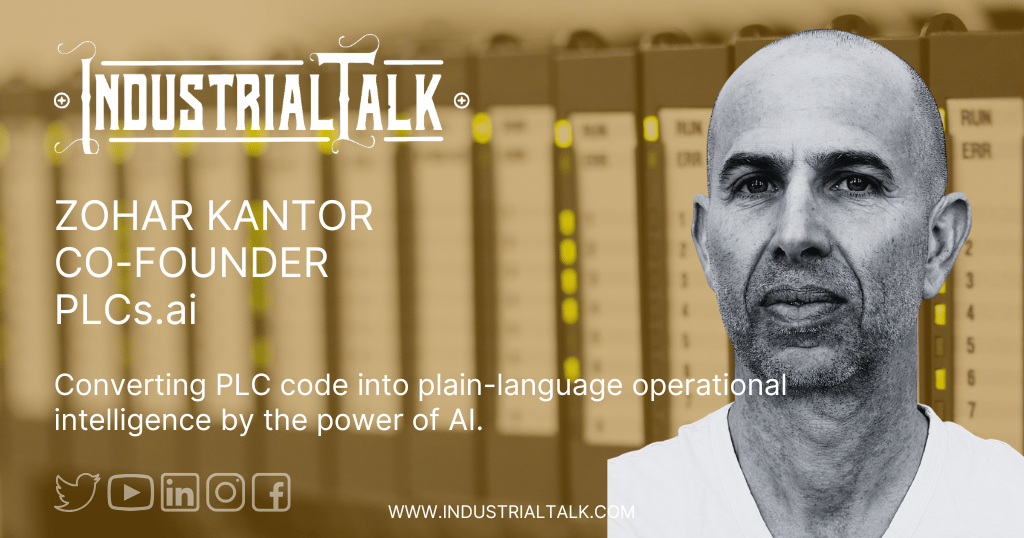
Industrial Talk is talking to Zohar Kantor, Co-Founder at PLCs.ai about “Converting PLC code into plain-language operational intelligence”.
The conversation highlights the importance of the Barcelona Cybersecurity Congress from November 3-5, 2023, and the need for cybersecurity professionals to attend. Scott Mackenzie emphasizes the significance of industrial professionals telling their stories and leveraging AI to enhance their operations. Zohar Kantor from PLCs AI discusses their platform, which simplifies PLC programming and diagnostics, reducing downtime and improving efficiency. Kantor stresses the importance of trust in AI solutions and the need to empower employees rather than replace them. The platform offers code optimization and documentation, aiming to support manufacturers in maintaining and optimizing their automation systems.
Outline
Barcelona Cybersecurity Congress Announcement
- Scott introduces the Barcelona Cybersecurity Congress, emphasizing its importance for cybersecurity professionals.
- The event is scheduled for November 3-5 in Barcelona, with networking opportunities and expert discussions.
- Scott mentions their own participation and encourages listeners to mark their calendars.
- The event aims to provide valuable insights and connections within the cybersecurity industry.
Introduction to Industrial Talk Podcast
- Scott praises industrial professionals for their boldness, bravery, and problem-solving skills.
- The conversation shifts to Zohar Kantor and his company, PLCs AI, which simplifies PLC programming and provides greater insights.
- Scott shares their experience teaching PLCs at a technical college and expresses support for Zohar's solution.
Importance of Telling Your Story
- Scott emphasizes the need for companies to tell their stories through AI platforms.
- They discuss the critical role of storytelling in business success and social presence.
- Scott shares their experience of countless conversations with industry professionals and the importance of amplifying messages.
- The conversation highlights the challenges of finding, retaining, and inspiring people in the industry.
Challenges in the Industry and the Role of AI
- Scott identifies people-related challenges as the real impact on the industry, including finding, retaining, and inspiring talent.
- They discuss the importance of creating a resilient business culture and the role of leaders in inspiring their teams.
- Scott introduces the concept of a “high beer factor,” emphasizing the need for authenticity and relatability in communication.
- The conversation touches on the importance of persistence and the role of media companies like Industrial Talk in supporting industrial professionals.
Zohar Kantor's Background and PLCs AI
- Zohar Kantor, introduces himself and his company, PLCs AI, which focuses on simplifying PLC programming and providing greater insights.
- Zohar shares his experience joining a startup in 2017 that brought defect inspection based on AI to industrial manufacturing.
- He discusses the challenges of integrating AI with legacy PLC technology and the need to simplify the process for engineers.
- Zohar explains the concept of PLCs AI and its mission to open up the “black box” of PLCs, allowing engineers to understand and diagnose issues more effectively.
PLCs AI's Solutions and Use Cases
- Zohar describes how PLCs AI helps maintenance engineers diagnose and resolve issues by guiding them through the process.
- The platform allows engineers to query and diagnose issues from the HMI in plain language, reducing downtime and costs.
- Zohar explains the concept of “explain” and “generate” use cases, where the platform helps engineers understand and resolve issues quickly.
- The platform also provides recommendations for code optimization and ensures compliance with industry standards.
PLCs AI's Impact on New Lines and Commissioning
- Zohar discusses the role of PLCs AI in the commissioning process, helping manufacturers document and optimize new lines.
- The platform ensures that documentation is generated throughout the code on a line basis, making it easier for maintenance and operation teams to manage the line over its lifespan.
- Zohar highlights the importance of documentation in the life cycle of a line, where 85-90% of the costs are incurred in maintenance and retrofitting.
- The platform aims to support manufacturers in maintaining their brownfield with legacy PLCs, ensuring smooth operations and reducing downtime.
Challenges and Opportunities in the Market
- Zohar identifies the need to gain trust from engineers and experts in the conservative manufacturing industry.
- He emphasizes the importance of trust in human-to-platform connections and the role of PLCs AI in empowering employees.
- The conversation touches on the broader impact of AI on the workforce, with a focus on efficiency and productivity rather than job replacement.
- Zohar shares insights from top-notch manufacturers who approach PLCs AI for solutions to their automation challenges.
Conclusion and Contact Information
- Scott wraps up the conversation, expressing admiration for Zohar's passion and the potential of PLCs AI.
- Zohar provides contact information for PLCs AI, encouraging listeners to reach out and try the platform.
- Scott reiterates the importance of telling one's story and the role of Industrial Talk in supporting industrial professionals.
- The conversation ends with a reminder of the upcoming Barcelona Cybersecurity Congress and the importance of staying connected and informed.
If interested in being on the Industrial Talk show, simply contact us and let's have a quick conversation.
Finally, get your exclusive free access to the Industrial Academy and a series on “Why You Need To Podcast” for Greater Success in 2026. All links designed for keeping you current in this rapidly changing Industrial Market. Learn! Grow! Enjoy!
ZOHAR KANTOR'S CONTACT INFORMATION:
Personal LinkedIn: https://www.linkedin.com/in/zohar-kantor/
Company LinkedIn: https://www.linkedin.com/company/plcs-ai/
Company Website: https://www.plcs.ai/
PODCAST VIDEO:
THE STRATEGIC REASON “WHY YOU NEED TO PODCAST”:
OTHER GREAT INDUSTRIAL RESOURCES:
NEOM: https://www.neom.com/en-us
Hexagon: https://hexagon.com/
Arduino: https://www.arduino.cc/
Fictiv: https://www.fictiv.com/
Hitachi Vantara: https://www.hitachivantara.com/en-us/home.html
Industrial Marketing Solutions: https://industrialtalk.com/industrial-marketing/
Industrial Academy: https://industrialtalk.com/industrial-academy/
Industrial Dojo: https://industrialtalk.com/industrial_dojo/
We the 15: https://www.wethe15.org/
YOUR INDUSTRIAL DIGITAL TOOLBOX:
LifterLMS: Get One Month Free for $1 – https://lifterlms.com/
Active Campaign: Active Campaign Link
Social Jukebox: https://www.socialjukebox.com/
Business Beatitude the Book
Do you desire a more joy-filled, deeply-enduring sense of accomplishment and success? Live your business the way you want to live with the BUSINESS BEATITUDES…The Bridge connecting sacrifice to success. YOU NEED THE BUSINESS BEATITUDES!
TAP INTO YOUR INDUSTRIAL SOUL, RESERVE YOUR COPY NOW! BE BOLD. BE BRAVE. DARE GREATLY AND CHANGE THE WORLD. GET THE BUSINESS BEATITUDES!
Reserve My Copy and My 25% Discount
Transcript
SUMMARY KEYWORDS
Barcelona Cybersecurity Congress, industrial professionals, PLCs AI, automation, maintenance engineer, code optimization, AI integration, manufacturing efficiency, technology trust, operational leverage, industry innovation, storytelling, Automate conference, manufacturing challenges.
All right. Before we get into the conversation, I want you to be aware of a conference that you need to put on your calendar, and you have time. It is the Barcelona Cybersecurity Congress. It is necessary. You need to up your cybersecurity game. You're connected. You need to make sure that you're protected right here. This event, Barcelona Cybersecurity Congress. It is November 3 through the fifth. You have time, November 3 through the fifth this year in Barcelona. And I'm telling you right now, the team at Farah who put this particular Congress on the best. You will not be disappointed, and you know what else you get to do? You get to network with some of the best cybersecurity professionals from around the world. You need to do this. You need to put this one on your calendar. All of the contact, all of the information is out on Industrial Talk. I'm going to be there. I'm going to be broadcasting. I'm going to be talking cybersecurity with the best in the world. So be there. Put this one on your calendar. That is November 3 through the fifth. I'll see you there.
Welcome to the Industrial Talk podcast with Scott Mackenzie. Scott is a passionate industry professional dedicated to transferring cutting-edge, industry-focused innovations and trends while highlighting the men and women who keep the world moving. So put on your hard hat, grab your work boots, and let's go! All
right, once again, welcome to Industrial Talk. Back in the hot seat, telling the story of industrial professionals such as yourself, I say it all the time: you're bold, you're brave, you dare greatly, you innovate, you collaborate, you're solving problems each and every day. And industry is where it's at. It's a hopping market out there. I don't care where you're at, you know things are happening, disruption is taking place. It's an exciting time in a hot seat. Speaking of which, Zohar Kantor PLCS AI, and we're talking about PLCs being able to simplify that code, get it a little great, just greater insights into it, and and outstanding solution. Let's get on with the conversation. Yeah, it never changed. I taught at a technical college PLCs. Yeah, I did, and and it was hands on. It was doing all that stuff, and and here is a solution that simplifies that process. Yeah, I'm all in. Greater, you know, greater insights into your operations, pulling that information, that data out of that operation. Yeah, nothing's wrong with that. Absolutely not one thing. Zohar Kantor, PLCS AI. There it is. All right, soapbox time. I say it all the time, and this is just from my heart. I was thinking about this. I wanted to share it with you, and I think I'm going to continue to sort of hammer on it, for lack of a better term. The need for you to tell your story. Just go out there, whatever AI platform, and type in why is it important for you to podcast, and you'll get information. Good information, easy. It's all right there, and why it's important for your company, for your solution, for your service, to be able to tell your story, just that you got AI, you don't have to hear it from me. It's probably pulling from my information anyway, but you just have to do that, and then you realize how critical it is to the success of your business, to the message that goes out, to to your social presence, it's that easy. It's that important. I'm here to share with you that I've had countless, and I mean countless, conversations with the best industry professionals Out there, we can do better. We can amplify that message even more. We have to. As I have conversations going forward, there's always concerns. Is the concern technology? No. You got a lot of great people really hammering on that technology and making it as efficient as you possibly can, it is the technology is the technology, and it's becoming more and more user friendly, insightful, fast. All of the all of the things that you want from a technology. But the real challenge that I think impacting industry today is people finding people, retaining people, inspiring people. You know there are examples of companies out there that truly understand the need to create that culture within your organization to be able to pull in the talent that you need to create that resilient business. You need to do that, and it comes in these individuals, these companies. You will always understand that they they're out there. The leaders are out there. They're telling their story. They're not this, you know, robot marching out there thinking that that that inspires and that gets everybody to sort of buy into the the the purpose of the company. No, I'm here to tell you, it's about being real. It's about being just, just hey, this is what we do. Have a conversation. It's like, and I and I coined this term. You need a high beer factor. Here's an example. Here's a use case. So I go into a bar, and I look at the bar, and you can tell the individuals that don't have a high beer factor that you don't want to sit next to and have a conversation just because you're stuck at a bar and you're there chirping back and forth. To the ones that have have a high beer factor, they're the ones that you want to just say, yeah, I'll sidle up to them at this bar and have a conversation or two about whatever, and then be able to enjoy that time drinking a beer. That's a beer factor. You got to have a high beer factor. You got to put yourself out there. It's you don't have to be some you know, you know showboater.
No, you just have to be real. You come over to my house, and you, you know, drink my beer. Maybe it'd be something a little stiffer, but drink my beer. We're just going to have a conversation. We're going to talk about what you do, why it's important, why are you important, what? Well, how did you do? How did you get here? That type of stuff. You need to do that. There are so many companies that don't get that, and and and I'm just my heart is broken because I believe the key to your success is right here, telling your story, and it doesn't have to be fancy. It doesn't have to go through the typical media or marketing grinder. You just tell your story, get it out, and do it again, and do it again, and you have fun. And then you highlight somebody that's using your solution, and you do it again, and you have fun, and and you just keep at it, persistence. It's not that difficult. We're here. Industrial Talk is here. We're a media company. We're here. We have all of the industrial street cred that you can imagine, right here. We understand marketing, so we market for industrial professionals. We tell their story. We create the content that gains the eyeballs on what you do, and then of course we want you to succeed. So we also promote you. We also provide all of the. We're just not. We're just a turnkey solution. You don't have to look that far, but we want you to succeed. At a minimum, you just have got to feel comfortable telling your story. I've got a lot more in my head, but I just it you know over and over again I find myself just agonizing because I could do this, I did it. I had a company. I decided to podcast just because I needed to tell the story. Was that in my DNA? Absolutely not. Do I did I realize that? Well, yeah, I can have conversations. It's all about relationships. Yeah, there it is. Do it, Scott. Oh, oh. Oh, oh, oh, and do it again, and and do it again, and get comfortable doing it. You need to do the same thing, and if I can do it, you can do it, and we are here to help. You just go out to Industrial Talk right there. Boop. Talk to me. Let's get that story out there. Let's do it. All right, onto the conversation. Off my stovebox. Onto the conversation. Zohar Kantor, PLC AI. Well, you got to be careful because it's PLC little s. AI. It was a great conversation. See this guy right here, Zohar. When you listen to his conversation, he loves what he does. He's passionate about what he does, and it comes through in his voice. It comes through in his face. It does. It is just a wonderful in interaction. That's what industry's about. Right here, we are industry. Right there, I've got this hashtag on the T-shirt. If you're out on video, you see it. We are. It's a human equation, and it will always be a human equation, no matter how much technology we deploy, or automation, or whatever it might be. There will always be this need for capable people, just people, to tell their story and why this. Don't get me going on the necessity of your obligation. It's my obligation and your obligation to help inspire that next generation. They have to hear it. They just-they're not getting it through the air. They're all distracted by other stuff. We need to make sure, and we need to deliver on an on a platform that says this is why it's cool. Zohar, there. Sorry, Zohar. I I was just been thinking about it, and and you you're you're passionate about what you do, love it. Anyway, enjoy this conversation with Zohar. Zohar, welcome to Industrial Talk. Thank you very much for joining. You're not in Israel. You're in Chicago, so I don't feel so bad. I was looking at the time you scheduled, and I said, "Oh my gosh, it's late in Israel, but now you're in Chicago, and it's not a big. Yeah, I'm
here in Chicago, and we have lovely weather. It's a lovely show here at Automate. A lot of folks coming, and it's a really interesting show going on.
How how big is that show?
It is huge. They there is a session going on. There is a north and south fault.
Yeah,
really, a lot of show, a lot of companies coming in. There is a lot of interesting discussion going on. Really, feel the energy of in the of the industry. So it's it's like the pulse. If you want to get the pulse of what's going on in automation in in in industrial manufacturing, this is the place to be. I truly recommend it to everybody that sees
it. I tell you, man, Chicago delivers on big events. I mean, they do. They have IMTS and and I'm sure others. But every time I look at IMTS, I'm always dazzled. So Automate is in in line. And this segues into who you are and what the company is. But is it really? Have you been going to Automate for many?
No, no. This is my first time. I've been a lot of shows in the industry, a lot of in Europe. Yeah, but this is my first time in Automate, and it's huge. It's it's really big, really. It's like a show. There is so many robots, and you know, really entertaining booth. You can stand there just watching for hours.
Yeah, that is pretty cool. But you've been in it for a little while. There's a lot of changes, and I know that manufacturers are looking for ways of being able to be more efficient, greater quality, dealing with the fact that I can't find people, so I have to sort of go down that automation route. There's just so many things that are being addressed there, so that's pretty cool. Again,
absolutely, I agree with you.
I I don't feel bad about time, so it's all good. When when did you get up in Chicago? When'd you fly in?
I flew in yesterday morning after. from New Jersey, New York. This is where we have our offices. That's right. This is our offices. This is where the team is. Where the magic happened. This is where we have the R and D, the support, the customer success. So we're based out of Hoboken, and for us it was just a less than two hours flight, so we're happy to be here.
I'm skipping a jump. Before we get into the company, I want to have the the people listening understand who Zohar is. So give us a little background on who you are.
Good. Who am I? Sometimes I'm asking myself the same question every morning when I wake up.
Yeah.
. Relevant to our call today,:hole. This
and and and and that came, you know, for us that was very instrumental in the sense that we said, you know, this needs to be changed. We need to allow free those folks, those lovely engineer, whether maintenance engineer, operational engineer, advanced engineering maintenance engineers that are dependent on you know the automation running smoothly, but at the same time know nothing about it. So this is when we you know started to set course with PLCs AI. This was our you know initial mission. Let's open up this black box and allow every engineer to be able to understand, diagnose, make sense of this black box. So there will be less dependent on what I'm going to call throughout the call as you know the the expert, the PLC expert. Yeah.
See, which is really pretty interesting because you know how many companies out there depend on PLCs. That's a PLC for the listeners out there. Programmable programmable logic controls PLC, and every every operation has PLCs.
Absolutely, I don't, I don't know how much you know. I'm sure the folks listening to our conversation today, whether coming from manufacturing background, they all understand that the beating heart of every line at the end is the PLC. Everything is connected to the PLC in every industry, in not only manufacturing industry, any industry that has some sort of you know automation, whether it is water, water treatment, electricity, anything at the heart of it is PLC. This is what makes automation possible.
Yeah, I was. It's the way of your operations, communicating what's taking place and being able to do it effectively and efficiently, and what I'm really intrigued is how your organization PLCs with the little S C S AI, which is your location, how you've taken something that's been around forever, I forever, and trying to apply today's technology to that legacy technology and make it easier to understand. Because you're right, the people are not there. They're not, and and
it's it's fascinating, and and I totally agree with you, Scott. This this this this PLC has been there forever. And in a in a lot of ways, it didn't evolve at the same pace that our other technologies out there have evolved. When we talk about energy 4.0, we talk about so much AI being brought to the industrial space. None of it reached the automation space. Now you can listen to some PRs, and you know some of the big names are now throwing in into their IDs some copilots. You know these are you know a bit too late and a bit too too slow at the pace of other apps out there affecting the industrial space. So we we saw that as a huge opportunity. Yeah, it's so it's so lovely when you meet a manufacturer and you don't need to preach the pain. They understand the pain. The pain is that they're being in wall garden of of IDEs, nobody understands what's going on. Only you know few. Some of them retire, some of them leave, and they're dependent on it. So the pain is there. It was it has always been there. The only thing that changes that today you have so much AI capacities that were not yet before, you know. We have today, and embracing all of them together, orchestrating today with a single task of helping manufacturing in this space. This is what we do on PLCs AI. We have we have
here's sort of a nuts and bolts, Zohar. So I'm always fascinated by the fact that I have this operation, this automation. It's being controlled by, of course, PLCs, and they're pretty. I mean, they're they're they're pretty pretty amazing, quite frankly. But they've been around for a long time. So here I am, the PLC or something, an error happens in my operation, my automation. It just happens, which just blows my mind. Just because they're not moving parts, you know that that Bradley is not moving around. That Alan Bradley, it's just not there. You know, but then all of a sudden it it it fails. Then take us through what PLCs AI can do because I I I'm now I'm I don't have my technician that technician someplace else doing other technician type stuff now I'm now I'm down. Take us through sort of a process of why we can work with you.
Absolutely, it's it's it's it's it's it's a good question. That kind of a segue of of the use cases we provide or how we can help manufacturers. So when a line fails, in most cases, I'll I'll be frank and open here. It's it's it's not a problem of the glitch of the of the code itself. If the line is there, and PLCs for the folks out there that are listening. Their lives spanning anywhere between 10, 15 to even 25, and sometimes even 30 years. So if the the line has been commissioned, it is in up and running. Probably it's not the fault of the code. It's it's something to do with a mechanical issue. Something there is now no functioning. And I always say, lines are are alive. They are morphing. They are changing weather, humidity, tolerances, supply, material. A lot of things change and might affect. And even you know parts fail. So now, as you said, let's go back to the the point you mentioned. There is a failure. So what do they do? They're they're they're operator. I'm the guy on you know on the line. I'm Zor the operator. The line is not functioning. It's stopped. There is an error on the HMI. It makes sense to me. I'm off now. There there is a a red light spinning on the line. Yeah, I'm stuck. What I do, I call the technician, maintenance team. Somebody comes. You know, it's always remind. I always make the funny story about you know the the captain that circulates the the the plane before we take off. We see him through the window, through the through through the plane. He what does he check? Oh, wheels are here, engine is there. I see the tail. The wing is still intact. Okay, we we can go. We can fly. This is what the technician does. He said, "Okay, I'm looking around. Okay, whatever he's he has like a drill he can do. But if it's not something visual that he can see, believe it or not, sometimes they take the line down, power down, the weight, pray, take it up. If if there's something fault, it's not going to resolve it. So now, that's it. They open a ticket. What's a ticket? They call an expert. In a team, the expert arrives. The line is not working. It's standing still. It's in idle. They're losing money. The clock is ticking. You can imagine. It depends on the industry. The clock of an hour of a line of unplanned time. I don't
like that. That's not good. And
most folks, even big brands, don't have expert available on call. You know, getting there immediately, rushing and fixing it. So you wait. You can wait hours. You can wait a day, depending on you know who's going to come and rescue you. So the line is down. So what PLC comes in now. We can allow the maintenance engineer to query question, even from the HMI itself. So he has an HMI box in plain language. My line is stuck. I see this error, and PLC PLC. Okay, we can help you step by step. What is possibly the fault in the machine. Check this. Okay, I check this. Now what? Now check this. Now reset that, and so on. We can even connect to live data tags from the PLC itself, so we actually know what's going on, so we can help you diagnose the problem as quickly as possible. Why the clock is always sticking there on the cost?
Let me let me let me let me go down that road because now all of a sudden, I'm taking your platform. I I haven't I have a connection to the PLC. The PLC has the information. Of why or potentially why your your line has failed for whatever it's in there. It's the data has that information.
Absolutely. Then
you're saying that your system, your your platform will say, "Hey, it looks as I as I talk to this PLC. The PLC is saying, "Hey, it looks like X, Y, Z. How do you and your system say, "Hey, it's it's a belt, whatever for lack
of. I'll give you the analogy.
Okay.
We always say that we would like to be treated as your PLC expert companion. So now the maintenance engineer can have a PLC expert companion, which is PLCs AI, out there asking questions and guiding him through the process. So what does a PLC expert does when he comes in? He looks through the code, whether he coded it or not. In most cases, you have never seen the code before. Oh yeah,
no, they haven't.
Firefighting. It comes in. He's he's he's stopping whatever he's doing. He needs to travel. He needs to come to that plant, that line. You have never seen it before. No documentation. Nobody knows what's going on.
Zero documentation. I'm telling you right now,
people, because it lasts so many years, I'm just opening now a window for for for for context.
Yeah.
The the the only knowledge of what's going on is in the head in the PC of the last guy that was there. Yeah. Doing some some sort of work. He he knows what it is. It's undocumented in 99.9 infinity. There is no code review. Nobody knows what's going on. There's no documentation. And now you come in, Scott. You are the the expert. You come to the line. It's you need to diagnose. So you need to go through the code. You need to go through it. You need to understand the sequences, dependencies, and so on. And then you start going through it, and then you get to the belt. Oh, the belt is not functioning, or I don't get this message, or this temperature sensor, or this gage here didn't give me the. And this is faulty. Yeah. In most cases, it's some port of outdoor malfunction or something. But the only way to understand it, to cipher what it is, it's through the code. And this is what PLC is doing, and this is what we guiding him. Check this, okay. Check this, okay. Check this, okay. It's the belt. It's that sensor, and then they know what to do. They're good technician. They're good engineer. In most cases, they're gonna have a spare back in in in in in in in somewhere. They just bring it, replace it, reset it, and they're up and running. So this is this is something which we fundamentally do. But I just just just for the sake of the discussion, I want to point out this is one use cases that we call the explain. Explain to me what's going on. Explain to me one day. But at the same time, we have the generate, and this is more the expert because when we started the ideation process and we spoke with a lot of engineers, a lot of experts said, "Guys, we need this as well. You know, Scott, you come to the planet as I said before. You're not going to waste an entire day understanding what's going on in the code. You want to use that tool so we can point you in the right direction very quickly, so you can close this ticket, move on to your to whatever you need to be, and and and close this ticket as soon as possible. So there is a lot of experts that are using today PLC's AI platform, you know, to expedite to help them in what they do. They're the man in the loop. Whenever we do a change, whenever we suggest a change, they're going to be there approving it, going through it. But we make the process much faster, and from an organizational point of view, we make sure everything is within the standard of the brand, of the manufacturer, of the enterprise. So it's not a cowboy movie that everybody comes in and doesn't change and leaves, and there isn't any policy or any kind of sort of documented processes and standard that are being followed throughout the the expert that is touching the system. So it's very
what I have is I have a I have a use case that says I can fix it, and I go through the code. My your platform goes through the code, says here's the alarm, and then notifies the maintenance individual. It's a belt. It's a temperature. Whatever, whatever. Replace
it. Absolutely. So
that's one use case. That's that's you know plug play. Listen, look at it. The second use case that I I can and and correct me if I'm wrong. So I have a new new PLC. No, hold it. Now I'm going to back up. In that analysis of the the code, does your platform say, "Hey, this is a great code. However, you might want to consider some changes here and do this and modify that, tighten it up a little bit. Here are some other recommendations that we want to provide.
uld tell them this project is:So here, here is another example, or, or I'm trying to sort of be nuts and bolt. I'm putting a new line in. There it is. I got the money, putting a new line in. It's all good. I have to have all the controls in place. I've got to do that. I've got to program it. I got to, I got to get out there and hit the pavement. And all I see to get it in in a operational form, whatever that line is, I've got to code. I'm a coder. I got to. I got to do this stuff. I got to program these PLCs. Is it possible to take your platform and be able to cut my my coding down significantly, so that when that new line comes on, I don't have to sit there and grind it out. I have a tool, and that tool is helping me get to it to a standard that I like. There.
Okay, I understand, and
and
I'll and and I'll share with you PLCs AI perspective on that. We our our mission is to help manufacturers maintain their brownfield with legacy. And when when we're talking about a new line for PLCs AI perspective, it becomes very relevant to engage in the commissioning process. Meaning, somebody wrote the project outside of PLCs. They can do it wherever they find fit and in the best manner. This is, by the way, and and I want to make a point here. On the on the line building and commissioning, there is a lot of expertise involved. Everybody is there. Everybody is playing. But there is a point where they live, and they leave the manufacturers run it. They do the training. Here is the book, and now it's yours. I see lines that are being commissioned, sometimes even more than month, years, and a lot of people come in and make the changes and attachment, adjustment to to you know to fine tune it, and this is where we kick in. We help them document everything. We help them optimize everything. We make sure everything is running on sync, so they can and document it. By the way, very important the documentation aspect that we generate throughout the code on the line basis and in project basis, and they can then hand it over to maintenance and operation, and that's going to run smoothly over the years. So this is very important. I always say, when they build the line, there is a lot of expert involved, but they're going to leave, and the manufacturers start. And this is why they tell us, and this is a very important figure I want to share with you, throughout. Cost of the life cycle of a line or PLC, the initial phase of building and getting it to commission is somewhere between 15 10% of the cost. 85 90% is on the brownfield on the life cycle, the running over the years, the maintenance, the retrofit to making sure it's going to be working smoothly over there, and this is where they struggle. And those, I would say, incumbents out there, the IDE vendors and the PLC are less interested in their manufacturing. In fact, most of their solution don't cater to them, and this is where we fit in.
All right, a couple other things. One, you're at Automate right now. You're there in big big conference, all about automation, all about what you do. Are you? Do you have a booth there, or are you walking around?
We're walking around. This is our first conference. We're just launching the product now, so we we we we take one step at a time, but we have already plans to be in in the next conference, both in states and in Europe, and and we're gonna have a boot. But it's it's very you know, I love the connection with with with people, and I like to talk, and I walk through the allies and I stand there and I meet a lot of people. And whenever I see a big manufacturers and you know there is they have the sign automation manager and I say hey so from PLCs AI, you have PLCs and he says oh yeah we have a lot of them says okay we're gonna be good friends you listen you need to listen and and it's like 10 second and they get it and say you know, let's connect. Let's connect after because it's like you know they know they have the pain. Suddenly, they find somebody that can provide remedy, the solution. And this is this is this is you don't need a booth to do that. You know, I have a lovely PLC shirt. Everybody sees in the back. PLCs AI. What do
you do? I agree with you 100% I think that I was going to ask. So it sounds like it's resonating. The your your value proposition of your platform is resonating with many of the individuals at Automate. That's great. The question I would have, based off of all of the conversation we've just had and the success that you're having at Automate, I what what are the roadblocks? What what are preventing people from saying I'm all in?
I mean, this is this is a very good question. I think it it it applies to us as PLCs AI, but it applies to a lot of you know different AI out there. I think we need to gain the trust. I always say it's all about trust, you know, as humans connecting, and as human connecting with platform. You have those those engineers, you have those experts in in in you need to gain their trust, so they feel they they are in good hands. Whatever we generate, whatever advice we give them, isn't something that they can blindly trust. And this is since you know manufacturing is a very conservative industries, and and the pace of change is is becoming much more rapid, but still it's pretty conservative.
I I agree to a certain extent. I believe, especially today in this market, I believe there are more individuals, more companies that are looking for operational leverage and more efficiency, and that's a technology question. You can't throw bodies at it. You still need bodies. Don't get me wrong. I'm not not trying to minimize the body component, but to truly extract maximum value out of your operation-that's a technology question.
Absolutely, but but it it's like it's like layers, and the first fundamental layer is trust, and and a lot of those have already experience working with OpenAI with with Claude outside. You know when when they do a lot of different stuff, but when it comes to automation, oh no, okay. So now we're bringing that technology. We're bringing that experience to the automation, and and I think there is a lot of really forward-looking manufacturers. A lot of them approach us, and we were fortunate that we're being approached by really top-notch manufacturers, and in in gaining their trust is is is I think the basic in order for them to rely on it, and I always say, engineers have every day they come to work, they have a choice with whom they're going to work, and we're going to work hard so they can trust us that we're going to be their go-to for any PLC slash automation task they have on on their day to day. It's very very important. For us, but I want to say something about the people. Yeah, being an AI company and the discussion you you hear about, you know, in the news and and most of the discussion is around due to AI, we're laying a lot of people out there. We we you hear companies you know laying off 20% 30% you know, and this is kind of the discussion. And we as PLCCI, we say no, no, no. This is not what we do. We want to empower your employees to do better. We want to allow them tools so they can be more efficient in what we do. By all means, we need those folks. We need the boots on the ground, on the you know, on on on the production floor. We need the maintenance engineer. We're not replacing anybody. We're just helping manufacturer to be more efficient with what they have. They're losing travel knowledge. People come and go, retire, leave. You know, they don't have the luxury anymore. And this is I'm quoting words that I've heard from a very famous manufacturer. Said we don't have the luxury anymore to have people working their entire career on the floor. People are moving. People are retiring, and I don't see a lot of new generation coming into you know PLCs. And and we are there. We are there to support them. You know, in the course of of the lifespan of PLCs, and just empower the people to do more. Allow people that couldn't do that before.
Yeah, and it's a it's an interesting time in the marketplace. I think it's exciting, quite frankly, for me. You're absolutely correct in that companies are struggling with that, and yeah, I don't hear many people out in the field going, "Hey, I want to get involved in PLCs. It's not happening that much, and I guarantee you, but it's still necessary. And it's and I I like exactly where you guys are at. I think that's a phenomenal solution. I
thank you.
Definitely wish you the best. Hey, Zohar, is somebody saying I like what he's saying? How do people get a hold of you?
It's very easy. Our website is PLCs AI, and my email is the one coming. You know, they can see on the name is Zora PLCSAI. So feel free to share. You're out
on
LinkedIn too, right? You're out on LinkedIn.
Correct, and on LinkedIn, shoot me an email. We'll be happy to discuss. We love the connection. We manufacture. We learn a lot. We adjust. We're agile, and and you know we the engagement is is fun. This is our passion. You know both AI and manufacturing as well, and the combination of it is very powerful. And this is what we love. So whomever wants to shoot an email. Feel free. Send me a LinkedIn. Send me a message. Go to our website. And by the way, we we we we allow people freely to you know to try us. So you know they can go in, create a user, and and test it on their project freely. And if they love it, and I hope they do, you know we would love to have them as our customers.
I love it. All right, Zohar's his name. All the contact information will be out on Industrial Talk. I want to make sure that you we're clear on the URL. It's P L C s.ai. So make make a note of that. But it doesn't matter because you're going to go out to IndustrialTalk.com and you're going to connect there. So that makes it easy peasy because we're going to have a stat car. We're going to have everything. You'll be able to find as much information. Zohar, you were absolutely wonderful.
Thank you so much for having us, and you know, thank you for the invitation.
Yeah, get out of here, man. It was a lot of fun. All right, we're going to wrap it up on the other side. We're going to have all his contact information again out on Industrial Talk. Stay tuned. We will be right back.
You're listening to the Industrial Talk Podcast Network.
Zohar Kantor P L. c s a i. There, there it is. It's all out on Industrial Talk. If you're not inspired by that conversation, we're going to keep on trying. But that was fun, Zhaohar. That's great. Good guy to hang out with. You can tell. Speaking of beer factory, you know he has a high beer factor. You can tell he's beer factor. One of these days, maybe we'll we'll be able to sort of connect. I don't know, in person, not not digitally. There, that that would be great. Maybe at one of those great events, those great industrial events that I broadcast from. Hey, I have to apologize for going off and and stepping on my soapbox about the need for you to tell your story. It's important, and yeah, and I take it personally, and it's in my heart because I just I enjoy industry so much. And I want, and and you you have to succeed. It's it's a non-negotiable. You have to succeed, and and and throughout history, the the organizations, the individuals, and everything, the the ones that truly impact and make a that are successful, they're able to tell their story, whatever that might be. It's historically backed up. Again, go out to any of your AI tools, type in why it's important to tell your story, and and you'll get all of the information. As the AI goes out there and scours the internet, it's a. You just got to tell you something. You know how easy it is, and I don't have a dog in this fight. You just go out to Industrial Talk. You're saying, okay, connect with Scott, connect with me, have a conversation, and we will definitely help you and direct you to the fact that we want you to succeed, so we'll do anything we can to help you, no matter what. It's easy. Click, connect. Zohar, put that on your priority list too, because he's pretty good guy. And and because I taught PLC, I like his solution. There, that's it. All right, be bold, be brave, dare greatly, tell your story, hang out with Zohar like he told his story, and you know what? Again, you will be changing the world. Another great conversation on Industrial Talk is right around the corner, so stay tuned.