Joe Anderson with ReliabilityX
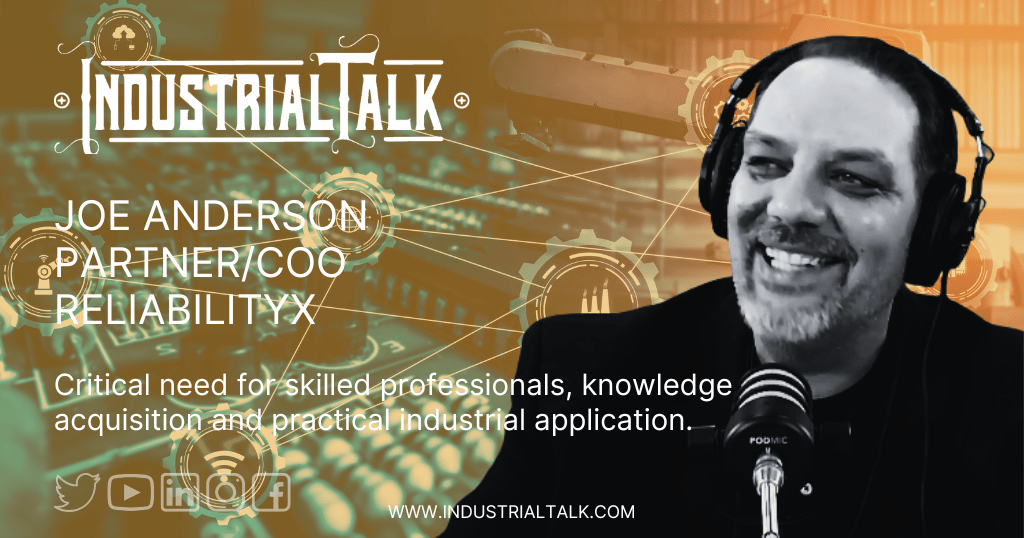
Industrial Talk is onsite at SMRP 2026 and talking to Joe Anderson, Partner/COO with ReliabilityX about “Industrial knowledge acquisition and practical application”.
The conversation emphasizes the importance of cybersecurity, marketing, and leadership in various industries. Speaker 1 promotes the Barcelona Cybersecurity Congress from November 3-5, 2023, and the SMRP conference in Fort Worth, Texas. Joe Anderson discusses the critical need for skilled professionals in manufacturing, highlighting the gap between knowledge acquisition and practical application. He advocates for a shift from a focus on metrics to one on leadership and culture, aiming to build an army of problem solvers. Anderson's company, ReliabilityX, aims to improve organizational reliability and culture through practical, quick-win solutions.
Outline
Barcelona Cybersecurity Congress Announcement
- Scott introduces the Barcelona Cybersecurity Congress, emphasizing its importance for cybersecurity professionals.
- The event is scheduled for November 3-5 in Barcelona, with networking opportunities and expert discussions.
- Scott plans to attend and broadcast the event, encouraging listeners to mark their calendars.
- The event is organized by FIRA, and Scott assures listeners they will not be disappointed.
Scott Mackenzie's Career Insights
- Scott shares his experience of taking responsibility for marketing and sales efforts in his other businesses.
- He admits to being lazy in engaging on social platforms and generating necessary content.
- Emphasizes the importance of pushing out meaningful content to tell one's story effectively.
- Encourages listeners to go to Industrial Talk for help in improving their content strategy and storytelling.
Introduction to Industrial Talk Podcast
- Speaker 1 thanks listeners for joining and mentions this is the 17th conversation at SMRP.
- Announces the interview with Joe Anderson, a renowned professional at SMRP in Fort Worth, Texas.
- Encourages listeners to put SMRP on their calendar and highlights the opportunity to meet professionals like Joe.
Joe Anderson's Passion for Helping Companies Succeed
- Scott praises Joe Anderson's passion for helping companies succeed and his desire to make an impact.
- Joe shares his goal of having some sort of impact on the many manufacturers out there.
- Discusses the urgency of establishing a different culture and the challenges of trade shortages.
- Scott and Joe express concerns about the industry's readiness and the need for a renaissance.
Challenges in the Industry and the Importance of Leadership
- Joe compares the current situation to a meme where a dog claims to be fine despite a fire around it.
- Emphasizes the importance of practitioners in keeping the world running and the neglect of their role.
- Discusses the bureaucracy and the shrinking skills, highlighting the need for leaders to focus on the right things.
- Scott and Joe talk about the flow of capital and the lack of preparedness among technical colleges.
Builders vs. Destroyers and the Importance of Action
- Joe explains the concept of builders and destroyers, emphasizing the need for people who take action.
- Discusses the Pareto principle and how a small percentage of people do the majority of the work.
- Highlights the importance of focusing on reliability as a behavior rather than just an outcome.
- Scott and Joe discuss the challenges of changing culture and the need for consistent action.
The Role of Metrics and Best Practices
- Joe explains the misconception that metrics are best practices and the importance of focusing on the right behaviors.
- Discusses the impact of teaching people to focus on outcomes rather than inputs.
- Highlights the role of consulting companies and the need for trust in their business models.
- Scott and Joe discuss the importance of leadership and the need to focus on developing people.
Developing an Army of Problem Solvers
- Joe shares his vision of building an army of 10,000 problem solvers to address the issues in the country.
- Discusses the importance of developing people at all levels of the organization.
- Emphasizes the need for continuous development and support to ensure long-term success.
- Scott and Joe talk about the challenges of maintaining momentum and the importance of quick wins.
The Impact of ReliabilityX on Organizations
- Joe explains the disruptive approach of ReliabilityX and the need for organizations to be open to change.
- Discusses the challenges of engaging the entire organization and the importance of having a champion.
- Highlights the success of ReliabilityX in raising EBITDA and the importance of quick wins.
- Scott and Joe discuss the ongoing nature of change and the need for continuous support.
Final Thoughts and Contact Information
- Joe emphasizes the importance of developing robust systems to ensure long-term success.
- Discusses the challenges of maintaining momentum and the importance of continuous development.
- Scott and Joe talk about the importance of building relationships and supporting people.
- Joe provides his contact information and encourages listeners to reach out for more information.
If interested in being on the Industrial Talk show, simply contact us and let's have a quick conversation.
Finally, get your exclusive free access to the Industrial Academy and a series on “Why You Need To Podcast” for Greater Success in 2025. All links designed for keeping you current in this rapidly changing Industrial Market. Learn! Grow! Enjoy!
JOE ANDERSON'S CONTACT INFORMATION:
Personal LinkedIn: https://www.linkedin.com/in/joeanderson-entrepreneur/
Company LinkedIn: https://www.linkedin.com/company/reliabilityx/posts/?feedView=all
Company Website: https://reliabilityx.com/
PODCAST VIDEO:
THE STRATEGIC REASON “WHY YOU NEED TO PODCAST”:
OTHER GREAT INDUSTRIAL RESOURCES:
NEOM: https://www.neom.com/en-us
Hexagon: https://hexagon.com/
Arduino: https://www.arduino.cc/
Fictiv: https://www.fictiv.com/
Hitachi Vantara: https://www.hitachivantara.com/en-us/home.html
Industrial Marketing Solutions: https://industrialtalk.com/industrial-marketing/
Industrial Academy: https://industrialtalk.com/industrial-academy/
Industrial Dojo: https://industrialtalk.com/industrial_dojo/
We the 15: https://www.wethe15.org/
YOUR INDUSTRIAL DIGITAL TOOLBOX:
LifterLMS: Get One Month Free for $1 – https://lifterlms.com/
Active Campaign: Active Campaign Link
Social Jukebox: https://www.socialjukebox.com/
Business Beatitude the Book

Do you desire a more joy-filled, deeply-enduring sense of accomplishment and success? Live your business the way you want to live with the BUSINESS BEATITUDES…The Bridge connecting sacrifice to success. YOU NEED THE BUSINESS BEATITUDES!
TAP INTO YOUR INDUSTRIAL SOUL, RESERVE YOUR COPY NOW! BE BOLD. BE BRAVE. DARE GREATLY AND CHANGE THE WORLD. GET THE BUSINESS BEATITUDES!
Reserve My Copy and My 25% Discount
Transcript
SUMMARY KEYWORDS
Barcelona Cybersecurity Congress, cybersecurity, Industrial Talk, SMRP, Joe Anderson, leadership, reliability, problem solvers, culture, metrics, safety, action, innovation, networking.
All right. Before we get into the conversation, I want you to be aware of a conference that you need to put on your calendar, and you have time. It is the Barcelona Cybersecurity Congress. It is necessary. You need to up your cybersecurity game. You're connected. You need to make sure that you're protected right here. This event, Barcelona Cybersecurity Congress. It is November 3 through the fifth. You have time, November 3 through the fifth this year in Barcelona. And I'm telling you right now, the team at Farah who put this particular Congress on the best. You will not be disappointed, and you know what else you get to do? You get to network with some of the best cybersecurity professionals from around the world. You need to do this. You need to put this one on your calendar. All of the contact, all of the information is out on Industrial Talk. I'm going to be there. I'm going to be broadcasting. I'm going to be talking cybersecurity with the best in the world. So be there. Put this one on your calendar. That is November 3 through the fifth. I'll see you there. There was a point in my professional career, my other businesses, that I had to take responsibility. Me, Scott, responsibility for marketing and sales efforts. Now you're saying to yourself, "That's a no-brainer. No, this is the next level. I recognize that I was not engaged on the social platforms. I recognize that I was not generating the information that is necessary to give me the attentions that I need for my business. In in short, I was lazy. Once I took responsibility for the fact that I needed to up my game and produce content in a way that's meaningful and rapid, things started to change. I'm here to challenge industry that stop getting bogged down with social minutia and be able to start pushing out the content that is necessary that tells your story. It's vital. You need to succeed, and if you're having difficulty, if you're struggling on how to do that, and if you're bogged down with the minutia, go out to industrial talk, contemplate, and and we'll have a conversation. It's it's it's vital that you tell your story, and do it with a sense of speed and purpose. We're here to help you. We want you to succeed.
Welcome to the Industrial Talk podcast with Scott Mackenzie. Scott is a passionate industry professional dedicated to transferring cutting-edge, industry-focused innovations and trends while highlighting the men and women who keep the world moving. So put on your hard hat, grab your work boots and let's go.
All right, once again, welcome to Industrial Talk. Thank you very much for joining. This is like, this is the the the 17th conversation I've had at SMRP. 17, maybe more. I don't know. And I'm I'm getting tired of my intro. So here, there's a new intro. He's a legend. We're going to be talking to Joe Anderson because he is here at SMRP, which you need to put on your calendar, and it's here in Fort Worth, Texas, and it is a collection of incredible professionals. If you have not put this on your calendar, you need to do it next year. Find some budget money, put it on your calendar, and be here because you will not be disappointed. You get to meet people like Joe. There, that's it. Yeah, you get you get the compressed version of of my intro because it's like, oh, okay, I got you. Yeah, how you doing? Always a
pleasure, man. It's always cool. Yeah, yeah.
You're a legend. I don't know. The reliability acts. It's just like everybody knows
you. Yeah, they know Ramesh for sure in Georgia. Yeah,
Ramesh. He's shrinking. Yeah, it's so funny. Like I remember when you were six foot tall, there, Ramesh, way back when, and now all of a sudden you're yeah, and he gets
pulled a million different directions, and he's worn out by. Yeah, you're good.
Okay, sorry, I have another lineup. Yeah, no, he's he's incredible. Everybody's incredible, and you know what's incredible is the fact that you have this passion. You truly have a desire to to help companies succeed.
I love it.
Just in the heart, and and and and that's so cool.
Yeah, my desire. You know, I I would love to help everybody, but you know the reality is there's so many manufacturers out there. If I ever will, but hopefully have some sort of impact. That's the goal.
I I think it's a non-negotiable. I think you need to pursue the focus on on establishing. A different culture. I just or nobody's going to work for you.
Yeah, for sure.
It's not going to come over
for sure. I mean, we talk about you know trade shortages and all this stuff, but we're doing nothing to codify that or to to build it up, and so that's always you know an issue.
Weird. I get a sense of urgency. Like I like, like it's a five-alarm fire. I just sense that we're not gonna we're not gonna achieve what I believe is a renaissance because we just we don't have an answer.
Yeah, it's it's a tough one. It's uh it reminds me of the meme where the dog's sitting in the room and the fire's all around and it says I'm fine. You know, that's kind of where we're at.
Yeah,
and it's sad because practitioners keep the world running. Yeah, and to neglect that and not focus on it, we're going to be in a world of hurt. Everybody wants to be a quote unquote leader, which means really a Manager, yeah. Manager doesn't make you a leader, but the bureaucracy is growing and the skills are shrinking, and it doesn't seem that many are really focused on it as much as we've we've been talking about this for years. For years, it's coming. It is, and and it's here now.
Yeah, and and here's a flow of capital coming in. We're going to expand this business. We're going to do this. We're going to we're going to live this beautiful dream. And and I cannot ignore the fact that I don't see the people. I don't I don't I don't know. Does somebody does somebody else see something I don't see?
No, I just I don't know. I don't want to
be doom and gloom. I think it's there's there's excitement. There's opportunity. I mean, but but are we nimble enough? You know, I look at these technical colleges. I taught at one, right? Were they prepared? I don't know. I mean, I I did PLCs,
right?
And were they ready to run out there and go work at you know Shell? No,
no, not not even close. No, but it's a start, right? I mean, the first step is actually taking action. So there are people doing it. My fear is that it's becoming more and more popular. But if we can survive the next 10 years, I think we'll be okay. But the question is, can we survive it?
Yeah, but but don't you think it's see you, you and George and ReliabilityX, you get it. You're going to constantly talk. You're going to constantly put yourself out there. You're going to make yourself feel uncomfortable, maybe, but you're just going to do that because you see the bigger picture, you see the the macro impact that one might make. Sure, but I look around, and and this is going to be a part of the closing panel. I look around, and I see a lot of people with a lot of skills, but they don't put themselves out there because I don't feel comfortable. I don't think that of whatever reason.
I break it down like this, though. Scott is there's I don't want to say two types of people. We'll we'll just narrow it down to two types of people. There's those that hoard knowledge and those that do. Right. And so, and I think it's a product of our own environment at this point. Is we give accolades and praise to the people that acquire knowledge, but we're not praising someone that actually go out and do. For example, I could read 100 books this year and tell you, Scott, man, I read 100 books. You're going to be good for you. That's awesome. Your growth, blah blah blah. But they never put it into action, where you'll find people that will read one book, but they master it. They're out doing it, living it, gaining the experience. Yeah, yeah, yeah, yeah, yeah. And we're not not complimenting them, giving them their flowers, and and we're missing the mark there. It's like it's great if you can read 100 books and put it into action. Just picture how much more
yeah
zations is it's it's not even:you know that stat? That's a that's a staggering stat. Don't get me wrong. That that's an amazing stat. It hasn't changed.
I know. It
hasn't moved. It's it's like safety data. If you look at safety data, it's the same. It's it with all of the safety awareness that exists out there. It stays the same. Well, don't move that.
Let me let me challenge that a bit, just from this perspective. Yeah. The reason for that is we're focused on the outcome, which is safety. Safety is an outcome. People think it's a behavior; it's not. Reliability is a behavior. So if I consistently wear my safety glasses, that's a reliability thing. But we teach people it's a safety thing, and it's not. The outcome is I reduce the risk of an eye injury. That's the outcome. What we're doing is teaching people to focus on the outcomes. We're not teaching them how to change the input to get the outcome. And so, reliability is the input to get quality, safety, cost reduction, all that type of stuff. Yeah. And so we we kind of teach it wrong, and we say, oh, you should lock that out because it's safety. No, you lock it out consistently, following the procedure, day in and day out, you reduce risk. The outcome is I don't get hurt.
Yeah,
safety is an outcome.
Yeah,
and so you know there's that piece of it trying to understand that metrics are another one, and and this industry particular with what we do, we're horrible at teaching that metrics are best practices, that couldn't be further from the truth. Metrics are the outcome of the practices that you have in place, whether good or bad.
Right.
But we say, well, these are the best practices. So what it does is it drives the check the box red green behavior, which isn't the behavior we want to see. The behavior we want to see is if I do these little things and I get really good at it, safety goes down, safety incidents go down, right? Costs go down, quality goes up, those types of things. And so,
why do why do we still struggle with that?
Well, I mean, we have a societies upon societies built around teaching that metrics are best practice, we'll say, "Hey, this is a best practice. That's a best practice. But no one's telling you what the actual
consulting companies.
Well, it's you know it is, and I'm one of those. Yeah, and it's funny because I use the joke that consultants are like lawyers. The 99% give the 1% a bad name. You know, it's true. It's
it's true. Just because
you've had a bad experience with one in the past doesn't mean we're all those types of people. And our business model isn't based around becoming a cash cow. And I think that's where a lot of the trust has become. My business model is to put myself out of business because I want to give you everything I know to be the greatest that you can be right, developing your teams, working with that. But like, for example, we focus on culture, but culture is an outcome of leadership. We need to be focusing on leadership. Leadership changes the outcome of the culture that you develop. How do
you how do you focus on leadership so that you ensure that culture, because there's there's a potential perverse definition of that leader, and and how do we right that ship to be right? A toxic culture
tells you that leadership is toxic.
Yeah.
Right. And so the problem is one management and the word leader, we need to get out of our vocabulary when we talk about positions of authority. That doesn't make me. That's one. That's
interesting. Yeah, because
we automatically say, "Well, my leader, blah blah blah, and what we mean is our person and authority. Leadership is influence, good or bad. That's what leadership is by definition, so it can be the janitor that influences people to make great decisions. And so, teaching people to be a person of influence, to influence the right behaviors and do the right things-it's at all levels of the organization. What we do is we narrow it down to this mid-level management thing and go. Those are our leaders; it's their responsibility. Some of the responsibility is on them, but onus is on us. We control our own outcome. We control our own lives. We're responsible for our own things. So the question is: Is how great do you want to be? What legacy do you want to leave? You know, what are the motivators? Those types of things that get people to focus on being a person of influence. They know what works, but the problem, like I said, it comes back to builders or destroyers. Builders see a problem and they want to fix it. Destroyers complain about it; they're the problem tellers.
So here's a question I have for ReliabilityX. Yeah, what you're saying is a disruptive type of approach. You go into organizations, and you know somebody says, "Hey, I want to get ReliabilityX in here. We want to be able to change what we what we need to change, and and and deploy that. Yep. But you're going to be ruffling feathers.
We always
do. Yeah.
But do you want to be better or not? That's the question.
Yeah.
And we're the type of people that if you don't, okay. I mean hire somebody else because I don't want to be set up for failure. And so a lot of times, what happens is people want to set us up for failure. They give us the lowest volume line with all this other stuff, doing everything they can to ensure that we fail because one person in the organization wants help and brings. Us in, but the whole organization doesn't want help, right? They don't see a problem with it. They're too busy, blah blah blah. It's this vicious cycle that they get cut off. Yeah.
Oh yeah.
So we see it a lot. But those that do engage, they see tremendous success. And so you know, and it isn't us capturing cost avoidances and bragging about cost avoidances that have no effect on the bottom line. We're raising EBITDA.
Yeah.
So what we do raises EBITDA.
So do you you go in how how quickly? And I'm sure it's very
circumstantial. Yeah,
very, but but how? If you have the support of management, whatever, big topic. How quickly can you begin to truly train change that culture
under two months or less? Because action drives change. Action, not talking about it. See what what happens is is we have these change management initiatives. We spend 18 months talking about it before we deploy it. While you're doing that, I'm out there doing. I'm solving problems at the line. People that have been frustrated for years because no one will fix it or they don't know how. We go out there and solve it. Guess what? I just one one person over.
Yeah,
right. And you do it one person at a time. Yeah. And so it's like that, and you build up momentum, you know, and you reach your tipping point. Do
you also provide? You go in. You you make these changes, and there's and you're saying, okay, two months have gone by. It could be one going, whatever. You you you said okay, and we're done.
We we're not done. So I was just going to say he
can't be just letting go.
What I'm saying is that's the beginning of it, right? Is people start to we have to build trust, and the only way you do that's through action. I could sit and talk about it all day long, but they're just saying, "Ah, he's full of it's all BS and blah blah blah. But when I go out there and solve that problem, I already won, and so now it's just building upon that. The quick win, continuing to build upon the quick wins. The easy part is us getting equipment and processes to run effective. The longer stretch is driving it into the culture, so that that's the life they live now. So that's why, you know, it takes.
But boy, I mean, you're you're talking about something that is ongoing. You you can't let that up.
No,
you you can't just sort of walk away. We we kind
of model it and handhold right because a lot of yeah, that's what we do.
And what happens in a situation where you've you've seen success, and then the head cheese decides that you know going on to bigger and better things. It
happens. What we what we like to tell ourselves is that we have to develop robust systems so that it doesn't happen. Blah blah blah. But that is that isn't true. The reality is, once the champion leaves, everything is gone.
Isn't that just that's sad? It is,
but that's the cycle that we live in. You know, that's the reality. I
curl up in a ball. I know, but it's but but you know the sad part about is I've been a part of a number of organizations, and I see it all the time.
Yeah,
it's it's it's that amoeba. It just keeps on just dungeon. It just moves, and so you just, I guess you just, from your perspective, you get the wins, your victory, and you just keep moving forward. Well,
and I don't lose contact with the people that I developed. I still have relationships, yeah. Because I continue to develop them, whether they pay me or not, because I want their success. And I've seen many, many people, even at the technician level, work their way up into maintenance management, on up and continue. So if I can multiply myself, we can change the world. Now, do I get paid along the way? I do, but that isn't. The money comes later. My thing is I want to build people, and right now our focus-we're shifting our focus to build an army of 10,000 problem solvers. That's where we want to go now. That's good. Is I don't the rest of the stuff, whatever. I want to create an army of people that want to do, and I want to-I'll give everything I have to develop them. I don't really care. I want them. We have a free online community. We're trying to get people to join. We're going to start working on that, developing them on the side, no cost. You know, like. But I want people to be able to go out and execute and solve problems, because the only way we fix the issues in this country is we solve problems.
Yeah.
So
see, you never disappoint.
Thank you.
Because I really, I really like that, and I think, I think you guys are. If I just look at it specifically from a business perspective, it's needed.
Yeah,
it really is. Yeah, especially now.
Well, I can't be the one complaining about it. I got to go solve it too.
Yeah. See, that's exactly right. But you have to point it out that that. Hey, these are the realities that exist out there in the market.
For sure. How do people
get a hold of you?
ReliabilityX.com. Yeah. Or send me an email, Joseph Anderson at ReliabilityX. Do you
respond to LinkedIn?
Got LinkedIn, Twitter, Instagram.
Good. All right, Joe Anderson. He is a must connect. Do so because he's cool. Thanks for all right. We are once again broadcasting from SMRP here in Fort Worth, Texas, and we're having a great time. And there is a great-you get people-you got to put this on your calendar. You get to meet people like Joe, so put it on your calendar for next year. All right, we're going to wrap it up on the inside. Stay tuned. We will be right back.
You're listening to the Industrial Talk Podcast Network.
Yeah, again, Joe Anderson. Does he ever disappoint? No, I don't think so. He never disappoints because he's Joe Anderson. He's with ReliabilityX, and he knows his stuff. All of ReliabilityX folks know their stuff. You realize you are in the company of Reliability Juggernauts. I don't even know if that exists. You can either Reliability Juggernauts, but it's it's always an amazing, always wonderful to be able to see what's on his mind, start picking his brain because it is so important, especially in the world of reliability asset management and maintenance and all of the good stuff that's associated with that. Check him out. His contact information is out on Industrial Talk. You're not reach out to him, find out more. You will not be disappointed, as well as all of the other ReliabilityX, you know, folks out there. All right, that was SMRP 33. You know what's next? SMRP 34, right around the corner. It's in Raleigh, North Carolina, September 28th through the October 4th. Nope, it's October 1st. 4th is another date that I'm dealing with. Anyway, once again, September 28th to October 1st, Raleigh, North Carolina. That is SMRP 34. I will be there. We will be broadcasting. We will be also doing some roundtable conversations, and it is an an exceptional event. You have time. You have time. You want to meet people like Joe. You want to meet all of the reliability professionals that you could get. I mean, they're all there. Walk around, Doc. Chirp. Have that reliability conversation once again. SMRP 34. It's in Raleigh. It is September 28th through October 1st. I'll be there. All right, be bold, be brave, dare greatly, hang out with Joe, hang out with Reliability Hulks, hang out with people at SMRP, and you will be changing the world. We're going to have another great conversation shortly. So stay tuned.