August Bogner with EC Power
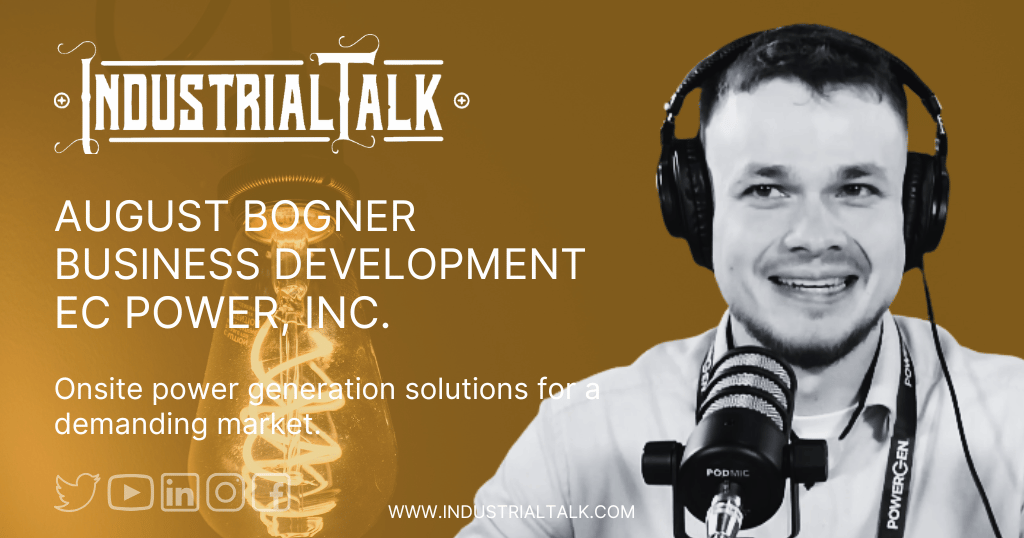
Industrial Talk is onsite at PowerGen and talking to August Bogner, Business Development Manager at EC Power about “On-Site power generation solutions”.
If interested in being on the Industrial Talk show, simply contact us and let's have a quick conversation.
Finally, get your exclusive free access to the Industrial Academy and a series on “Why You Need To Podcast” for Greater Success in 2026. All links designed for keeping you current in this rapidly changing Industrial Market. Learn! Grow! Enjoy!
AUGUST BOGNER'S CONTACT INFORMATION:
Personal LinkedIn: https://www.linkedin.com/in/august-bogner-466451228/
Company LinkedIn: https://www.linkedin.com/company/ec-power-inc/
Company Website: https://ecpower.com/
PODCAST VIDEO:
THE STRATEGIC REASON “WHY YOU NEED TO PODCAST”:
OTHER GREAT INDUSTRIAL RESOURCES:
NEOM: https://www.neom.com/en-us
Hexagon: https://hexagon.com/
Arduino: https://www.arduino.cc/
Fictiv: https://www.fictiv.com/
Hitachi Vantara: https://www.hitachivantara.com/en-us/home.html
Industrial Marketing Solutions: https://industrialtalk.com/industrial-marketing/
Industrial Academy: https://industrialtalk.com/industrial-academy/
Industrial Dojo: https://industrialtalk.com/industrial_dojo/
We the 15: https://www.wethe15.org/
YOUR INDUSTRIAL DIGITAL TOOLBOX:
LifterLMS: Get One Month Free for $1 – https://lifterlms.com/
Active Campaign: Active Campaign Link
Social Jukebox: https://www.socialjukebox.com/
Business Beatitude the Book

Do you desire a more joy-filled, deeply-enduring sense of accomplishment and success? Live your business the way you want to live with the BUSINESS BEATITUDES…The Bridge connecting sacrifice to success. YOU NEED THE BUSINESS BEATITUDES!
TAP INTO YOUR INDUSTRIAL SOUL, RESERVE YOUR COPY NOW! BE BOLD. BE BRAVE. DARE GREATLY AND CHANGE THE WORLD. GET THE BUSINESS BEATITUDES!
Reserve My Copy and My 25% Discount
Transcript
SUMMARY KEYWORDS
EC Power, CHP systems, power generation, cogeneration, micro CHP, heat production, electricity generation, building efficiency, natural gas, propane, energy demand, grid strain, on-site generation, thermal demand, energy savings
-:Welcome to the Industrial Talk podcast with Scott Mackenzie. Scott is a passionate industry professional dedicated to transferring cutting-edge, industry-focused innovations and trends while highlighting the men and women who keep the world moving. So put on your hard hat, grab your work boots, and let's go. All
right, once again welcome to Industrial Talk. Thank you very much for joining the number one industrial related podcast in the world, in the universe. It's even bigger than that. That celebrates industry professionals all around the world. You're bold. You're brave. You dare greatly. You innovate. You collaborate. You are solving problems each and every day. That's why we celebrate you on Industrial Talk. You guys are wonderful. That's why we just we just think you're wonderful. All right, we're broadcasting on site. Power Gen is the location. We are in San Antonio, and if you're in the world of power generation, if you're in the world of supporting power generation, you needed to be here. If you're not here, you need to be here next year because you get great people, you get great problem solvers like August. I knew it was August. I had to look down on it. I was just-I didn't want to screw up your name. But you-you know-you wrote. What's your last name? Bogner.
Bogner. Yes. Well, at least that's what I go by here in the U.S.
Don't understand. Expand upon that. What do you mean by that?
Well, I'm from Denmark, and in Danish it would be Bona, but nobody could really say that. So Wagner's what I go by here.
Really?
Yeah. Well, it works.
You guys have been in the news
just a little bit lately.
Yeah. Yeah. Do you live there now?
I live in Rhode Island right now.
You live in Rhode Island. Yeah,
moved about a year, almost a year and a half ago. I moved from Denmark to Rhode Island.
That's that's quite the move.
It is. It's been fun. It's been interesting.
I bet it has.
Yeah.
What foods do you miss?
Oh, I don't even know where to start. There's, you know, I'm not. Some people have, you know, they have enclaves of, like their people from their country, so they can get their food once in a while. I can't.
No, it's, it's. You don't have many enclaves of right Danish, right? You know, Danish enclaves. But what, what food? Give me one food that you miss.
Fliskestai.
Yeah, Which is what?
That is a. It's a. It's a pork dish. It's always you know. It's it's like a pork with skin on. Skin gets crispy. Crispy. There's gravy, potatoes, cabbage. It's. I love it. We have it for Christmas every year, and it's probably my favorite. Oh,
it just sounds divine. Are you having a good conference?
Yes. Why? It's been it's been quite interesting. There's so many different people here.
Yeah.
You know, you have pretty much the whole chain of you know the whole value chain is represented here. I've talked to quite a few people actually that are interested in distributing our products and working with us, and you know that's ultimately that's what we're hoping for when we go to things like this. So it's been great.
Yeah. So give us a little background on who August
is. Well, I am 24 years old from Denmark, as you know. My father started the company EC Power that I work for now.
No way.
I, I joined in in Denmark in:yeah you started when you were you're still a pop
well I mean I was, Ian. I was in this situation where I never really was very good in school. I wasn't. It just felt like school wasn't for me.
Yeah, yeah.
And and so I I was also like I was always like after high school I'll I'll probably just start working on something,
yeah.
And it came pretty naturally. I mean, I growing up with with my father who started the company. I sort of was, you know, adjacent to it my entire life, and and so I just figured, you know, the experience I get there is probably going to be just as valuable as some. Oh
yeah,
some education that I can just barely force myself.
Yeah, no, I agree with you 100% So, with EC Power, give us a little background, just just about the company. What what what are you serving? What what is it? What does EC stand for, by the way?
That is the age-old question everybody asks. The official explanation is that it's easy, and then people say, "Why isn't it easy? And I can't tell you. I don't know.
I'll take it. I'll move forward. So tell us a little bit about the company. Yeah,
we manufacture small combined heat and power systems. In well, maybe I should start with what that is. Yeah, I was
just you just jumped to the because I was getting ready to say what is that? Yeah, right, right,
right, right. Yes, I think if you're not familiar at all, one of the the best ways to understand it is every single building needs heat, and every single building needs electricity. And currently, almost all buildings have a boiler for heating, and you know the electric supplies electricity, so you buy from the utility. And what a combined heat and power system is is a system that produces electricity and heat on site. Is that like
sort of cogenish? It
is exactly cogen. Combined heat and power, co-gen. Those are yeah good terms. Okay,
thank you. Continue. I didn't want to rain on your parade when I'm going. No, absolutely.
So that's the idea. That's what we do. We've been doing it for 30 years this year, and our systems are small, so light commercial, commercial. Here in the U.S. we offer one system currently, which is 24 kilowatts. In Europe, we have some some other models, but they're all smaller. We're trying to work. We want to get some traction with the model that we have currently in the U.S. before we start introducing new things. So,
so what would be the the it's primarily buildings that what what right? Give me the application. Yeah.
So the most of our applications are in buildings such as hotels or schools, nursing homes. Really, you know, it's really any application that needs a lot of heat and a lot of power, you know, and as constant as possible. The the more constant the demand, the better it is for CHP, generally speaking.
Fuel, multi-fueled. You take natural gas, propane. Yeah, our
our system does.
Your system does. Yes,
absolutely. I can't speak for all cogens out there, but well,
no. I mean, and in in fact, you know, truth be told, cogeneration means that it was always like a a turbine solution, superheating water, steam turbine, you know, and and of course extracting as much energy out of that whole chain. So,
yeah, yeah. I think what you're talking about is like sort of how it started. Yeah, and probably how a lot of people know know cogeneration
Yeah.
So I said ours are small. Technically, I think they they go under micro CHP classification, and so they they're small package systems. They go right into they actually fit through a standard door. It's um
standard door like standard door like a standard door like like a standard door. That makes sense.
Yes, sir.
That is fascinating. So, how many does EC Energy sort of have deployed?
Well, worldwide we have around 20,000 systems deployed. In North America, we're just getting started. We're around a. 100 units, but we are.
Yeah, look at got
to make it happen.
Well, yeah, you got to. I mean, it doesn't just you. You got to put toward the effort, but it makes sense. The the business. If I'm a building, how does how does your solution? And I need water. I need hot water. I do, but I'm my building is being fed by the utility. How does how does your solution fit into that you know standard model?
Well, what you do essentially is you go into the boiler room, and a lot of these commercial type facilities, there's two or three boilers, and most of the time, at least one of them doesn't really ever run. It's just for backup, and so what you do is you take out one or two of those, put in one or two of our systems, and then you get that same hot water supply, but you also get the electricity generation. And we want to size the system so that we don't export electricity usually. I
was just getting keep on going, which
is for regulatory purposes. Yeah, like in Germany, for example, has been a great market for us because we can our customers can sell the electricity. They can net meter for you know a good good rate, which has been great there. A lot of places in the U.S. you can't really do that. It's complicated.
Hey, it's Scott Mackenzie with Industrial Talk. IRISS is the global leader in electrical maintenance safety, delivering technologies that let team inspect energized equipment safely, using closed panel condition-based monitoring to reduce risk and downtime. Their patented infrared and ultrasonic inspection windows make it possible to detect issues early, boosting reliability and protect the people who keep the operations running. If improving safety and avoiding unplanned failures is your mission, IRISS has the solution to get you there. Learn more at IRISS.com. How how would you in in with that objective, with that goal, with that that focus to be able to just size the generation component? Of course, you have to size the water. You have to size them both. You can't, you know. How do you address that? That scalable. Let's say I'm a building and I'm growing and I and I and I need more. How how do you reconcile that?
m, you know. So you could put:Because it's interesting because if I if I went and I was saying yes, I like EC Energy and I like the solution, I like what it delivers. Are we saying that your your value proposition from a from a cost perspective is it comparable to let's say maybe a utility cost per kilowatt? It
is. I mean, this is one of those people often ask the question of what is my cost per kilowatt hour with your system, and it's it's a little bit difficult to answer just because there's two components to it. There's the value of the heat that you're producing. That's what I was getting. Yeah, yeah. Electricity. If you if you want to just speak in broad terms, you're looking at probably in New England, for example, we have quite expensive electricity, so you're looking at maybe a quarter or third of the price per kilowatt hour when you add everything up. So the savings are quite substantial.
See, that makes sense because also you have that that thermal component. You know, you just have the the energy component, then you have that thermal component of the the water,
yeah.
How if you're if you're moving away from from a boiler type of setup,
right?
What happens if the demand for water? I'm I'm not I don't need hot water right now. What what happens?
No, it depends on the application. There's usually in in the facilities that we go into. There is usually a demand for water almost constantly. Yeah,
you you'd have to. I would imagine.
But you know, when there's no demand, it doesn't make sense to run the system. In some applications, it makes sense to reject heat. If you, if for some reason electricity is really expensive or something, you really need that electricity to generation, you can reject heat, just vent it to the outside. But we never, you know, we like to not advocate for that because it doesn't really fit the efficiency. Well, no, it doesn't. No, it it
would seem to me that my focus, if I was a a building, right, and I need I need hot water, whatever that is, whatever that, and and it's almost as if the generation component is sort of the secondary discussion because because I need water, I need it hot. That's my primary reason, and and the the generation component to your solution is just what great. Yeah, it's just one of those things. But I need hot water.
Yeah, no, no, that's that's that's a really good insight. I mean, there's people tend to look at it either as power first, yeah, or hot water first, and hot water is is usually how we size the systems. Yeah, CIO demand. So right, it makes sense that that you're looking at it that way, and and it's how you get the best runtime because C
you're you're saying I have a consumption rate of hot water at X, and then that that just means I need a compatible generating unit of this, and because this is all and and I know that I have this water demand of that, so I'm good, and it's I'm not going to get into a situation where, if I'm looking at it from a power generation perspective, there might be, well, what's happening with your water demand? That that to me seems
right.
Where do you where do you see it going? What what what sort of that horizon of what what you're looking at?
Well, I think we're in an incredibly interesting time right now. We're in a period where the demand for electricity is just keeps rising.
Yeah,
you know everybody's talking about AI data centers. There's electric vehicles, heat pumps, and we're also in a time right now where there's people are starting to realize that we can't fix it all with just solar, it's going to be incredibly difficult, if at all possible. Solar and wind are usually the two main things people talk about. So there's sort of a realization that we can't discard gas in natural gas and propane, which is you know what our systems run on is very clean, and and we need that generation. And when you think about it, every time you put one of a combined heat and power system into a building, all that electricity that that system produces, the building doesn't have to get from the grid. That's right. So you relieve strain from the grid, freeing up those electrons to go somewhere else. Yeah, and you know, in the aggregate, that could that could be very meaningful.
Yeah, you're touching upon something that is really interesting from my perspective: is how do you create or remove inefficiencies from the existing grid? Because if they're not building, you know, more support of the grid, which they're not, because of multiple reasons. Then where is the inefficiency? Where does that exist?
Yep.
And and how do we how do we create a smarter type of you know grid and remove that?
Absolutely. And I think I think one of the things is you've got boilers in all of these buildings. Why not have that hot water supplied by something that also produces electricity? Yeah, it makes
sense.
I don't want to call it a boiler that produces electricity, but you can sort of, sort of think about it that way functionally.
Well,
there's always boilers, and they superheat the water, which then you know spins a steam turbine. It's it's a it's out there. It's
just
it's just
sort of you're modifying that model a little bit more. Yeah, that is you know that's that's that to me is really interesting.
And then I think the on-site piece is really important as well. I mean, there's there's no transmission losses or distribution losses. No, nothing. You're producing that energy exactly where you need it. Yeah,
yeah. See again to that that efficiency, like all of that loss that exists out there today, which is tremendous. How do we how do we do it in a you know a brighter way? How long? How long does it? If a company came to you and said, "Hey, I'm interested, how how quickly can you deploy your solution? And I know it's like, okay, I got it. I got
it. I understand. I mean, from our perspective, we can we can ship them out same day essentially. The question is, how quickly is the project gonna progress, and what regulatory hoops are gonna have to jump through?
Yeah,
and it really depends a lot. If the if you have a customer that's very called ready to go, yeah, have a great appetite for it already, it could be it could be fairly quick a couple months or so. There's there's some engineering work that has to be done usually around the the heating system, but it inspires easily, and then the the regulatory piece is actually what takes by far the longest.
I I truly hope that that we can streamline that.
I
because they're talking nukes, they're talking nukes, and they're trying to you know these these package nukes. They're they'll never get deployed if they have the these the traditional regulatory hurdles that happen, and I'm I'm hoping that we can streamline that most definitely. And
it's and it's interesting. And there's um we have our systems need to be interconnected with the grid, and the interconnection approval process is excuse me kind of ridiculous. Yeah, we're we're being more or less seen as, yeah, like a real power plant, a big power plant. Whereas we're very very small in the system, right? You know, one system, one unit is not gonna do much, and so, but we still have to pretty much jump through a lot of the same hoops, which is
really surprising when when they're connecting, you know, Teslas to to the you know the the distribution side of the grid, right? They're connecting
it, right?
Do they have to go through so many hoops, or is it just?
Well, I don't know. I don't know either. I don't either. Not exactly in in that world.
Are you are you vertically integrated? Meaning, do you manufacture these units yourself?
We do. So we have suppliers from you know a bunch of different places. We manu we assemble everything in Denmark. A lot of our components are designed in-house. We have 27 patents, but then, you know, manufactured somewhere else. We put it all together.
Yeah.
We hope. We hope to establish some manufacturing here in the U.S. Once we have a little bit of traction, that's our sort of our goal.
Yeah. Why not? Medium term. All right. As we wrap up, we need to get a contact information for you.
Absolutely. Yes. I mean, you can find me on LinkedIn. There it is. August Bogner. There it is. Always happy. That's
what I like. You were absolutely wonderful. I love that conversation. Thank you very much.
Thank you. All
right, you got to connect with Austin. Thank you for August, not Austin. Just like Austin is over here. August is right here. There it is in Austin over there. Yeah. Anyway, you got to connect with him. We're going to have all the contact information for August out on Industrial Talk. So fear not. Reach out to him. He's a good guy, and he's got some mad skills. We're broadcasting from Power Gen. As you can tell, not as much buzz right now, but there was buzz, and it is in Austin, Texas. No, it's not in Austin, Texas. Everything, oh man, jeez, I'm all I'm all befuddled here. San Antonio, put this on your calendar if you're in the world of Generation. If you're supporting Generation, this is the show for you. All right, we're going to wrap it up on the other side. Stay tuned. We will be right back.
You're listening to the Industrial Talk Podcast Network.
Yep, this is on everybody's mind. Power generation. How do we satisfy the power generation requirements in a market that's expanding, in a market that's focusing on data center, in a market that needs power yesterday, Power Gen is the event for you. You get to collaborate. You get to collaborate with some of the best in the world. It is January 18th through the 21st. It is in Salt Lake City. All the contact, all the information is out on Industrial Talk. It is a must. I will be there. I will be broadcasting. I will be having the conversation from leaders that are shaping the future. That's Power Gen, January 18th through the 21st, Salt Lake City. See you there. All right, the hits just keep coming from Power Gen. That is an absolutely incredible event. Just is. That one you put on your calendar. You say, "Hey, here's a." I look out at the landscape, and I'm looking at conferences at 210. This one bubbles up to the very top. You need to be a part of that. That conversation is important. You know as well as I do. We're having that conversation all the time. August, EC Power. All his contact information is out on Industrial Talk. It's an exciting. It's really an exciting time. I'm, I'm just giddy. I wish I was younger. Wish I wasn't so gray a ball. Yeah, and I wish I was better looking. I wish all of those things. But anyway, power generation is an absolute amazing industry that you need to know more about, and find individuals that you want to connect with that can solve your challenges. And they're all out on, you know, out there and and power gen. You know, like the promo said, yeah, you're talking about it. Everybody's got to do that. All right, Industrial Talk wants you to succeed. We have. We are a marketing company. We are a media company. We are a promo company, and we want you to succeed. We come from the angle that we know industry, and we do. We're big into power generation. We're big into utilities, TND. We're big, big, big, big, and and manufacturing. Yes, we're in it all. That's why we're called Industrial Talk. Here are four things that I want you to take away. One, you need to tell your story. Two, you need to tell your customer story. Three, your prospects. You need to reach out to them in the world of media. That's exactly what you need to do, and you need to broadcast from events. I'm telling you, that is disruptive, that is successful, and all you need to do is go out to Industrial Talk, connect with me. That's it. That's that's that's all you need to do. All right, be bold, be brave, dare greatly. Put Power Gen on your calendar. Reach out to August, and you're going to be changing the world. We're going to have another great conversation shortly. As always, stay tuned.