Rob McGreevy with AVEVA
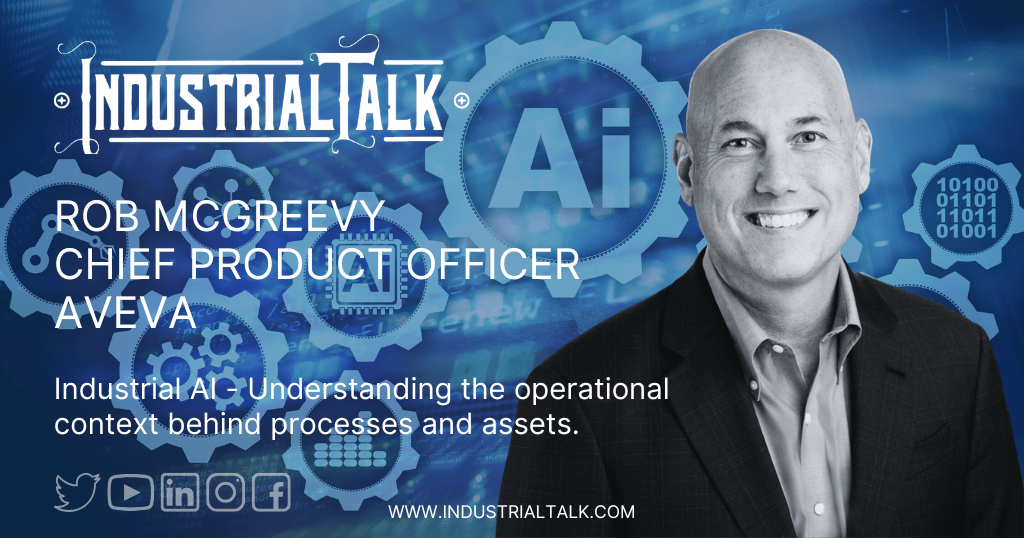
Industrial Talk is talking to Rob McGreevy, Chief Product Officer at AVEVA about “Industrial AI – Operational context behind processes and assets”.
If interested in being on the Industrial Talk show, simply contact us and let's have a quick conversation.
Finally, get your exclusive free access to the Industrial Academy and a series on “Why You Need To Podcast” for Greater Success in 2026. All links designed for keeping you current in this rapidly changing Industrial Market. Learn! Grow! Enjoy!
ROB MCGREEVY'S CONTACT INFORMATION:
Personal LinkedIn: https://www.linkedin.com/in/rob-mcgreevy-904296/
Company LinkedIn: https://www.linkedin.com/company/aveva/
Company Website: https://www.aveva.com/
PODCAST VIDEO:
THE STRATEGIC REASON “WHY YOU NEED TO PODCAST”:
OTHER GREAT INDUSTRIAL RESOURCES:
NEOM: https://www.neom.com/en-us
Hexagon: https://hexagon.com/
Arduino: https://www.arduino.cc/
Fictiv: https://www.fictiv.com/
Hitachi Vantara: https://www.hitachivantara.com/en-us/home.html
Industrial Marketing Solutions: https://industrialtalk.com/industrial-marketing/
Industrial Academy: https://industrialtalk.com/industrial-academy/
Industrial Dojo: https://industrialtalk.com/industrial_dojo/
We the 15: https://www.wethe15.org/
YOUR INDUSTRIAL DIGITAL TOOLBOX:
LifterLMS: Get One Month Free for $1 – https://lifterlms.com/
Active Campaign: Active Campaign Link
Social Jukebox: https://www.socialjukebox.com/
Business Beatitude the Book

Do you desire a more joy-filled, deeply-enduring sense of accomplishment and success? Live your business the way you want to live with the BUSINESS BEATITUDES…The Bridge connecting sacrifice to success. YOU NEED THE BUSINESS BEATITUDES!
TAP INTO YOUR INDUSTRIAL SOUL, RESERVE YOUR COPY NOW! BE BOLD. BE BRAVE. DARE GREATLY AND CHANGE THE WORLD. GET THE BUSINESS BEATITUDES!
Reserve My Copy and My 25% Discount
Transcript
Rob McGreevy Audio Conversation
,:SUMMARY KEYWORDS
Industrial AI, AVEVA, Software, Manufacturing, Workforce, Data quality, Digital twin, Automation, Power generation, Cybersecurity, Infrastructure, Energy markets, Design tools, Process optimization, Industrial software
SPEAKERS
Speaker 1, Speaker 7, Speaker 5, Speaker 4, Speaker 2, Speaker 3, Speaker 6
Yep, I'm thinking about it. You're thinking about it. Everybody is thinking about it. What do we do to rebuild America's workforce, restore America's capability? It's all hands on deck. We need solutions, and everybody needs to be part of the solution. Here's an event right there, right behind me, as you can tell, that's Build Freedom Summit. Yep, October 20 to the 21st. It's in Galveston Island Convention Center, Galveston, Texas. You just go out to BuildFreedomSummit.org, find out more. Be a part of the solution. Don't just sit on the sidelines and just complain because you can't find anybody. You need to be a part of it. I'll be there. I'll be broadcasting. I'll be speaking with some of the most passionate individuals that are focused on rebuilding America's workforce. Again, October 20 to the 21st, Galveston, Texas. You got to be there because I'm going to be there, and I want to talk to you. See you there. Yes, you need to get your cybersecurity house in order. You need to attend the Barcelona Cybersecurity Congress that is November 3 through the fifth, and meet the best cybersecurity leaders in the world to help you along on your cybersecurity journey, and who are protecting our future. Enter promo code BCCPODCAST26 and get your discount. I will be there. I would like to see you there. Talk soon.
Welcome to the Industrial Talk podcast with Scott Mackenzie. Scott is a passionate industry professional dedicated to transferring cutting-edge, industry-focused innovations and trends while highlighting the men and women who keep the world moving. So put on your hard hat, grab your work boots, and let's go.
up. I notice it's next year,:How do we build this workforce of the future, and you as a private company, you can be government, whatever you want, but you need to also participate. All hands on deck. You need to succeed. All right, let's get on with the conversation. AVEVA is the company. Rob is the individual. As I look off to the side to a stat card, and you know, as you scroll, you realize, yeah, he's pretty smart. Anyway, it was a great conversation, and we go to the same barber. Quite frankly, you know what that means. Anyway, let's get on with the conversation. Here's Rob. Rob, welcome to Industrial Talk. How are you doing today?
Today, Today, today, today it's it's a good day. I'm doing fantastic. Hey, what's the
weather like up there in Chicago area? Is it cool? Oh,
it's been a hot summer this year in Chicago for sure. Not cool, not cool yet, but but it's it's it's coming. I think it's coming.
Yeah, well, I'm we're in Louisiana, and it's it is just it's real bad.
Humid, humid. I assume no.
Yes, it is big time. Okay, so you're up in that area. What sports team do you follow? All the
Chicago teams definitely Bears, Cubs on the baseball. Okay,
so I have to ask the Bears a question. What about them leaving Soldier Field.
Oh boy! Oh boy! Don't don't know where that's going to end up. But my guess is that they don't leave Soldier Field in the U.S. You can't. Let's see. Let's see what happens. It's the monsters of
Midway. You can't do that.
I know. See, I I
grew up in California. My team was the Rams, L.A. Rams, way back when, right? And then they decided to go to St. Louis. I wrote them off. I wrote them off. And even they went back to L.A. Don't like them because of that
move.
Don't do it.
There's a lesson in that. There's a lesson in that.
Not much. You know, definitely no leverage or swag in that particular statement. That was just me as a kid going, "How dare you leave? How dare you? And then they brought down Oakland and they did the Raiders, and it's like, "Nah, that's not the same. Never mind. I digress. All right, looks like we're going to be talking about AI. Great, that's not a topic of conversation that I have all the time?
Yeah, I bet.
Yeah, but it but it's it's it's it's necessary, and we need to do it, and we need to find people like you to help us along on that journey, and your company of Eva and all that stuff. But before we get into that conversation, I need, and they need, and we need to know a little bit about Rob. What's his? What's Rob's background? What makes him such a great professional? Talk to us.
Sure. So I have been in the industrial manufacturing and critical infrastructure markets for my whole career. I don't really know much else. All software all the time, but the software that we do in industrial is you know talks to a lot of machinery and equipment, and so that's that's what I've been doing for the last 30 years, largely on the, like I said, industrial software side of things, which is basically designing and building software that's used by, you know, power plants, food plants, pharmaceutical plants, energy facilities, refining. Name anybody that makes stuff that use software, and and that's kind of where I landed.
Well, I cut my teeth. Yeah, I was a lineman for Southern California Edison, so I was climbing towers. But I have a very very soft spot in my heart for anything that deals with power, utilities, all of that. That's a that's a challenging market these days.
It is indeed, and it is indeed because it's gone from well, a lot's gone on there, but it's gone from essentially a fairly steady state base load kind of world to this intermittent world of wind, solar, and a quite complicated grid configuration. You know what I mean? Yeah, yeah,
it's a demand side. You know, now they're shipping shipping power through that that that transformer onto that distribution network, and I, I Scott, when I was there, and I was a part of the speakers bureau of Edison, I would go to the system operator, and it was very easy to watch that individual mash, you know, load and demand, and and be able to do that. And it was linear, right? You had a generator, you had transmission and substation, and so on, and all the way down to Joe Blow in that house. Now, I I don't know how they I don't know how they manage it. That's where you come in. That's where technology. Well,
software software certainly helps make a difference in trying to make to balance all these complicated systems and sources and factors. But yeah, that's and that's that's what we do at AVEVA, the company that I work for. You know, we've been doing the industrial thing since the late '60s, culminating in in in in all the software that you see today. And honestly, a lot of it is utilities and energy markets, like like you. We we sort of cut our teeth in a number of our software solutions in that space. You go?
Are you going to PowerGen, which is a conference in wherever I think it's Salt Lake? Are you going there?
I'm personally not going this year, but our we have delegates that go to most of the utilities and power events worldwide.
Okay, what about Distributech
Of course, definitely be at Distribute Tech.
There you go. Let's see. Are you going to be there? Because I'm trying.
I am trying to go this year. I didn't. I missed last year, but I was there. It was two years ago or three years ago.
Yeah, I was there. I was broadcasting. Yep.
All right.
Talk about! I'm like a kid in a candy store. When you look at that that setup, and you look at all of the the the stuff that's growing. Jeez, times have changed. It's amazing for
sure. For sure.
Okay, let's talk a little bit about AVEVA. What what is AVEVA?
So AVEVA is a industrial software company. We make software that transcends the design-build space through to production operations. And so, EPCs, engineering, procurement, construction firms, A and E firms. We use our design tools, design software, to build very large, complex capital assets like power plants. So think like a nuclear plant or you know, a fossil plant, or or refinery, or offshore oil rigs. So we'll use that sort of software to design those things, and then as they move their way into the production operation space after they build them and construct them, our software essentially runs that production operation side. So the planning, the scheduling, the actual execution systems that tell machinery what to do in a manufacturing setting-that's the bulk of what our our software does. And we're we're known by a number of brands in the market. Some of the in the utility space, the OSIsoft or Pi system is like nearly found in all facilities and plants. Yeah, you might have heard of that Southern Caladdison days. Yes, I never knew that. Yeah, that's that's a better
person, Rob. I didn't know that. I just like what? That's right. Blast from the
past. Yeah, and if that's another one, is a lot of our SCADA systems, supervisory control, and data acquisition, like the Wonderware software system, is also part of AVEVA, found in the majority of manufacturing sites around the world. And and then on the yeah the design side and simulation side, we've got tools like E3D for for the 3D design space, and SimSy and some other brands that have been out there. So we've been we're around in most of the heavy process industries. Anybody, like I said, anybody that makes stuff, whether it's power, water, pharmaceuticals, they've got some of our bits that are helping them helping them do that.
Well, because the company's been around for a number of years, right? And you're entrenched in a lot of pretty pretty big, you know, verticals, which is pretty cool, right? There there are two things that that I've seen as I have these conversations. There was a big push, right? You can you can have all the the device. Right, all of a sudden, you're jeez, skin. It's not. You know, I'm. I'm. I used to teach this. I can't remember. I'm vapor locking. Sorry about that, but that's okay. I can vapor lock. So there are two things. One, we're collecting more data. Just are. And I. And and it was sort of a timing situation where, hey, all of a sudden I've got these devices. These devices I can stick on these assets, and then I'm pulling the data off of these assets. It's like, ah. By the way, the term is PLC and DCS. I couldn't remember that to save my doggone life. That's right. I used to teach it at a technical college, college age. I don't know. So now it's
still prevalent, by the way. Very still runs on those very devices.
So I'm pulling data, and it seemed like a timing situation. Now I now I got the data, but I had no ability, or I had limited ability, to be able to say what's going on with that data, where's the gold in that data, you know, what what insights can I glean from that data what tactical action items, things like that. Then all of a sudden, it happened. AI. Now all of a sudden, you got this AI. Take us through that whole industrial AI from an AVEVA perspective. You see, they they've seen changes. Now this is this is huge.
Yeah, yeah, it's enormous. I mean, it's the impacts are quite quite exciting. So to kind of take you through it, it starts with like you said, the data. I mean, all this data is sort of sourced from this collection of devices, systems, and sources. Whether it's PLCs, programmable logic controllers that you were alluding to, distributed, you know, control systems, remote terminal units. So just this whole dog's breakfast of systems and sources that feed telemetry, real-time process. I'm going to use dog's
breakfast. I'm going to use that. I like. It just seems
like it sort of fit, but that is the that is the you know the the state of manufacturing. There's a lot of different systems and sources. There's not one, you know, type of device or one brand of device or one protocol. And so we we sort of sit in the centerpiece of that, where we capture and collect that data from all these different systems and sources. We also control those things, so we don't just capture it. But that's a maybe a separate topic for us, and that's that's the cornerstone of all these AI endeavors because for AI to make sense of things, to to make judgment calls, assessments, analysis, it needs to have high fidelity process, production, design data put in the right context so that it can be trained on doing industrial things. Like that's the simplest way to kind of put it, and that's where we're in a you know a unique position because, well, for the last almost 60 years, we've been building these systems and sources, amassing tons of data, and as you alluded to, there's just more and more sensor data that just keeps getting lit up or added to the stack, and we plug that into this infrastructure that we call Connect. This AVEVA Connect is like a data platform, and on top of that, we enable different forms of AI to solve different problems across that life cycle I described-that design, build, operate, and sort of optimize life cycle.
Yeah, and so
that-that's what we're all about. And it's been an incredible time for our industry. I mean, just dramatic changes.
How do you deal with the quality of data? Let's say I have legacy systems, and I guarantee you, those legacy systems has maybe some questionable data, but still maybe some data that is very valuable to create that history and and to be able to what's what's the policy or procedure for AVEVA you your team to go back historically and try to scrub some of that data.
Well, the good news is once it makes its way into our systems, the SCADA systems, the process historian systems, it's usually fairly hygienic, fairly well cleansed. But to answer your question, going back, we essentially institute different standards for defining what clean and sort of accurate and I'll just say relevant data looks like. So we have standard templates that essentially go through, troll through data sets, make sure that they're applied and mapped to the right data types and sources. We have algorithms that look for things that are out of bounds, like you know a sensor can't give a certain reading above or below a certain threshold. So there's a lot of a lot of rubric, a lot of process that goes into how we kind of filter these things, and the software tools today allow you to kind of do that in a real quick and easy way. So, but I'm glad you brought it up because in a lot of cases, that is the first step for customers in in this space is to get a good baseline of clean, trusted information into your system.
You do it if you if you're going to stick it in some sort of agent or whatever your AI solution, you don't want that that AI solution coming to you and saying no, it's it's X when it should be Y. You don't want that
exactly because the stakes are high. I mean, this isn't like stakes are real
high.
It's not like AI is going to you know send you on the you know if it if it gives you. Bad advice about some place to go on a trip-that's one thing. But if if AI gives you bad information about a process condition that can, you know, cause a problem in a power plant or a contaminated product, that's a big deal. And so we take that obviously quite seriously.
Yeah, every time when I used to deploy systems, that whole conversation about data, you know, and pencil whipping and quality of that data, and everybody said, "Well, we're going to go back and we're going to we're going to clean that data. That's always the first question, or always the first statement. And then about a week into that whole process, everybody's tapping out, saying, "I I can't do this. This is just we got to figure out another way of being able to sort of ensure that we have these this great information. All right, so here we are. We have AVEVA. AVEVA's sitting in the middle doing AVEVA stuff, and and how how do you? Because let's. I'll give you the analogy. So I'll go to the. I'll go to some sort of technology store, right? And I'm looking for a flat screen TV. Hey, that's a pretty cool flat screen TV. No, that's the price of the flat screen. It's a 15 $2,000. There it is, right there. I know in my heart that one week later there's going to be a better flat screen TV, and that one's going to be less. How does AVEVA ensure? How how do you deal with the dynamics of that data AI, you know, processing market? Because it's going to change. It's always changing. It's like cyber security. It's it's always changing. How do you deal with that?
Yeah, it's a good point. Look, not only is it going to continue to change, but it has been changing for the last decades upon decades. And the way we do that is we design and build our software so that it can be kind of evergreen, in the sense that it's always kind of being updated and updated. You know, if today's fashionable model happens to be OpenAI, but tomorrow it's you know X Y Z company. We make it so you can plug in those different LLMs. In that case, the protocols of those PLCs and VCSs you were talking about earlier, those things keep changing. They get more secure. They get more reliable, but they change. And so we make sure those those interfaces are all kind of up to date. So the very nature of our software, the premise upon which we've sort of built the decades of install base, is on that sort of evergreen, always upgradable and migratable, so that we can keep on top of these technology trends, and customers can take advantage of it, kind of where and when they when they're ready to, because as you know, each each industry in this space a little bit more a little bit different. Some are a little more risk averse than others, and we've we've found that that's been a really good approach.
Yeah, it it speaks to the architecture of of your platform. You know, you're not pinning yourself into a corner and saying, "Ah, we can't do it, or "Ah, we got to do that. It there are some solutions that exist out there in some of these companies, these technology stacks that that they've just you can't you can't get into them. It's just they're not nimble enough to be able to address the changes in the market. It just just not they're not slamming. That's right. Could be accurate.
Yeah, no no names mentioned. But you're right. It's zero. It's an important thing because that open we we call it open, neutral, agnostic, if you like. You have to be able to plug and play these different systems because, as I mentioned, the dog's breakfast earlier. It's a it's a lot of different equipment and information. And like, if a vendor or if a manufacturer decides to replace a new packaging line or a case palletizer or a mixer or a blender, it might come in with a totally different brand of of PLC or control system or protocols, and the software needs to be able to adapt to that. And so that's been probably the reason we've been around for so long, is we've just been able to plug into all these different systems and sources and kind of evergreen.
Especially now, and you brought up manufacturing. I have manufacturing conversations all the time, and one of the things that is constantly being hammered on manufacturers, of course, they're they're pursuing automation. They're I can't find people. I got to automate. I got to figure out ways of being able to deal with that gap. Is always how do I improve the quality of my end product because as the market is demanding that the technology can get you there and say yeah you got better quality whatever it might be but your your company again are constantly being inundated because I'm going to bring in another line that line is going to be more automated and now here's this this is how we're going to you know it's a it's a big investment. Here we go.
That's right. That's right. Well, that's the other dimension of it. It's it's not just that the equipment or the data sets themselves change, but the way in which we manufacture new products changes. And there's also been you know the the lines between like discrete product. Like think about like widgets, like a laptop or device, or a process where you make continuous process, like I'm making water, power. Even a lot of those are kind of coming together, and that necessitates software that can adapt to different processes about how you make something and then how you put it in a package or a bottle. And a good example is like drug delivery devices. It's you make a you make a medicine, but you put it in maybe one of those pens and you inject it. Right, becomes like an injectable. That's part discrete device and and part liquid pharmaceutical. Those things come together and it's it was quite an interesting time. But you're right, it necessitates really complex software to be able. You better be
nimble. You better be nimble. Yeah, it's it's a remarkable time. It's such a renaissance from my perspective. I because I get to I get to listen to all of the you know all these great stories, and it's it's just fascinating. It's just and and you know what the challenge that I always sort of stub my toe on is I'm a person. I'm a human being, right? I have to process. I I am not as fast as maybe the way technology is evolving and growing and pushing and all of the these you know these teams of people that are coming up with new use cases. Hey, we could use this, and you know me. I'm being left behind, but I know that I have to. I have to evolve. I have to grow. I have to to be competitive to create that, or to retain a resilient business going forward. I have to do it. I am overwhelmed. My ears are bleeding. My nose are bleeding. You know, because how? How do you? I just. I. It's always fascinating because it's always a human story. Technology is a technology. See, human story.
Very true. Very true. And I think that's true with AI. Even you know, there's a lot of talk about where does AI replace the people? Is it part? Does it extend the people? Does it help us? So there's always that that angle too of this confluence of like the tech piece with the with the human side.
You want you want to know a funny story. When I had AI, I got whatever, whatever Microsoft's version right there. I have it, and then I, I, I, I hate, I hate emails trying to come up with the words of the emails, right? So what I started doing is like, I'll just dump my my thoughts down on a on a on an email, whatever. I don't know. Then I have I have AI clean it up, right? And it's like, wow, that check that out. It all starts sounding the same. That's one thing. And then two, that part of my brain starts to atrophy, and then I'm I'm not able to do anything
more.
And then I came to the you know the epiphany of saying you better you better up your game scott and stop doing it. So I I write everything just because I'm not going. I again I'm not going to retire. No retiring
on this
side. I'm a valuable contributor to society, just like you are.
Yeah. Well, I think the thing about the AI is like you're right. I mean, it certainly can cause you to atrophy skills as a human if you're not careful. But it also can, you know, it can be a great productivity gain, like a way for you to kind of troll through info to do stuff like that really is incredible. And in industrial, like our world, what's really exciting is like we're using AI to help designers do like design layouts. So if you take like that we talked about the EPC thing earlier, the engineering procurement construction. So we use AI now in like doing pipe layouts, cable trays, and stuff. Whereas before, someone would sit in a CAD drawing in a laptop and route pipes across a 3D space, like for a power plant or chemical plant. And now we essentially have AI like do the connection endpoints, and we say, "Hey, give me a number of iterations. Design for me the best pipe routes between these two endpoints based on physics, flow rates, materials, elbows, all this stuff, and then it can give the designer three choices. And so, on the one hand, you might say, "Well, it's spectacular, but no, it is spectacular because you
still need that human individual to say, "I like option two, and here's the reason why I like, and it follows it through. No, there's no, there's no atrophy, and it's just the fact that hey, that's that's smart. That's smart stuff. I I I don't know what the future has, so I have to ask you, Rob, put that future hat on. Where do you see it? I mean, I I don't know. Quantum computing, there it
is. Yeah. Well, that's a whole nother leaf. I
know it's gonna. You know what's going to happen? It's going to somebody's going to crack that code. I don't know who. Just like they did with AI, all of a sudden we didn't have one day. The next day somebody flipped the switch, and there it goes. Somebody's going to crack that code, and we're going to have quantum. And it's just that's
right.
There you go. That's right. That's my prediction. I could be completely wrong.
No, I think that's a. I think. It's a good prediction, especially one with where we're not really sure when that will happen, but we know it will happen, right? Yeah, yeah. But I think for for me, more nearer term, the AI thing was it's just going to continue to evolve, and it's just going to continue to be ingrained in everyday life, just like the internet technology base of that. Then it just had these pervasive tentacles into everything from commerce to medicine to entertainment, AI will be the same way in industrial. I think for us in the near term, there'll still be the human in the middle. So AI will be advising operators, maintenance techs, machinists on how to do things, how to perform things. Just like the S in SCADA is supervisory, it means there's a human before they push a button and do stuff, I think you'll see that with with the AI pieces. But then over time, I think we'll see a lot more AI implementations to do the actual control and advanced algorithms that you see in like chemical plants, refineries, and stuff within a very narrow band, a safe sort of narrow band of AI. But I think it's going to be have quite an impact, and look, we're already seeing it today. I mean, already seeing huge benefits for AI implementations.
You know, when you start talking about process manufacturing, oil and gas, whatever it might be, and and those are very complex systems, but they're also Dangerous, potentially dangerous. I see a real safety benefit from from these tools. Yeah, you know, is I just and and to be able to respond quickly and see the trends and whatever. The other thing that I see happening is I let's let's say I have a a system that is, or a business that has pumps over here and valves over there, but they're not bound by walls. Utility, you know, you got a tower over here, and it's like the it goes all over the place. But to be able to have the data coming in, saying that you got to go out there, take this tool, use this, you know, you know, part. Go out there, and it just notifies you, and you just go out there and you take care of it. That to me
is pretty spectacular. No,
that's right. I mean, increasingly too, every manufacturer and everyone who's in critical infrastructure has a digital facsimile of their plant process equipment, and it's the digital twin called a digital twin. I interviewed the guy that came up with
digital twin. Is that
right?
Yeah, I can't remember his name, but I I remember his face. Yeah,
but there's a reason, good reason for that because all the things you describe is if you have that sort of digital piece, like a digital view of your value chain, you can start to look at it through like different lenses or perspectives, like really look at the plant through the lens of maintenance, or through the lens of sustainability, or the lens of production, and that just allows you to do some pretty amazing things in a safe, you know, sustainable, responsible way.
Simulate the heck out of it, optimize it, simulate it, run it, do it again. Just keep going. I like
it, sir. That's right.
Well, Rob, you're you're a fan. Fun time, fun time. I enjoyed this conversation.
Yes, been good. It's been interesting. I had no idea you had a background in some of these things, which makes it always interesting.
Yeah. See, I'm I'm I'm already around 95 years old. I have I know it all. I'm I'm such a bore at parties. Now, if I wanted to get a hold of Rob, what would be the best way? You better say LinkedIn, because I just grabbed the link like this. Yes,
LinkedIn. That's best way to reach me. And of course, you know, if any of the stories, customers, or examples I cited are interesting, do you check out AVEVA, right at AVEVA.com, or any of the social platforms we're about. But
yeah, yeah,
that's where you can best find me and best find more information about AVEVA in our partner ecosystem.
Cool. Yeah, I like that. See, everybody I interview never one never dull, and then two always has a high beer factor, and three, you know, likes their job, so they're
absolutely well. That's that's definitely ticks the boxes for me. Great, great industry, great job, great people to work with. Makes makes life great. You know, I love it.
All right, thank you, Rob, for being on Industrial Talk.
My pleasure.
All right, listeners, we're going to wrap it up. On the other side, we're going to have all the contact information for Rob out on Industrial Talk, so fear not. This is a high priority connection. Yeah, five. I can't. I can't elevate it anymore. You need to be. You need to connect with Rob. All right, stay tuned. We will be right back.
You're listening to the Industrial Talk Podcast Network.
through the fourth,: