Samir Bounab Toledano with BlackOrbit
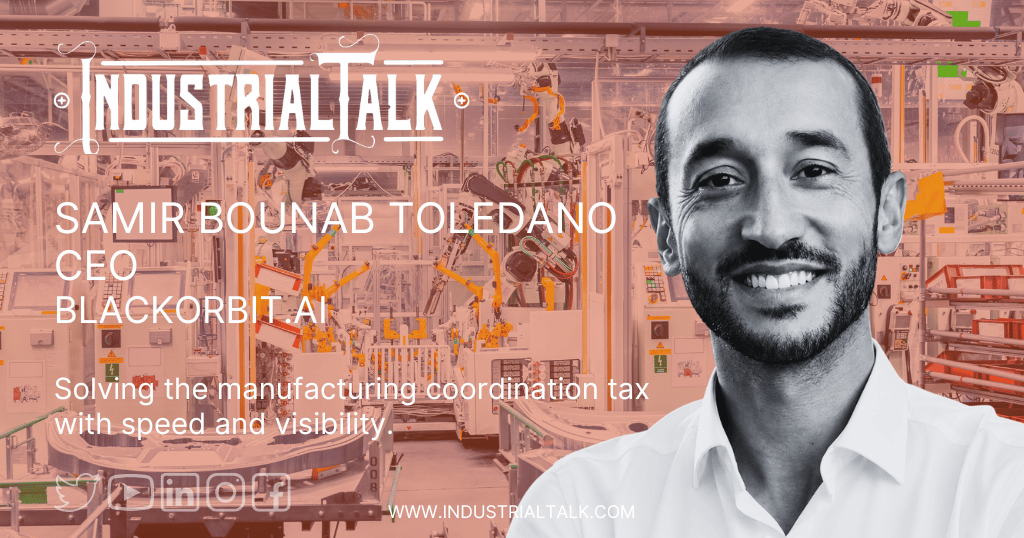
Industrial Talk is talking to Samir Bounab Toledano, Founder/CEO at BlackOrbit about “Solving New Product Introduction Coordination Tax”.
If interested in being on the Industrial Talk show, simply contact us and let's have a quick conversation.
SAMIR BOUNAB TOLEDANO'S CONTACT INFORMATION:
Personal LinkedIn: https://www.linkedin.com/in/samir-bounab/
Company LinkedIn: https://www.linkedin.com/company/blackorbit/
Company Website: https://blackorbit.ai/
PODCAST VIDEO:
THE STRATEGIC REASON “WHY YOU NEED TO PODCAST”:
OTHER GREAT INDUSTRIAL RESOURCES:
Industrial Marketing Solutions: https://industrialtalk.com/industrial-marketing/
Industrial Academy: https://industrialtalk.com/industrial-academy/
Industrial Dojo: https://industrialtalk.com/industrial_dojo/
Business Beatitude the Book
Do you desire a more joy-filled, deeply-enduring sense of accomplishment and success? Live your business the way you want to live with the BUSINESS BEATITUDES…The Bridge connecting sacrifice to success. YOU NEED THE BUSINESS BEATITUDES!
TAP INTO YOUR INDUSTRIAL SOUL, RESERVE YOUR COPY NOW! BE BOLD. BE BRAVE. DARE GREATLY AND CHANGE THE WORLD. GET THE BUSINESS BEATITUDES!
Reserve My Copy and My 25% Discount
Transcript
SUMMARY KEYWORDS
Black Orbit, Samir Toledano, manufacturing, NPI, coordination tax, efficiency, digital solutions, project management, AI, data quality, engineering, supply chain, productivity, software, innovation
-:Welcome to the Industrial Talk podcast with Scott Mackenzie. Scott is a passionate industry professional dedicated to transferring cutting-edge, industry-focused innovations and trends while highlighting the men and women who keep the world moving. So put on your hard hat, grab your work boots, and let's go! All
right, once again, welcome to Industrial Talk. Thank you, thank you for your continued support. Thank you for joining. Thank you for just being part of the number one industrial-related podcast in the universe that celebrates you, industry professionals all around the world. I say it once. I say it a million times. You're bold. Yes. You're brave. Absolutely. You dare greatly. You innovate. You collaborate. You're solving problems each and every day. You are without a doubt. Look up. Up. Doubt. I'm chopping the video. Making the world a better place. That's why we here at Industrial Talk celebrate you. You are, without a doubt, the heroes in this story. In the hot seat, the company is Black Orbit. The individual is Samir, and we're going to be talking about their product called Black Orbit NPI. NPI stands for New Product Introduction. Here's the reason why. You know it as well as I do. Got a new product? It's inefficient. I love the term coordination tax. We'll get into that in that conversation. Just FYI, it makes sense. Makes really big sense. Let's get on and cracking with the conversation. So here, here's Black Orbit. They got a, they got a solution. Talk about innovation. Hey, they got this solution. It's innovative. Anything to remove that inefficiency, I'm all in. If you're in the world of manufacturing, yeah, yeah. Just think about this, and I think I said it in the conversation. Just think about this: how much inefficiency exists out there in industry? Just simple time. Time is something that we just you know we take for granted sometimes. But time is it, man? It gets down to time all the time. It's like cash flow. If you're in business, you know what I mean. Cash flow is everything. Bottom line, it is. But in the world of manufacturing, efficiency, inefficiency is going to kill you. We don't want that. We want you to succeed. Here's Black Orbit. Here's what they do. I really enjoyed this conversation. I I'm not gonna lie to you about that. It was it was great. And again, I'm all about you succeeding, and therefore, you need to continue to drive out inefficiencies, and there's tools and there's you know techniques to be able to do that. Just keep pushing. Don't give up. We need you to succeed. Don't give up. All right. Here's a beef. I'm going to go right into this beef. So I'm always. This is just you know take it for what it's worth, I, I mean, you can go through one ear and out the other and put it right into the old trash bin. I, I, I can't stop that. But here's my beef: you need to tell your story, right? I say it all the time. You do. You need to put that human face on there. Got it? If you if you want to succeed, yeah, you got the the the your manufacturing, you got all that stuff, but you gotta gotta include telling your story. So some companies get that. It's like great, cool, cool. You know what they do, and and this is just something that that that I invested in because I. As well as you will not listen to something that just doesn't sound right. Not, not the topic, but just the quality of the sound. It's it's not not right there, right? It's like ordering French fries through the drive-through, and and you get French fries, You know it's it's not good, right? And you're not going to listen to that if you're thinking about, hey, I'm going to consume information that helps me succeed, and I and and and the other end, and and it sounds like ordering fries. Well, that's not good. That's not good at all. So here's my beef. Why? Why? Why? You go out to Amazon and you can find great audio stuff for a fraction of the cost. Nothing. Not when I first started. They didn't really have good pricing, but now they have great pricing. You can you can find, go on eBay and find something. There's there's stuff everywhere to up your your audio quality game as well as your video. Come on, I've seen it all, you know. Just if if it's important for you to succeed, yes, it is, and recognize that you got to get that story out. Yes, it yes you do you do yeah improve.
me, "Hey Scott, what kind of:I think you can guess. It's a it's great. I mean, it's perfect and warm. Yeah, it's perfect. Yeah, it's like 72.
I have to ask you because because I live there and I had my places. Where do you like to go in San Diego? I like like you go
well all time. I live in I live in Bird Rock, so close to Pacific Beach, and this is my favorite place to be honest. I just I can walk to the beach. I can bike over there. I love it there. It's a little neighborhood which is a little paradise. So that's my favorite place.
It is, and I don't know. I mean, I used to go up on. You said, did you say Mission Bay? Where do you what? Yeah,
not too far from Mission Beach. I'm like North Pacific Beach. Yeah, Pacific Beach. So I used to go to Mission Beach, Pacific Beach.
Yeah. So I used to go to a bar there, and it was just to listen to jazz. So there was like a great deal if it's there. It's been years ago, you know, one of those things. But it was good. It was a lot of fun. Anyway,
find me the name. Send me the name.
I I I I'm trying to remember. I can't remember what it was, but I'd go up on mission. Mission Boulevard, whatever I would, yeah, whatever I'd go up there, or no coast, coast. It's like PCH, but they they they get rid of the P part, and they just I think it's a coast highway. I think that's what they call it.
Can I try? I'll let you know with my hat.
Yeah, yeah, yeah. All right, all right. For the listeners out there, we need to establish who Samir is. So, give us a little background on who you are, and and then we'll dive into Black Orbit. Just a little overview of that, and then we'll just get into what we want to talk about. So, give us a little background.
Great, sure, yeah. So, as of today, I'm the founder of Black Orbit. Before that, like back, back, back. I'm an electrical engineer, electronics, electrical and radio communication. I did most of my university in France, and I worked as engineer initially, and and then technical product manager in radio communication and telco. That was the first part of my career, where I worked in Europe and in South America. Then I went to the dark side with more of a business career in MBA. Started a venture studio in Europe that was kind of starting lots of different startups and and selling those startup to to big corp, which led me then after the venture studio to actually buy a company with two partners, company that was in an embedded software industry. So embedded software is what you have in cranes, medical devices, trucks, or even smart watches. Everything which is not a computer. So I did that for for a few years. Grew that grew that company like fivefold, and and then as we had a really good momentum with all the IoT wave, and to continue to serve that wave, we we sold that company to a big Fortune 500 called Avnet, which is a big electronic distributor, U.S. based in Phoenix. And this is when I moved from Europe to to the U.S. Actually, I was supposed to stay two years just to manage the integration and go back to France. And turns out it's been five almost. So yeah,
so that's typically how. It's interesting that you guys you started with being an electrical engineer, and then as we start talking about Black Orbit, it's I I don't see electrical engineering in it. I see a lot of other things, but I don't see electric.
You know, it is what it is. It
is.
There is still that that willingness to be close to hardware, to product, to shop floors. I came back to that after so many years in office. I'm happy to be closer to the to the shop floor.
All right. So, what is your thinking behind that Black Orbit? And the website is Black Orbit AI. So, make a note of that, listener. Black Orbit AI. Give us a little background on what's what's your thinking. What what was missing from the market?
s, from the:yeah. You have to be disruptive. You have to look at the model. You have to look at that manufacturing model, and sadly, manufacturers, just industry in general, are not known for being nimble. There might be some examples of companies that are nimble and that are efficient and that, you know, are leading the way. But you're absolutely spot on. If you look at the ecosystem of manufacturing, I don't care where you're at, whatever you're doing, there's tremendous inefficiencies that are baked in, and I'll I'll even step out and say it's a combination of two things. One, you've got the the the vendor, the the solution provider. Okay, they're not; they might think that they're helping, but then there's the other side of that coin, and manufacturers are not known. Industry in general, they don't like change. It's it's a change thing, and it's a change management or whatever. It's new processes. There's a lot of internal stuff that has to happen to bring that along. Okay,
and we have black. Yeah, to add on on this one, I think they are pretty nimble when they want. Meaning, if they have an issue with a customer on a manufacturing problem, they'll see that in two hours they turn the world upside down and find a solution, which is completely amazing. So I'd say they can be nimble, but there is a bit of a lack of interest or maturity on digital solution because a lot of those leaders in mid-market manufacturing they have as a core skills mechanical or electronics or something which they are really good at. And plus, usually, if you are a CEO or leader of a company in that field, you're probably around your 55 to 65 years old, sometimes a bit more. And so, it's not it's not really easy to to know how to actually activate all those digital solutions in your organization. So I don't blame them, but I think there is a part of that. So they have hard time to apply their ability to to another context.
Yeah, I agree with you. I I I see a lot of opportunity where there's there's just a grand opportunity to be more efficient, and and if you embrace it, yeah, it's all there. The technology, the the people that just I love it. I love it. Now let's sort of shift gears a little bit. We've got this, and a couple of words that I see your form. We have Black Orbit NPI, and then the coordination tax. Take us through what that solution, that Black Orbit NPI, and then what are we trying to drive out?
Yeah. So first, to define NPI, so it's an acronym that can have different meanings, but usually the way people use it, it means new part introduction. So it's that process that takes someone from the order or the spec from engineering to the moment they can manufacture at scale, it is a it is a glorious moment and a bit chaotic. This is when you have a lot of design changes, a lot of bomb changes, date changes, priority changes. But this is what makes the core of the business of most of the mid markets is to take orders and manufacture them, and it's it's a it's a it's a process where you have a lot of different stakeholders, which will lead me to the coordination tactic. You have engineering that does drawings and designs, or takes some customer drawing and designs in the case of a contract manufacturer and can adapt it or make it more manufacturable. You have supply chain, you have PMO, project management office, you have quality team involved, you have operation, you have sales, you have the management, which is never too far. So you can have like seven or eight different. Teams working together to get to that end point with as little friction as possible. Now, if we go to what I call the coordination tax, the more stakeholder you have in a system, the more friction you have. It's natural, and that coordination tax is what happens because people don't have the right system, information, and processes to go fast, and so they lose time, which we call a tax. And that tax has like three subtasks, if you want, capacity tax. When they are doing some busy work, they are not helping the project. So instead of spending two hours entering data manually, if they could do it automatically, they would save two hours and be able to advise customers, solve technical problems. So people losing time. The second subtax is a latency tax. Some actions that are supposed to take three days, if you just do them like thoroughly, are taking 18 days because things are stuck in between two processes, you lack the alerting system or the nudge system, and so this is how you lose time. And a project, instead of taking three months, will take six because you add up all those delays. And when you have that delay, you make less money too because instead of being able to build your customer after three months, you wait for six months, and the last sub tax is the opportunity tax because when you're doing that, you're not serving your customer, so you're kind of limiting your own growth because you have that coordination tax. And if you look at, there is one two data that are completely crazy. If you look at the numbers, it's been 20 years. The productivity is flat in U.S. manufacturing. The support per worker is flat, and there is another number which I can't help but connecting the dot with. U.S. is spending half the amount of all the OCD countries in digital solution in manufacturing.
Yeah, yeah, not a surprise. That's my
theory. Yeah, it's those two facts are connected.
Yeah, and see, I see a compounding effect too on those taxes. It's like you delay, you you got those three realities, and you and you're it's delay, it's inefficient, and you just keep pushing things out. So, as a whole, there's a there's a compounding that takes place, and it's everywhere. If you look at it from a macro perspective, the amount of time, just the amount of time, I don't care, wasted because of what you pointed out. I I guarantee it's staggering, and if you just let's say a a 10% improvement, whatever, that's that is a staggering number too. It's all doable. How how do you with this black orbit NPI? Let's let's use me as an example as a use case. I'm Scott, manufacturer. I'd like to improve. I'm all digitally connected. I'm trying to do everything I can to be more efficient. How how would you approach me in my manufacturing to ensure or to gain greater productivity. How are you impacting my technology stack that I have in house?
Well, the first thing is probably I would highlight the technology asymmetry in between the shop floor and the office floor. Meaning, if you are investing a lot in digital as Scott, he would tell me, "Yeah, I have CNC, I have robotics, I have PLC, I have vision system for quality, I have automated inspection, I have Kikas MES, I have it all." And I would ask you, "Okay, I would say, how do people are treating new customer orders? How do they manage a PDF document and enter it in the project plan? How do they do versioning in their document? Do you use Excel a lot? Yeah, yeah, I do. I use Excel all
the time. It hasn't changed. You talk about something that's been there forever, Excel.
Yes. Yeah. And I would say, okay, do you realize how much people spend time on looking in their email inbox to try to find the information about a given project? I would ask you, okay, go to someone on the office floor and ask him five questions about the project: Where are we at? What is the latest status? When is supposed to be shipped, etc. If you don't have that reply in five minutes, that means you have a coordination tax. And so I would kind of first highlight the big gap there is in most manufacturing facilities in between all the nice machines. Jeans and toys that are there to optimize for three to 5% better productivity, where you have a 30% capacity tax in your office.
Yeah,
that would be step one. That's highlighting the problem.
Right,
and then the solution is manufacturing people have different tools. You have the ERP. Most people have an ERP. If they don't, yeah, you got an ERP, which is that to manage transactions. Best case, you have an NES to manage the shop floor. That's great. What I would say, you have nothing to manage that project moment, that project mode, which is called NPI, from the order of the customer to the moment things are settled and ready to be in the ERP and the MES, so the version 42 of the drawing, all the date changes, all the priority, all the who needs to do what, all the sub work packages that you need to handle, all the date shifts that you need to clarify, all the ref changes that you need to analyze. Where are they in emails and Excel? And it's not sustainable. People lose too much time. They lose data. It's scary as hell because you never really know if you have all the context you need. And so what we do with Black Orbit is we we we help to get visibility in that new part introduction process, better control, better coordination, and better speed.
So you pull in in data from from the ERP, my technology stack, all of the stuff, all of the APIs that are necessary for you to pull in that data and and then present that data in a very usable form. It's like here you are. This is this is where you're at with this this product, whatever.
Yep, exactly, exactly. And so we have connectors to ERP to get the data we need about material changes or order statuses, which we can reconciliate with the project plan, and for instance, say, hey, by the way, to deliver that new part in your project plan, you had a work package that was needing that specific part, and what we see in the ERP, that specific part is going to be three weeks late. However, your project plan is still saying that everything is okay, so we're going to surface that and say, hey, you need to update something, or you need to expedite that part. You need to do something about it.
Are you are you are you tapping into that logistics component? Let's say just for example, I have control out there. I've got some level of control. Okay, let's just take that. But every time, and I and I've had this conversation a number of times. When it goes outside the four walls, the parameters of the business, like I've got to ship my feedstock from you know point A to point B, whatever it might be, I lose that information. I don't see it. Yeah, are we are we able to sort of tighten that one up a little bit?
Yeah, that's that's a really good point because a lot of people and you'll see a lot of messages around manufacturing companies don't have the right data structure and system to benefit from digital and AI solution. I I wouldn't take the problem from that angle. What data do we have, and where are they? If if if they are in the ERP, great. What you are mentioning is probably they are not in the ERP because it gets out of the wall. There is another data point which is really good is emails. People love emails in manufacturing. You have tons of emails. So what we do is we we allow them to send the right email to the platform, not to have too much noise, so that it can be taken into account. So, example, you have the supplier A, which is doing plating on whatever part you need. There is no data in the ERP of any date change, but he sends you an email to say, "Hey, Scott, I'm sorry. We're gonna be three weeks late.
Yeah.
If you send that email to the platform, it will take it into account and warn you and say, hey, by the way, on again on that project, that work package, the ERP says that, but we see in that email something different, so you should check. And that's the power of AI, is we can take unstructured data and transform it into structured data, and so we don't need people to have everything updated every second and people spending their day on the ERP to update things and be slave of the tools. We can actually take the data where it is. What we cannot do is take data from people's head if it's on the head. But that's kind of obvious.
How how do you address the data quality question? Because let's say come rolling into Scott Manufacturing, and and I've been around for some time, and you know you know as well as I do that my ERP and my spreadsheets and all of my other stuff, some data is good. Some data is not as good. How do you? How does Black Orbit deal with the the realities of data?
Yeah, no, that's a really good point, and I think we need to be pragmatic there. If we wait for all the data to be clean, we can wait forever.
Yeah, you'll never get there. You'll never
get there. And so there is, there is different angles to that question. Angle number one is make it easy to enter data, because I believe that the reason why lots of data is not there is because it's horrible to enter data there. I mean, in some ERPs you just don't want to go. You open it and you already want to escape. So that's number one. We need to have good UX and solutions that people can use easily. Two, we can pre-build stuff for them, such as make it easy to have templates or to import PDF or to import kind of messy data and use AI to clean that up and enter that into the tools, and we are talking about saving hours a week. It can easily be five, six hours per week doing those kind of busy work that we can remove. And the third thing is to get the data where it is. So again, use AI to look in the network drives, in the people's emails, etc., to try to get an as much accurate view on the data as we can, and in that regard, I'd say to be fair, it's not only Black Orbit, but you can use like the standard frontier solution like Claude and Codex and Copilot. I know less, but they help a lot in reconciliating data from different sources that you can then then download or upload into your solution and into Black Orbit, for instance, the IMCP. That is a really powerful way to not say to people, "Hey, let's do a six-month consulting project to clean your data first, and then you'll have value," because if you do that, people don't adopt it.
Yeah, you're you're you're right about that. And and every system that I had deployed back when I was deploying systems, it was always that data conversation. How far, how far back do you go and clean that data? And I guarantee you, we didn't have the tools that they have today. And it was about it took us about three days, and then we just said, "Ah, we're not going to do it."
Exactly, it's just
hard. It's just ridiculous. Yeah,
yeah, and it brings no value upfront. No problem.
No, no, it it it doesn't. From a from a user's perspective, so let's say I'm a user. I'm in my ERP. Who's who is your primary user of your platform? Like guys, I'm getting I'm getting my information from my Black Orbit, and and because that's where I want to. Who is? Yeah,
that's a really good question because it it needs to be really clear to avoid having too much tool sprawl in companies. Who uses what? BlackRock is meant mostly for project manager, program managers, and people in engineering. The rest of the people around the NPI will contribute and might go to the platform from time to time, but the heavy users will be project and program manager and engineering, because this is where they see the project plan, the different work packages, the progress of the project. They get the data from the ERP to know if there is a disconnect in between the project plan and some of the supplies they need, etc. So whereas the supply chain would be ERP centric, the PMO and engineering would be Black Orbit centric.
How does how does your system what what translation exists within that API to ensure that whatever is feeding your platform is accurate data? So, let's say I'm in the ERP and I'm I'm pencil whipping. I'm not, but that data because there's a there's a communicate is it is it bidirectional for Blackboard? Yeah, it's a good
question. And we have a two step approach there. We start with a read only approach because we believe that people still want to have the ERP as a system of recall.
Yeah. Okay. Good. In
a year, in a year from now, when things are settled and we have like better data about usage and better trust into the different processes, we can go bidirectional. But the start will be here's one way going in.
Here's the data. Here's I've mapped it all. We're getting it from here, here, here, here, here, here, here. Map it. Boom, in it goes. And the best we can
do is to surface when there is a disconnect. There you go. If an email, if an email says say something different from the IP. We just say, hey, there is an email that says something different from the ERP. You better want to check that.
Flag it, flag it. You know, and and and everybody goes down. Is there a dashboard that I could just sort of look at it and go, hey, red's bad, yellow I better take note of it, green good, don't care.
Exactly as fast as possible. That's the whole idea.
Yeah, it that's that's good. Where do you see it going, Sameer? What what what is your vision outside of? I mean, what do you see it going? I want to know.
Well, it's it's it's a really interesting question, and it has two folds: where the manufacturing is going, and when where Black Corbett is going, where the manufacturing is going is through a pretty giant transformation because of the pressure that that manufacturing has on speed, on volume, on capacity, driven by the defense industry, on quality, driven by defense, space, AI infrastructure, smart grid. Those are the four big drivers, and so that's going to be shaky. There is a need for a lot of transformation, a lot of digitization to go faster, to adapt to the new generation arriving at a leadership position in in those companies too, and so have more modern tooling, etc., and so I I'm sure that we enter a phase where U.S. manufacturing will get productivity gain, will modernize, and and will will change a lot. So I'm pretty optimistic about that. AI will be used, maybe not at the speed that some people are mentioning because it takes time, but it's gonna be there. And in five months, five years from now, everybody will have AI workflows in their factories, even those small companies. I'm sure about that. As for Black Orbit, we are creating kind of a new category, which is a project-centric manufacturing, and so we're going to be top right in the Gartner quadrant of the software solution for new part introduction. We start from that use case, and as we are successful in that use case, we can extend to more use cases that will be useful for manufacturing companies.
I'm bullish. I'm bullish in manufacturing. I think it's an exciting time. I think it's a renaissance, and I think it's going to be driven by greater efficiencies, qualities, quality, and and I think the consumer me, I I want, I'll expect that. I I won't tolerate something that does not meet my needs, and it's just it's just the simple fact that that exists out there today. There's always that's that's my dog or something. Sorry about that. I guess here's here's the and and the reality is one, as a manufacturer, you need you need to start taking this stuff seriously. You, you, and and we have a product, Black Orbit, that'll make you better, more efficient. Just, it makes sense. That's that's how I look at it. You need to be because we need for you to succeed and be competitive. Just do globally. You are absolutely beautiful, Sameer. Let me ask you. Thank you so much. How how do people get a hold of you? What's the best way?
LinkedIn is a good channel. Good. Really responsive. Usually in 12 hours you get a feedback. Good. Obviously there is a contact form on our website. Same thing. In between 12 to 24 hours, you get a reply. I promise. So I'd say those are the two two best channels to to reach out to me. There he
is, man. All right, black to come to San Diego as
well. Yeah,
come to San Diego. Be that old. San Diego. Yeah, wait
for January when it's cold everywhere and you are depressed and days are short and just come to San Diego at that time.
Yeah, it's a beautiful. Yeah, living in a beautiful area. All right, Black Orbit AI is the the website. We're gonna have everything out on Industrial Talk. We'll have all the contact information for Samir, so fear not. This is important. I'm really fascinated by the coordination tax. Yes, you, you, you manufacturer, whoever's listening, can be more efficient. You just can't drive out that and be more competitive. I'm all in. I'm all in. Well, Samir, thank you very much for being on Industrial Talk.
Thank you so much, Scott. It was a great, great discussion.
Outstanding. Again, we're wrapping it up on the other side. Stay tuned. We will be right back.
You're listening to the Industrial Talk Podcast Network.
Yes, you need to get your cybersecurity house in order. You need to attend the Barcelona Cybersecurity Congress. That. Is November 3 through the fifth, and meet the best cybersecurity leaders in the world to help you along on your cybersecurity journey and who are protecting our future. Enter promo code BCCpodcast26 and get your discount. I will be there. I would like to see you there. Talk soon. That's Samir. Black Orbit is the company. It's Black Orbit AI. Make a note of that. But it's all in doggone industrial talk, so you're not. His stat card's great. His pedigree in innovation, next level of my head. Great conversation. Really enjoyed that. No, that was a lot of fun. Yeah, and yeah, yeah. If you're not, and I know you're busy. I know you're a busy person because you're changing the world, and you gotta be busy. And we really appreciate you here on Industrial Talk. But here's the reality: you gotta be more efficient. We want you to succeed, have that that business resilience going forward. You need you need solutions like this. You do, yeah. Reach out to him, find out more, have a great conversation because oh boy, you need to succeed. And well, speaking of success, we want you to succeed. Industrial Talk wants you to succeed. That means you know I'm not. I'm not going to be doing this old black orbit stuff just because. Well, I'll leave it to the professionals. What I do know is that you need to tell your story. Get a better mic. Get a better camera. Spend 100 bucks. Invest in that. But nonetheless, you need to tell your story. You need to get that story out there. You need to get more eyeballs. You need to get more ears, and you need to do it in a way that makes sense. Industrial Talk. We're an industrial marketing company. As you can tell, I get pretty geeky about the whole stuff, and we want you again. We want to help in any way, shape, or possible. You just go out to Industrial Talk. You click. You say, Scott, I want to connect with you. Okay, yeah, I'm not, I'm not gonna push back on that. Let's just have a conversation. Fit, great. Doesn't fit? Well, that's fine too. I mean, we just again, we want you to be around for a long time. We want you to help the next generation. We want everything. And by the way, next generation. We need to inspire them. We need them. You need them. We all need them. That means we need to again tell your story. All goes back to that. I can help you out. All right. Be bold. Be brave. Dare greatly. Hang out with Samir, Team Black Orbit, and nah, you you will be changing the world. We're gonna have another great conversation shortly. So as always, stay tuned.