
Soroush Korivand with Mississippi State University
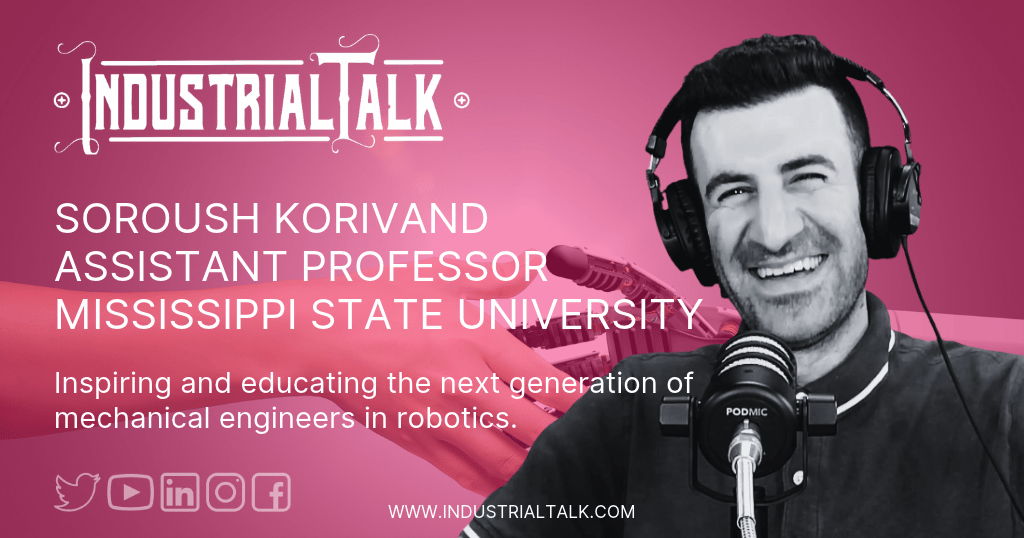
Industrial Talk is onsite at IDEELabs/Mississippi State University and talking to Soroush Korivand, Assistant Professor about “Educating the Future in Robotics”.
If interested in being on the Industrial Talk show, simply contact us and let's have a quick conversation.
Finally, get your exclusive free access to the Industrial Academy and a series on “Why You Need To Podcast” for Greater Success in 2025. All links designed for keeping you current in this rapidly changing Industrial Market. Learn! Grow! Enjoy!
SOROUSH KORIVAND'S CONTACT INFORMATION:
Personal LinkedIn: https://www.linkedin.com/in/soroush-korivand/
Company LinkedIn: https://www.linkedin.com/school/mississippi-state-university/
Company Website: https://www.msstate.edu/
PODCAST VIDEO:
THE STRATEGIC REASON “WHY YOU NEED TO PODCAST”:
OTHER GREAT INDUSTRIAL RESOURCES:
Industrial Marketing Solutions: https://industrialtalk.com/industrial-marketing/
Industrial Academy: https://industrialtalk.com/industrial-academy/
Industrial Dojo: https://industrialtalk.com/industrial_dojo/
Business Beatitude the Book
Do you desire a more joy-filled, deeply-enduring sense of accomplishment and success? Live your business the way you want to live with the BUSINESS BEATITUDES…The Bridge connecting sacrifice to success. YOU NEED THE BUSINESS BEATITUDES!
TAP INTO YOUR INDUSTRIAL SOUL, RESERVE YOUR COPY NOW! BE BOLD. BE BRAVE. DARE GREATLY AND CHANGE THE WORLD. GET THE BUSINESS BEATITUDES!
Reserve My Copy and My 25% Discount
Transcript
SUMMARY KEYWORDS
Robotics, Machine learning, Human-robot interaction, Robot learning, Foundation models, Artificial intelligence, Automation, Manufacturing, Disassembly manufacturing, Muscle signals, Amputee assistance, Industrial innovation, Mechanical engineering, Computer science, Adaptive robotics
Welcome to the Industrial Talk podcast with Scott Mackenzie. Scott is a passionate industry professional dedicated to transferring cutting-edge, industry-focused innovations and trends while highlighting the men and women who keep the world moving. So, put on your hard hat, grab your work boots and let's go!
All right, once again, welcome to Industrial Talk. Thank you very much for joining the number one industrial related podcast. Guys going right, he's got hair, man, right there, right there, there, there. The number one industrial related podcast in the universe that celebrates you, industry professionals all around the world. You're bold, you're brave, you dare greatly, you innovate, you collaborate, you're salt. problems each and every day, and without a doubt, I have no doubt in my heart that you're changing the world for better. It's it's just without a doubt. Thank you very much for what you're doing. Thank you for your continued support. And this story is all about you. You are the heroes in this story. We are here, as you can hear in the background. There's some people banging something going on here, but we're on the floor. ID Labs right here, right now, and it is with Mississippi State University. Can't complain. They are absolutely amazing. They're hitting on all cylinders. They're training. They are part of the solutions of training the next generation of industrial and manufacturing leaders, and they're doing a great job at it. The passion is off the charts. In the hot seat, Soroush Korivand Corvan Korivand Korivand, got it, got it. We're talking robotics because they do it here too, and they have people like Soroush, so let's get cracking. Yeah, I've been looking forward to this conversation.
Me too.
Yeah, I'm telling you right now, it's gonna it's gonna rock because I want to hear what you have to say. I do. I I I think just just me personally. It's just I'm just the Scott Mackenzie. Just I think Mississippi State, the people like you and others, are doing it right.
Yeah,
trying. You're you know you're you're succeeding. I'm just telling you right now. I've been around the block a couple of times, and I think you guys are just absolutely succeeding. It's fantastic. Yeah, it's fantastic. All right, I digress. All right, we need to know a little bit about you.
Yeah,
sure. Give us a little background on who you are, there, my friend.
Yeah, sure. So I'm Sorouch Korivand. I do research on robotics, and this background is mainly coming from my the major that I studied, which is mechanical engineering, I did my PhD in mechanical engineering and my master in computer science at the University of Alabama, and then I moved. You don't you
you hold that back, right? You you don't you don't. Yeah, especially it's just like
it's a low hush tones, you know, you know,
yeah. Actually, SEA beat MSU very bad this last weekend. It
wasn't pretty. I was, I was optimistic. I said, "Hey, they're hanging in there." Yeah,
6623, I guess. Yeah, the
wheels went off the bus. It just was, it was not pretty. Yeah, keep it going. But anyway,
yeah, continue,
keep on. And yeah,
after that, I went to SMU Southern Methodist University in Dallas, Texas. I was postdoc there, and then I joined MSU to expand my research in robotics, human robot interactions, robot learning, more specific.
Robotic, robot learning.
So
yeah, you need to you need to expand upon that real quick. Yeah,
sure, sure. So basically, we want to our group, me and my PhD students, my undergraduate students. We are developing some methods that with those methods, the lo the robot learn some things that learn things that currently they are not capable of doing that. So basically, what is robot? Robot has sensing, actuation, and intelligence that makes the decision. So we are targeting the intelligence part, so yeah. So, for example, robot. There is a method called, for example, imitation learning that the robot can learn from some demonstrations. So, if you show something to the robot, move like from point A, put it on the point P, the robot can learn it from you, but it's not as straightforward as it sounds. Basically, there would be a couple of problems. For example, if you change the object a little bit, a little bit bigger, a little bit smaller, or you want the trajectory to change a little bit, so or maybe you have a. Block in between that doesn't work anymore. So in this case, we are, for example, adding cost functions or different mathematical approaches to tackle this problem. So that would be so. In this way, the robot we are enhancing. We are moving from the current capability of the robot of learning, so we are basically moving the learning a little bit further. That would be one example. Yeah, this is
interesting because you're trying to take a robot, whatever that might be. It could be your your typical, you know, single arm robot, whatever that might be, or something, and and be able to have it, and correct me if I'm wrong, to be able to have it sort of adapt, be able to adapt to the changing situation in front of it. So without saying, okay, you know, I program it to move this over to here, move this over to here, but now you can program it or try to program it where it's a little less organized, but be able to adapt to that. Is that right? Yes, that's right. Like what we do naturally in in what we do, you know.
Yeah, that that is correct. So I think these all stem out from my dream. Okay, I have this dream that the robot. I have a. I have my personal robot, and it can understand when I say something. Go grab a coffee. Take me a picture, or it can be my assistance with talking, or even for example, there is no talk even just by with my hand motion, with my eye movement, or even with my even when I'm not saying something, it can use my brain signals. Okay, I can wear a cap and send the signal. So and then it can interpret what do I want and what I'm looking for, and it can you know basically team up with me to do what whatever I'm thinking of, whatever I'm asking the robot to do. But there are tons of challenges. So me and me and many other researchers are tackling these challenges one by one, small small beats, and trying to get there.
How do you deal with the? You're getting, you're getting to a point where you're at least you can't stop it, but you're you're getting to a point where the robot is becoming more and more, shall I say, human-like, and and there there are people that say, hey, that's that's I'm uncomfortable with that.
Yeah, uncanny value. Yep.
Because I I just what's your thought on that? Because I for me I don't I really don't have opinion. I just know what people say, and it's like yeah.
I think that is that's not my research area. So that I know that the the design behavior things they are changing it basically gets back to the trust to the robot and all these concepts that's not the topic that I do research on but I know it affects the people being comfortable to be around with them but I think that it's changing maybe a few years ago, if you had even one robotic arm around you doing some tasks, that was strange. Yeah, yeah, a robot. Yeah, yeah. And then, but right now, if I have like a humanoid robot around me, it doesn't scare me. So basically, that uncanny valley that you are talking about, of course, it is changing. But yeah, I don't have. I don't do research on that. I like to have as many robots as possible to be around me. One robot do the cleaning. One robot, you know, just work on the clothes and one just cooking. I want to be, I mean, among tons of robots. That's my idea, but I understand many people don't like that.
Yeah, but do you think? And and I I have an opinion, and I'm not gonna I'm gonna I want to hear what you have to say. I still think we're at a point where it's still new because like we haven't even really, yeah, you know, it's just new.
of the papers shows up after:Surush, here's here's what's interesting. What was that point in time? Now I'll give you a case in point. I worked with an organization out of Barcelona. Good, right there. And we were talking at that time years back, talking about hey guardrails, creating guardrails around AI, and then ChatGPT comes out with their thing. It's like a. It was a switch in the world of robotics and what you're doing. What was that sort of event in time that said that that opens the door, that moves robotics not from here to there rapidly? What was that moment in time? Do you do you have a sort of sense of that.
as the big jump that starting:Wow, that's that's a that's a high percentage of success.
Yeah, that's
an A in any book.
Well, basically, so my point is that imagine that you are now in the disassembly manufacturing. You can throw a lot of things to the robot. You don't need to program the robot. So that's really game changer. That robot can only you don't need to
program it because it just knows.
Yeah, yeah. We don't. So in the example that I gave you, he didn't program the robot to do it. Basically, the location of those objects can be everywhere on the on the disk of the robot. So we don't program that robot. Okay, go exactly to this point A. Yeah, it can be everywhere. So now you imagine that you are throwing some parts to the robot for disassembly. Okay, so don't need to program that. That part doesn't need to be in a specific position configuration. The robot can figure this out, and you can just talk to the robot. Okay, I want just put the screws here, put the motherboard over there, put the ramp in place speed. So you can just talk and figure things out.
See, here's the the the real exciting part of that is just the gain in productivity, the gain in efficiency. So me, and and I always got to go back to that human element. I'm more productive. I I focus on things that are really significant for the business, and and allow the robot to to you know do the mundane maybe to the repetitive stuff and do it effectively and with a high level and okay I'll say it 24/7 doesn't matter doesn't need a break so it's different so that's a from a business perspect perspective I see that it's a game changer.
Yes, absolutely. I think now maybe it's a great opportunity. It's a golden opportunity to work on like many like bigger problems. Now that we have AI, why not attacking on cancer issue? Now we should be able to you know solve the cancer, but when I want to you know go from Starkville to maybe New York, Los Angeles, why it should me take me that many hours? You know, it should be just half an hour, 20 minutes, or maybe shorter. So now we have to. I think it's the time to think much, much deeper. Yeah, we shouldn't just see front of our face. I think that's the time that you should have that long horizon and you know attack the much bigger challenges.
Yeah, see, I agree with you. And what makes sort of a program like this, and and and I I've had a number of conversations with a lot of companies, and it's always like I can't find somebody. I can't do this. I can't. I can't. I can't. And what I'm saying, and and this is sort of in line with what you are talking about. I think there's disruptive innovation, disruptive in a positive way, not a not a negative. Don't don't go there, but a positive way that will truly transform your business and move it forward if you're willing to just do it and figure it out. Because whether you like it or not, robots are here. Whether you like it or not, AI. You're not going to put that back in the genie bottle. I don't care what you think, it's going to happen. And and me as a business, and I'm in a competitive environment. If I'm not doing it, somebody else is, and they're reaping the benefits. And and I just think I think you just need to be all in, and I think you need to be consuming as much information, and then finding individuals that I trust to be able to help me along on the journey, like you.
Thank you.
You're welcome. As I stand on my soapbox and sit there and run, because I agree. I just agree. I think it's, I think it's so exciting, and I think that we're, we're, we're really at a renaissance.
Yes, yes, we are. Yeah, yeah. Let's give you like one more example that I work on. So, for example, I think at this moment the amputee loss of hand or leg shouldn't be an issue anymore because using this AI machine learning, we can exactly see on basically decode and understands the muscle signals. So, in one of my PhD students is working on this aspect. So, he reads all this muscle data from this part of the hand, and basically he can predict if you are doing a compression or extension, which finger is doing that, and also how much force you are applying. That's always
a big deal. The force is like how much pressure do I apply to whatever it is, and exactly,
exactly, yeah. So, so yeah, we are really getting to the point. I think getting to the point that you know, amputee is not stopping someone's life, and I think that's where exactly we should be going. Yeah, you see, these big major problems are doesn't sound like big problem anymore. Yeah, because our capabilities are, you know, getting stronger and stronger.
I think too, along, and I agree with you 100%. And that's why this is such an exciting time. Is that just like ChatGPT? One day it wasn't there, the next day it was there, and then it just exploded. And I think that technology as a as a whole, there's going to be somebody that's going to crack that code, boom, and it's going to explode. And that amputee analogy, that's pretty dog-eyed cool. Above my pay grade. I mean, it's way above my head, but I think it's all doable. Everything is doable. So I want one last little shot. When I look at labs like this, and I get dealing with the cobot over there, and just looking at labs, and the students have free rein. They can do whatever they want in a sense. They have an idea. They can execute upon it. They can design it. They can do it. They can iterate, and you can just keep on and refining. That to me is just brilliant, and that's the same thing that you're in in the world of research. You just okay, I got to keep going. You keep you keep moving forward. You keep you just keep innovating.
Yeah, and I I truly should admit that it's like a great pleasure to work with these students, these young brains, because sometimes I have an idea, I give them the idea, and then when they start, they are actually far beyond what I was thinking. So basically, I think now nowadays maybe imagination is like much more important than your think that you can.
I I I I am absolutely enamored by that statement. I agree with you 100%.
Yeah, yeah. So yeah, you you imagine something, but I think the imagination capabilities, especially these new people, new undergrad. That the imagination, you know, basically beats my imagination super easy, and they go beyond what I have designed. What I what my idea was that for them to do with the robot, they just do something better. Yep, and I love that. I enjoy working with them.
And they say, why not? Yeah, absolutely. Why not? Why not? Why not? Tell me. You're saying I can't do that. Why? And it's it's so so foreign to them. It's like, well, yeah, I can I can figure that out. How do people get a hold of you, my friend? They're saying I want to know more about what what Soroush does. How do they contact you?
Yeah, they can contact me via LinkedIn. I will share my profile.
Yeah, there you go. That was a great conversation, Serge.
Thank you. Good talking to you.
I like it a lot. There he is, right there, man. He's amazing, right there. All right. Once again, we're broadcasting, as you can tell by the noise in the background, we are at the ID Labs here in Mississippi State. Right on the floor, there's a guy banging on a doggone CNC machine right there. He's going to win that battle. Just FYI, he's going to win it. You can tell he's got he's got passion in his eyes. He's going to make that happen. Yeah. All right. We're going to wrap it up on the other side. Stay tuned. We will be right back.
You're listening to the Industrial Talk Podcast Network.
just running and gunning, and: