Brielle Reisman and Tanner Mays with Prime Controls
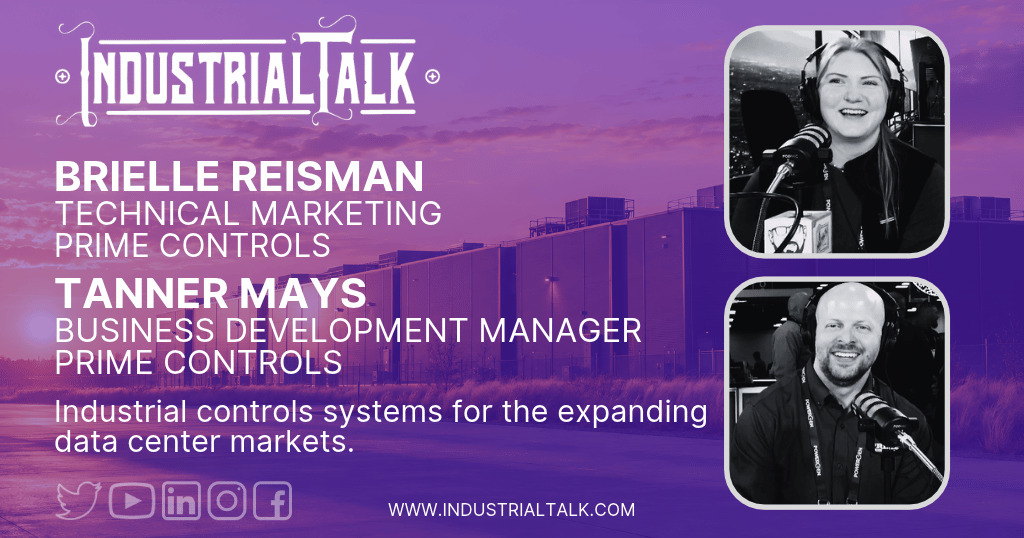
Industrial Talk is onsite at PowerGen and talking to Brielle Reisman and Tanner Mays at Prime Controls about “Supporting Mission Critical Data Centers”.
If interested in being on the Industrial Talk show, simply contact us and let's have a quick conversation.
Finally, get your exclusive free access to the Industrial Academy and a series on “Why You Need To Podcast” for Greater Success in 2025. All links designed for keeping you current in this rapidly changing Industrial Market. Learn! Grow! Enjoy!
BRIELLE REISMAN'S CONTACT INFORMATION:
Personal LinkedIn: https://www.linkedin.com/in/brielle-reisman/
Company LinkedIn: https://www.linkedin.com/company/prime-controls/
Company Website: https://www.prime-controls.com/
TANNER MAYS' CONTACT INFORMATION:
Personal LinkedIn: https://www.linkedin.com/in/tanner-mays/
PODCAST VIDEO:
THE STRATEGIC REASON “WHY YOU NEED TO PODCAST”:
OTHER GREAT INDUSTRIAL RESOURCES:
Industrial Marketing Solutions: https://industrialtalk.com/industrial-marketing/
Industrial Academy: https://industrialtalk.com/industrial-academy/
Industrial Dojo: https://industrialtalk.com/industrial_dojo/
Business Beatitude the Book

Do you desire a more joy-filled, deeply-enduring sense of accomplishment and success? Live your business the way you want to live with the BUSINESS BEATITUDES…The Bridge connecting sacrifice to success. YOU NEED THE BUSINESS BEATITUDES!
TAP INTO YOUR INDUSTRIAL SOUL, RESERVE YOUR COPY NOW! BE BOLD. BE BRAVE. DARE GREATLY AND CHANGE THE WORLD. GET THE BUSINESS BEATITUDES!
Reserve My Copy and My 25% Discount
Transcript
SUMMARY KEYWORDS
Power generation, Industrial controls, Automation, Data centers, AI, Digitization, Process control, Cybersecurity, Scalability, Efficiency, Engineering, Prime Controls, System design, Management change, Reliability
-:Welcome to the Industrial Talk podcast with Scott Mackenzie. Scott is a passionate industry professional dedicated to transferring cutting-edge, industry-focused innovations and trends while highlighting the men and women who keep the world moving. So put on your hard hat, grab your work boots, and let's go. All
right, once again, welcome to Industrial Talk. Thank you very much for joining the number one industrial-related podcast in the universe that celebrates you, industry professionals all around the world. You are bold, brave. You dare greatly. You innovate. You collaborate. You're solving problems each and every day. That's why we celebrate you on Industrial Talk. You are the heroes in this story. We are broadcasting. If you hear a little buzz, buzz in the background, we are at Power Gen. It is in San Antonio, Texas, and it's a collection of problem solvers. And I got to tell you, the topic of conversation, of course, yeah, we're at Power Gen. Of course, it's going to be talking about Power Gen. But I think, in general, if you're looking at it from a macro perspective, power generation is on everybody's tongue. Trying to figure that out. If you did, if you're here, you need to visit those folks at Prime Control. They're just right across. They're in the neighborhood. They got a fancy booth, I think. But anyway, we have two, Tanner and Bree. They are with Prime Control, and we're going to be talking about well, prime control. That's what we're going to be talking about. How you guys doing?
Good.
Doing great.
Yeah. Has it been a good show? Don't bring me down.
It's been wonderful. We've had a ton of foot traffic. Some really good conversations. So
you know why you have a ton of foot traffic?
Because we're right next to you, I think so. Darn Tooting! There it is. Great lights. It's like a moth. They just like,
hey, check out the lights. I'll go over and talk to parental control. Yeah, why wouldn't I? Yeah. Now I always enjoy the show. You know, it's been fascinating has been the fact that it has changed. I've been doing the show for a number of years, and the conversation has been generations. But now it's it's it's all of a sudden become real. Like you got to do it. Got to be. Got to do it right. Got to find trusted people. Speaking of trusted people, Brie,
yes,
give us a little 411 on who you are.
Sure. So my name is Brielle Reisman.
Brielle, can can we call and just go Bree? Oh
yeah, let's go. Let's go Bree. Let's go nice and easy. Yeah. So I'm a chemical engineer by training, and I've worked in industrial controls since I graduated, which was not too long ago. So I was
gonna say what I was 10. Yeah.
So I've been an automation specialist for a few years, and then I kind of asked too many questions, and they were like, "You should probably go into sales." So, did sales for a few years, and then asked too many more questions. They were like, "Would you like to get into marketing?" And I'm like, "Yeah, let's go. I love it."
Check it out. Yeah, yeah. You're all at what? 15 now. Tanner.
Tanner Mays worked for Prime Controls now for just a short time, but I've been in the automation controls industry for 16 plus years. I always say I had one real engineering job out of college where I worked for. I went to Texas A&M University, mechanical engineering, and then I went to the dark side of technical sales. After a couple of years of real engineering, I just couldn't couldn't cut it, so I've been in sales and in the automation and control space for a good while now, and it's a great place to be. Is is is it
bubbling and a lot of people are looking for solutions? There, Tanner. See, I getting ready to just throw out a question, and you guys are getting ready to say, look at each other. Don't know. Who's going to answer it? Yeah,
yeah, absolutely. It's you know, automation controls been around a long time, but especially now everything is getting more digitized every day, as everyone knows. And I think it's becoming more apparent to people and more tangible to people, and it's kind of you know layering into people's everyday lives, and so it's a subject everybody should be concerned about, and I think most people know about it and are looking into
it. I don't, I don't know too much about it. Bree, explain to us what that means. What Tanner was saying.
So if you think about it, like plants used to be run by people looking at gages, used to be run by all these operators, but now technology has come so far that all of those signals we pull back into a main control system, and someone has to come in and figure out how all that happens, how the hardware gets in, how that information gets back, how the electrical signals get back, and then once it's there, what do you do with it? How do you decide when to start the reactor and what to add and all these kind of things? And it used to be dependent on people following recipes, and now you have it completely done by people like us. So that that's really the bread and butter of what Prime Control says. So here,
here's this absolutely begs the question: How is AI impacting your business, Tanner?
I I don't like to talk about AI. No, I'm I'm kidding. You can't help. Can you? You can't. No, I'm I'm I'm joking. You can't help but do it a little bit, right? So for us, it's it's it's been like an evolution, right? And and and we've been hearing about AI. Obviously, in recent years, it's becoming more and more layered into everything. Any kind of software that anybody is releasing basically has some kind of an AI component these days. And so for us, that means really. Bottom line is better management of the inputs and outputs that are going into one of these big complex systems. There's so much data that a person can't really parse through it with with their eyeballs, and so you've got this AI assistance and things like that that are really helping people make better business decisions. See, and it's important
that you use that technology, that solution, to be able to take that tsunami of data and be able to rifle through it effectively, and be able to come up with some sort of tactical, you know, decision to be able to say, "Yes, Scott, yeah, you know, this is sort of failing to go out there and do whatever you need to do." How do you? I mean, companies are demanding that, right? They're just saying, how do we use, you know, AI? How do we use? How do we take your control systems and take it to the next level? Are they asking those questions, Bree?
Yeah, absolutely. And I think you know, you're also seeing it from the manufacturers. You're seeing it from people like Rockwell and Siemens and you know Schneider Electric, who are really leading the charge in that and deploying parts of AI in different products. That maybe it's not the entire solution, but it's being built in so that operators can sit and you know maybe the documentation is behind the scenes, and instead of trying to look up an SOP for how to handle a specific situation in the plant, they have some kind of AI intermediate where they can say, "Hey, this is the situation going on the plant right now." I would normally call up Joe; he's on vacation. But you know, what are we supposed to do in a situation like this? And so I think that's a pretty rudimentary way of using AI, and it will get much more sophisticated. But just better connecting and having being a better search tool for operators for what are we supposed to do when this situation happens inside the plant is a very tangible, real, you know, meaningful way that AI is already being implemented.
How how long has the company been in business here, Tanner? Because you haven't been with the company. Yeah, over 30
een Prime Controls since like:think your primary bread and butter is? Is it power, Tanner?
It would power's in there. Everything needs power. Data centers and the power associated with it is a huge growth area for us right now. Oh yeah.
So Bree, that means you guys are in the data center world. We are, yeah,
heavily, definitely. Yeah, they they need industrial controls. They need the reliability and the redundancy of industrial controls. I mean, they're protecting liquid gold in those you know data centers, so they spare no expense in making sure that those things are taken care of, and the uptime is absolutely insured. Stress. Yeah,
that's stress. How many people work for your organization?
,:it. Good, y'all. No, go ahead.
Somebody's got to do. Yeah, I was just going to
say there's a gap if you don't want to do it. There's a gap. I'm not a management consultant, but I can tell that that's a problem. So, outside of the data centers, outside of all that, when when you go to a company, when you start to have these conversations about control, do you take the existing control systems that they have, do you improve that? I mean, because many of these companies have been around for a little while, and they might not have your solutions in there. They might have some sort of other DCS or PLC type whatever arrangement. Do you guys go in there and sort of? This is to you, Tanner. See,
yeah.
Do you guys go in there and try to sort of make it 21st century, as opposed to those those old companies that don't.
Absolutely, you know, and there's there's companies that have been around a long time. They have these power gen facilities been around for decades a lot of times. Yeah, and at the end of the day, like a big steam turbine or a genset probably hasn't drastically changed in the last 20, 30 plus years. I guarantee it hasn't. But what has changed a lot is digitization, compute capabilities, the ability to make actionable decisions based off of
information that is being readily served up to the operators, and all of that is done through the control system. I always tell people from most high level, like you know, they spend millions, sometimes billions of dollars on these facilities, and then sometimes the control system is almost an afterthought, and it's like that is going to be your window into this facility for the next forever. You probably should give it a little more forethought than to save it at the end for somebody to come in and scramble on.
What about what about tangible benefits? The bottom line. So I'm a I'm an old turban, and I'm trying to upgrade. I'm trying to do some stuff. Is there a real financial intangible benefit of being able to do that upgrading, Tanner?
Yeah, and some of it, some of it is like, okay, now there's there's softwares that are doing efficiency calculations that you could never do manually. That there is really a bottom line, like you will save dollars by running this turbine closer to this, you know, control margin than you would. And if you don't know that's where you were because you didn't have the right instrumentation and the right visibility to your operators, you wouldn't know that you could do that, right? And then some of it is just obsolescence. Like, hey, you can't afford for this machine to trip offline; you lose your control system. Yeah, that's exactly what will happen. So you just have to, you know, maintain it, stay up to just like you switch out bearings and oil and whatever. It's like eventually these control boards get, you know, old and need replacement. And then there's usually some other benefits, like we talked about with efficiency improvement and better visibility into data that come along with that. Just obsolescence type replacement. Bree,
when you approach a customer that is, you know, hey, we we have control systems, and you approach a customer, and the customer says, yeah, hey, that's great, man, love them, love love what you guys do. Engage, and they engage you in in, you know, figuring out what their solutions need to be. Do you design the system in such a way that it's flexible, that it's scalable, that it's because what I see is that there's this demand for that scalability. I'm I'm deploying capital. I want to increase my output. Whatever whatever the strategic drivers are, I think that that's taking place. Do you design a system so that it's a hey, you're here today, but it looks like you'll be there tomorrow. Let's do this.
Yeah, definitely, especially when you're talking about like you know sizing a server or when we're sizing a control cabinet. You know, part of the thing we do is making sure that there is additional room for additional I/O in the future when you add transmitters, when you realize there's something else you need to monitor and you want to pull it into the SCADA system. Yeah. So making sure, I mean, most control panels are built with a 20% redundancy, but you can build in even more if the customer is saying, "Hey, this is a system that we think needs to grow." It also depends. You know, you you pick the product based on does the customer think they're going to grow significantly. It changes the kind of processor that you want to get. You might go with a bigger, more beefier processor, just because it has that you know kind of room to grow for the future and to make sure that you can continue to handle new sequences, new information, new I/O, and you know new demands. So flexibility is extremely important for sure. No,
I would think it's it's paramount because I'm not going to, I'm going to invest a gazillion dollars. I'm not exaggerating. I'm going to invest a gazillion dollars in in retrofitting my existing plant or scaling it or whatever it might be, whatever that is. I I want something that is going to grow with me because I believe we're going to be successful. So I don't know, Bree. Where do you see it going? What's that future look like? Oh
God! You know, process control at its core is process control. You control the process. It is about safety. It's about knowing what's going on in your process. And I think, to a degree, a lot of that will not change because it it really is the core of you know making sure you're getting. Optimal output, whether it's at your refinery, at your power plant, you know, in your data center. So I think you know, as we're seeing it go further with the incorporation of AI, you're just getting to do more with less people. You get more insight. You're able to kind of you know take those trends and pass them on to the people who can actually make decisions about that. Your upper level management, and I think cybersecurity, especially, is playing a huge. Yeah, it's a great point.
Oh, geez, I forgot about that. Yeah, I have a podcast about cybersecurity, and look at me.
urther, you know, TSA and ISA:It's amazing. I think I had a conversation with someone that was talking about controls and then modifications to the controls and the the lack of control of those control modifications. Right? Yeah. I said controls in there quite a bit, but it's amazing that some of them just, just sort of pencil whip it.
Yeah, yeah. I was gonna say, Scott. You know, management of change. Yes, there it is. That's
better. And the thing is, is
like that's a process, right? Yeah, it is. It's a process-driven thing. Yeah. But there's software and there's solutions that help you manage that process in and of itself. So even that you can benefit from you know improved technology to help where some of it's automatic or you have a a software that as you click through it it sends out the right notifications to the right people everyone documents it people sign off on it before you go to the next stage of the of the change in process so do you guys do you guys help do
you guys help with that
absolutely yeah that's that's usually part of what we're doing. We and we have our own internal processes that we're improving with technology, so that when we turn over a project to a customer, it's very clear everything's been documented. They're able to then take it like a giant user manual and know how their system was engineered and how they can support it and run it in the future.
Okay, Bree. With that said, have you ever gone into a company that's, I guess, like oh my gosh, where do I, where do I start?
Oh yeah, I mean you know definitely, I think a lot of the time, customers know what they want at the end. They know what's going wrong in their facility right now, but they really need someone to actually take their hand and walk them through. Okay, this is how the process usually goes. This is what we typically do, and I think at Prime we're really good at. You know we are the experts in this field, so we're really good at walking people through those indecisions and giving them enough information so that they can make a decision, but not giving them so much information that they have you know decision fatigue because that they look to us for our advice and we provide that.
I like decision fatigue. I I agree with you on that. We've all been there, done that, and that's not fun.
No,
and and and I would imagine from the world of process controls, it it wouldn't take much to, you know, make my ear bleed and struggle. Yeah, it's
very complicated.
All right, all right. Let's let's wrap this thing up. Now, how does somebody who's saying, I like what they're saying about Bree. How do people get a hold of
you? You can call:You didn't say LinkedIn.
You can visit us on LinkedIn. Here's
a deal. It's about people. It's about if I want to if I want to just connect on a you know website. Come on, I want the person. What about you, Tanner? Don't let me down.
Same deal. Call me at home. My you know Scott got my number. Call him first, and then he'll he'll send you my number. So reach out LinkedIn.
Yeah,
love to hear from
you. They were late. They were late to their schedule. Just FYI, shortly, and I'm not I'm not regretting it at all because they were absolutely stellar. I enjoyed that. I really did. You guys were great. Thanks. Thanks a lot. You guys got a high beer factor, whatever that is. I I I'm I'm I'm that's my term,
high beer factor. High
beer factor. You don't want to have a beer with you. You don't want to. I mean,
I agree. You know, he's like, yeah,
okay, I'll have a beer with you. All right, good. All right, all right. Once again, reach out to them. We're gonna have all the contact information for these two incredible professionals out on Industrial Talk. So, we're here, Power Gen San Antonio, you get great people like these two, and they're amazing. All right, you got to put this one on your calendar. We're going to wrap it up on the other side. Stay tuned. We will be right back.
You're listening to the Industrial Talk Podcast Network.
Hey, it's Scott Mackenzie with Industrial Talk. Iris is the global leader. In electrical maintenance safety, delivering technologies that let team inspect energized equipment safely, using closed panel condition-based monitoring to reduce risk and downtime. Their patented infrared and ultrasonic inspection windows make it possible to detect issues early, boosting reliability and protect the people who keep the operations running. If improving safety and avoiding unplanned failures is your mission, Iris has the solution to get you there. Learn more at iris.com. How about that for power gen? Is there a topic that is creating more buzz in the marketplace than power generation? Well, yeah, there's a lot. You know why there's a lot? Everything seems to be connected now more than ever. Data, power generation, utilities, cybersecurity, technology, how to get it all together to create that picture. It's an exciting time to be in industry. I just want to let you know, and and and you as as a professional have to do your part to inspire that next generation because we need them because it's happening and it's happening fast. How about that conversation? That's Prime Controls. That's the company. They were in my neighborhood. They were right across, right across, just just right there. I'm going to screw up her name, but it doesn't matter because it's in the podcast. But I really enjoyed the conversation with Brill and, of course, Tanner. They were great. There again, right across, and of course Tanner and I go to the same barber. He's a good-looking guy. Anyway, you need to put that one on your calendar. It's just right around the corner. Put that, put that conference on the calendar because it is a part of the conversation. Industrial talk is always here for you. We are passionate about your success. Big heart, big desire to be able to help you succeed going forward. It is all there. We do it all. The team. We do it all. We we want you to tell your story. We need more eyeballs on what you do. We need more ears to hear what you do, and and why you are such an important component. Why you need to succeed in the marketplace in industry. That's it. I don't know how else to you know sugarcoat it, but you need to succeed, and we're here to help you. Just go out to Industrial Talk. You can connect with Tanner. You can connect with real, yeah, real, and and make them a part of your your your team of individuals that are helping you succeed. We're here, they're here, and everybody out on Industrial Talk is there for you. You just just peruse around and say, "Hey, I'd like to connect with that individual." Hey, I heard your podcast. That's it's just that easy. God, gone it. Anyway, be bold, be brave, dare greatly. Hang out with the team from Prime Controls, and you will be changing the world. We're going to have another great conversation as always shortly. So stay tuned.