Bert Warner with Propane Education and Research Council
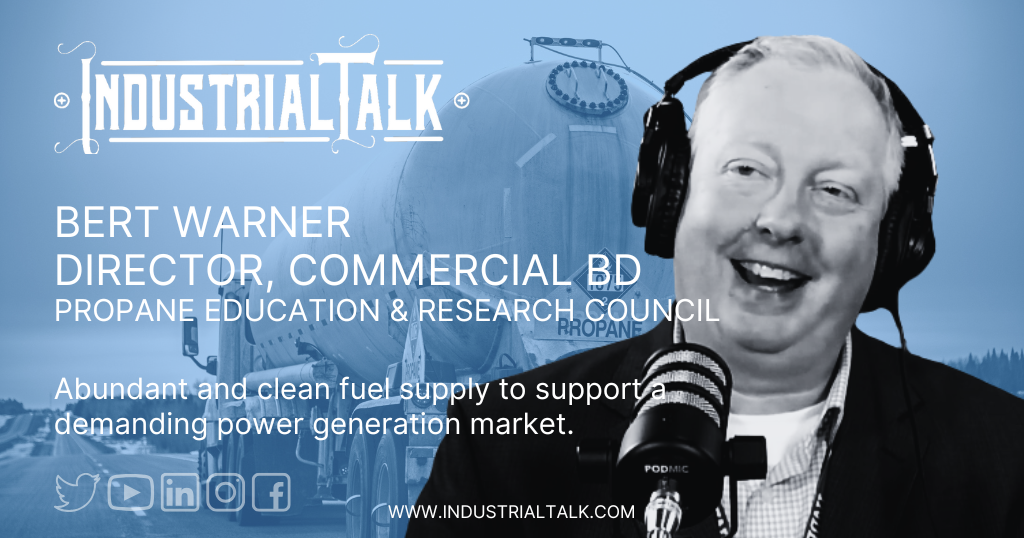
Industrial Talk is onsite at PowerGen and talking to Bert Warner, Director of Commercial Business Development at Propane Education & Research Council.
The Industrial Talk podcast, sponsored by the Propane Education and Research Council, discusses the growing role of propane in power generation. At Power Gen in San Antonio, industry professionals highlight the advantages of propane, including its speed of deployment, cost-effectiveness, and environmental benefits. Propane is a byproduct of natural gas extraction, with the U.S. using only about 10 billion gallons annually, while the rest is exported. The conversation emphasizes propane's potential to replace diesel and natural gas in certain applications, offering flexibility and economic benefits. The discussion also touches on the need for infrastructure and equipment to meet growing demand.
Outline
Introduction and Overview of Industrial Talk Podcast
- Scott introduces the episode of Industrial Talk, sponsored by the Propane Education and Research Council, highlighting their commitment to safety, training, and innovative propane power technology.
- Scott Mackenzie, welcomes listeners to the Industrial Talk podcast, emphasizing the focus on industry innovations and trends.
- Scott thanks listeners for joining the top industrial podcast, celebrating industry professionals who solve daily problems in power generation.
- The podcast is broadcasting from PowerGen in San Antonio, with Scott encouraging listeners to attend future events.
Discussion on Power Generation and Propane
- Scott introduces Bert Warner from the Propane Education and Research Council, focusing on the role of propane in power generation.
- Bert Warner, comments on the increased size and interest at PowerGen, emphasizing the need for diverse equipment solutions.
- Scott discuss the challenges of meeting immediate power demands in a fast-paced world, highlighting the importance of pragmatic solutions.
- Bert Warner explains the advantages of propane, particularly its speed of deployment compared to traditional infrastructure build-outs.
Propane as a Prime Power Source
- Bert Warner discusses the potential for propane to be a prime power source, not just a backup or emergency fuel.
- He explains the flexibility of using propane for base loading, peak shaving, and other applications, providing economic and environmental benefits.
- Scott and Bert Warner delve into the historical use of propane in remote and emergency situations, and its growing potential in urban areas.
- Bert Warner highlights the abundant supply of propane and its clean, safe, and affordable nature, making it a viable first choice for energy needs.
Propane Extraction and Market Potential
- Bert Warner explains that propane is a byproduct of natural gas extraction, with a significant amount exported globally.
- He discusses the increasing demand for natural gas and propane due to electrification efforts, emphasizing the abundant supply available.
- Scott and Bert Warner explore the shift from natural gas to propane in urban areas, highlighting the advantages of propane over diesel and other fuels.
- Bert Warner emphasizes the resiliency and cost-effectiveness of propane, making it an attractive option for commercial and industrial applications.
Infrastructure and Distribution of Propane
- Bert Warner discusses the extensive infrastructure of propane companies in the US, ensuring reliable delivery and support.
- He highlights the advancements in tank monitoring and automatic deliveries, enhancing the convenience and efficiency of propane use.
- Scott and Bert Warner discuss the potential for propane to compete with natural gas and other fuels, emphasizing the need for responsible energy diversification.
- Bert Warner encourages companies to consider propane as a strategic fuel option, providing flexibility and cost benefits.
Challenges and Opportunities in Propane Market
- Bert Warner identifies the potential bottleneck in equipment manufacturing as a challenge in meeting demand for propane.
- He discusses the export of propane to Asia and Europe, highlighting the global demand and the role of LNG terminals in propane transportation.
- Scott and Bert Warner explore the complexities of the energy market, including the need for diverse fuel sources and the role of propane in meeting market demands.
- Bert Warner emphasizes the importance of education and awareness in promoting the benefits of propane as a primary energy source.
Conclusion and Contact Information
- Scott thanks Bert Warner for the insightful conversation, expressing excitement about the future of propane in power generation.
- Bert Warner provides his contact information for further inquiries, encouraging listeners to reach out for more information.
- Scott encourages listeners to attend future Power Gen events and to stay informed about the latest developments in the industry.
- The podcast concludes with a reminder of the importance of propane in meeting global energy demands and the role of the Propane Education and Research Council in promoting its use.
If interested in being on the Industrial Talk show, simply contact us and let's have a quick conversation.
Finally, get your exclusive free access to the Industrial Academy and a series on “Why You Need To Podcast” for Greater Success in 2026. All links designed for keeping you current in this rapidly changing Industrial Market. Learn! Grow! Enjoy!
BERT WARNER'S CONTACT INFORMATION:
Personal LinkedIn: https://www.linkedin.com/in/bert-warner-7a08a9134/
Company LinkedIn: https://www.linkedin.com/company/propane-education-research-council/
Company Website: https://propane.com/
PODCAST VIDEO:
THE STRATEGIC REASON “WHY YOU NEED TO PODCAST”:
OTHER GREAT INDUSTRIAL RESOURCES:
NEOM: https://www.neom.com/en-us
Hexagon: https://hexagon.com/
Arduino: https://www.arduino.cc/
Fictiv: https://www.fictiv.com/
Hitachi Vantara: https://www.hitachivantara.com/en-us/home.html
Industrial Marketing Solutions: https://industrialtalk.com/industrial-marketing/
Industrial Academy: https://industrialtalk.com/industrial-academy/
Industrial Dojo: https://industrialtalk.com/industrial_dojo/
We the 15: https://www.wethe15.org/
YOUR INDUSTRIAL DIGITAL TOOLBOX:
LifterLMS: Get One Month Free for $1 – https://lifterlms.com/
Active Campaign: Active Campaign Link
Social Jukebox: https://www.socialjukebox.com/
Industrial Academy (One Month Free Access And One Free License For Future Industrial Leader):

Business Beatitude the Book

Do you desire a more joy-filled, deeply-enduring sense of accomplishment and success? Live your business the way you want to live with the BUSINESS BEATITUDES…The Bridge connecting sacrifice to success. YOU NEED THE BUSINESS BEATITUDES!
TAP INTO YOUR INDUSTRIAL SOUL, RESERVE YOUR COPY NOW! BE BOLD. BE BRAVE. DARE GREATLY AND CHANGE THE WORLD. GET THE BUSINESS BEATITUDES!
Reserve My Copy and My 25% Discount
Transcript
SUMMARY KEYWORDS
Propane, power generation, clean energy, infrastructure, cost efficiency, prime power, backup power, natural gas, energy demand, resiliency, fuel flexibility, market diversification, BTU conversion, export markets, industrial innovation.
This episode of Industrial Talk is brought to you by the propane Education and Research Council committed to advancing safety training and innovative propane power technology across industries. Learn more at propane.com
-:The propane Education Research Council leading the way in cleaner, safer and more efficient energy future.
Welcome to the Industrial Talk podcast with Scott Mackenzie. Scott is a passionate industry professional dedicated to transferring cutting edge industry focused innovations and trends while highlighting the men and women who keep the world moving. So put on your hard hat, grab your work boots, and let's go
t here, you need to look into:Yes, and the amount of people and interest, it's been a tremendous show. Yes, absolutely. It seems like it's, it's necessary for it to have this larger audience and all these different equipment types and solutions that are out there. So it's very fitting and very timely.
It's a it's an outrageous time. Yeah, no, I mean crazy right now. It it is.
And is there one side of me that says, Is this all hype, or is there is this really happening, and it's the speed at which we need this solutions? It's real, right?
Yeah, it is. I think it's somewhere in between. I do think there's some artificial there is thank you and and then there's the reality. And, you know, I look at it, try to be as pragmatic as possible. And I think that, yeah, we've got some challenges, and we have to get outside the box a bit to provide some solution and answers, because not we cannot do business as usual and expect to meet all the demands that are being thrown at us.
The big challenge, just like anything else we live in, this, this, this hyper speed world, yeah, and it's just like you, like you. You've got this burning energy inside. He's like, I gotta, I gotta act. I gotta do it. I gotta make it happen now yesterday, and then the market saying, I need power. When do you need it? Oh, yesterday, then, and it's just virtually impossible. You can't do that. You can't operate
that way. Well, I think that's a very nice segue. Thank you for that. Congratulations. So that is one of our big advantages. And I think you're right, these challenges of building infrastructure, we're talking about years, years. The beauty of propane is our speed of deployment. We can, you know, it's plentiful. We've got tanks you can put infrastructure in. Well, we're talking months instead of years. So this speed to power advantage that we have really comes into play when we talk power generation, and so that is one of the real challenges. Is, you know, if you're trying to extend gas lines or if you're trying to build out transmission lines and infrastructure, it's not going to happen quickly. We can provide a solution in a fraction of the time of typical infrastructure build out. What about cost? Well, how do you want to look at it? You want to look at long term me, I'm just, how is expensive? Is it to wait? You know, you're absolutely right. So I think you probably will have some capital costs that may be a bit greater. But the beauty of it is, I think if. You look at it as a bridge solution. That cost incurred at the capital side can actually turn into something different once the infrastructure is in place, because we can bridge now from a primary system to maybe a backup system once the grids are there. So you've already incurred that expense. I don't have to do it again. I'm shifting it now to where I don't have to now worry about some redundant system because I've already got it. I'm just shifting the responsibility because I was the prime I'm the I'm the prime load to start, yeah, for these next three to five years. And then once the grid or gas lines get there, great, cool. Just move me around the back and I'm there for your standby or backup. So it's actually an economically positive decision.
Where do you see the the growth of propane and power generation like like because it's such a viable option for remote and whatever it's, it's, it makes sense. Where do you see it? What? Where do you focus?
No, I think that's historically, we've had a solid and strong position in the standby or emergency or backup situation where we see the opportunity now is moving that to prime the prime power choice for what you want to do, and it can be done in a variety of ways. It's, it doesn't have to be a whole system takeover. We you know, you can look at using propane as a prime base loading system, you know, just, you know, take care of the consistent load and then use the, you know, ancillary equipment for peak conditions. Or you can do it for peak shaving, because when those rates jump, hey, you know, let's use a more economical energy, yeah, so you can play with it as you see fit, because every application is going to have some nuances that make it a challenge. And the beauty of it is, you can be flexible with it and shift it around a bit. You're not beholden, because you're kind of controlling your own on site energy now, as opposed to being dependent on a grid of some sort, so you're, you're kind of the master of your domain to a degree.
This is, this is interesting, and I think that it warrants a conversation, so that people can level set. We're talking propane from a manufacturing perspective. Give us a little, you know, propane 101, of where it comes from, and why it's abundant, and how do we get it?
Okay, so Propane is a natural, natural byproduct of the extraction of natural gas. So it's going to happen in that processing, and there's a way to capture it, and we make a ton of it. So we're gonna make somewhere between 30 to 40 billion gallons of propane, of which we only use about 10 billion in the US. The rest of it is exported. So with that, you know, we can really have an abundant amount, because as these parent, power needs are increasing, electrification efforts are going high. We're using more natural gas for that generation. Therefore we've got more propane. We are literally swimming in propane. So that is here, it's clean, it's safe, and it's affordable. So when you you know, when you talk about having having it, the safety and green aspects and the economics of it, it's really, we're beyond the grill. We're beyond standby, to where we can be that first choice energy, as opposed to a down the road solution. Because, oh yeah, I get it. We're going to be in farms, we're going to be in remote locations, because that's really your only choice. Yeah, we could start getting a little more urban now, and start to extend this, because we can play on several check boxes along the system.
So for my clarification, so here we are. We're extracting natural gas. And a part of that, of course, is, is propane, right? Yep. And so we're splitting it out. Natural gas goes over here, propane goes over there. That's great. Why? Why not just shift to propane? Why is it, you know, propane is the rural, you know, fuel source, versus natural gas, outside of why?
Well, I think the world's changing quickly. And I think historically, you know, you kind of had these buckets, so if you had a farm or remote, you always had propane, if you've got natural gas lines, and even today, if you're natural gas available, that's what you're going to use. We're not, that's not what we're going to really have a huge advantage over. Well, where I'm looking at is displacing diesel, you know, it's a lot dirty, a lot more maintenance. So instead of, instead of going to, and that's a kind of a default energy that our industry has, you know, all just go, Hey, okay, take a beat. Think about what you're doing. You know, we got to think about that. You know, the aspects of it, the maintenance involved, the costs, and we are a better solution in those ways. So. With the world changing their needs, because it's happening very quickly. We're able to look differently to the market, and we can provide that same energy now, but we can move it around and it's at your door, and we can do it quickly, and you're not sacrificing these other things, like, oh my gosh, yeah, I can get it fast, but it's bad for the environment. Nope, we check that box. Yeah, I can get it fast, but it's costly. Nope, we're economical. So we're becoming more and more attractive and trying to get to be that default energy source outside of grid or gas lines. So once that's there, I get it. We're not going to fight there, but it's getting to be where it could be a straight economical decision, yeah, because rates are going crazy right now, and you're, you can, you know, you're dictating your propane prices so, you know, and you can budget around it, you know, I tell the story, and I'm no different than anybody else. When I open my energy bill or my utility bill in July, I'm freaking out because it's been 100 degrees, you know, I'm trying to keep that number until Yeah. And so if I know going in, hey, I'm going to be spending x. That's that's beneficial, especially on the commercial side, where you're looking at profit and loss statements and and then there was, I didn't even talk about resiliency, so I'm just, if it's so expensive, it better work. You know it better. So if you want to hedge your bet, you go with propane. I know I've got the power because I can see it. It's right outside my door in that tank. Yeah. And when things get tough and I need it, it's on, yeah. So that's a big advantage.
And see what I would imagine, too. You've got the infrastructure of being able to deliver the product too. It's not something that, oh, no, we, how do we get it to point B and from point A? And it's all, it's all there and
, yeah, it's, I mean, there's:See, I think it's, it's it's exciting, you know, it's a and given the demand for power, given the demand for energy and your your booth is always covers some, some great companies that are, are all in or or use propane. It's, it's really a fascinating so you think, you think that, I think hearing you talk that for me, let's, let's just say I'm a company. I can, I can say I want propane. I can. I can have, I can have that conversation as a strategic conversation for my power needs, for my fuel needs, I can. I don't have to just go with natural gas and again, you we can have it as a backup. It's there, so you never have a worry about that. Do you think it will ever get to a point where you'll have distributions, like, like, like, natural gas has lines and all that stuff. Do you think propane
will get to that point? Well, yeah, I mean, there are, is, you know, the distribution channels that are available or not, it's kind of integrated. That's one of the big advantages natural gas is you got this built in. That's what we started on as you're going to lay it out. And I think, you know, the distribution and the availability to literally have it delivered to your door is a big advantage now. And I don't think we're going to take the natural gas gas customer away, but we can start to eat our way at the diesel guys and some of the electric guys, yeah, yeah. So that's not really my main I don't want to say competition, because I do think we need responsible energy diversification. Yeah, we need an we need electricity, we need nuclear, we need all of it, because our appetite is bigger than our plate right now, and so we just want to make sure propane got a spot on that plate, and you're allowed to, you don't feel have to feel bad about using it like there's a lot of advantages. So you asked, you know, can these companies start having these discussions? Not only Can't they should? You know, I think so true.
Yeah, I think so too. And I think that's where your your organization, can create that education to say, yeah, you need to have this conversation. You need to be able to consider that maybe this is the right move for you. Maybe in your portfolio of whatever assets that you have around the country, maybe some need that propane solution and others, maybe not right. But it's not just a one fuel and done. You know, Proposition, yeah, there's no silver bullet. There's no and what. And this is, from my perspective, what's the heat rate? What are we talking about from a natural gas, propane heat rate type stuff. When you say, define heat rate, like, like. The conversion of energy that it's like,
yeah, it's going to be comparable my conversions I look at and I think that what resonates the best is we're all we're going to come back to a BTU, no matter what you know. So a gallon of propane, we have 91,500 BTUs, which is equal to 27 kilowatts of electricity. So when we talk about these three numbers, that's where we start to equal out. So when we have these comparisons, if you really want to do apples to apples, yeah, those are the energy numbers we need to talk yeah. BTUs, yeah. And so, you know, gallon propane is 91,500 BTUs, simple. And so depending on what your capacity requirements are, whether it's for heating or power generation or whatever, we can work backwards, and we have tanks that can get significant sizes, over 100,000 gallons in a tank. And so we can do quite a few big loads. And that's, I think that's one of the big changes over the last few years, is we've got the we've got the propane, which is great, but you also have to have the equipment, yes, runs on it, yes, yes, the equipment is advancing. And so they're doing larger scale applications that are using propane and developing these new products that are multi fuel uses, because you have to have this flexibility and diversity. And so it's great to see, as you walk around the show floor, the people that are doing that and investing in this versatility and that we can benefit from, because we have to demonstrate to the marketplace
from a supply chain perspective, you know, there is the necessity to have tanks and things associated with the propane. Is there an issue or a potential issue, that demand for propane, the need and end of the generation market, because we talked about it impacts the lag time for, you know, bringing tanks to market, or whatever
it might be, you know, the only
t I can't get my gen set till:from an from the the exporting side. And again, you bring up a really interesting point, because we're, we're pulling more natural gas, which then means more propane and and it means that we just, you know, there's storage. We can have storage, but not, I mean, eventually we just have to get rid of it. You have to just move it. Where does it go?
Well, it's exported to, you know, on boats across. You know,
got that. But just, is there a continent that uses propane more than the other? A lot
goes to Asia? Yeah, Europe, yeah. But I'd say, and I'm not a full expert, but the majority of it, I believe,
is Asia, yeah? Because here's the thing. So you have these LNG terminals, yeah, they're big, they're massive. They're gargantuan. They're just amazing, right? Yeah, the same thing. You put them on the same propane, on tanks, on vessels, too, and they ship them off Bert. I'm trying to work this out in my head. It's a lot of moving parts. There's a lot of moving parts. That's exactly correct. Son of a
gun, energy is not easy, no.
And when, when you come to a power Gen like this, and you're talking to people, I had a conversation, and I just said, I can't figure that out. I can't figure it out. Yeah, I don't. And yet, we're still, you know, on a train going down that track. We're gonna make it. And I and I think, and I agree, and I agree with you. I think some of it's hype.
Yeah, it is. You know, we talk a lot. It's still pretty simple. I have a power need, yeah, have a power source. How do I deliver? Yeah, you know, we can't. That's the basic structure of it. And if it gets beyond, I'm too pretty to know what happens beyond that, you are pretty. Yeah, I get that a
lot. Yeah, it's, I'm sure it's a common tale.
The burden I have.
How do people get a hold of you. What's the best
way reach email? Bert, B, E R T, dot Warner, W, A R n, e r@propane.com or check out propane.com for all kinds of stuff propane,
there's a lot out there. There is you guys are there. Guys are incredible. I really appreciate. Again, that conversation. I don't know it's going but I'm all excited and giddy about what's taking place in the power generation market. I just am. I mean, I wish I was young and full of hair like you Bert, good looking. Thank you, yeah, having me on, yeah. Well, thank you for being on and being paid. No, I'm not saying you were patient. You were you hit the time. We're awesome. All right, we're going to have all the contact information for Bert out on Industrial Talk. You on LinkedIn, yeah, of course you are. Why wouldn't you? Because everybody wants to view your stat card, because you're that important, right? We're going to have it all out on Industrial Talk. So fear not. You will be able to get a hold of Bert, because you need to get a hold of Bert. And again, power Gen here in San Antonio, you're not here, you're not meeting Bert, you're not fulfilling your purpose. I'm just now. All right, we're gonna wrap it up on the other side. Stay tuned. We will be right back.
You're listening to the Industrial Talk Podcast Network. You
perfect Bert. He delivered again. He's been out on Industrial Talk, and you know what he did then? Yep, delivered again. Great insights, propane, Education and Research Council, they're a big part of power generation, big, massive part of power generation, you need to reach out to them all the contact information is out there, right there on Industrial Talk, looking at a stat card out on LinkedIn. He's got mad skills. An amazing, amazing professional. All right, you're looking into it. You're saying, Hey, Scott, I wasn't at power Gen. Oh, you need to be at power Gen next year. You just, do? You get to meet people like Bert. But the reality is, is that we're all just focused on figuring out how to satisfy the demands of the market. Who just, they just need more power. You need to be a part of power Gen, great, great event. It's just getting bigger and more expansive. All right, Bert, reach out to him. That's your that's your to do list. Be bold, be brave. Derek, greatly hang out with Bert. Change the world. We're gonna have another great conversation shortly. So stay tuned.

About the author, Scott
I am Scott MacKenzie, husband, father, and passionate industry educator. From humble beginnings as a lathing contractor and certified journeyman/lineman to an Undergraduate and Master’s Degree in Business Administration, I have applied every aspect of my education and training to lead and influence. I believe in serving and adding value wherever I am called.
