Robert McGinty with Braden
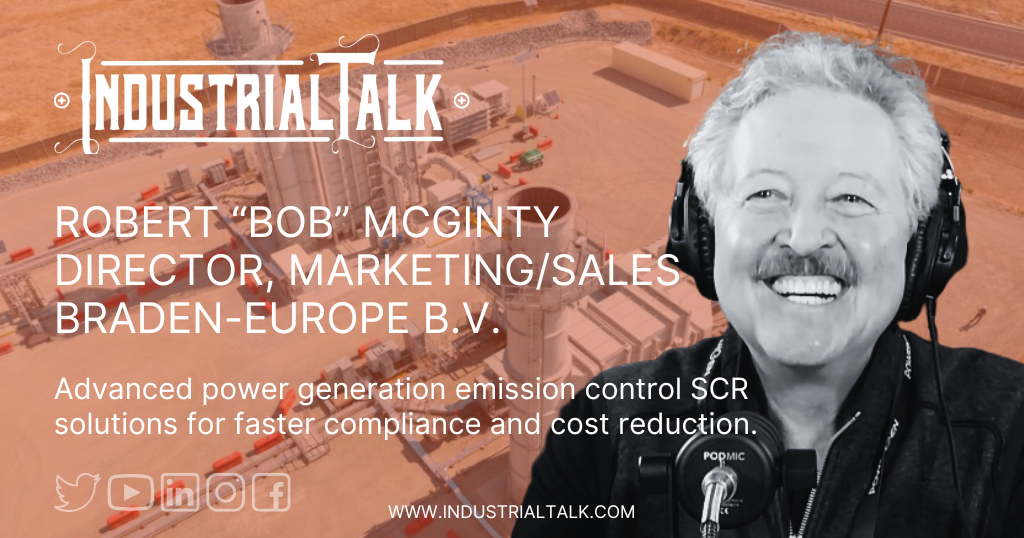
Industrial Talk is onsite at PowerGen and talking to Robert “Bob” McGinty, Director, Marketing and Sales at Braden about “Advanced SCR Solutions”.
Bob McGinty, a veteran in the power industry, discussed the evolution and growth of the power generation sector, particularly driven by data centers and AI. He highlighted Braden's role in emission control and gas turbine technology, emphasizing their advanced SCR system for faster compliance and reduced costs. Bob noted the increased demand for power due to population growth and technological advancements, stressing the need for responsible environmental practices. He also touched on the challenges of renewable energy costs and the importance of mentorship and family-oriented environments in the industry.
Outline
Introduction and Welcome to Industrial Talk Podcast
- Industrial Talk, sponsored by the Propane Education and Research Council, highlighting their commitment to safety, training, and innovative propane power technology.
- Scott Mackenzie, welcomes listeners to the Industrial Talk podcast, emphasizing the focus on industry professionals and their innovations.
- Scott thanks listeners for joining the top industrial podcast, celebrating industry professionals for their boldness, bravery, and problem-solving skills.
- Scott mentions the PowerGen event in San Antonio, encouraging listeners to attend next year and introduces Bob McGinty from Braden.
Bob McGinty's Background and Current Role
- Scott introduces Bob McGinty, who has been in the Navy and has extensive experience in the emission and environmental marketplaces for over 35 years.
- Bob shares his journey from the Navy to the emission marketplace, focusing on improving emission controls through technology in the power industry.
- Bob discusses his transition into the gas turbine industry and his role in growing the Braden group, a multinational company.
- Bob emphasizes the importance of contributing to society and bettering human life through his work in the power industry.
Impact of Data Centers and AI on Energy Market
- Bob explains how the data center industry and AI business have driven the energy market to new heights, contributing to the growth of power generation.
- Scott and Bob discuss the increased demand for power in the US due to population growth and the retirement of aged coal-fired systems.
- Bob highlights the role of new gas turbine technology and the symbiotic relationship between conventional and new power generators.
- Bob mentions Braden's involvement in various aspects of gas turbine technology, including auxiliary systems, acoustic control, and emission control systems.
Challenges and Opportunities in Power Generation
- Bob discusses the structural challenges in the way power is consumed and delivered, emphasizing the need for different approaches to meet growing demand.
- Bob highlights the importance of responsible environmental compliance and the US's leadership in this area.
- Bob explains the migration of transparency between conventional and new power generators, particularly in the data center and AI industries.
- Bob shares Braden's expertise in building advanced air pollution control systems and the company's global presence in design, supply, and manufacturing.
Braden's Role in Power Generation and Emission Control
- Bob explains Braden's role as an equipment supplier for power generators, providing systems according to specifications or best practices.
- Bob discusses the importance of managing exhaust trains safely and preparing air for generator operation.
- Bob highlights Braden's experience in building gas turbines since the 1960s and the company's knowledge in preparing air for generator operation.
- Bob emphasizes the need for advanced emission control systems to meet regulatory requirements and improve air quality.
Regulatory Challenges and Technological Advancements
- Bob discusses the evolution of emission control technology, from addressing efficiency haze in the 1960s to advanced catalytic systems today.
- Bob explains the use of precious metal catalysts and the development of technologies to meet single-digit parts per million emission levels.
- Bob shares his experience working in Southern California, a region known for its strict air quality regulations, and the impact on Braden's technologies.
- Bob highlights the importance of developing technologies to meet regulatory challenges and the role of the EPA in setting and enforcing standards.
Impact of Renewable Energy on Power Market
- Bob and Scott discuss the challenges and costs associated with renewable energy, particularly in California.
- Bob explains the high cost of electricity in California and the impact on consumers, comparing it to other regions.
- Bob highlights the need for a balanced approach to energy generation, combining renewables with traditional sources.
- Bob emphasizes the importance of reliable power supply and the challenges of rolling brownouts in a major economy like the US.
Future of Power Generation and Workforce Development
- Bob discusses the return of baby boomers to the workforce and the importance of mentorship programs in developing new talent.
- Bob highlights Braden's family-oriented environment and flat organizational structure, fostering a supportive work environment.
- Bob emphasizes the need for continuous development and the role of new technologies in meeting market demands.
- Bob shares Braden's involvement in bringing power to remote areas in the US and globally, addressing energy needs in underserved regions.
Braden's Advanced Technologies and Market Impact
- Bob introduces Braden's advanced emission control system for gas turbine exhaust systems, designed to meet the demands of data centers and AI companies.
- Bob explains the benefits of the new technology, including reduced footprint, lower costs, and faster market deployment.
- Bob highlights the importance of speed to market and the role of advanced technologies in addressing regulatory challenges.
- Bob expresses excitement about Braden's innovative solutions and their impact on the power generation market.
Conclusion and Contact Information
- Scott thanks Bob for the insightful conversation and encourages listeners to reach out to Bob for more information.
- Scott highlights the importance of attending events like PowerGen to stay updated on industry trends and meet key industry professionals.
- Scott invites listeners to visit industrialtalk.com for more information and to connect with other industry professionals.
- Scott concludes the episode, emphasizing the importance of collaboration and innovation in the power generation industry.
If interested in being on the Industrial Talk show, simply contact us and let's have a quick conversation.
Finally, get your exclusive free access to the Industrial Academy and a series on “Why You Need To Podcast” for Greater Success in 2026. All links designed for keeping you current in this rapidly changing Industrial Market. Learn! Grow! Enjoy!
ROBERT MCGINTY'S CONTACT INFORMATION:
Personal LinkedIn: https://www.linkedin.com/in/robert-mcginty-34717119/
Company LinkedIn: https://www.linkedin.com/company/braden-europe-b-v-/
Company Website: https://braden.com/
PODCAST VIDEO:
THE STRATEGIC REASON “WHY YOU NEED TO PODCAST”:
OTHER GREAT INDUSTRIAL RESOURCES:
NEOM: https://www.neom.com/en-us
Hexagon: https://hexagon.com/
Arduino: https://www.arduino.cc/
Fictiv: https://www.fictiv.com/
Hitachi Vantara: https://www.hitachivantara.com/en-us/home.html
Industrial Marketing Solutions: https://industrialtalk.com/industrial-marketing/
Industrial Academy: https://industrialtalk.com/industrial-academy/
Industrial Dojo: https://industrialtalk.com/industrial_dojo/
We the 15: https://www.wethe15.org/
YOUR INDUSTRIAL DIGITAL TOOLBOX:
LifterLMS: Get One Month Free for $1 – https://lifterlms.com/
Active Campaign: Active Campaign Link
Social Jukebox: https://www.socialjukebox.com/
Industrial Academy (One Month Free Access And One Free License For Future Industrial Leader):

Business Beatitude the Book

Do you desire a more joy-filled, deeply-enduring sense of accomplishment and success? Live your business the way you want to live with the BUSINESS BEATITUDES…The Bridge connecting sacrifice to success. YOU NEED THE BUSINESS BEATITUDES!
TAP INTO YOUR INDUSTRIAL SOUL, RESERVE YOUR COPY NOW! BE BOLD. BE BRAVE. DARE GREATLY AND CHANGE THE WORLD. GET THE BUSINESS BEATITUDES!
Reserve My Copy and My 25% Discount
Transcript
SUMMARY KEYWORDS
Propane Education Research Council, Industrial talk podcast, power generation, Bob McGinty, Braden group, gas turbine technology, data centers, AI business, emission controls, environmental compliance, renewable energy, regulatory challenges, speed to market, advanced technologies, mentorship programs.
This episode of Industrial talk is brought to you by the propane Education and Research Council committed to advancing safety training and innovative propane power technology across industries. Learn more@propane.com
-:The propane Education Research Council leading the way in cleaner, safer and more efficient energy future.
Welcome to the Industrial talk podcast with Scott MacKenzie. Scott is a passionate industry professional dedicated to transferring cutting edge industry focused innovations and trends while highlighting the men and women who keep the world moving. So put on your hard hat, grab your work boots, and let's go all right
once again. Welcome to Industrial talk. Thank you very much for joining the number one industrial related podcast in the universe that celebrates you industry professionals all around the world. You're bold, brave, you dare greatly, you innovate, you collaborate, you are solving problems each and every day. Thank you for what you do. You are the heroes in this story, and thank you for your continued support. We are broadcasting at PowerGen. PowerGen in San Antonio, I got the state wrong, or city where I'm on I'm a little sensitive. Now, I got San Antonio, I got it. But anyway, we're here. And if you're in the world of power generation or supporting power generation in some way, shape or form, and you're not here, you need to put this one on your calendar for next year. Clarion does a great job at putting together this event. You need to be a part of it, and you get to meet great people like Bob. Bob McGinty, Braden is the company we're going to be talking about. Well, Braden, that's, that's pretty much as much as I got. So let's get cracking. Hi Bob.
Bob, okay,
doing okay. Yes, I'm doing great better. Great day, great time, great show. Listen to can't get any greater. Listen.
He's just rolling. He's I can't keep up now. Now I feel like I need to buckle in and saying, here goes Bob. He's running off and he's doing what he needs to do. But you are having a good show.
Absolutely. It's been a very successful show. It's very productive. There's a lot of energy at this conference. It's twice the size it was a year ago. So she changes.
See, I couldn't put my finger on it. I couldn't I didn't want to put my finger on it, but I said, this seems bigger. Absolutely, you
agree with that. Absolutely, the world's changed in the last year and a half, and it's been, driven by the data center industry. It's been driven by the need for more power in the US, from population growth, from aged coal fired systems to new gas turbine technology, and in particular, the data centers in the AI business has completely transitioned the energy market to heights never seen before.
Hey, Meg, he's just, it's like, you pull him a string on him, and he's just going, he's great. He's making my job easy. Meg, there he goes. Meg, off to the side, there. I just wanted to make sure that she was a part of the conversation.
Meg, keeps me from floating off into space, you know, like, keep that balloon. Yeah, I hear you.
I hear you. Go, I understand. I understand the struggle. I understand. So that's good. Give us a little background on who Bob is.
Well, Bob comes out of the Navy, long time ago. You know, that's grind my teeth on that, cut my teeth. And went to emission marketplace and environmental marketplace about 35 years ago, and saw it as a way to be able to improve emission controls through technology and the power industry. And have stayed focused in the power industry for more than 35 years. Transitioned into the gas turbine industry when it really started taking off, and the coal fired and gas fired power plants started to retire out and been in that area, in that mode, through that time, and joined the Braden group to help them grow this company, a multinational company, to to heights. Haven't to grow them to new heights.
Check it out. I'm really enjoying
this conversation. You're making it easy, Bob. I like it a lot. All right, I
have a lot of fun doing this. I mean, this is near and dear to my heart when we think we're contributing something to society and bettering human life. See, you can't do any better.
See, I agree with you 100% I think these are heroes. And I mean, especially now, I mean, this is such. I wish I was younger, because it was never this way when I was with the utility company. Was never, we never had conversations like this. What we're having today. This is outrageous and wonderful opportunities. This is amazing time.
It's transformational. I've worked all over the world, traveled all over the world. Worked in countries where they didn't even have power in the cities I was working in, we brought power to the cities in China and Middle East and these different organizations. And what's happening here is just incredible, in terms of the growth that we're seeing here in the US today, we helped other countries to help get their feet on the ground in terms of having energy to their infrastructure, and now we're reinventing the infrastructure here in the US
have to this whole this whole grid and this whole utilities model and the increased demand, and there's just some really structural challenges that exist in the way we consume and deliver power. And I'm I'm thinking companies like Braden, you and others are challenging those perceptions and saying, We got to do it different. We've got to to achieve and to succeed in all of this wonderful stuff. We have to do it different,
absolutely, and we have to do it in a responsible manner. And I think that's the US has always been the leader in responsible environmental compliance to be an example to the world. And I've seen that across you know my life in the commissioning engineering world associated with gas fired power plants, coal fired power plants, and ultimately, gas turbine power plants. And the new model we're seeing here in the US, where we're growing the organizations and running parallel together to build the infrastructure out in the conventional assets, and at the same time building new assets in the data center and AI industry, which will ultimately back feed into the conventional network. So there's a there's a migration of what do you call it, transparency, between the two types of energy generation requirements, between the conventional power generators and the new power generators. And I think that's going to be a symbiotic relationship that will take place. And of course, brain is very involved in it, from every OEM in the gas turbine industry supplying everything that's associated with the auxiliary systems. We don't build gas turbines, we don't build generators, but we build everything around those, the air inlet filter houses, the diverter and bypass systems, the acoustic control systems, the conventional exhaust systems, and ultimately, the emission control systems. And that's where my expertise stands, at which I've been doing all my professional career in this is focused on the environmental side, how to make this better place for us all in terms of what we breathe and what we do. So we build very sophisticated and advanced air pollution control systems select the catalytic reduction and CO oxidation systems for these gas turbines all around the world, and we've been an example for the rest of the world in the expansion of that type of technology, and it's been very successful to us, as Braden is a multinational organization growing various divisions from all of those technologies that I just mentioned. We do that on a global scale, in both terms of the design, supply and manufacturing, so the sun never really sets on the Braden technologies in terms of execution of products, so that we can work literally, on a global basis, around the clock, to be able to provide speed to market requirements for the for the Technology today. And I think that's really critical.
Can you, can you make sure that I buckle in when you start on your your story? Because I'm not buckled in, I feel like I'm, I'm I'm slipping around in my chair. I need to be buckled in. And by the way, on a side note, do you feel that cold breeze? Absolutely? What the heck is that I know I'm all of a sudden, I'm all distracted by the fact that my feet are cold.
Welcome to San Antonio. Geez.
Yeah. All right, let's, let's talk about Braden outside America that you just peppered me with a lot of things about Braden. You're here at power Gen Great. Yes, and, and everybody is talking specifically. This is what's so amazing about the power generation business. So you, you everybody's like, yeah, I got a generator. It's right over there. It's a generator. And I can, I can do this. I can, I can pull that generator up. I can stick it on wherever I can. I can. There's so much that goes on. It's just, you just don't do that, because there is the stuff that you guys provide has to be a part of that conversation. Absolutely, generators, don't the companies that manufacture don't have that capabilities on site, right?
That's right. That's not their expertise. They reach out to folks like us, who are the equipment suppliers who design this equipment, sometimes according to their specifications. And sometimes, according to our best practices, and with 100 year history, and be moving 100 year history of Braden and then moving into the gas turbine world back in about 64 when they first started building gas turbines, we are fundamentally there from the very beginning, the grassroots, yeah. So a lot of experience and knowledge and building things on, how to, you know, prepare the air for the the operation of the generator, how to control the sound coming off of it with our enclosures, to make sure that it's acoustically safe. So, you know, people aren't doing a rock concert. Sound attenuation type of problem associated with it to being able to manage that exhaust train. Because, you know, obviously these exhaust trains are very high temperature and can be very dangerous, and we're ensuring that we are managing that so that safely exhausted through the system, or to prepare it through an emission control system where we've got to prepare it for Catalyst operations and reactions. I was going to say that, yeah, we want that air is clean coming out of the stack as it was going into it. And our technologies today can achieve that.
Yeah, here, here's the funny thing about that. Right back in 64 they weren't really. They the focus on all that wasn't really there. Wasn't there period. So as a company brain, there has to be that regulatory component, you know, because it evolves, it grows, it changes. It is it greater demand. But that's that's good business for you guys, because if I'm a, if I'm a company, and I have to modify my my exhaust, whatever it might be, due to regulatory challenges, well, but you must have seen
you have to know where to go and how to step through those processes, because it's highly technical. Yeah, you know, a lot of the time I, one of my colleagues, calls it a black box. It is, you know, and it is, it's, it's, it's technology, it's chemistry, and it's Advanced Systems Design and implication. Back in the 60s, we called it, you know, an efficiency haze. When you watch that, you know, brown smoke coming out the stack. Yeah, you know. But in reality, that was oxides of nitrogen and other precursors of, you know, some emissions that we don't want. And so introducing oxidation catalyst to remove the CO and the VOCs and the hydrocarbons and and then introducing a vanadium based catalyst reacting with ammonia to remove the oxides of nitrogenium became vanadium. And those, you know, those are precious metal catalysts, or specific metal type of formulations that we use in the catalytic system. And it's necessary in order to get down to these, you know, single digit parts per million levels of emissions coming off these systems. You know, I'm from California, and we I'm in Southern California, in between Los Angeles and San Diego and a lake mission. Viejo, yeah, I grew up in Barstow. Okay, so you're right up on the desk.
I lived in San Diego. I'm up in the desert. Nobody goes there, quite frankly, nobody. They eat on the way to Vegas. They eat at the in and out burgers on the way to Vegas. Great place to eat.
There it is, baby. But you know, coming from that world, we were known as the tree hugger capital of the world for many years, you know, the air quality district there, so back in the 80s and the 90s, you know, getting involved in the emission control marketplace, particularly in the 90s, had a chance to work with the engineers there and develop some of the processes and procedures necessary for testing, and took that information and trained other departments across the United States, Department of Environmental Protection for New York, TCE Q here in Texas, Pennsylvania, one state after another. So it was basically the proving grounds in the birthplace of the regulatory oversight for these advanced
I worked for Southern California, Edison, very,
quite aware of all of those challenges,
sure, and so taking that knowledge and applying it to what we do today in the turbine technology field and for the emission control systems has been a step as they tighten the regulations, because as the years gone by and then, you know, obviously, working with the EPA and some of their regulatory sites and being testifying In terms of what can be achieved and what can't. EPA always does what they want to do, no matter what you tell them. But at the same time, we're always being challenged to develop the technologies to be able to address the regulations, because sometimes they put out the regulations before the technology has evolved. I remember.
No, they wouldn't do that. How dare you say that? No way. Yeah, there are so many conversations it's like, yeah, here's this guy, regulation coming down the term like, and you need everybody in the room is like, what?
That's exactly right. That's exactly right. Scott, I mean, when we testified on the VOCs, and how do you measure 91 ppb? Think about that. How do you even have the technology to do that? And while we testified what the catalyst could do and what was achievable on that, you know, there the EPA puts out this regulation that we can't quantify, and so we have to develop the technologies in order to be able to quantify it, to prove that the catalyst can do what
we want. That's that's money, baby. Yeah, it really is. It's money, and it really is. And are we getting to a point where we've recognized No, nobody wants to pay more for power. Nobody, I'm not sure of anybody saying, hey, I want to pay more power. I used to negotiate those power purchase agreements for those, these renewables, and it was always expensive. And it's like, but how do, how do we renewables that with all just, you know,
the renewables are very scary aspect of what we saw migrate across the United States. And I think you're as well well aware of that, because it was always subsidized. And once the subsidy stopped, you can't it became extremely I live in one of the highest, expensive, most expensive states in the country for electric cost. You know, 55 cents a kilowatt hour. People are just, you know, in the Midwest, would absolutely be in shock when they're accustomed to paying 689, cents a kilowatt hour to be hit with that because of the renewables, and then we go through rolling brownouts because power isn't available. Heard of right? For unheard of, for the fourth largest economy in the world, unheard of. This is something that has to change.
It has to i That shocked me, because when I, when I was a word for Edison, I was a transmission lineman, right? So I in South Central LA you saw I'm climbing towers, I'm doing transmission work. And we never, not one time, ever had a conversation about a rolling blackout or a rolling brownout or shutting down lines, or we just never did that was unheard of, and
that's third world country. Yeah, we were, that's why I went to China. That's why I went to the Middle East. That's why I went to South America. Was to bring power to those that didn't have so nobody. So I think our technology today, and I'm glad to see that there's some some sanity going on in the political side that we've got in place today, where, you know what, we've grown the company the country. We decided we wanted to bring back industry back in I worked in China. When W they went into WTO, they shut the country down to celebrate. And overnight, a million companies moved to China, and I saw what happened over there, and I came back to my home and watched the change in the transition and the rusted buildings and all of that stuff as everything became a band. It is so refreshing to me and exciting to me to see the new industries coming back here, yes, and the landscape starting to change. And we do. We have a larger population that we have to be able to address. We have to be able to bring power to those that population, to stabilize our cities that we have going on today, and to address the new technologies, not only just data centers, but all the manufacturing that's coming over here, one company after another coming over here, and that's a good thing. This is what made America great.
See here, here's, here's, it's so funny when I hear that, I think, okay, greater demand for power. Bring everybody re shore, near shore, whatever shore manufacturing scale, bring it on every it's all wonderful. And I and and all I can think about because I'm not smart like Bob. Is that one? How do we satisfy that? Bob's got a lot of scars, yeah. How do we satisfy that demand to meet the needs of that, that expansion, the financial capital markets, to be able to support that? And then I always get down to the people. Where are they? I don't know. I need people.
Boomers are coming back to work. Yeah, they're consultants. Now we see that, and there's a big there's a big draw going up, but we also see a lot of mentorships. And also, as Braden is involved with this, mentorship programs as well, we reach out to the universities. We bring people in and bring talent in and teach them from the ground up as to what's going on. We believe in a an environment that's family oriented environment. We're a very flat organization, you know, it's and we're, we're building it up so that people are in this business. What you build, you see, and. Long after you retire. You know, this is lifetime stuff. Oh, yeah. And so we want, we want people involved that are have their family supporting on what they do, because we make sacrifices in what we do. We're sitting over here at this conference. We're going to shows. We're going to different places throughout the world and and is particularly, you know, there's some places in the US are pretty remote as well. You know, it's we don't have lights, you know, some certain things. And we're bringing those type of assets to those empty spots in the United States as well as the world. So we want to make sure that we have our family oriented environment. And at the same time, you know, we're at the cusp of technology, addressing speed to market transformational and bringing new technologies to the forefront, developing, testing, executing to be able to satisfy the demand and the draw that's being required of us.
Yeah, the market is saying, I want power yesterday, and I need to do that, and I needed to plug it in because this reason and that reason, and we're just not wired, that that's right. I did wire, yeah, wired that way.
That's right. And one of the technologies in speaking specifically about emissions, because that's what I've been doing for the last 35 years. On our SCR system, is for for the gas turbine exhaust systems, we develop our product. It's our drive technology product. We brought it to the market about two and a half, three years ago. It is one of the most advanced technologies to be able to address the marketplace for the data centers and the AI or for companies that need to have operational responsibility, be able to start up their turbines and get them into compliance sooner and faster, install them quicker and sooner. And that drive technology allows us to be able to do that. So we've really reduced the size of the footprint of our emission control systems, reduced the cost of it, and at the same time, improved its speed to market. See, man,
you were a pepper.
Just a pepper. I'm very excited about what we're doing up you can tell
too much coffee. I'm not sure when I don't know.
I can feel like I could conquer the world. After talking to Bob, they
used to call me Mr. Coffee on the East Coast. I can understand that.
Man, how do people get a hold of you? Bob. Can
LinkedIn account there.
You know, Coach Did you see I did that? That's coach. I don't have to deal with all the drama about and this is our URL.
No way You were great. Thanks a lot. Hey, thank you for that insight. You need to reach out. He's gonna his contact will be out on Industrial talk. You need to reach out to Bob. Bob is the connection that you need. He's got a lot of information out there, and of course, it will be out on Industrial talk. We're broadcasting on site right here, PowerGen, San Antonio, Texas. And if you're in that business and you're not here, you're missing out. You're missing Bob. You know you don't want to miss Bob. Bob will make your day. We're gonna wrap it up on the other side. Stay tuned. We will be right back.
Thanks. You're listening to the Industrial talk Podcast Network,
right? Well, that was Bob, Bob McGinty, and I got a stat card right here, Braden. And you know, it's interesting, when we were broadcasting from PowerGen, which we were, as you can tell, great conversation, Bob delivered. And what's interesting, everybody's talking about power generation, and rightly so, because that's what the market is demanding. But if you start to look at it from the perspective of how many companies are necessary to help fulfill that. You know, objective to have more power to fulfill the demands of the market, it goes a long way. That's a great show. You need to put that on your calendar. Reach out to Bob. You will not be disappointed. All right, we're building a platform that celebrates you. Go out to industrial, talk.com and just reach out to me. I would love to have a conversation with you. All right, be bold. Be brave. dare greatly. I say it all the time. Hang out with Bob. You will be changing the world. We're going to have another great conversation shortly. So stay tuned. You.

About the author, Scott
I am Scott MacKenzie, husband, father, and passionate industry educator. From humble beginnings as a lathing contractor and certified journeyman/lineman to an Undergraduate and Master’s Degree in Business Administration, I have applied every aspect of my education and training to lead and influence. I believe in serving and adding value wherever I am called.
