Dan Anderson with ReliabilityX
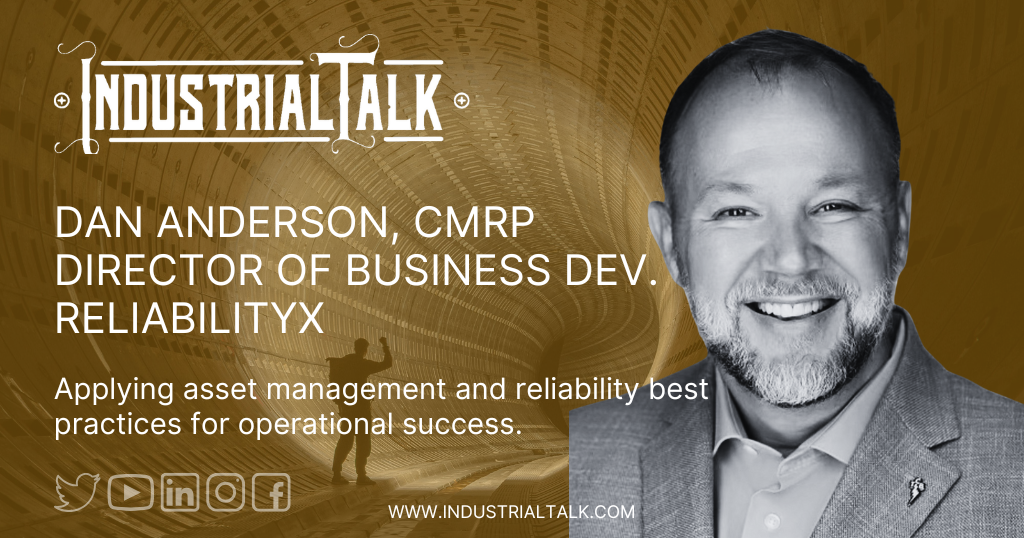
Industrial Talk is talking to Dan Anderson, Director of Business Development at ReliabilityX about “Asset management and Reliability best practices”.
Scott Mackenzie hosts an industrial podcast featuring Dan Anderson, a reliability and asset management expert. Dan discusses the importance of integrating asset management and maintenance reliability practices within organizations. He emphasizes the need for a high-level policy and strategic asset management plan (SAMP) to drive these efforts. Dan highlights the benefits of proactive maintenance, citing a case study where a company saved significant costs by implementing best practices. He also stresses the importance of top-down management commitment and continuous reassessment to sustain these improvements. Dan provides contact information for further discussions on these topics.
Action Items
- [ ] Reach out to Dan Anderson at ReliabilityX to further discuss reliability and asset management best practices for the organization.
- [ ] Conduct a loss analysis to quantify the financial impact of downtime and short/stop times on production
- [ ] Develop a business case to justify investment in reliability improvement initiatives like planners, reliability engineers, and predictive maintenance technologies
Outline
Introduction and Welcome to Industrial Talk Podcast
- Scott MacKenzie welcomes listeners to the Industrial Talk Podcast, emphasizing its focus on industry professionals and their innovations.
- Scott introduces Dan Anderson, highlighting his expertise in asset management, reliability, and his role as the chairman of the board of SMRP.
- Scott praises Dan's insights and passion for reliability and asset management, describing him as a delightful and knowledgeable individual.
- Scott mentions upcoming events, including Power Gen in January, MD&M West in February, and Accelerate with Fluke Reliability in March, encouraging listeners to attend.
Upcoming Events and Their Importance
- Scott discusses Power Gen, emphasizing its relevance to the power industry and its location in San Antonio, Texas.
- Scott highlights MD&M West, focusing on its significance for the manufacturing and med tech sectors and his excitement about broadcasting from the event.
- Scott talks about Accelerate with Fluke Reliability, praising its user conference and encouraging listeners to attend if they are interested in asset management and maintenance.
- Scott introduces the Barcelona Cyber Security Congress, emphasizing its importance for cyber security and digitalization in the industry.
Introduction of Dan Anderson and His Background
- Scott reintroduces Dan Anderson, emphasizing his expertise in asset management and reliability.
- Dan provides a brief background, mentioning his role as the Director of Business Development at ReliabilityX and his position as the chairman of the board of SMRP.
- Scott and Dan discuss the importance of the SMRP annual conference and the positive interactions they had there.
- Dan shares his experience of dressing up for the SMRP annual conference, highlighting the professional atmosphere.
Differences Between Asset Management and Reliability
- Dan explains the differences between asset management and reliability, noting that asset management is more strategic and driven by executive leadership.
- Dan describes the importance of a policy and a strategic asset management plan (SAMP) in asset management.
- Dan contrasts this with reliability, which involves day-to-day maintenance and proactive measures to ensure equipment is running smoothly.
- Scott and Dan discuss the importance of having a policy that is well-thought-out and not overly complex.
Best Practices for Reliability and Asset Management
- Dan shares insights from Bruce Western at PGT Windows, who implemented best practices in asset management and reliability.
- Dan explains the process of developing a policy and a strategic asset management plan, emphasizing the importance of executive leadership.
- Dan discusses the need for a business case to justify investments in reliability and asset management, using examples of cost savings from reduced downtime and overtime expenses.
- Scott and Dan talk about the challenges of sustaining these practices over time and the importance of top-down management commitment.
Challenges and Solutions in Implementing Best Practices
- Scott and Dan discuss the challenges of changing organizational culture to be more proactive and less reactive.
- Dan emphasizes the importance of change management and the need to reward proactive behaviors to sustain best practices.
- Scott shares an example of a company with unused thermography equipment, highlighting the need for proper implementation and execution.
- Dan explains the financial benefits of reliability and asset management, especially for companies operating at full capacity.
Engaging with ReliabilityX for Improvement
- Scott poses a challenge to Dan about how to sustain reliability and asset management practices over time.
- Dan suggests starting with education and assessments to develop a business case and understand the organization's current state.
- Dan explains the importance of reassessments and re-energizing the workforce to maintain best practices.
- Scott and Dan discuss the role of third-party consultants like ReliabilityX in providing ongoing support and training.
Final Thoughts and Contact Information
- Scott and Dan wrap up the conversation, emphasizing the importance of proactive maintenance and asset management.
- Dan provides his contact information, encouraging listeners to reach out to him for further discussions.
- Scott thanks Dan for his insights and encourages listeners to reach out to ReliabilityX for their expertise.
- Scott promotes other podcasts in the Industrial Talk Podcast Network, including Ask Molly and the Business Beatitudes Podcast.
If interested in being on the Industrial Talk show, simply contact us and let's have a quick conversation.
Finally, get your exclusive free access to the Industrial Academy and a series on “Why You Need To Podcast” for Greater Success in 2025. All links designed for keeping you current in this rapidly changing Industrial Market. Learn! Grow! Enjoy!
DAN ANDERSON'S CONTACT INFORMATION:
Personal LinkedIn: https://www.linkedin.com/in/danandersonlinkedinprofile/
Company LinkedIn: https://www.linkedin.com/company/reliabilityx/posts/?feedView=all
Company Website: https://reliabilityx.com/
PODCAST VIDEO:
THE STRATEGIC REASON “WHY YOU NEED TO PODCAST”:
OTHER GREAT INDUSTRIAL RESOURCES:
NEOM: https://www.neom.com/en-us
Hexagon: https://hexagon.com/
Arduino: https://www.arduino.cc/
Fictiv: https://www.fictiv.com/
Hitachi Vantara: https://www.hitachivantara.com/en-us/home.html
Industrial Marketing Solutions: https://industrialtalk.com/industrial-marketing/
Industrial Academy: https://industrialtalk.com/industrial-academy/
Industrial Dojo: https://industrialtalk.com/industrial_dojo/
We the 15: https://www.wethe15.org/
YOUR INDUSTRIAL DIGITAL TOOLBOX:
LifterLMS: Get One Month Free for $1 – https://lifterlms.com/
Active Campaign: Active Campaign Link
Social Jukebox: https://www.socialjukebox.com/
Industrial Academy (One Month Free Access And One Free License For Future Industrial Leader):

Business Beatitude the Book

Do you desire a more joy-filled, deeply-enduring sense of accomplishment and success? Live your business the way you want to live with the BUSINESS BEATITUDES…The Bridge connecting sacrifice to success. YOU NEED THE BUSINESS BEATITUDES!
TAP INTO YOUR INDUSTRIAL SOUL, RESERVE YOUR COPY NOW! BE BOLD. BE BRAVE. DARE GREATLY AND CHANGE THE WORLD. GET THE BUSINESS BEATITUDES!
Reserve My Copy and My 25% Discount
Transcript
SUMMARY KEYWORDS
ce, best practices, SMRP, ISO:Scott, welcome to the industrial talk podcast with Scott Mackenzie. Scott is a passionate industry professional dedicated to transferring cutting edge industry focused innovations and trends while highlighting the men and women who keep the world moving. So put on your hard hat, grab your work boots and
let's go all right once again. Welcome to industrial talk. You industrial juggernaut. Thank you very much for joining and thank you for your continued support of the number one industrial related podcast in the universe that celebrates you industrial professionals all around the world. Yep, you're bold, yep, you're brave. You dare greatly. You dare greatly. Big time you are changing lives, and you're changing the world each and every day. Thank you for what you're doing. Thank you for what you're doing. All right, in the hot seat. Dan Anderson, ReliabilityX. He's been on the the industrial tech show a couple of times, in fact, and he knows asset management, reliability and everything in between. He's also the chairman of the board of SMRP, the Society of maintenance and reliability professionals. Yep, that's what the wheelbarrow is full of insights and wisdom when it comes to reliability and asset management. Let's get a Kraken. Yeah, he's he's a delight. Can I say that? I'm not sure. Can I still, can I still hold on to my man card when I say he's a delight, but he is. He's a really, very, very nice gentleman. And boy, talk about insights come not even close. Well, I never claimed to be close, but the reality is, is that he really does, and he's passionate about reliability, asset management, maintenance and helping companies with their best practices to achieve outstanding results. That's that's what he does. That's what team ReliabilityX does. So there he goes. There they're just all they're all into it, man. All right, before we get into the conversation, I have some house cleaning opportunities here. Events one, I'm gonna, I'm gonna pop out four. One is in January, and that's power Gen. And I'm looking at my computer because I can, and I want to make sure that this is absolutely spot on. Power Gen. There is a topic, a topic of great interest, and that is all things power how do we satisfy the demands of the market? Power Gen is the event for you. I will be broadcasting from that site. It is January, 20 through the 22nd San Antonio, Texas, and the location is the Henry B Gonzales Convention Center. You need to put that or just go out to industrial talk and find the link and and be a part of it. It's a great conference. There's some really cool solutions there. All right, the next one, which I'm very excited about, because why wouldn't I? This would be in February, February, 3 through the fifth. MD&M West is the event. And if you're in the world of manufacturing, which you are, I know you're listening out there. You're saying, That's me, yes, if you're in the world of manufacturing, med tech, this is an incredible event, and I'm so honored to be there again, repping news and brews. We're going to have, for the first time, a podcast on the floor. We have the studio for news and brews, but now we're going to have a podcast on site at the location, and yours truly will be broadcasting from that event and and having a great time, great conversations and, and really sucking up the fun at that event. So put that on a calendar, of course, February, February 3 to the fifth, Anaheim Convention Center. It's there, all right. Number three, this is accelerate with Fluke reliability. This is this event is March 9 through the 11th, and it is at the Hyatt Regency, Austin, Texas. This is one of my favorites. I love going to this user conference. They do it upright, Fluke reliability, accelerate. Absolutely spectacular event. If you are in the world of asset management, maintenance and reliability, I highly recommend, highly recommend that you go to this particular event and it's and they do it up, right? So this is, of course, Austin, Texas, March, 9. Through the 11th now, this one, this last one, you put your future hat on, put your future head cap on, and this is the Barcelona cyber security Congress. I've had the wonderful honor to be able to broadcast from their shows. This is Fida, Barcelona, the individual, the organization that's putting it on and, yep, top notch. But boy, is there a topic. Let's say we got power, but there's got to be that, that cyber component. Let's say we have all these connected devices that are pulling in data and all that. Yes, there's that cyber component. There, this cyber security going forward to achieve this digitalization dream that we are all and AI, everything that's associated that's impacting industry cyber security, and it's not boring, it's not it's not dry, it's really interesting. And kudos to everybody out there in the world of cyber security. Thank you for what you do. This event is a must attend. Yep, I said it. I'm going to be there. I'm going to be broadcasting. I want to talk to you. This is Barcelona cyber security Congress, November 3. See it's way off. You can you can put it in. You can find that budget money. November 3 to the fifth. Barcelona. I'll have that link out there. They are great people. All right, let's get on with the conversation. I have more to talk about, but I want to get on the conversation. Here's Dan Anderson, ReliabilityX, we're talking about best practices when it comes to your reliability and your asset management efforts. He knows it. That's all I can say. He knows it. Here's Dan. Hey, Dan, welcome back to industrial talk. You're You're a favorite of mine.
You're one of my favorites. Scott, thank you for having me back.
Oh, always looking forward to this conversation. You're quite the gentleman.
Oh, you're the kind man. I had to dress up a little bit today, Scott, you put me to shame at the SMRP annual conference. And I was like, okay,
yeah, I appreciate that. You got to up your game. You got, if industry has to do something, it has to up their fashion game. That's what I want. I I want that. Amen, brother, I'm carrying the flag for that one. That's why I have this knitted shirt with my hat.
You're always looking sharp, Scott. Plus, it was
in my closet, and it was easy to get to very, very little friction on getting to it all right, four level setting. If you haven't checked out Dan's conversation in the past, check out Dan's conversation in the in the past. So you all know exactly who Dan is. Dan is the top notch Asset Management reliability professional with ReliabilityX and like I said, he's always a great conversation, a great individual that sheds incredible light on what you as an asset management, maintenance, reliability professional need to do. There he is, Dan, free of charge, right? There. You're listening to it. You're learning, growing with me. Hi, Dan again. Welcome. Thank you, Scott, pleasure to be here. Yeah, before we get into that, can you just sort of give us a little background again on who you are? Yeah, certainly. So I currently serve as the Director of Business Development for a company ReliabilityX we are a maintenance reliability asset management consulting firm that provides, you know, education services, assessment services, implementation services, a lot to in manufacturing, with a focus in food and pharma. I also serve as the chairman of the board of directors for SMRP. So professionals, yeah, that's a great organization. That's if you haven't checked it out. We we spoke at SMRP. We were on the floor, and I spoke to Dan, and he was great there. See how, see how quick I come to the point like he was great,
Scott, you're fantastic resource there for the community. And everybody loves you. So really great.
Put that on your calendar for:So if you're looking at different communities of practice, right, historically, and, and, you know, kind of generalize this a little bit, you've had the asset management community and then the maintenance and reliability community, and they've kind of functioned a little bit differently. We talked about this at the annual conference on how the asset management folks tend to be a little bit more white collar, and the maintenance and reliability folks tend to be a bit a little bit more blue collar in nature. However, I think that they complement each other very well. And if you're bundling them all up into one, I understand that as well too, because if you don't, if you're not looking at the specific details, and I can explain those to you as well, too. Scott, yeah,
I was saying, Yeah, that's what I want. I want to know you've already sort of laid the foundation. You're saying there is some differences, but there is some synergies that exist between Asset Management and reliability. Take us through the subtle differences between those two.
Okay? Well, I will start off with asset management, right? And this comes from a background of learning the whole ISO 55,000 and then how that complements, you know, the maintenance and reliability world. So if you look at it from that phase of it, you know you're thinking very high level with an organization, an organization to achieve ISO 55,000 there's usually, generally two things that you need. One is a policy, which is a very high level edict or document to your executive level decision makers within an organization. This is how I'm going to manage my assets within that organization, and that's the policy that's put together. And again, it's generally a one page document that highlights that for folks the next is a SAM or a strategic asset management plan, and this is developed through the middle part of the organization, the middle managers, the ones that are getting things done every day and and really taking that that high level vision or focus it comes from executive levels and driving it down throughout the organization, the strategic asset management plan or the samp is what's going to drive your asset management efforts. And again, a lot of times these seem very strategic in nature, and they are right. So once you get to the level of engineers and technicians and folks out there within the organization that are actually out there, you know, conducting the maintenance, making sure that production lines are up and running non stop. Then you start getting into the maintenance and reliability. So if you're looking at it from how do I divide the two from one another, asset management, in my opinion, are ones that you know, what are you focusing in on? From an executive level, driven through the middle management, and then as you get into maintenance and reliability, those are the folks that are making it happen day to day, that are out there, running the machines, making the machines, making sure they're up and running, being proactive in the way that they're handling the maintenance on the machines. So that's kind of how I would distinguish the two.
Scott, what's interesting, and you brought it, and I was writing down, I was listening to you, but I was reading notes, because this is I can only write notes when I look down the the term policy, and when we start talking about upper management and developing that policy layer, I'm maybe I'm a little jaded. Nobody really looks at that. Do they really look at that policy again? I created a policy, I wrote it, and then I put it in a three ring binder, then I put it on the bookshelf, and there it sits. Not to be opened again, do they? Does that? Does somebody get in there and really, a a top notch organization, go and drive into there, like, let's check out the policy.
I think the policy has to be very defined into the point, right, like so that's why you generally say, and this could deviate a little bit, but from what I've been trained in, the policies that I've been a part of developing, they're very high level, right? This is, you know, how asset. Management is going to add value to my organization, and this is the approach I'm going to take. It's not a 500 page document for the policy. The policy is generally a one pager, but it's very thought out, well thought out. It's almost like a vision for your organization. When you draft a vision for your organization. You know, those are generally a couple cents as long they're not a whole thing that's going to get put to a binder and set away for years to come. Okay?
Because I, all I could think of it is like, hey, check that out. Check out that business plan that's sitting on that bookshelf that never gets touched again because, because I believe in the world of asset management, in the world of reliability, just the nature of that profession is proactive. You're trying to make sure things are operating properly as efficient as they possibly can. Be proactive in identifying challenges before they become catastrophic and and, you know, conduct repairs accordingly. And that's a real push and active business model. So, all right, so, so we have a differentiation between Asset Management and reliability. Take us through, if I was an organization and I was talking to Dan and I'm I take us through some key components of best practices that I need as an organization to consider adopting.
Well, I think a lot you know for talking about asset management and reliability, some of the one of the most, brightest guys I know, a gentleman who I worked with for a number of years, Bruce Western. He's at PGT windows down in Florida, their storm window, and he had to go in. And I gave a presentation with him at IMC a couple of years ago, and he really talked about his approach in implementing best practices within the organization. And he took a little dabble of this. So he took a little dab from ISO 55,000 in development of a policy and a SAM so he got his executive leadership to understand the value of maintaining assets. He went through with his middle management, put together a strategic asset management plan, and he knew reliability inside and out, because he had done it for organizations out there, and he knew the best practice metrics that went along with, you know, having a planner in place, having good reliability engineering in place, starting to implement predictive maintenance technologies to forecast, you know, when problems would happen. And he took a soup to nuts approach to where he started off in developing with the the C suite folks and developing that policy. But then, as he went through, and he, you know, to justify the journey, right, not the race at the end of the day, to justify planners and justify getting RE's in place and justify getting some of this new predictive maintenance in place. You know, he created a business case, and that was going in and really taking a look and assessing the organization on how much were they spending, and expediting parts, how much are they spending in overtime expenses, from Lost downtime, from short start and stop times within a production line that were eating their lunch and then taking that business case and saying, hey, you know, this is how much we're losing, and you're telling me I can't afford to hire a planner right now, I'd say that we can't afford not to hire a planner. So it was real interesting to see that in the progression from education to really assessing where they were to implementing and justifying the cost to invest in reliability, maintenance and reliability.
How long did that process take? I'm just starting. That's That's amazing. How long? How long did he say? And this took fill in the blank.
He was still on the journey, right, you know. So it's never like when people say I need reliable, or my boss says, I want to get reliability tomorrow. Yeah. And you can make intimate, incremental changes that, either, you know, improve things. But in order to take a steps change a lot of times without that, you really need to have the business case in mind and then put together a master plan. But to answer your question, Scott, you know you can start to see impact if you engage with an outside partner within the first like six months, you start to see some traction. Within a year. Year you start to see, you know, pretty good results. The ones that I've seen, you know, move from reactive to world class that takes years, and depending on where you stand in that, you know, maturity scale, whether you're reactive or emerging maybe at some point in time, really determines how long that takes. But again, it's a journey. It's not a race. It's something you're continually doing and refining as people move out and move back in.
Yeah, and it has to be driven by the top. It just does. If it's hard to take that strategy, that focus, and although it probably, you know, might be embraced, but to do it from the bottom up versus the top down, very challenging. So it has to be at the top down. And Dan I, in an effort to try to sustain it over a period of time, you mentioned it, you know, maybe you're in one year, you'll see some improvement, but to truly sustain it again requires that effort up on top,
yep, yep. So important, Scott, I think that's really the foundational element of it. You know, is is management commitment being driven from the top down, and then plant partnerships in the business of reliability, it's not a maintenance exclusively initiative. It's a partnership between maintenance and operations that's driven from the top down. And you could have all the awesome PDM the best CMMS system, in place. You can even do work management really well, but without those two foundational building blocks, it's very difficult to sustain. Very difficult.
Yeah, unfortunately, I've been in organizations where that edict comes down from the top. We want to be less reactive, more proactive, be more reliable, operational efficiencies, all of that. And it all makes sense. It's, it's all great industrial jargon, but to sustain that is, is really and it's a it's, don't you think that it's a human equation? All of this stuff is fine. All of this technology is great. It's wonderful, but it always gets down to that person. I don't care what it is.
Always, oh yeah, yeah. And that's a critical aspect, too, Scott. I mean, if you go in and you're looking at the term change management, sometimes gets thrown around with management of change and those are two totally different things. The change management's addressing the people aspect. When you come in and you do like a business process, re engineering engagement to where you want it to be sustainable. You want the culture to change. You want people to understand that, hey, it's so much better for my cell phone not to be going off on the weekends, and to me get called into a plant because a critical piece of equipment is down, right? And in order to do that, you have to help an individual understand what's in it. For me at the end of the day, if I'm not getting compensated for doing something different, because change is so hard, that's really the hardest thing. And to take an organization from where a machine breaks down, we run out to fix it, and everybody celebrates because the machine is fixed. From the norm to I'm going to go out there and proactively replace that bell, or I'm going to go active out proactively, lubricate that bearing, and do it to the standards that are going to keep my machine up and running. That's, uh, that's difficult. That's very difficult, yeah.
And you're asking an organization, yeah, if you do it right, you're asking an organization to, sort of, for lack of a better term, be boring, be predictable, be yeah, there's no sharp edges. Everything's like, yeah, that's okay. We got it. It's all taken care of. And to change that culture, because we're a 40 year old company, company, and we have Joe here, who comes riding in on his horse to repair everything. He does a great job, but it just to change that. It's almost as if that mindset that everybody's so used to has to sort of retire, to bring in new, new thinking, new approaches, so that they're not being, you know, saying, Gosh, I'm getting all popped up on goofballs because I get to repair this thing, you know, in the middle of the night, and I get paid more money because I'm doing it that type of stuff.
Yeah, but so you have to change the reward system a lot, yes? So the maintenance. Far as Anne, who comes in and fixes it in the middle of a Friday night, they're not having a company picnic for that individual, but you're rewarding the group for being proactive and catching a problem before it happens, and not rewarding the reactive behaviors at the end of the day. And that's just something that helps to sustain that.
So here is a challenge that I pose to you. So I'm an I'm an organization. I contact ReliabilityX, and I say, I want to be world class. I want to do what is necessary to be world class. Come in, help me, and I'm going to spend that money. And I know that ReliabilityX Dan will do a great job at helping me achieve some real wins real quick, because I've been doing it for 40 years. I have some inefficiencies, and you're I'm going to gain some value and I'm going to spend that money, but over a period of time, I get better at it. I'm spending more. I'm spending money on my my operations. How do you stop an organization from saying we're really doing well, we're, you know, operationally efficient. We're doing everything real. Why are we spending this type of money in in reliability and asset management. We're look at us. I'm the new CEO, and I see all of this money going out to this thing, but we're already efficient. We're world class. How do you how do you sustain that?
I think the best organization, Scott recognized the need for reassessments and coming in. So initially, you know, the approach that I've learned throughout the years is start with education. It's relatively low in cost. It helps to develop your workforce and understand that there are better ways out there. Because it like, just like we were talking about a second ago. It all starts with the individual and the individual understanding this is a better way to do things, and this is how it's going to help my company and help me to grow within my company. So starting with a career progression, some education for that individual, and then as they move up, coming in and doing an assessment, which would involve development of a business case, maybe a loss analysis. That's something that we specialize in, at reliability ads, you know, and understanding that, hey, you know, we're not just looking at downtime losses. We're looking at short start and stop times that are keeping you from making or selling 100% of your product that's out there. And then you get to the implementation phase, where you're working with a group within the organization in a pilot area a lot of times to help them implement these new processes. But to answer your question, and go back to that, Scott, the best organizations, the ones that hit world class, are humming at this. They're constantly understanding that, again, it's a journey, it's not a race, and you may be winning, but a lot of times, that maturity level is going to slip back down as people turn over within the organization, as leadership changes, as priority shift, and you got to get it back up to standard. So what I do at that time would just suggest, you know, having and again, you're not fully engaged with the third party, but somebody like ReliabilityX is coming in and teaching you how to fish. But it's good to get them come back in and re energize the workforce and understand, Okay, we've slipped off in this area. We can get better. It's so amazing.
You just identify how organizations it's, yeah, hopefully that it, it just keeps going up over a period. It dips, comes back. It's just but, but the trajectory is always sort of at a positive slope of whatever that operational efficiency is because you're absolutely right with churn, with with just movement of people, because it is such a people centric profession. Yeah, you're I gotta tell you, I was at an organization one time walking through, looking in cubicles. Not that I was eyeballing. I was just looking. I was walking by, Hey, what is that? Thermography, right, sitting there in a cube, stayed there in the cube was never used. They spent the money on the tool, but never used it. And I, and it's chess, you know, it's hard not to be sort of that, that guy that said, Yeah, whatever we've talked about being reliable, or, you know, being asset centric, we were, but do we execute? That's why, you know, organizations like yours are so vital, because you that's what you do, is there you. Is there real bottom line financial value in doing this or becoming world class?
t them, you know, hundreds of:Yeah, I don't know. My body's a temple there. Yeah, it's a temple.
But there see that?
That's a great analogy. That's a great word picture that you just painted there. Because I You're right. If I'm sold out, if I'm at at 100% capacity, and I'm moving everything I can that's a that's a great problem to have, right? That is, but you don't want to have a burp snarl to knock you down. You don't exactly, how do you how do you put my last question, how do you take a company that is is selling all of that. They're moving fast. They're, I'm sure their hair is on fire. It wouldn't, you know, I don't have hair, so it wouldn't be but if they had hair, they'd be on fire. How do you go in and try to change that? Say, Hey, we can help you be better, to get their attention when they're just running and gunning. That's that's got to be challenging.
Yeah, it is challenging. It is challenging. But if you're talking to an executive level person who wants to squeeze every dollar they can out the business and they understand it, one of the hard parts Scott is running into executives nowadays that don't come from a sales and marketing background, right? Ones that have worked in manufacturing and maybe even engineering and maintenance, and so they understand this. They understand that keeping that machine running versus just, you know, hey, I'm selling enough. My site is producing enough. Why do I need to worry about it, but if you can really help them to create a vision, and that vision just entails the dollars and cents that are going to add to the bottom line, you know, that's how you would position that with somebody at that level. Now, if you're working with, you know, somebody who's a reliability engineer or a planner, you know, starting off of that education and helping them to understand, and then saying, and then they come into class, they go, this is great stuff. This is really good. How do I do this? At my facility, you say, well, you put out a program for them to go and articulate a business case back to management. Do there's a lot of online assessment tools. ReliabilityX provides an assessment tool that you can go out there and look at the maturity within your organization, but then doing a loss analysis on a production line to really show the quantitative benefits of a long term real time results.
That's a no brainer. It's easy to say, what happens if this line goes down for one hour? And I have the history to say that this line has gone down five times, which equates to X dollars, it's it's not a difficult I'm sure I'm oversimplifying it, but it can be done. It's all there,
yep, yep,
go ahead. Go ahead. No,
just there's a lot of tools out there. And I think in particular, you know, when we do an assessment, we'd like to conduct a loss analysis, which helps the. Quantify that lost downtime. And it's not just because a cylinder might have been missing, and that's why this line was down for four hours. It's quantifying all those short and stop times, those little adjustments that maintenance makes when they come out to a production line to get it center lined or back up and running, those in the long term mess up the asset pretty good. So you're just trying to get all those adjustments in place, trying to help leadership understand that there's a better way of doing things in a more proactive manner.
You're a doctor. You're an asset management doctor. You're just sitting there. Call, call Dan, get him out here. Our patient is not feeling really well. Let's figure out how we can make this patient feel better. Doctor, amen, hey, how do people get a hold of you?
-:look at that. There is no excuse not to get a hold of Dan right there. He's got everything, and I'll have all of Dan's contact information out on industrial talk. You'll find him. He's that good. Reach out to him. Put that on your to do list. You will not be disappointed. Dan, you were fantastic. Thank you, Scott, always a pleasure. Sir. Always Absolutely. All right, we're gonna wrap it up on the other side. Stay tuned. We will be right back.
You're listening to the industrial talk Podcast Network.
Dan is the man had to do that. And I have to do this, Mr. Anderson, I had to do that too. You know, don't blame me that those are out there. But anyway, how about that for a conversation. Dan knows his stuff. Reach out to him. All the contact information will be out on industrial talk as well as follow those wonderful people at ReliabilityX. It's a stable full of incredible professionals. They really are they, and they're passionate about your success. Really passionate. It's they're always fun to have a conversation with. All right, industrial talk is here. We have more podcasts that are coming out. We have one that's called Ask Molly, and it's all things about marketing and sales. From her perspective, she knows that too. And as well as the business beatitudes podcast that's about the heart, about industry the heart. Check them out. We've got more coming. People. Be brave. Dear greatly. Hang out with Dan and change the world. We're gonna have another gay conversation shortly. So stay tuned.

About the author, Scott
I am Scott MacKenzie, husband, father, and passionate industry educator. From humble beginnings as a lathing contractor and certified journeyman/lineman to an Undergraduate and Master’s Degree in Business Administration, I have applied every aspect of my education and training to lead and influence. I believe in serving and adding value wherever I am called.
