Frederic Borne with Resonetics
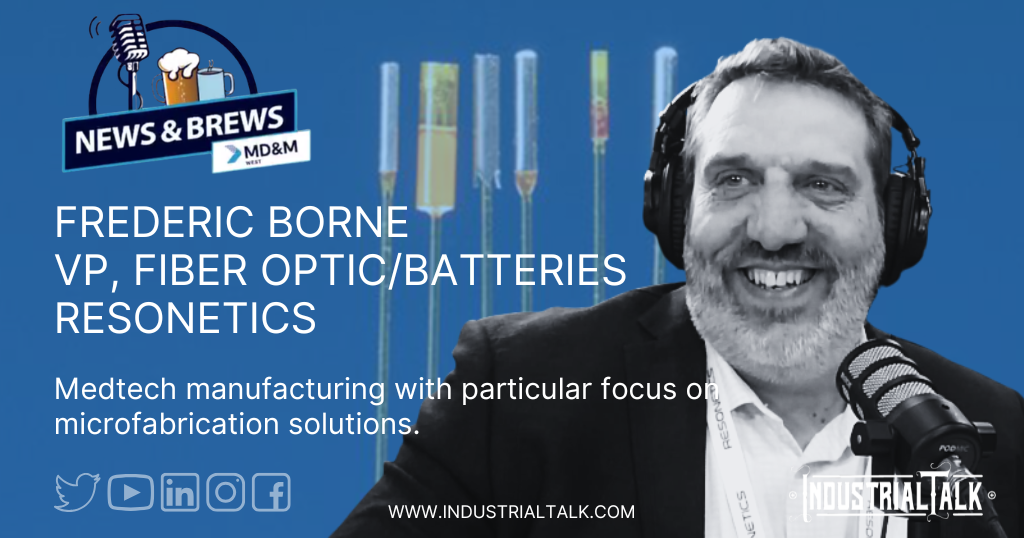
Industrial Talk is onsite at MD&M West and talking to Frederic Borne, VP at Resonetics about “Medtech manufacturing and microfabrication solutions”.
Fred Borne, a physics engineer and leader at Resonetics, discussed the company's expertise in medtech manufacturing, particularly in interventional cardiology, advanced diagnostics, minimally invasive surgeries, and bioelectronics. Resonetics specializes in microfabrication, including laser micromachining, and has expanded its capabilities through acquisitions, such as MemorySays for nitinol production. Borne highlighted the company's role in developing fiber optic sensors and implantable batteries, emphasizing their applications in neuromodulation and cardiac devices. He also touched on the potential of brain-computer interfaces and the future of neuromodulation technology.
Outline
MD&M West Event Introduction
- Industrial Talk, sponsored by MD&M West and the News and Brews team.
- Highlights the importance of MD&M West in delivering medtech automation, packaging, plastics, and design under one roof.
- Emphasizes the innovation, energy, and conversation at the event.
- Thanks the listeners for tuning in and celebrating the people driving industrial innovation.
Welcome to Industrial Talk Podcast
- Scott reiterates the podcast's dedication to celebrating industry professionals worldwide.
- Encourages listeners to put MD&M West on their calendar for next year.
- Mentions the importance of meeting people like Fred Borne at the event.
Introduction of Fred Borne
- Fred shares his background as a physics engineer specializing in fiber optics.
- Mentions his education at Laval University in Quebec City, one of the top photonics optics schools in North America.
- Discusses his career in fiber optics and the acquisition of memory says by Resonetics.
Resonetics and Market Solutions
- Fred explains that Resonetics is a top 10 contract design manufacturing company for the medtech industry.
- Specializes in interventional cardiology, advanced diagnostics, minimally invasive surgeries, and bioelectronics.
- Highlights the company's expertise in microfabrication and the acquisition of memory says for the production of nitinol.
- Discusses the company's ability to provide micro components of nitinol, stainless steel, and other materials.
Microfabrication and Medical Applications
- Scott and Fred discuss the concept of microfabrication and its applications in medical devices.
- Fred explains the use of laser micro machining for creating extremely small components.
- Mentions the company's ability to handle various materials and the importance of precision in their work.
- Discusses the challenges and innovations in the medical device manufacturing process.
Fiber Optic Sensors and Medical Implantable Batteries
- Fred explains his role at Resonetics, managing the fiber optic sensors and medical implantable batteries divisions.
- Discusses the use of fiber optic sensors in blood pressure monitoring and other medical devices.
- Highlights the applications of fiber optic sensors in diagnostics and heart pumps.
- Explains the use of medical implantable batteries in cardiac applications and neuromodulation devices.
Neuromodulation and Future Technologies
- Fred discusses the growing field of neuromodulation and its applications in medical devices.
- Explains the use of neuromodulation devices to treat conditions like urinary incontinence and asthma.
- Mentions the use of neuromodulation devices for sleep apnea treatment.
- Discusses the future potential of combining neuromodulation with brain-computer interfaces (BCI).
Battery Technology and Innovations
- Fred explains the advancements in battery technology and the company's focus on increasing capacity.
- Discusses the differences between rechargeable and primary batteries based on application requirements.
- Mentions the use of rechargeable batteries in neuromodulation devices due to their non-life-sustaining nature.
- Highlights the importance of reliable battery technology in medical devices.
Contact Information and Final Thoughts
- Scott asks Fred Borne for the best way to contact him, and Fred suggests LinkedIn.
- Scott expresses his admiration for Fred's work and encourages listeners to connect with him.
- Reiterates the importance of attending MD&M West and meeting industry professionals like Fred.
- Concludes the podcast with a reminder to put MD&M West on the calendar for next year.
If interested in being on the Industrial Talk show, simply contact us and let's have a quick conversation.
Finally, get your exclusive free access to the Industrial Academy and a series on “Why You Need To Podcast” for Greater Success in 2026. All links designed for keeping you current in this rapidly changing Industrial Market. Learn! Grow! Enjoy!
FRED BORNE'S CONTACT INFORMATION:
Personal LinkedIn: https://www.linkedin.com/in/fredbornegm/
Company LinkedIn: https://www.linkedin.com/company/resonetics/
Company Website: https://resonetics.com/
PODCAST VIDEO:
THE STRATEGIC REASON “WHY YOU NEED TO PODCAST”:
OTHER GREAT INDUSTRIAL RESOURCES:
NEOM: https://www.neom.com/en-us
Hexagon: https://hexagon.com/
Arduino: https://www.arduino.cc/
Fictiv: https://www.fictiv.com/
Hitachi Vantara: https://www.hitachivantara.com/en-us/home.html
Industrial Marketing Solutions: https://industrialtalk.com/industrial-marketing/
Industrial Academy: https://industrialtalk.com/industrial-academy/
Industrial Dojo: https://industrialtalk.com/industrial_dojo/
We the 15: https://www.wethe15.org/
YOUR INDUSTRIAL DIGITAL TOOLBOX:
LifterLMS: Get One Month Free for $1 – https://lifterlms.com/
Active Campaign: Active Campaign Link
Social Jukebox: https://www.socialjukebox.com/
Industrial Academy (One Month Free Access And One Free License For Future Industrial Leader):

Business Beatitude the Book
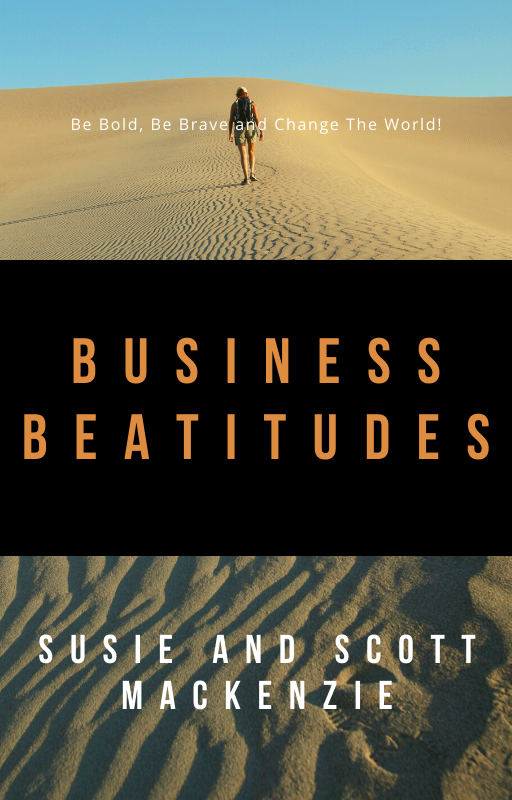
Do you desire a more joy-filled, deeply-enduring sense of accomplishment and success? Live your business the way you want to live with the BUSINESS BEATITUDES…The Bridge connecting sacrifice to success. YOU NEED THE BUSINESS BEATITUDES!
TAP INTO YOUR INDUSTRIAL SOUL, RESERVE YOUR COPY NOW! BE BOLD. BE BRAVE. DARE GREATLY AND CHANGE THE WORLD. GET THE BUSINESS BEATITUDES!
Reserve My Copy and My 25% Discount
Transcript
SUMMARY KEYWORDS
MD&M West, medtech automation, fiber optics, microfabrication, neuromodulation, implantable batteries, laser micromachining, interventional cardiology, advanced diagnostics, bioelectronics, precision manufacturing, AI integration, medical innovation, industrial innovation.
Hey, this episode of industrial talk is proudly brought to you by MD&M West and the incredible news and brews team. MD&M West delivered big medtech automation, packaging, plastics and design all came together under one roof, the innovation, the energy, the conversation, it was everything that makes this industry extraordinary. I was on the floor, capturing the stories, the breakthroughs and the leaders who are shaping the future. Thanks for tuning in and celebrating the people driving industrial innovation. Industrial talk powered by MD&M West and the news and brews team.
Welcome to the industrial talk podcast with Scott Mackenzie. Scott is a passionate industry professional dedicated to transferring cutting edge industry focused innovations and trends while highlighting the men and women who keep the world moving. So put on your hard hat, grab your work boots, and let's
go all right once again. Welcome to industrial talk, the number one industrial related podcast in the universe that celebrates industry professionals all around the world because you're bold, brave, you dare greatly, you innovate, you collaborate, you are solving problems each and every day. That's why we love you on industrial talk. That's why this platform is dedicated to you. Thank you for what you do. You are the heroes in this story. We are here, news and brews brought to you by those wonderful people at MD and M west. It is a great event. It is wonderful. And you do not if you're not here, you're missing out. It is a you just, you just need to be here. If you're in the world of manufacturing, you need to be be here because it's a, it's a non negotiable. Put it on your calendar for next year, definitely. All right. And the reason you want to put it on your calendar, you get to meet people like Fred Borne Resonetics.
Got it. You got it, Scott, let's
get cracking. You know, one thing I forgot to tell you, and I'm sorry, is the cadence of the conversation, so just follow my lead. Will do Yeah, hopefully don't, yeah, you'll be fine, trust me, this, this brings a little uncertainty. And no, it's, there's not there's, there's nothing going on. Hey, are you having a good conference?
Absolutely, this is the Super Bowl. Scott, so it is the Super Bowl. We call it the Super Bowl.
How long, how many times you've been here? Where the heck are you guys from? Too many questions.
We're all over. We're 19 sites all together. So primarily in the US, three sites in Canada, Costa, Rica, Israel, Switzerland, so all over the place where you from? Myself from Canada. I'm Canadian, Frank Francophone from Canada.
City, Quebec City, correct? My dad was Borne there. Awesome. Yeah. There you go. Just wrap it up, right there. Quebec City. There you go, there you go. All right, all right. Give us a little background on who Fred is, like, you know, give us a little CV on Fred.
So, I'm a physics engineer by trade, so I studied optics and other sides of physics. Hey, would you go to school in Canada? I went to school in Laval University, which is in Quebec City, one of the top four photonics optic school in North America.
You killed me. All right, continue. Sorry about that.
Yep. So spend beginning my career in fiber optics, and pretty much my entire career in fiber optics. Hence, the fiber optic sensors.
I have to ask the question. It's just, seems it's an interesting passion to say, I want to be in fiber optics. I mean, it's just, it's an interesting what, what drew you to just that?
Well, the passion didn't start at five year old. No, I started in physics because I didn't really know what I wanted to do. I knew I wanted to be an engineer, but I didn't know which type of engineers I wanted to be. And physics engineering ends up being sort of a mixed match of different ones. And after two years, we had to specialize in a specific subject. So I did big fiber optics.
Did you have a conversation with your parents? I want fiber optics.
They said, Oh, yeah, yeah, the Christmas trees that light up, yeah?
See, it's like, nobody really understands the fiber optics. It's just amazing. That's a fantastic or
you want to work with glasses, not really. Yeah, I see, there it is. I've had those conversations.
I was just gonna say, you sound like you've got experience behind that Absolutely. All right, let take us through Resonetics, specifically around what you do, what problems are you? You solving what First off, what's the pain in the market? And what pain relief are you providing to the market?
Well, let's start with what Resonetics is. So we're top 10 contract design manufacturing companies for the med tech industry. We specialize in four different market. Interventional Cardiology is the biggest one, advanced diagnostics, minimally invasive surgeries and bioelectronics. These are the four verticals for different applications we're going to have. It's amazing. Yes, I mean, we're known for microfabrication, so we do all kinds of different metal microfabrications. We specialize, or big, big chunk of our business, and night null. So we've acquired memory, says, couple, couple three years ago, where we now have from melt to market, and nitinol. So we do provide micro components of nitinol, stainless, even polymer and other things.
The question I have to ask, and it has really no bearing whatsoever, I gravitate toward the term micro. Give me an example of something that is micro. It's small.
It's smaller than small.
It's smaller than small. So okay, I'll share with you. This is our granddaughter. She had heart surgery. Okay? She had to have a valve, and I can't, I can't wrap my head around it, so the valve needed to have a patch and a patch. I mean, she saw it's already small, and then they put a patch on, and then they suture it.
Okay? That blew my mind.
And they might have delivered the valve with a system that we would have provided very small components, small tubes, to deliver to the heart.
She, I can't even see it. How do you sorry? I, I should, I should be disciplined in the way I process. But I just, I have so many questions. How do you how do you manufacture this stuff? I don't know how you do that.
Yeah, well, the company started with laser micro machining. So it's very specialized lasers. And we do very small micro machining, poke holes, everything. So we can do extremely small,
extremely small. Where do you do this? Where do you 19?
Where do you do this in 19 sites. So, no kidding, yeah, 19 sites. Each site, or whereabouts, has its own kind of unique expertise. But we do laser micromachining in the number of our sites, depending on the metal or the materials, there'll be different locations, but we do a number of different sites,
feedstock. How do you get the stuff to do it? I mean, it's like, okay, I need that special metal. It comes from, you know, Timbuktu, and you know, you can only find it on the North Slope of this particular how do you how,
as far as night Knoll is concerned, like I said, we do from melt. So we actually have a plant that will do the ingots for night Knoll. So we do from the night Knoll ingots all the way to the micro machine part that may end up in your daughter's heart. So we do we do this on contract, so customers will reach out to us with a challenge, with a part they want to make, and we help them resolve how we're going to make it for them again.
How does a company, Resonetics? It's just rolling off my tongue, Resonetics constantly, because you're in the world of manufacturing, respond to the changes that are taking place within the manufacturing world and be nimble enough to be able to say, yeah, we can do that. Yeah, we can do that.
I don't know. Well, we listen to our customers. Probably aren't right the biggest answer. So we listen to our customers, yeah, and then we go out and either develop new technologies or acquire them. So yeah, that's we focus on key customers, key market applications, and we do provide more service to these customer base.
How has and precision?
I just can't, I can't even fathom the precision that is necessary for what you do. Okay, that's one thing, so let's just take it for what it is, precision off the charts. How has the the Advent from impacting your business of of using AI to be able to improve that accuracy? Even more so I.
Um, while we do use AI, it's still in the infancy, but we still, I think it's tip of iceberg. Yeah, I agree. There's just getting started. So we do use AI, or a number of reasons, first to better understand the customer requirements, and then we're starting to feed more and more of the customer feedbacks and the new technologies coming in to better address those requirements,
yeah, I just that to be in that business, to be in your business, given the nature of what's taking place out in the market, it's, it's almost like the Wild West. But you can't have the wild west in the medical world. You need, you need structure, but, but the demand is always like, Okay, keep going. Keep going. Keep innovating, keep pushing the the envelope. Help relieve pain, all of that stuff. Let's get into fiber optics. Tell us a little bit about what, what, what you're doing in the fiber optic sensors and medical power. There you go.
ion, and was acquired in late:that so, what? Give, give, give me an application for what what that is.
So on the sensor side, let's say pressure. So we do have blood pressure sensors that are integrated into a number of different devices. It could be diagnostics. So fractional floor reserve, or FFR, is one of our biggest application where the pressure wire effectively will be placed into a cath lab and quantify the stenosis, quantify the blockage to decide or not to stand. So in order to quantify it, they have this little wire with one of our pressure sensor and then they measure the blood proximal and distal. There are now devices like pvad pumps, so pumps that are helping the heart to flow. So these are new types of applications, all kinds of devices for blood flow restorations, so getting rid of stenosis. These are your typical fiber optic sensors. Applications on the battery front, yeah, the battery front started with cardiac applications. So defibrillator, pacemaker, so they're still very active. Cardiac monitors, they're still very active. But what's really taken off now is neuromodulations. Say that one again, neuromodulations,
okay, you got to expand upon that as it you can't just leave it dangling out there.
What's going on? So, neuromodulator. It's been around. Quite frankly, it's been around for a long time. So it's basically an active implantable, yeah, that has a battery, of course, yeah. And that will send impulse to leads on different nerves, yeah? So he did her spinal cord, different nerves, even in the brain. So it's been around mainly to trade pain for a number, yes, yes, drug deliveries or things, but the number of different therapies now that are being developed using neuromodulations is just exploding. Why?
Why is this? People are saying, Yeah, we could do it here. We can do it via it here. I never thought about that, but that's right, there.
You got it. So now it started basically with the spinal cord for the most part, yeah, but now vagus nerve, tibial nerve, sacral nerve. Don't all new terms for me for a number of last few years, but it's amazing what is being developed at the moment. Just by tickling a few nerves, you can fix urinary incontinence, asthma, no way, yeah, you might have seen there's a lot of ads from inspire medical sleep, yes, yes. There you go. That is one that is one of the fastest growing company. It's a neuromodulation device so it tickles some of your nerve and it fixes sleep apnea.
It's so funny. I was wondering how that worked. I just said it. And they have, you know, this, this device that's sort of this little, you know, remote control. They stick it on there, whatever, and then it turns it on.
It's an implant, and actually charge it with external but it's an implant
powered with an implantable batteries.
Tell me about the battery tech now you you've been in the business a long time. Battery technology has changed.
It has changed. It continues to change. So we can, we are. Our goal is to always increase capacity with the same volume, right? So basically making it smaller, right deliver more capacity. So we do separate batteries into rechargeable and primaries. So depending on the applications, we'll do either rechargeable primaries, a lot of the neuromodulations can be rechargeable because it's an implant that is on the surface. And can be rechargeable it's not life sustaining device. So you can, you can afford rechargeable batteries, whereas typical defibrillators and other device like this would have primary batteries, because you can't, you can't forget to charge your device.
All right. Future hat, tell me what gets you excited about the future?
Definitely, neuromodulation. That's really if I, if I do combine neural modulation with brain computer interface. So BCI, yeah. So the neural link and all the followers, all the other companies around those two together, is explain
neural link. I, I, you know, I got the Elon Musk, whatever he's doing, and I hear all of that stuff, what, what, what.
So I will not explain neuralink, but I was playing a little bit about BCI. So basically, the different kinds of modalities. But basically implanting some types of electrodes to read the signal from the brains, and then a whole bunch of algorithm being developed to decode what what is read from the brain, and then have people start, let's say, talk again with their families. That's I've seen videos in the last year or so in conference is just amazing, really?
Yeah, we're gonna be no case
changing families, yeah, future, for sure,
you're blowing my mind. You know, what's interesting is the fact that I've heard about this. I've seen some, I don't know some results, but it can only get better. We're still at the tip of the iceberg. We have not really explored some of the benefits of that. All right, Fred, if somebody says, hey, I want to talk to Fred, what would be the best way to do that?
LinkedIn is always easy. Everybody's on LinkedIn, so easy way to get to me.
Thank you. That made that easy. I like the fact that you said LinkedIn, and I don't have to go down the road of going, No, give me the LinkedIn thing. You are absolutely spectacular. You blew my mind. I like that. You're way above my pay grade, way above my pay grade. All right, we're gonna have all the contact information for Fred out on industrial talk, his LinkedIn profile. You can find his stat card out on India's industrial talk. You'll be impressed, just like I was impressed. All right. News and brews is the crew, and we are broadcasting from MD&M West. And it is you need to put this on your calendar. It is a must attend event, as you can tell Fred, it's massive you need and you and you want to connect with Fred. It's all good. All right, we're gonna wrap it up on the other side. Stay tuned. We will be right back.
You're listening to the industrial talk Podcast Network.
Fred Borne Resonetics. Yeah, I'm looking at a stack card LinkedIn, as I indicated. You need to connect with old Fred, because he's got solutions. He's he's addressing the challenges that are taking place in the old med tech world and and delivering, yeah, he's a must connect all of his contact information out on industrial talk. You just click the link and then you say, connect, and we're good to go. That was MD&M. Wes brought to you by those incredible people at Informa, news and brews. We had a great time, and it was fun broadcasting on the floor, looking out at all of these incredible manufacturers and then some and the solutions. Put this on your calendar for next year. It's about as as Fred was saying. It's the Super Bowl of manufacturing. You got to do that. You got to be out there. Be bold. Be brave. Dare greatly. Hang out with Fred. Change the world. We're going to have another great conversation shortly. So stay tuned.
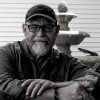
About the author, Scott
I am Scott MacKenzie, husband, father, and passionate industry educator. From humble beginnings as a lathing contractor and certified journeyman/lineman to an Undergraduate and Master’s Degree in Business Administration, I have applied every aspect of my education and training to lead and influence. I believe in serving and adding value wherever I am called.
