Jay Hack and Navin Kulkarni with Fluke
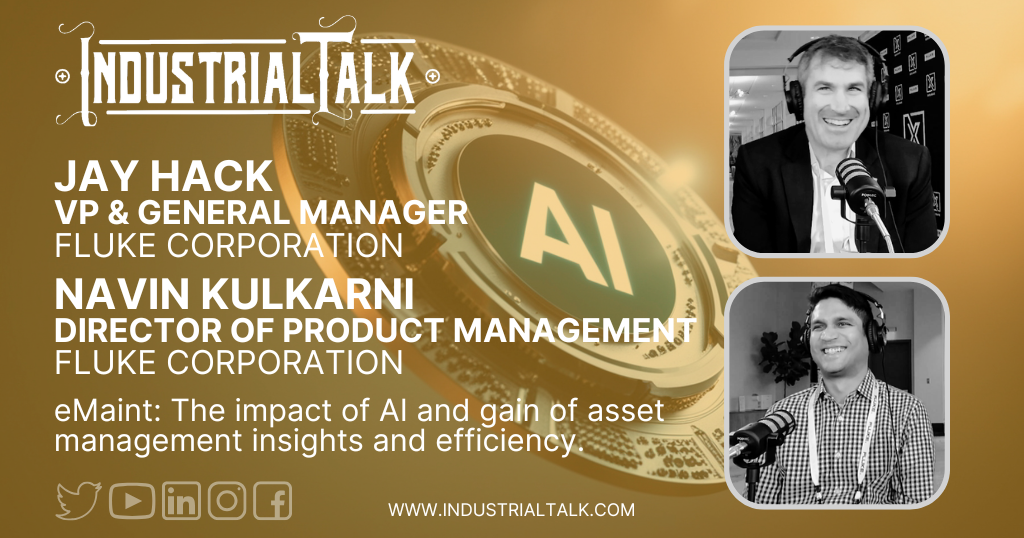
Industrial Talk is onsite at Xcelerate 2026 and talking to Jay Hack and Navin Kulkarni about “eMaint and the impact AI has on asset management”.
At Fluke's Xcelerate 2026 event, Jay Hack and Navin Kulkarni introduced new AI features in eMaint, a maintenance management system. They highlighted four key features: AI-driven email data interaction, SOP generation from OEM manuals, natural language work order creation, and multilingual document translation. The AI features received significant interest, with 40 customers eager to join the beta test. The system ensures data quality, supports structured data ingestion, and allows for real-time updates. Future plans include enhancing work order management and leveraging historical data for better decision-making and asset management.
Outline
Xcelerate 2026 Event Overview
- Scott introduces the Industrial Talk podcast, highlighting the importance of industrial professionals and the event Xcelerate 2026.
- Scott mentions the event's focus on real-world strategies, predictive maintenance tools, and AI diagnostics.
- Scott emphasizes the importance of attending the event and mentions the swag received on site.
- Scott introduces Jay Hack and Navin Kulkarni, who have been on the hot seat before.
Introduction of AI Features in eMaint
- Jay Hack announces the launch of their first AI features in eMaint, which were well-received during the intro presentation.
- Jay mentions that 40 customers in the audience wanted to sign up for the beta test immediately.
- Navin confirms positive feedback from customers and customer success managers.
- Jay and Navin discuss the importance of AI in improving operational efficiency and customer satisfaction.
AI Assistant for Email Data Interaction
- Jay explains the AI assistant feature that allows users to interact with email data in a chat GPT-style fashion.
- Jay provides a use case where users can query the system to get intelligent responses about asset information.
- Navin discusses how the AI assistant improves access to historical work orders and other data without the need for additional queries.
- Jay emphasizes the importance of having good quality data for the AI assistant to be effective.
SOP Generation and Document Digitization
- Jay introduces the SOP generation feature, which allows users to upload OEM repair manuals and generate preventive maintenance procedures.
- Jay explains that the SOPs need to be validated by the customer to ensure accuracy.
- Navin discusses the process of digitizing user manuals and other documents to make them accessible through the AI assistant.
- Jay and Navin highlight the benefits of having the latest and most accurate documentation available in real-time.
Work Order Generation and Prioritization
- Jay introduces the work order generation feature, which allows users to create work orders by speaking into their smartphones.
- Navin discusses how the feature can help prioritize work orders based on their criticality and importance.
- Jay and Navin emphasize the importance of having a complete and contextualized work order to improve maintenance operations.
- Navin mentions that the roadmap includes allowing users to close work orders through the system.
Translation and Language Support
- Jay introduces the translation feature, which allows users to translate dense documentation into other languages.
- Jay explains that the feature is particularly useful for customers operating in multiple countries.
- Navin discusses the process of validating translated information and the importance of having accurate translations.
- Jay and Navin highlight the benefits of having a multilingual AI solution to support global operations.
Future of AI in Maintenance Operations
- Jay discusses the future possibilities of using AI to track and analyze asset data and maintenance tech proficiency.
- Jay mentions that AI can help infer the rate of learning and competency of maintenance techs.
- Navin discusses the potential for normalizing data across different geographic locations to improve decision-making.
- Jay and Navin emphasize the importance of having a secure and reliable AI solution to support maintenance operations.
Conclusion and Contact Information
- Jay and Navin provide their contact information for listeners who want to connect with them on LinkedIn.
- Scott wraps up the podcast, encouraging listeners to attend Xcelerate 2027 and connect with industry professionals.
- Scott emphasizes the importance of being bold, brave, and innovative in the industrial field.
- The podcast concludes with a reminder to stay tuned for future episodes and events.
If interested in being on the Industrial Talk show, simply contact us and let's have a quick conversation.
Finally, get your exclusive free access to the Industrial Academy and a series on “Why You Need To Podcast” for Greater Success in 2026. All links designed for keeping you current in this rapidly changing Industrial Market. Learn! Grow! Enjoy!
JAY HACK'S CONTACT INFORMATION:
Personal LinkedIn: https://www.linkedin.com/in/jayhack1/
Company LinkedIn: https://www.linkedin.com/company/fluke-corporation/
Company Website: https://www.fluke.com/
NAVIN KULKARNI'S CONTACT INFORMATION:
Personal LinkedIn: https://www.linkedin.com/in/navinkulkarni/
PODCAST VIDEO:
THE STRATEGIC REASON “WHY YOU NEED TO PODCAST”:
OTHER GREAT INDUSTRIAL RESOURCES:
NEOM: https://www.neom.com/en-us
Hexagon: https://hexagon.com/
Arduino: https://www.arduino.cc/
Fictiv: https://www.fictiv.com/
Hitachi Vantara: https://www.hitachivantara.com/en-us/home.html
Industrial Marketing Solutions: https://industrialtalk.com/industrial-marketing/
Industrial Academy: https://industrialtalk.com/industrial-academy/
Industrial Dojo: https://industrialtalk.com/industrial_dojo/
We the 15: https://www.wethe15.org/
YOUR INDUSTRIAL DIGITAL TOOLBOX:
LifterLMS: Get One Month Free for $1 – https://lifterlms.com/
Active Campaign: Active Campaign Link
Social Jukebox: https://www.socialjukebox.com/
Industrial Academy (One Month Free Access And One Free License For Future Industrial Leader):

Business Beatitude the Book
Do you desire a more joy-filled, deeply-enduring sense of accomplishment and success? Live your business the way you want to live with the BUSINESS BEATITUDES…The Bridge connecting sacrifice to success. YOU NEED THE BUSINESS BEATITUDES!
TAP INTO YOUR INDUSTRIAL SOUL, RESERVE YOUR COPY NOW! BE BOLD. BE BRAVE. DARE GREATLY AND CHANGE THE WORLD. GET THE BUSINESS BEATITUDES!
Reserve My Copy and My 25% Discount
Transcript
SUMMARY KEYWORDS
ictive maintenance, Xcelerate:Industrial Talk is brought to you by Fluke. We were on site at Fluke’s Xcelerate event where reliability reimagined came to life from high energy keynotes to hands on predictive maintenance tools to break through AI diagnostic the event delivered real world strategies teams can use today. Xcelerate once again, proved why it is the launch pad for smarter, faster, reliable operations go out to Fluke.com to find out more.
Welcome to the Industrial Talk podcast with Scott Mackenzie. Scott is a passionate industry professional dedicated to transferring cutting edge industry focused innovations and trends while highlighting the men and women who keep the world moving. So put on your hard hat, grab your work boots, and let's go all
ell, we're on site. Xcelerate:it's been amazing. So for the viewers of the podcast, we end up launching our first AI features in within eMaint, we end up launching four features incredibly well received during the intro presentation. I think we were 40 and counting customers in the audience that wanted to sign up for the beta test right away.
Really, hey, and now, Navin, you were you, you expanded on that, and you showing all the functionality and and today, tomorrow, into the future, all of that stuff. You getting that same type of
positive feedback? Absolutely.
We have customers, As Jay mentioned, who have already signed up for the beta testing. We've great feedback coming from our customer success manager and customers who are already reaching out to them, saying that I need that now. How do I get that?
See, this is interesting, and I know some AI.
So I went down the road of AI. AI was writing my emails, right? Because I sort of scribble out something on an email, and then I realized, I realized quickly that's not good for me. And the reasons it's not good for me my that part of my brain of trying to struggle with an email would atrophy, and I didn't want that. So I'm thinking, okay, so this is just, this is just like, barely a scribble of what can be done and and the value that the that the solution can provide. Jay, what are we talking about? What you spoke on it in the morning. And what are we talking about? What do you see happening?
Sure, well, we'll give an overview of the features. Yeah, high level, please, please. First one is, is we call it talk. You basically can interact with your email data. So think about, we have all these database records, work orders, asset information. You can basically query it like a chat GPT style fashion to get answers about what's going on.
So here's the use case. I'm email. Is this x4 x5 or just x5 right now the x5 so I'm an email and I have this data. I have this historical data on all the it just, it's a it's a huge database. So I can go in and just like I do with whatever AI tool I have, and just say, Hey, I'm wondering about this particular asset. And it doesn't, it doesn't say, Hey, I don't understand what you're saying. You can just sit there
and do it. So show. Me on asset ABC, show me the work order history of this asset in the past year, and actually get an intelligent response. It's pretty cool.
Navin, take us what how does that that opportunity to be able to see all the historical work orders? What was it like before? How did you how did you access historical work orders? And how does that improve and make it more effective?
Well, you mean already a pretty powerful solution, so it provided customers with capabilities to create what I would call queries and views, so customers could get insights from their data. In the past, however, if I wanted to ask it a new question or something that I had not created a query, I would have to go back and write another query, create another insight. So now, with the email AI assistant, you can ask a natural question, do it and say as what give me the history of work orders, or what parts should I be issuing to a work order? And it just spits the information out. You don't have to write any additional queries or dashboards.
So, but Jay, I'm pinging data. How do we ensure that that that layer, that AI layer, is hitting good data, as opposed to pencil whip data, and Kim and me, because I know for me, I'm sitting there and I'm going to, well, what about this? What about this? And I can just create the What about this thing?
And maybe I'm just obviously data and garbage in, garbage out. You're only as good as the underlying data, yes, within the system and and, I mean, look, we have to believe most successful deployments of email actually have pretty good quality data at some level. Obviously different aspects of the records are kept at different levels of of sophistication. But the other thing you can do again is, which, which I'll elaborate on, is, if there's two data sets, and you say a time, a time based data set at asset based data set, how many work orders in January were for this particular asset? Like, that's another cool use case, because you're doing some different things, where it won't be very transparent, because it will look at all the work orders and you know what's going on. How many were performing in January? How many were this asset? You can do some cool things.
Navin, what is the internal policy or strategy within eMaint, cleaning up historical data? I will go, you know that that was always a question. It's like, Hey, we're putting in this new technology layer, and we need to go back and clean data and that, that efforts lasted about a week. And everybody's like, Yeah, I'm tapping out. I'm not going to do this. This is just ridiculous. It makes sense. And so how, what's a good sampling of data to be able to say, Yep, I'm good.
Well, there's no, like, hard and strict rule for like, how much data we need for these AI features to work, given that they're built on large language models. Yeah, even with minimal amount of data, you can start using these capabilities today. Now, to your question of what kind of governance that we're putting in there. I mean, there's a couple of different ways you can look at this. One is that email itself has what I would call mandatory fields. So without filling in those fields, you can't really take an action. So we encourage our you know, every year, when we our customer success organization talks to our customers, they ensure that they do a full review of their deployment, understand if there's any changes that the customer wants to make to this deployment. But on the AI side, what we're also doing, in addition to these mandatory fields, is allowing customers to input or ingest data in a systematic way, right? So the SOP generation is a great example of allowing customers to capture information in a structured way so that you can get the output and insight in a reliable manner as well.
All right, Jay, take us to number two, because we thoroughly beat the heck out of that one. Sure.
So number two is in the build category, and it's SOP generation, which is what Navin was just speaking about. You can take a manual. Let's take an OEM repair manual for a pump. You can then put that OEM repair manual, upload the PDF and email, and using SOP generator, will parse out all of the preventive maintenance in that OEM mantle and generate procedures that you can use an email so before someone manually had to type all this stuff in. Now we have a tool where, let's say you have hundreds of manuals, you can go in and generate these, these, these. SOPs. One thing I want to say, though, is they still need to be validated by the customer. Yeah, Scott, and that's really important, because we can give, we can give you, we can give you what the 95% solution is. But you may have some things you want to adjust, or maybe the AI doesn't read the manual correctly. We want to make sure you're still in control of your maintenance operations.
Navin, I have on my bookshelf over here. I've got, I've got, you know, binders full of stuff. How do I get that into the system and get rid of that and be able to access the knowledge and that into the system?
A great question. So our customers had already sort of started doing that by digitizing them into PDFs or Word documents. But then the next step or challenge would be your binder full of user manuals would be 200 pages. So now they're having to read through those 200 pages on a PDF, as opposed to on paper. So with our AI assistant, you will now be able to parse through all these documents, search them, intelligently, summarize them, and even get reference as to where this information is coming from within the document, so you can validate it
yourself. So I would imagine that would be a great
asset to be able to say, Okay, I'm mobile. I'm out here. I'm at this pump. I'm I'm looking at this pump right now and and given the information and the data that I'm looking at this pump, right and I can pull up all of the documentation associated with that, which I would imagine is one quality of repair, two, safety of course?
Yeah, absolutely. So there could be safety manuals, user manuals, or whatever work that was done inspection manuals in the past. So you have customers who may have attached multiple different documents for an asset, and it will search through all of them and summarize the information.
Okay, one last, I have this question, these documents are static. What about the dynamic one? So I call of a sudden, yeah, this one was our document from 72 and we've been using it from 72 but really, there's got to be some, you know, there's, there's these documents could be dynamic, as opposed to static. How does, how does the solution take into consideration? Are we? How do we ensure that we have the latest and greatest documentation out there?
Well, the AI solution itself doesn't solve updating the documentation problem, but it will read through the latest document in real time. So if you attach an updated document, it will give you the updated information. So that way it's it's not like storing information from a document and reading from that store that may be stale or six months a year old, it will constantly give you the latest information from the latest manuals that you have. Go ahead. Go ahead. Jay.
I was just gonna say, I think it's important that the maintenance professional is still in control of the maintenance procedure. So if there's an updated document, one we don't want the system like crawling the web right now that was,
I was getting ready to ask that girls like get it, scour the web and get all that information
at this point in time. And as we learn more, this may evolve, but at this point in time, the maintenance professional controls the maintenance procedure that's being performed. We can give a shortcut for how them to get maintenance in the system. It is still up to the maintenance professional to approve that work construction, and I think that's really important, because every facility needs to control what's best for them. I'll say it like that.
It is true, and it's case by case. Yeah, I agree with you on that. You know, if, if I had a nickel every time I go to a facility, and it's like, this is how we do it, and this is how, this is why it's important, and all of that good stuff. Okay, go to three.
Jay three. It's around speak. And so this is what, what I call, it's the, it's the natural language of how you actually do work. And so if you look at one of the problems in the industry, day you get a work order, request, pump broken. Need repair. Now, well, what's broken? What is it? Is it? Is it or pump not working, or pump making noise, or whatever the case is. In this particular case, instead of having something that may be suboptimal, someone can actually make a work order request by speaking into their smartphone, and it will actually take the text that you speak and populate a work order with all the information that that we're that you're seeing, what we're hoping is the behavior of this will cause Work Order Generation to become one more frequent but two and most importantly, more complete and contextualize, so that the email, the data and email is more richer, and people can actually more effectively manage their maintenance. Its operations.
I like that
being able to speak and create a work order. Navin, if it's easier for me to create a work order, let's say I'm walking around. I see the pump, I see the motor, I see the valve, I see everything that's happening in my operations and and I create a work order there, work order there, work order there. How do we prioritize and be able to sort of not have that backlog of work orders that everybody talks about?
Yeah, great questions. In fact, right before I got here, I was talking to a customer who was bringing forth a real life use case where this would work because they're a food and beverage manufacturing customer. And what he mentioned was that they have very harsh refrigerated environments where you cannot really have access to systems. And you know, people are wearing gloves, so you can't really type work over requests. So his question was, can this help me not only log work orders, but also provide a criticality or priority of this work order? So for example, I may say pump is broken, this is high priority. So what that would do is, when the work order request is created for the supervisors, they can assign either change or assign that priority to the work order that's created, or automatically created.
Can I close it out relatively easy. So I'm out there. I got my work order, it pings me. I've got my gloves on, whatever I'm doing, and then, yep, I affect the change. I affect the repair. Boom, done. And close out that work order relatively quick. That is
literally the next step in our roadmap is to try and figure out, how do we allow customers to talk through their closing comments?
So, yeah, we create and then close,
because this is what happens out on the field. Here's the reality. I go out to that pop, I correct that I have not I have my work order and I have my paperwork, whatever. That's the real world. They go out there, do the stuff, and then, for whatever reason, they never make it back to the office.
So, all right, Jay,
number four. Number four. This is learn. So this is what. This was a feature that in Canvas, we start off with three, Scott, and then this one kind of came about as a subset of number one, but it's really cool. How do you take dense documentation that you've uploaded, contextualize what you're looking for, and potentially translate it into another language? And so this is pretty dark, so this is incredibly powerful. So for some of our customers that have operations in multiple countries, this is one of their pain points. So you have an English only user manual, but you have a customer that's operating in Germany, yes, what do you do? And so basically, what this does is it takes data. Will end up, let's say you wanted, I want pump information about how to do XYZ, search the document, get the information, translate the information, give it back. And it's a very, very basic use case. It's actually much easier to develop than the other use cases we just talked about, but it's actually quite powerful and actually generated a lot of interest, so we ended up adding it as we developed in the back half the year to be able to launch here. And it's been well received.
How do you, how do you, Jay and your team, validate that if I'm doing something in Chinese, who says, yeah, that translation was thumbs up.
So at this point, again, it's contextualized information. And so again, it's, it's, we have a disclaimer. It's the customer's responsibility to validate data. We are not the experts in your SOPs, but we can provide tools to make you more effective in doing that, and that's what, that's what this is really about. So it's an empowerment tool, and it should be taken that depending on criticality, yeah, you need to make a judgment call of of if you need a professional translator, versus good enough. Here's the reality of this situation, good enough is good enough in 95% of the cases,
it is, it is. I, I'm learning Spanish, and so I use translate all the time, and I just sort of accept the fact that it, it works, right? So with that, that, that learn aspect there now, I mean, are we talking, are you prioritizing the languages that, that you know can be you that can use this solution? It's like, oh yeah, we got customers in Germany. We got customers in China.
s already translated in about:How difficult is it to say all of a sudden, I'm speaking papiomento down in Curacao. How do you do that?
I mean, the good, good news is that we, As Jay mentioned, this was an easier part of the AI implementation, so it's
kind of, it's a heck build use case, man, it's a heck of a use case. All right, then we're gonna wrap this up, but I need Jay to tell me put that future hat on. Where are we going? What are we doing with all of this incredible stuff that's taking place that's gaining a lot of attention?
What I think there is a world in the future where there is a lot of asset data and how you can track on that, you'll read it like it's its own book. In the same thing with the maintenance tech, think about this, Scott, at some point in the not so distant future, you'll be able to know every data, every work order that that Tech has ever done, and the degree of proficiency that they've done it with because of what they've done in the future and what they've done in the past. So you can then infer what they're capable of doing in the future. You can infer their rate of learning. Maybe it's even portable, and you can bring that competency matrix with you when you go to another organization or another facility. I mean, the possibilities are quite limitless here
Navin, I have to, just have to add this, so I'm up. This is, this is an example. I'm a, I'm an operations, and I have operations down in Louisiana, hot,. I live there. Don't, don't send me anything. I live there. And and then I have similar operations, and it's up in Minnesota, and and then another one in another geographic location, will the ability to for me to be able to go into this solution and say, Hey, I have a pump, Acme pump, and be able to pull up and try to sort of normalize all of these. And my northern one has the same Acme pump, but it's got a different set of is there is there some opportunity to glean some insights into something like that?
Absolutely so based on, you know, your user permissions, first of all, we want to make sure that the data that you see in the AI solution is secure. So if you're not supposed to see from Louisiana the pump information from Minnesota, yeah, we will not show you that, right? But if you're allowed to see that within email, we will compare and contrast and say that asset in Minnesota was maintained this way, and this asset here and Louisiana has maintained this other way,
speed, that's what I see it just speed to decisions. That's what I want, absolutely in action, speed to decision. Speed to action, speed to correction. All right, there it is. You can use it. Go for it.
Thank you. Anywhere. How would I go it? Not yet.
Okay, just like a it doesn't mean I've got to kick you out. It's just music. Jay, how do people get a hold of you? They're saying, I want to get a hold of you. Absolutely.
Find me on LinkedIn. So I'm Jay hack, and I'm based at Fluke, and you'll see my profile if you search for me. I do a lot of postings, and we'd love to have you as a follower. So follow me.
Navin, same here. I'm available on LinkedIn. Navin Kulkarni,
ing once again from Xcelerate:You're listening to the Industrial Talk Podcast Network.
Yeah, that was Xcelerate.:ts, you need to put Xcelerate:
About the author, Scott
I am Scott MacKenzie, husband, father, and passionate industry educator. From humble beginnings as a lathing contractor and certified journeyman/lineman to an Undergraduate and Master’s Degree in Business Administration, I have applied every aspect of my education and training to lead and influence. I believe in serving and adding value wherever I am called.
