Klaus Andersen and Nils Olsson with Tacton
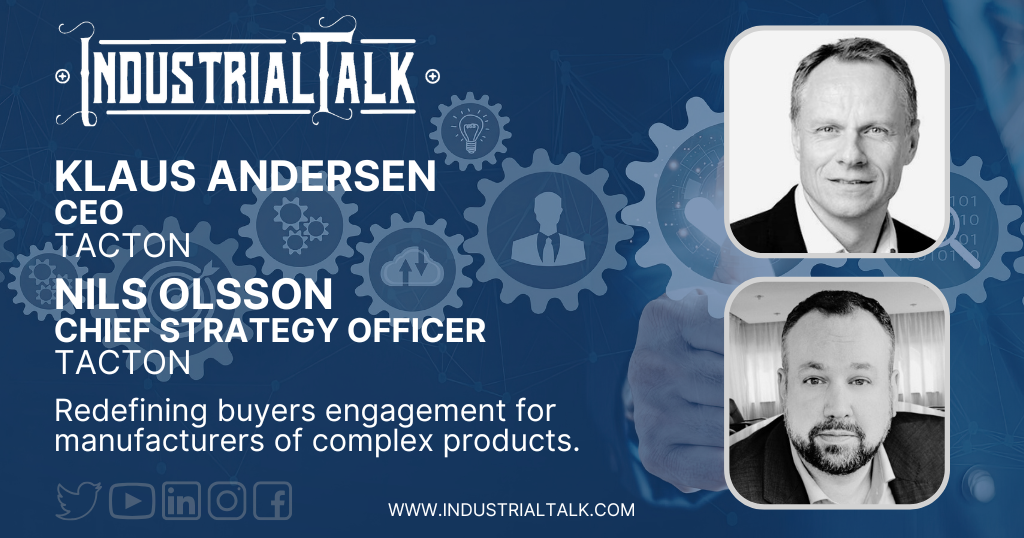
Industrial Talk is talking to Klaus Andersen and Nils Olsson with Tacton about “Redefining buyers engagement for manufactures of complex products”.
Scott Mackenzie introduces Elevo Tech, a company offering ERP, EAM, and business intelligence solutions, and then transitions to discussing Tacton, a Swedish company specializing in advanced manufacturing configuration. Tacton's CPQ solutions help customers configure complex equipment, supporting both direct sales and omnichannel interactions. The platform integrates with existing systems like CRM, PLM, and ERP, aiming to increase win rates, efficiency, and reduce errors. Tacton's AI capabilities can cut configuration time by up to 80% by structuring unstructured product data. Implementation times vary, typically between six months and a year, depending on the project's scope.
Outline
Introduction to Elevotec and Industrial Talk Podcast
- Scott Mackenzie introduces Elevotec, highlighting their ERP, EAM, and business intelligence solutions.
- Scott Mackenzie welcomes listeners to the Industrial Talk Podcast, emphasizing the importance of celebrating industry professionals.
- Scott Mackenzie introduces Klaus and Nils from Tacton, discussing their platform and its solutions for today's challenges.
- Scott Mackenzie expresses excitement about the renaissance in industrial solutions and the importance of human-to-human connection in marketing.
Challenges and Solutions in Advanced Manufacturing
- Nils explains Tacton's specialization in configuring complex equipment, comparing it to configuring consumer products like computers or cars.
- Klaus describes Tacton's CPQ solutions for advanced manufacturing, supporting both direct sales and omnichannel support.
- Scott Mackenzie and Klaus discuss the importance of making the configuration process easy for customers while ensuring technical accuracy.
- Nils emphasizes the need for a buyer-centric smart factory, making it easy for customers to navigate the solution space without technical expertise.
Integration and Flexibility of Tacton's Solutions
- Scott Mackenzie inquires about Tacton's integration with existing IT systems like CRM, PLM, and ERP.
- Nils explains that Tacton is an agnostic player, able to augment existing systems without complete reconfiguration.
- Scott Mackenzie and Nils discuss the financial benefits of Tacton's solutions, including increased win rates, efficiency, and reduced errors.
- Klaus highlights the importance of accurate quotes and the impact of errors on warranty costs and rework.
Customer-Centric Pricing and Data Management
- Scott Mackenzie asks about the flexibility of Tacton's pricing methods, including value-based pricing and detailed bill of materials.
- Nils explains that Tacton supports various pricing methods, depending on the business needs.
- Scott Mackenzie inquires about how Tacton ensures the system stays updated with the latest product changes and data.
- Nils describes the typical setup of connecting PLM and CPQ systems to ensure data accuracy and timeliness.
Implementation Time and AI Integration
- Scott Mackenzie asks about the implementation time for Tacton's solutions.
- Klaus estimates the implementation time to be between six months and a year, depending on the project's scope.
- Scott Mackenzie inquires about Tacton's use of AI in their solutions.
- Nils explains that AI is used to structure unstructured product data, significantly reducing the time required for configuration.
Future Challenges and Market Reception
- Scott Mackenzie asks about the future challenges and opportunities for Tacton.
- Klaus and Nils discuss the increasing use of AI in their solutions and the expansion into configuration lifecycle management and production configuration.
- Scott Mackenzie inquires about the market reception and any roadblocks to adoption.
- Nils mentions that companies are eager to adopt Tacton's solutions, and the main challenge is ensuring widespread awareness.
Contact Information and Final Thoughts
- Scott Mackenzie asks about the best way to contact Klaus and Nils.
- Klaus and Nils provide their contact information, emphasizing their visibility on various platforms and their willingness to engage with potential clients.
- Scott Mackenzie wraps up the conversation, highlighting the importance of Tacton's solutions and encouraging listeners to connect with them.
- Scott Mackenzie emphasizes the need for industry professionals to tell their stories and use platforms like Industrial Talk to share their experiences.
If interested in being on the Industrial Talk show, simply contact us and let's have a quick conversation.
Finally, get your exclusive free access to the Industrial Academy and a series on “Why You Need To Podcast” for Greater Success in 2026. All links designed for keeping you current in this rapidly changing Industrial Market. Learn! Grow! Enjoy!
KLAUS ANDERSEN'S CONTACT INFORMATION:
Personal LinkedIn: https://www.linkedin.com/in/klaus-andersen-8445121/
Company LinkedIn: https://www.linkedin.com/company/tacton-systems-ab/
Company Website: https://www.tacton.com/
NILS OLSSON'S CONTACT INFORMATION:
Personal LinkedIn: https://www.linkedin.com/in/nils-olsson-400715/
PODCAST VIDEO:
THE STRATEGIC REASON “WHY YOU NEED TO PODCAST”:
OTHER GREAT INDUSTRIAL RESOURCES:
NEOM: https://www.neom.com/en-us
Hexagon: https://hexagon.com/
Arduino: https://www.arduino.cc/
Fictiv: https://www.fictiv.com/
Hitachi Vantara: https://www.hitachivantara.com/en-us/home.html
Industrial Marketing Solutions: https://industrialtalk.com/industrial-marketing/
Industrial Academy: https://industrialtalk.com/industrial-academy/
Industrial Dojo: https://industrialtalk.com/industrial_dojo/
We the 15: https://www.wethe15.org/
YOUR INDUSTRIAL DIGITAL TOOLBOX:
LifterLMS: Get One Month Free for $1 – https://lifterlms.com/
Active Campaign: Active Campaign Link
Social Jukebox: https://www.socialjukebox.com/
Industrial Academy (One Month Free Access And One Free License For Future Industrial Leader):

Business Beatitude the Book
Do you desire a more joy-filled, deeply-enduring sense of accomplishment and success? Live your business the way you want to live with the BUSINESS BEATITUDES…The Bridge connecting sacrifice to success. YOU NEED THE BUSINESS BEATITUDES!
TAP INTO YOUR INDUSTRIAL SOUL, RESERVE YOUR COPY NOW! BE BOLD. BE BRAVE. DARE GREATLY AND CHANGE THE WORLD. GET THE BUSINESS BEATITUDES!
Reserve My Copy and My 25% Discount
Transcript
SUMMARY KEYWORDS
Tacton, Industrial Talk, digital transformation, ERP EAM, business intelligence, configuration, CPQ solutions, advanced manufacturing, buyer journey, AI integration, product data, PLM systems, ERP systems, customer experience, manufacturing efficiency.
Hey, it's Scott Mackenzie, your industrial friend, and I want to bring your attention to a great company, Elevotec. Elevotec is transforming how businesses manage assets and operations with powerful ERP EAM and business intelligence solutions. They deliver streamlined processes real ROI and over 20 years of proven expertise if you want technology that actually drives performance, not complexity, Elevotec has you covered. Learn more at Elevotec.com. Elevotec empowering your digital transformation with clarity, expertise and ROI check them out at Elevotec.com
Welcome to the Industrial Talk podcast with Scott Mackenzie. Scott is a passionate industry professional dedicated to transferring cutting edge industry focused innovations and trends while highlighting the men and women who keep the world moving. So put on your hard hat, grab your work boots, and let's
all right, once again, welcome to Industrial Talk. Thank you very much for joining the number one industrial related podcast in the universe that celebrates you industry professionals all around the world. You are bold, brave, you dare greatly, you innovate, you collaborate. You are absolutely the heroes in this story. That's why we celebrate you. Thank you for your continued support. We have two in the hot seat, Tacton, all the way from Sweden. They were in Sweden, and we're talking about with with Klaus and Nils, their platform, what they do, how they solve the challenges of today. And it's, it's a great conversation, so let's get a cracking Yeah, yeah. It's always great to have these conversations. Do you know when I've in industry, as I continue to talk about industry, it always amazes me, of all the solutions that exist out there that are really driving to create businesses that are resilient and to be able to respond quicker to The market and the tools, it. It's a really, it's, it's a renaissance that I can tell and and it's exciting coming off of my trip to Anaheim for MD&M West, and seeing all of these solutions, tactics, right in the right, right in the thick of things. So this is a paper and pencil conversation. And I highly, and I mean, highly recommend that you contact these two individuals and team tech, and because you will be dazzled by what they can deliver. Before we get into that conversation, I need to ask some questions. We need and in this world of AI, and it's, it's out there, you need to be able to have a human to human connection with your market, right? You just do there's no way of doing it. And the way I always advocate is that, are you doing, or are you committed to doing podcasts. Do you have your own channel? Do you have the ability to be able to create and reach out to individuals and see what they're doing and have a conversation around that Industrial Talk is here for you. I want you to succeed. You need to succeed. It's incumbent upon you to succeed. And to succeed, you need to be able to tell your story. You need to be the at storyteller, but you need to do it from the perspective of being human, not some sort of AI chat bot, whatever this this gets. This ensures that you constantly maintain that connection that you need with your market, and you do it and I Industrial Talk is here we will let you We'll even let you post on Industrial Talk to get more attention, or if you just want to be on Industrial Talk, you just need to let me know we have ways of being able to ensure that you get that story told. And we're we're warm and fuzzy, and we're cuddly, and we make you feel good, yeah. But more importantly, let's have a conversation. Now. You just go out to Industrial Talk. You click on contact me. It's me and it's me. The bench is pretty shallow back there. But anyway, have this conversation and and let's see how we can ensure that your business has the human to human contact and is resilient and opens up opportunities for success. That's what it's all about. That's what this platform is all about. We want you to succeed. All right. On to the comp. Station, Klaus and Neil's right there. Tacton, you'll be dazzled by the solution. And I got to tell you, kudos to them, because they were just so kind, the starts and stops and, you know, live by technology, die by tech, all of that stuff. But they they were very resilient, very kind, very gracious individuals. So that's the culture of their company. These are the leaders. So enjoy the conversation. Klaus and Niles. Nils, I'm sorry. Nils, welcome to Industrial Talk. How are you doing?
All good. God. Thank you very much, and thanks for having us. This is
number two. We've been having some challenges, and these two gents have been just the most kind, professional individuals. And I just said, you know, kudos to you. I guess we were having some challenges yesterday, and of course, they came back on, and they're all the way from Sweden, and they're just doing they're just, you guys are great. Thank you very much. I really appreciate it. Thanks for having us. Yeah, I've been, of course, I've been, I've been hot on trying to, let's go tactic. All right, look at this. I got the website. Oh, look at all these questions. I'm I've been boning up for the conversation. All right, before we get into it, this is going to be going to Nils first. Talk to us a little bit about your background. Give us a little background on who you are.
note tag team already back in:Well, Klaus, that's a hard act to follow. Give us a little background on who you are and where you came from.
That's that's impossible to follow. So my name is Klaus Anderson, and I'm the CEO for Tacton. So I've been working with taxon over the last five years in different roles, the one I have now, and also non exec roles, I have a background in in B to B software, which I've been working in for my entire life.
All right, before I want to, I need to. And this was goes to Nils, I need for you to sort of tell me what that problem is that tacked and said, Hey, or we've been around for a little while, and we've been, you know, navigating these waters and solving the problems, just for the listener out there. Help us understand, put our arms around the value proposition and the problems you're solving at Tacton.
So in a nutshell, we specialize in hardcore configuration of equipment. And what that basically means is, think about, you know, you're ordering a computer online or a car. That's what you as a consumer would normally be configuring the clients of our customers. They buy things like production setups, they buy power plants, they buy oil tankers, they buy all sorts of huge equipment. And when you're selling that type of equipment. The configuration of that equipment is extremely vast and complicated. There are just a few companies in the world that can deal with that level of complexity, and we seem to be one that does it best.
So let me, let me try to put it in layman's terms. So I have this big piece of equipment, and I'm a consumer, or I am the buyer of that equipment, and I have certain configuration requirements for me to acquire that equipment. Are we saying that? And this is to you, Klaus, are we saying that I can go through, through, through your solution, fact and solution, and then be able to really, from my perspective, configure that, that asset in a way that meets my needs today and whatever, maybe tomorrow, whatever the strategic and be able to do that so that the manufacturer of that equipment says, Oh, My god, yeah, that's good. I can do that.
Said, how it works? Is that how it works?
That's exactly the case. So, so what we, what we, what we have specialized in, is, is CPQ solutions for advanced manufacturing, and that's configure, price quote and and 111, way of using our solutions is, of course, if you have a sales team of direct sales people who are then using the tools to configure the solution that the buyer is interested in, with the buyer in the room or on the phone or whatever way of interacting with the buyer. But nowadays. It's of course, changing, right? Because the buyers want to do a much longer part of that buying engagement in a digital way. So so we also support, on top of direct sales support, we support omnichannel support, meaning reseller networks can use the solution or even the end, end buyer can use the solution and without, without involving the manufacturer before they feel that they want to involve them, so they can do a lot of the actual configuration and the research digitally with, with the support of this, solutions that we that we make, make available, and we call that support, support for the buyer, for the buyer journey in an omni channel setup,
Nils, it sounds so what I heard, Klaus said, we've got direct so let's say I'm a Sales individual for the company. I can sit down with the client and say, on my computer, talk to them and talk them through it as we, you know, configure their solution. Great Love that tool. And then today, in the digital world, I don't have to go, I don't have to go there. I could just go online, whatever that that that user interface, and be able to do it myself. I'll get it to the point where it's 90% there, and I have 10% that needs some you know, interaction is that system? Is your system that flexible? Because I'll tell you right now. I'll be up front right now, if I was me, not wanting to deal with people common I go on the digital side, and then I start to configure this important asset. I guarantee I'm gonna, I'm gonna leave something out. I am.
And that is, yeah, that's, that is the challenge, right?
The core challenge that we're addressing is, at the same time that we have to be extremely good at picking out the fully valid and accurate solution that serves the customer's needs. Yeah, we also have to make it easy enough for the customer to navigate what they can get and not leave anything out. So we call it the buyer centric smart factory as a as a sort of term to encapsulate that. But what it means is you want to make it easy enough for the user to be able to navigate the full breadth of the solution space, what you can get without having to be a technical expert and still get all the technical details right.
You know, Klaus, as I, as I, put my little it hat on my little system implementation hat that never stops evolving. Because I would imagine at at Tacton, simplicity, user interaction is a driver. It just is. It has to be because you can't just, you can't make that solution difficult for me to get the answers that I need and the solutions that I need. How does tactic? How do you keep up with that? I mean, you've been in business for a lot of years. How do you keep up with the drive to make it simpler and to make it more efficient? I don't know. I don't know. So I think, you know,
I think the starting point, Scott to get get that clear is that many, many manufacturers in over many, many years have really sort of tried to move more towards configure to order instead of engineer to order when we are talking about these very complex machinery and so on, because, for good reasons. Of course, right? So, but managing highly complex products from a configured to order perspective, and then at the same time be able to present a very simple and intuitive user interface to the buyer. That's tricky, because it's two different languages you're speaking, needs to understand and answer questions and so on, which which he or she can relate to, whereas, underneath the surface, you need to be sure that you can actually fulfill the requirements with a valid configuration,
yeah, I, I give you kudos, because that's not easy. Billy, the ability to deliver that level of that that quality user interface, to be able to say, I Scott Mackenzie, I'm not. I don't have to be an. Engineer, I know what I need, but I don't have to and and to have the system Nils to be able to do that. How? How does your system integrate with the procurement in the sales component of an existing system, like the technology stack that exists at this you know, Acme manufacturing company, whatever. How, how does that look?
Well, if you want to do it really well, you want to make sure that any company can gain these capabilities without having to completely redo their existing it setup. So as a result, what we have always been very focused on at Tacton is to make sure that we are what we call an agnostic player in this space, if it comes to interacting with different CRM systems like Microsoft or Salesforce or any any others, as well as PLM systems like wind chill or team center or ERP systems from Oracle or SAP, all of those systems are typically already out there. And what we do is we come in and we augment those systems. We help make them better, because we're solving this quite tricky, as you say, issue of, how do you match customer needs with with your product range?
Klaus, what's the value proposition here? What are we talking about? It seems to me, as I feed you an answer here, it's the compression of time and clarity of what I need as a customer. So I customer receive exactly, to a certain extent, exactly what I need. But I, but me manufacturer, it's compressed. The the the the time of receiving that product is compressed, is it? And worse, help us understand the financial impact?
Well, I mean, so if I take a third stab at it, there are kind of a couple of key financial impacts from this. The first one is, by making it easier for customers to understand and buy from your product portfolio, you're basically increasing your win rate and thereby your top line revenue. Yeah, you become more attractive. You can answer customers quicker with better quotes. But then, of course, you know, we're automating a ton of stuff here, so that naturally gives efficiency as well. A ton of engineers are typically involved in checking quotes and so forth, before they go out to customers and tell me that's, you know, nobody went through engineering school to double check quotes from from sales staff, so they're happy to move on to more productive and innovative tasks. But then the last one, which is really interesting as well, is quality through the intent process. When you have people working on these things, not only are, of course, people sitting with cues of stuff to do, and as a result, slow to respond, but they're still human beings, even if they're very skilled in what they do. So they make mistakes, and those mistakes stack up. So you send out a quote a customer that almost does what the customer has been promised. Now, you know, once you end up delivering that, you're sitting with penalty fees, warranty costs, all sorts of things. Sometimes you catch these errors before you start producing the equipment, or hopefully before you send it down to please. But that still carries cost. It's rework, it's scrap, it's lost time. So by marrying the two aspects here, by both becoming more agile in sales, being able to answer your customers questions quicker and better, and at the same time taking away those issues internally, you're basically solving two problems in one. And this is the reason why a lot of companies are really pushing to get going with with our solutions.
But I would imagine it, and Klaus, I would imagine you're nailing that that price down more accurately. So me as a as a consumer of whatever the product I'm trying to buy, I me have a higher confidence in the actual overall price. Because, you know, as well as I do, there's some old school thinking that I'm going to pad that, you know, quote, because of all of the other things that I don't see in here, but if I had it, I'll be able to sort of cover my problems. Is that, do I feel better with my quote when I see it? It's like 20 bucks. Yeah, good. I feel
good Tony and Claus. I think look at me
if you. Look at the buyer journey from the start to the end, then the first couple of steps in the buyer journey is all about convenience. It's all about can I find the information I need to find, and they are typically also comparing with competitors, right? So can I buy it over here in the best in a better way, or whatever. So the first couple of steps is very much convenience, and especially what we talked about before, the ability to interact with the buyer in a language that the buyer understands. And then this mapping into the more technical world where our configurator comes into play, which is, by the way, constraints based configurators. So we can actually solve configurations based on what parameters you want to optimize. It's not, it's not rule based, it's it's constraints based, and and then, and then, at the point where the buyer decides that, okay, this seems to be what I am interested in buying. Then the then it switches from from being from being convenience to, I want the best possible quality in the delivery. And that's that's why it's so important that we have sort of proper links to the manufacturing systems, the ERP systems and so on, so we can really take the sales configuration and very, very high quality detailed deliver that to the to the ERP system, so that the that the machinery can actually be built and delivered
exactly if I pick up what you said there, I'm patting the quote with a little bit of extra. That happens. But you know, it's a double edged sword. You all of a sudden put a little too high margin on the deal. That takes down your win rate, and now you're sitting with lost sales instead, so getting the balance right, not being too, you know, fat in the pricing, as well as being very lean and knowing that you're able to deliver what you promised, that's where the optimal margin set for
as as a customer.
Past businesses that I've had, I was, I always advocated sort of price clarity, like elements breakdown, like here, here's, here's the price of this, here's the price of that. And trying to just say here, this is what it costs me. Here's my margin. I try to be upfront as much as possible and forward in that pricing. Will I have that same capabilities or similar capabilities if I'm coming through the tact and portal, being able to sort of configure this and be able to sort of see that the details associated with that transaction, it
really depends on on your business, right? So depending on what type of business you're running, you want to have different types of clarity towards your customer. Now, of course, yes, it is fully possible to do exactly what you say. We can get the entire bill of material out and you can you can account for every nut and bolt and your in your equipment, if that's what you'd like to do. But at the same time, you could actually switch over to a completely value based pricing, where you're pricing the functionality and features the outcome that your customer will get. So we see companies using different pricing methods depending on their industry, and of course, all of it being supported by our capabilities, because we can, of course, attach the price to pretty much whatever you want it to be attached to.
So what I hear Klaus, it's, it's, it's pretty, pretty flexible. It's, it is customer centric. It's sort of, it's up to me, and of course, it's up to the the the individual that has provided this portal. But so it's that's good. I do like that.
How does the system respond to,
let's say I'm a manufacturer of whatever that big piece of equipment is. I it changes. It changes. Hey, we we're not putting this in now. We're putting that in now that's better, and this oil is better than that old oil and so on and so forth. It constantly evolves in the hope of making whatever that final product is better. How does the system ensure that that you're pulling in the right data, the right change is taking place, and I'm going to just throw it out to whoever wants to handle this question. How do you ensure that is is updated, and that my portal in Tacton is, is the right? You know, information?
Well, I mean, there's, there's many different. Ways of doing it. But typical setup would be, you have your PLM connected to our CPQ, so the parts that you have there, they're being updated as you change them and release new ones in the PLM. But it actually goes, you know, in other systems as well, in your ERP, for instance, you very often have your lead time for different components and and stuff which could affect what you're wanting to offer right now, customer might be time sensitive in terms of delivery. So now you're going to pick something, you know, which is quicker to get out there. Same thing goes for services and so forth. So being able to use data that is sitting in the different master data systems is absolutely crucial. But of course, to also be able to do that across the product life cycle,
yeah, it again very whenever anybody talks about data and we also talk about data quality, we also talked about all of the elements associated with that, and being able to get the right information into the system. I can't help but ask this question, and maybe Klaus or Nils. And it doesn't matter if I came to Tacton and I said, Hey, I really like what you what I'm seeing here, it makes sense. I want to be able to sort of see the value coming from that particular system for my clients, what are we talking time wise? For an implementation,
it of course, depends very much on what we are talking about. Don't say 18 months? No, I think, I think it's probably more, some something between six months and up. I would, I would say, and of course, large implementations, you would never do that Big Bang. You would always do that in phases and tranches. So, so you would then take sort of product lines, or you would take a special geography and implement that first and so on. So, so some projects can take years, whereas others can be relatively quickly.
Yeah, I see it, but I this is, this is really impressive. I have to also ask this question, because I've had this conversation Well a lot of times, and it deals with, how is tact and saying, Hey, look at this tool. It's called AI. How are we how are we incorporating AI into what we're doing? For a better answer, Nils, can you sort of expand upon that?
Yeah, I don't have an hour to go through it all, because we're doing but pertaining to what we've just discussed here, a key area, of course, is companies are very often sitting with a ton of unstructured product data on top of their master data. And by taking that wealth of information coming from could be quotes, existing quotes. It could be price lists. It could be conversations with customers and so forth, and using that as input into the tacked on structure, that's, of course, a way to cut down time tremendously. We've seen companies cutting downtime as much as 80% by simply letting AI sort out the data for you.
Yeah, see, I think it would be well suited for the tools, the algorithms, whatever the historical information, being able to sort of digest that information and be able to develop and present a higher quality solution to the customer. I just, I get it. I understand this is to you, Klaus, outside of AI where let's put your future hat, what do you think the next challenge is? I know that companies and cus, we're, I'm, I'm having a hard time with people. I am. I don't have that skill set. This would be great to be able to have a solution like this so that can deal deal with the challenges that exist in the marketplace. What does that future look like at Tacton?
So I can start and then Nils can, of course, add here, right? But of course, AI powered capabilities is something that you will see more and more of also, right? And we look at it as very much. This is a technology, and that technology needs to be used in the areas where it makes sense to use that technology. It's not, it's not sort of the universal answer for everything, but it serves a number of use cases extremely well, and that is exactly what Nils talked about, taking unstructured information and create a structure that you can then put into the system and that you can then use for for the for the configuration the system, which is. Deterministic, right? So you know exactly that you're getting the right answer out. You don't have any hallucinations or stuff, stuff like that with within AI. So we have picked sort of a number of use cases that we where we are implementing generative AI in the solution, and that's to strengthen, of course, the CPQ solution we have, but where we are moving now is actually into the adjacencies, right? So we are moving into a more comprehensive support for configuration, lifecycle management, so that we that we know exactly that what version of the product is now released to sale and what's still sitting with engineering and so on. So we are sitting in between the PML, PLM system and the CPQ system, and then on the other side, also when it comes to production configuration, we are working on that area as well, which means that we would both have the sales configuration tool, the configuration lifecycle management as well as the production configuration in the triangle, in our now, in our support, in our software
support, yeah, I, I,
I like it. I like what you're saying. I like the solution. I like the given the nature of what's taking place, specifically in the marketplace. Nils last question, well, what's the roadblock? I'm all if I had the money and the business, I would be all over this. What? What? What's the what's the pushback? What's the roadblock for people that you see in the marketplace, for the solution,
honestly, we have companies kind of falling over themselves to start working with us on these capabilities. So in a way, we're fortunate that companies are, you know, coming after us inquiring about these capabilities. It's great. But of course, you know, we're not going to sit here and say, Oh, we're so happy and we don't need to do anything. So making sure that the word is out, making sure that as many companies as possible know about this. Because honestly, what Klaus just described is something that just a few years ago, many companies would have thought impossible. Yeah, and we're sitting here with something that is, you could almost say it's the Holy price of manufacturing. The one solution that I know myself, having worked in manufacturing for decades, I was always trying to get to and I we didn't have the capabilities back then. Yeah, with tact, and we're sitting with these firmly in place. It's not, it's not a test or anything. There are companies up and running with these capabilities. So when we introduce it, it's, you know, I would give everyone the advice, hey, come talk to us, and let's see where we can get you in in a slot to get these capabilities in place.
stuff there is going to be in:how do people get a hold of you?
If I wanted to talk to Klaus, what would be the best way to get a hold of you? You just have to say, LinkedIn, that's
no I think we're pretty visible in the in the space. Scott, so, so the telephone numbers are there, and the email addresses are there, and LinkedIn is there, and yeah, we have local offices in several places of the world and so on. So we, we are, we can be reached.
Yeah, somebody's listening, I can't get a hold of Klaus or Nils. I don't know how to bigger, bigger challenges. Let's just put it that way. Neil, same thing sort of you know LinkedIn, you're out there. And of course, we got the website, we got all the other stuff.
As Klaus said, we're very visible out there on all of these platforms. And of course, on our website. Just let us know. We love talking to companies about these capabilities. So get in touch.
You guys are great. You're also flexible, but you guys are great. Hell of a solution. That's good stuff. I really appreciate you being on. Industrial Talk. Thank you very much. Thank you. All right, we're gonna have all the contact information for these two gents out on Industrial Talk. Don't come to me. Don't come whining to me and say I can't get a hold of them. They're out there. Got a great website, by the way, that I like, always like websites with little videos. You got a little automation off. It's good stuff. All right, all right. We're gonna wrap it up on the other side. Stay tuned. We will be right back.
You're listening to the Industrial Talk Podcast Network.
Yeah, that's Klaus Nils now with Tacton. I'm on their website. That's a pretty cool. Doggone website got a lot you know why it's cool. Got a lot of things moving around. They got a lot of automation. But the reality is, is that they're doing big things in the world of manufacturing. I think you need to check them out. In fact, I highly recommend that you check them out, and I highly recommend that you connect with them any way, shape or form. As always, it's all out on Industrial Talk. You can't tell me that. You can't get a hold of them, but I think you need to have a conversation with these two gents and the rest of the tech and team. Yep, that's what I think. All right, you need to tell your story. It's a must figure that out. Do it on a podcast. Have your own podcast and publish it out on Industrial Talk. We need to get the message out every day. All right, be bold, be brave. Dare greatly. Hang out with Klaus and Nils and you will be changing the world. We're going to have another great conversation shortly. So always stay tuned.

About the author, Scott
I am Scott MacKenzie, husband, father, and passionate industry educator. From humble beginnings as a lathing contractor and certified journeyman/lineman to an Undergraduate and Master’s Degree in Business Administration, I have applied every aspect of my education and training to lead and influence. I believe in serving and adding value wherever I am called.
