Vineet Thuvara with Fluke Corporation
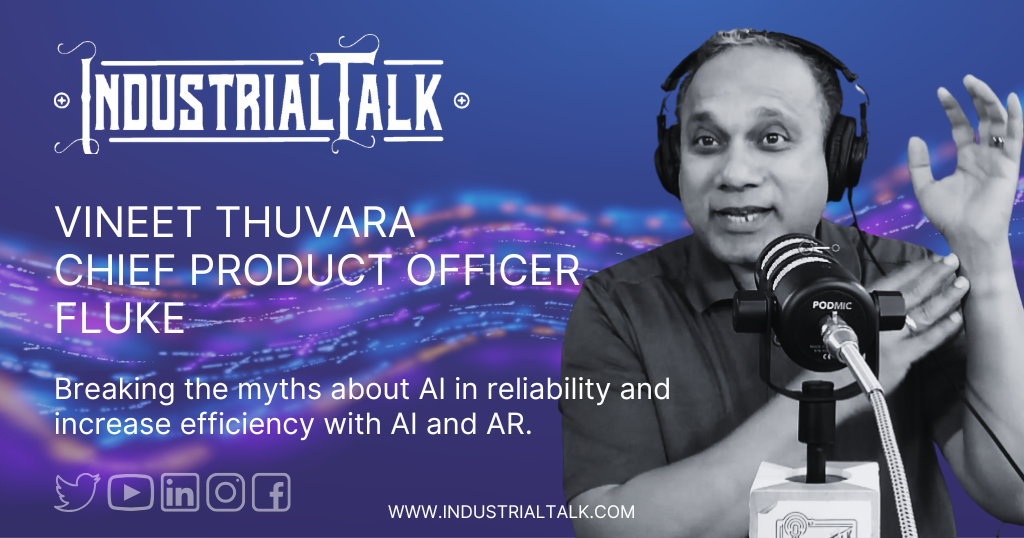
Industrial Talk is onsite at Xcelerate 2026 and talking to Vineet Thuvara, Chief Product Officer with Fluke about “Busting the AI myths with reliability”.
Vineet Thuvara, Chief Product Officer at Fluke, discussed his journey from mechanical engineering to leading product development at Microsoft and Amazon, and his current role at Fluke. He emphasized the importance of breaking myths about AI, particularly in industrial reliability, and highlighted Fluke's efforts to enhance technician efficiency using AI and AR. Thuvara shared that Fluke's new sensors and software aim to reduce unplanned downtime, which costs $50 billion weekly, by providing real-time, accurate data and insights. He also discussed the potential of AR glasses to improve safety and efficiency in technical fields.
Outline
Fluke Xcelerate Event Overview
- Scott introduces the Industrial Talk podcast, highlighting the Fluke Xcelerate event.
- The event featured high-energy keynotes, hands-on predictive maintenance tools, and breakthrough AI diagnostics.
- Fluke's Xcelerate event is described as a launch pad for smarter, faster, and more reliable operations.
- Listeners are encouraged to visit fluke.com for more information.
Introduction to Vineet Thuvara
- Scott welcomes listeners to the Industrial Talk podcast and thanks them for their support.
- Vineet Thuvara, Chief Product Officer at Fluke, is introduced as the guest for the episode.
- Vineet shares his background, including his education, work experience, and career transitions.
- Vineet discusses his excitement about joining Fluke and the company's culture and people.
Vineet's Career Journey
- Vineet details his educational background, including mechanical engineering and industrial design.
- He shares his experience working at Microsoft, leading various product teams, including Xbox Kinect and Surface devices.
- Vineet's tenure at Amazon, where he led the product team for Echo devices, is also mentioned.
- He explains his transition to Fluke, driven by the company's culture and his personal connection to the brand.
Fluke's Culture and Brand Loyalty
- Vineet talks about Fluke's long history and the loyalty of both employees and customers.
- He shares a personal anecdote about his father using Fluke tools in the Indian Air Force.
- Vineet emphasizes the importance of the transition from consumer electronics to industrial applications.
- He discusses the goal of building a connected ecosystem of Fluke devices and software for predictive reliability.
Challenges and Opportunities in Industrial Reliability
- Scott and Vineet discuss the challenges of running operations and the importance of proactive diagnostics.
- Vineet highlights the need for seamless and efficient operations in the industrial space.
- The conversation touches on the rapid advancements in technology and the human spirit's role in innovation.
- Vineet shares his optimism about the future of industrial reliability and the potential of AI and connected devices.
Myths and Misconceptions in AI Adoption
- Vineet introduces the topic of his presentation at the Fluke Xcelerate event, focusing on myths about AI.
- He shares insights from a dinner with CXOs discussing the challenges of AI adoption.
- Vineet explains the importance of breaking myths and assumptions to drive AI acceptance.
- He uses the analogy of an elephant with a chain to illustrate the need to question long-held assumptions.
The Role of AI in Industrial Reliability
- Vineet discusses the potential of AI to transform the workflow of technicians and improve efficiency.
- He outlines the steps involved in a technician's workflow and the drudgery associated with it.
- Vineet emphasizes the need for new tools and AI to automate repetitive tasks and improve data collection.
- He highlights the importance of human involvement in the process to ensure accuracy and accountability.
Addressing the Data Tsunami
- Vineet addresses the common myth that AI creates too much data, leading to information overload.
- He explains how new tools and AI can help derive meaningful insights from large datasets.
- Vineet mentions a partnership with Treon to showcase new sensors and data collection tools.
- He discusses the importance of maintaining a high signal-to-noise ratio in data collection.
AI's Impact on Human Productivity
- Vineet addresses the myth that AI will eliminate the need for human involvement.
- He argues that AI accelerates human efforts and transforms the nature of work.
- Vineet shares examples of how AI is used in product management and research at Fluke.
- He emphasizes the importance of human accountability and oversight in AI-driven processes.
Enhancing Technician Efficiency with AI
- Vineet discusses the potential of AI to improve technician efficiency and reduce costs.
- He highlights the importance of standard operating procedures (SOPs) and the challenges of managing large manuals.
- Vineet explains how AI can automate the process of accessing and using SOPs.
- He shares examples of how AI can streamline data collection and reporting for technicians.
The Future of AR in Industrial Applications
- Vineet introduces the concept of using AR glasses to enhance technician interactions with devices.
- He explains how AR can provide hands-free data collection and analysis.
- Vineet discusses the benefits of AR for new career technicians and experienced professionals.
- He highlights the potential for AR to improve safety and efficiency in industrial settings.
Conclusion and Contact Information
- Scott wraps up the conversation, emphasizing the importance of networking and learning at events like Fluke Xcelerate.
- Vineet provides his contact information, encouraging listeners to connect with him on LinkedIn.
- Scott reiterates the importance of the Fluke Xcelerate event and the value of connecting with industry professionals.
- The episode concludes with a reminder to visit industrialtalk.com for more information and to connect with the podcast.
If interested in being on the Industrial Talk show, simply contact us and let's have a quick conversation.
Finally, get your exclusive free access to the Industrial Academy and a series on “Why You Need To Podcast” for Greater Success in 2026. All links designed for keeping you current in this rapidly changing Industrial Market. Learn! Grow! Enjoy!
VINEET THUVARA'S CONTACT INFORMATION:
Personal LinkedIn: https://www.linkedin.com/in/tvineet/
Company LinkedIn: https://www.linkedin.com/company/fluke-corporation/
Company Website: https://www.fluke.com/
PODCAST VIDEO:
THE STRATEGIC REASON “WHY YOU NEED TO PODCAST”:
OTHER GREAT INDUSTRIAL RESOURCES:
NEOM: https://www.neom.com/en-us
Hexagon: https://hexagon.com/
Arduino: https://www.arduino.cc/
Fictiv: https://www.fictiv.com/
Hitachi Vantara: https://www.hitachivantara.com/en-us/home.html
Industrial Marketing Solutions: https://industrialtalk.com/industrial-marketing/
Industrial Academy: https://industrialtalk.com/industrial-academy/
Industrial Dojo: https://industrialtalk.com/industrial_dojo/
We the 15: https://www.wethe15.org/
YOUR INDUSTRIAL DIGITAL TOOLBOX:
LifterLMS: Get One Month Free for $1 – https://lifterlms.com/
Active Campaign: Active Campaign Link
Social Jukebox: https://www.socialjukebox.com/
Industrial Academy (One Month Free Access And One Free License For Future Industrial Leader):

Business Beatitude the Book
Do you desire a more joy-filled, deeply-enduring sense of accomplishment and success? Live your business the way you want to live with the BUSINESS BEATITUDES…The Bridge connecting sacrifice to success. YOU NEED THE BUSINESS BEATITUDES!
TAP INTO YOUR INDUSTRIAL SOUL, RESERVE YOUR COPY NOW! BE BOLD. BE BRAVE. DARE GREATLY AND CHANGE THE WORLD. GET THE BUSINESS BEATITUDES!
Reserve My Copy and My 25% Discount
Transcript
SUMMARY KEYWORDS
Fluke Xcelerate, predictive maintenance, AI diagnostics, industrial innovation, Vineet Thuvara, Chief Product Officer, cloud computing, AR glasses, data collection, signal to noise ratio, technician efficiency, safety, unplanned downtime, connected devices, reliability.
Industrial Talk is brought to you by Fluke. We were on site at Flukes Xcelerate event where reliability reimagined came to life from high energy keynotes to hands on predictive maintenance tools to break through AI diagnostic the event delivered real world strategies teams can use today. Xcelerate once again, proved why it is the launch pad for smarter, faster, reliable operations go out to Fluke.com to find out more.
Welcome to the Industrial Talk podcast with Scott MacKenzie. Scott is a passionate industry professional dedicated to transferring cutting edge industry focused innovations and trends while highlighting the men and women who keep the world moving. So put on your hard hat, grab your work boots, and let's go all
on site right now. Xcelerate:Absolutely, I think, like we are a 78 year old company. I have team members who are celebrating 55 years of the company really, yeah, it's crazy. There are, there are employees who tattoo the building coordinates on their body. Shut up. There are customers who tattoo our products on their body. It is brand our customers and employees love because they get to really make a change to the world.
Yeah, my dad had a flute meter. That's how I know. That's how I go. Look at the flute color. Look at the name. So in a heck of a brand, we drink yellow. Yeah, it is. It's a heck of a brand, man, I really all right, before we get into the conversation for the listeners, give us a little background on where Vineet comes from. 411, on you.
Excellent. My name is Vineet Thuvara. I'm the Chief Product Officer at Fluke. I grew up in India. Did my mechanical engineering. Worked in the factory floor for the first two years as an industrial engineer, designing jigs and fixtures and stuff. And then I was fascinated by design, and did my Master's in industrial design, did my own startup back in India, came to the United States to study at MIT. And then did you really and then Microsoft hired me from there. I spent 15 years at Microsoft, five years in cloud computing, two years in Xbox gaming, the Xbox Kinect two was my baby, and then about eight years in Surface devices, if you think about every aspect of device, from PCs to foldable phones, the whole spectrum of devices. And then after 15 years, I spent about three and a half years at Amazon. I was leading all of echo devices as the product leader there, yeah. And then out of the blue, Ford even Fluke reached out to me. And of course, I've been a Fluke fan. As an engineer, I've used Fluke, yeah, but I was not sure, from consumer to industrial, what does it mean? But when I as I was kind of talking to the people at Fluke, there is something about the culture, the people that attracted me. And personally for me, my dad was the Indian Air Force, and he was in aeronautical Inspection Services, which means he was using tools like Fluke to keep make sure the plane is safe, the pilot is safe. And I felt like in my career, I've been focused on consumer electronics, and it will be so cool to be able to go do something for those technicians who keep our world safe. And the best thing is the transition from consumer electronics, where there is a lot of connected devices to the cloud, where you have a software fabrics that connect all these devices and true build true connected experiences. That is the same thing. We are trying to build an industrial space where we have these great endpoints with our Fluke devices, and we are trying to build a fabric like email and software, software layer that connects these and truly provides predictive reliability or connected. Liability, in a sense.
See, I see that's all excited. See, it's exciting because I've been in the industry for a long time, and that's sort of like the Holy Grail. The holy grail is to be able to run that operations, and be able to pull that information, all that diagnostic and be able to in a proactive way, in an efficient way, to be able to affect corrections or changes or optimize whatever it might be, but do it in such a way that it's seamless in a sense, that's the Holy Grail.
Absolutely, I have a long way to go, but I'm optimistic about
I agree with you. I think, yeah, you have a long way to go, but I'm telling you, you know, as well as I do, the leaps that have been happening. It from my perspective, it's hard as a human to keep up with the technology and the speed of that technology, the gap seems like it gets farther and farther. I have to ask about cloud when you guys, when, when you were dealing with all the cloud stuff and you're having this conversation, did you ever envision it ever being what it is today, and all the demands that are taking place in the power market, and all of the requirements, and it just, it bodes well for, like, an, you know, Xcelerate, and the E mate and the Fluke, it's a, it's an interesting market.
's a baby step. I remember in:and that's, that's the human spirit. Because the human spirit is always going to say, hey, what else? What else can I do? Can I do a different and that's just evident within that, okay, you're speaking. You're speaking at this event. Is she spoke at other things. But this one is very interesting. It's about myths. Take the listener through what you're going what you're talking about, and then we can sort of riff on that Sure.
Recently, I was having a dinner with the CXOs, a bunch of CXOs from different industries, from Costco to Amazon to Microsoft to MacKenzie. There is a we all got together their private dinner and talked about, what are the key challenges in adoption of AI or technology in general? And the one thing that stood out for everybody is culture. How do we make sure humans are accepting of the change? Yes, and all AI is not same AI, because all the way from Alan Turing simple AI to straight natural AI, which is more programmed based on logic to the current LLM based stuff that you can upload a whole bunch of data and derives inferences. There's a spectrum of AI in the field that we are in in reliability. We cannot afford hallucination. We cannot have a voltmeter show three volts instead of one volt. So we have to make sure that we're using the right tools for the right purpose. But in order to do that, we have to break the myths or assumptions of people in our factory with our customers, everybody in our industry, to make sure they understand that some of the assumptions we made in the past are wrong or are changed now today, there is an example. There's a story I like to tell all the time, which is many times you see a big, strong elephant standing with a small chain to its leg and tied to a small post. We all look at it and say, We know that elephant can rip it apart and walk away, but it doesn't, because when it was a kid, you tied it and its brain that it cannot walk away. We all have including myself. We all have our own shackles based on how we've grown up and what, what experiences and exposure we have had. We have to question some of those assumptions and truly see where are the places we can break our shackles and walk.
I got to use that analogy. That was good, and I was thinking, Yeah, I'm gonna, I'm gonna steal it absolutely. I don't know what I'm gonna use it on, but I'm gonna steal it nonetheless. So back to your presentation. When we start talking about I think, and correct me if I'm wrong, I think today, especially, we have greater opportunities to break those shackles, to think differently, to to say, Well, why not? Or what if? What if we do it this way? Why not? And, and I think we're in a position to do that, and you can see it, you know, and like SpaceX. Come on, they just challenged every aspect of their manufacturing and their so take us through that. Yep, absolutely
when you look at the workflow of a technician, first stage is plan. On the site. We before you go to a site, you want to figure out what is the action. And you take what equipment are you looking at? Do you understand that equipment? How to fix it? Do you have the information you need? Then you have, do you have the tools you need? Then you plan your transportation there. And when you're there, you have to ask a bunch of questions. Sometimes you have the answers there or not. Then you have to reach out to somebody in the office, and after that, you have to use these devices to measure, take the measurement, make some inferences, write down the data somewhere, use that data to put into an excel sheet or something, and do the analysis to see what's the insight you need to get. Once you get the insight, you need to go figure out how to fix it, or how to date the next action, or share that information with your customer. If you look at the drudgery in this process, yeah, it is. Yes, it's painful. It is. It is painful. Imagine it. Imagine a technician standing on a ladder trying to have three probes on the ceiling, trying to connect with two hands, and struggling to write down the notes on his pad and then take it back on a Saturday when he has to, know, go play with his kids, writing row notes and sending it. And we made that part of our life. We've accepted it in many ways. Yeah, still operated. We don't question those assumptions. Why should they have to, like, memorize 75 pages of the manual for an HVAC machine? Why should they have to do that when they go there? Why do we have to write it down? We all naturally talk to each other. Yeah, we we look at each other and talk. So can you use vision and voice to capture that information which is context related? So we are literally going through the journey of our customers from end to end and saying, What? What are the questions that we have getting used to? What do we need to question? Saying, why should it be the understanding so asking, Why is? Is a culture we're trying to build a Fluke every product manager, my team, the main commitment is to ask, why?
Yeah, brilliant. Every time when I would I don't do it anymore. I used to, when I was with Price Waterhouse, we would do flow diagrams, just float, nothing big, as is to be, right? How do you do it today? Right? And then you go through it, and then you go, well, oh, why? And and then you have people in the room and in the room with somebody saying, well, because of this, and then the other person would say, Well, I do it. Or they just have that, that that tension that exists. And then you come up with the to be and say, Okay, we don't need that. We've just made it. We've streamlined it, and then always and always bring it into whatever technology stack they might have, and then be able to say, see, you got to working together. You got things. And I believe correct me if I'm wrong, but I believe the next generation of leaders, the young people, will ask, why? Because I have my cell phone, I just do this. Well, why not? Absolutely.
So maybe, maybe you can talk about the three myths that I want to talk Yeah, please. I want that the first myth is, whenever we talk about sensors on the edge and collecting data. People are saying, or a lot of times we hear, there's so much data, there's so many pieces of information. I'm already bombarded with this. I don't need information. It's a tsunami of information. I don't want any more. So sensors are creating more data, which is true in the past. But if you look at the new tools, exactly like you mentioned, the new workforce that is coming into work the early in career professionals. They are the people who my kids are growing up on chat, GPT and AI and AR glasses. And they're asking, why do we have to go write this down? Because people want to focus on the work all the other stuff around making notes and sending some reports to somebody. That's drudgery nobody wants to deal with. So what we are doing is question that assumption, that, is it just data, or with the new tools we have with AI, can we, can we gather the data and derive patterns and meaningful insights? So that's where we are partnering with a company called treon. They're getting on stage with me tomorrow, where we will, we will showcase what's the new sensor we're launching with them. This is going to connect to the infrastructure in our customers premises, and then we are able to collect the data and to drive insights.
Are you? Are you saying when I'm collecting data? One of the challenges that I always dealt with I did a project a number of years ago, was, is the tsunami? I didn't have a mechanism to say, yeah, it's data. You got it. Here it comes. But have the the logic or algorithm or the the solution to said that now get rid of that's this. This is the data, or that. Everything's fine. Don't, don't let it. Don't do anything.
Absolutely right? I think one of the biggest challenges we've created the data tsunami, is signal to noise ratio. Yes, because we we have so much noise and it's hard to parse out what's a signal. Yeah, the benefit of the AI tools Is it collect lots of data and look at patterns and saying, what are the key signals you should care about? Yes, we have human in the loop in the process. We have reinforcement training happening as a part of building the neural network. So it is not just like, oh, AI is saying. This, but we are constantly monitoring this, because, like I said, we are in the business of reliability. We don't have the flexibility to go wrong a lot.
Yeah, but, but this is my take on everything. I don't see how, even with AI and whatever you know version it is, or where you're at there will always, and I mean, always be that human necessity. There's, there's no other way of getting around it.
I There's no way, absolutely, and I have this joke in my team, like, I cannot go to my CEO, or my president, Parker or limited and say, Oh, well, this AI tool said this. So let's launch this product. Nope. There is accountability that is finally ends with a human
Yeah, it is. Give us that second myth.
The second myth is,
AI is going to eliminate human need? My answer is, absolutely no, absolutely no. We've had calculators. The nature of work might transform a little bit, but the fundamental things that human beings are trying to accomplish all the way from just having food to survive to trying to get on the moon and invent new things, like we are all trying to do the same thing. What AI does is Xcelerates that effort. Yes, even today, in our product management work that we do at my company, my team, we use a lot of AI tools for the initial research. Do evidence, collection, assimilate the data, look at trends and patterns, which is faster, but eventually we take our prototypes and meet with our customers where they work, and see how does the rubber meets the road?
Yeah, no, I agree. There's a there's a story, just like everybody else, and everybody did this, I'm going to have a I write an email. And then I thought, Okay, I'm going to do this. So I scratched something out that is pathetic at max, you know? And I say, hey, AI, clean this up. And AI comes up. You know what's happening? People knew that that was aI written. That's why, absolutely, so you lose credibility right off the bat. And then I says, I came to the point where I said, Nah, no, I don't want that part of my brain to atrophy, so I'm going to do, I'm going to grind it out, and I'll use AI for something that has, you know, a little bit more meaning,
absolutely, absolutely. Yeah. So tomorrow, when we talk about one of the one of the myths we are breaking is AI is going to enable humans to be more more productive. For example, the SOPs we talked about, we have the ability to upload all available standard operating procedures or manuals of publicly equipment that has been published by manufacturers, which readily available, which are sources of truth, so that when somebody is going to a site on their on their device, they can see step by step procedure for an equipment without having to read through 25 manuals. And you have to go through that step to make sure you've met with the reliability regulatory or compliance needs, because it is, it is automatically built like that. And the second thing is, people have to go, like I mentioned earlier. People have sometimes go home on a Saturday, write these notes. Now you can literally speak to the device, yeah, and it can capture all the information, and it creates an handoff report, so the next technician is ready with the report.
Yeah, yeah. That's how many systems have I deployed, and I and and every system has pencil whipped data, and nobody likes it, and everybody has that conversation about who's going to clean up the data. And then in about a week, maybe, maybe 10 days, people are tapping out, saying, I can't do this. And so there always has to be. And if I can make it, if you're if, if we can make it simple, to be able to give meaningful updates, yeah, and and log it, I'm all in Absolutely.
And like I mentioned, we are making sure that we use incredible source of data, facts that are publicly available to deliver these inferences, so that people can go back and say, Oh, this gave me this recommendation, or this step on SOP, I want to go back and check where did this come from that manual. It will automatically link you back to the manual and show where in the manual it said this, which is the manufacturer who said this.
It seems to me, outside of the the efficiency component, there's a huge safety component, you know, as well as I do, if I have the information there readily available, yes, and I'm not cutting corners because it's there, yep,
there's a safety win. There is a big win, both on safety, because you're doing the right thing at the right time without having to pull from your memory. Yeah. The second one is the cost of retakes, which means every time you send a technician who's not gone to that site or not experienced that site, we we have heard from our data, from our survey with the customers, but 15 to 20% cost increase just because you have to go back to the site again to check something, yeah.
And I tell you a lot of stakes Yes. And I tell you a lot that that still, here's the funny thing, it still exists. You know, that exists all over it's the amount of money that is just wasted from a macro perspective. Is staggering because of inefficiencies.
Yeah, yeah, our survey shows that $50 billion about a billion dollars every week, is lost to unplanned downtime. See, 43% of that downtime is predictable, which means machines broke down and nobody was prepared, or they did not know it was going to happen. So think about the money that is getting wasted, that could go to so many productive purposes, from like poverty alleviation to science exploration.
It's it's staggering, it's and and we don't, and not we. You guys are doing your part, but I think we don't
communicate that enough. I don't think that we,
we amplify that message enough, because it's, it's real, it's meaningful, it's significant, absolutely, all right, give me last, yeah,
yeah. I was just admit I want to talk about,
we all say, let's, let's build bigger ladders, and ladders can that can hold more tools and stuff, but if you look at the third hand problem, we talked about the probe and three, three probes in your hands and landing on ladder writing notes, what we are doing as as the future of interaction with our devices is being able to use things like AR glasses, augmented reality glasses, where you can interact with real world, but read the data from Our devices on the on the screen, so you can be fully hands off.
I'm a big fan of AR, and I interviewed somebody with with Boeing, and what they're doing with AR is being able to take those line maps that they have, the cable maps, and they're able to just put the glasses on and then find where they need to do the work. So I'm all about the safety side too, but, but the fact that it's sufficient,
yeah, and what? What now you see in the demo that we do tomorrow, which is you will be able to say, hey, Fluke, send it to my customer, save it to my device or cloud. And there is a big side benefits to this one is not just, not just safety, but think about, think about the new in career, early in career technician that is coming to learn something. Yes, they can walk this and walk to the site, and also have a trained, experienced person back in the back office, where they can reach out and, hey, this is not making sense. What do you think I'm seeing this? And they can actually see what you're seeing. So it's just fascinating. World is great.
It is. It's just, I wish I was younger, I wish, I wish I was you get to be a part of that, because it's it's amazing, because it's just that alone, and that ability to be able to really, and it's all about that compression of time between identification, or maybe the challenge, the little, whatever it is and resolution, it's just getting pressed. Press. It's beautiful. And that is us is a factor of efficiency. That's a beautiful thing. You're amazing. I like it all right. As we wrap it up, how do people get a hold of you? What's the best way to get a hold of a need?
Best is to connect me on LinkedIn. We need to water or reach out to me on we need talk to water at Fluke.
ar event on your calendar for:You're listening to the Industrial Talk Podcast Network.
s the neat that was Xcelerate:
About the author, Scott
I am Scott MacKenzie, husband, father, and passionate industry educator. From humble beginnings as a lathing contractor and certified journeyman/lineman to an Undergraduate and Master’s Degree in Business Administration, I have applied every aspect of my education and training to lead and influence. I believe in serving and adding value wherever I am called.
