Adam Wright and Dennis Ostrowski with Gems Sensors
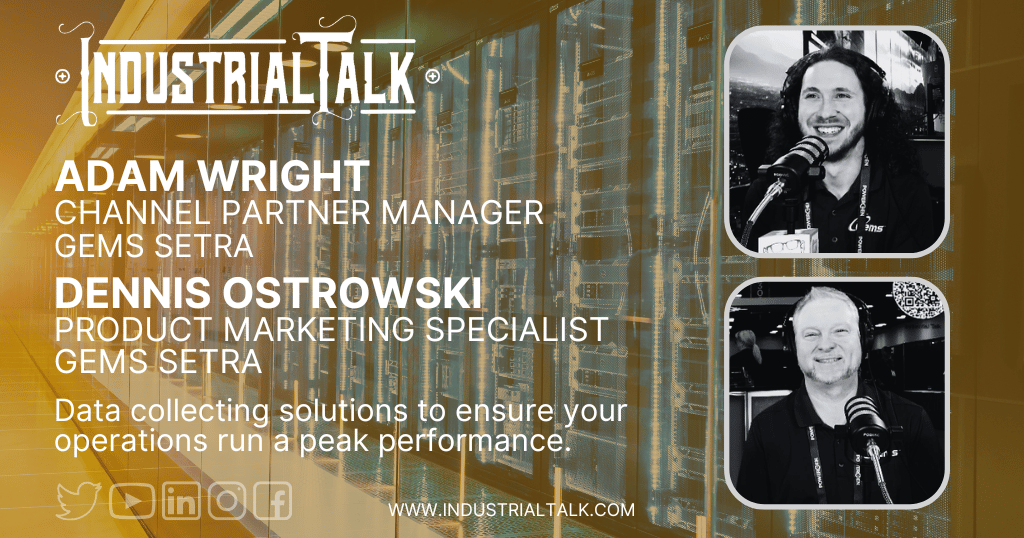
Industrial Talk is onsite at PowerGen and talking to Adam Wright and Dennis Ostrowski at Gems Setra about “Data collecting solutions”.
If interested in being on the Industrial Talk show, simply contact us and let's have a quick conversation.
Finally, get your exclusive free access to the Industrial Academy and a series on “Why You Need To Podcast” for Greater Success in 2025. All links designed for keeping you current in this rapidly changing Industrial Market. Learn! Grow! Enjoy!
ADAM WRIGHT'S CONTACT INFORMATION:
Personal LinkedIn: https://www.linkedin.com/in/adam-wright-28032a92/
Company LinkedIn: https://www.linkedin.com/company/gems-setra/
Company Website: https://gemssetra.com/
DENNIS OSTROWSKI'S CONTACT INFORMATION:
Personal LinkedIn: https://www.linkedin.com/in/dennisgemssetra/
PODCAST VIDEO:
THE STRATEGIC REASON “WHY YOU NEED TO PODCAST”:
OTHER GREAT INDUSTRIAL RESOURCES:
Industrial Marketing Solutions: https://industrialtalk.com/industrial-marketing/
Industrial Academy: https://industrialtalk.com/industrial-academy/
Industrial Dojo: https://industrialtalk.com/industrial_dojo/
Business Beatitude the Book

Do you desire a more joy-filled, deeply-enduring sense of accomplishment and success? Live your business the way you want to live with the BUSINESS BEATITUDES…The Bridge connecting sacrifice to success. YOU NEED THE BUSINESS BEATITUDES!
TAP INTO YOUR INDUSTRIAL SOUL, RESERVE YOUR COPY NOW! BE BOLD. BE BRAVE. DARE GREATLY AND CHANGE THE WORLD. GET THE BUSINESS BEATITUDES!
Reserve My Copy and My 25% Discount
Transcript
SUMMARY KEYWORDS
Power generation, Sensors, Industrial automation, Data collection, Process control, Fluid level, Temperature monitoring, Pressure sensors, Liquid cooling, Data centers, Asset management, Predictive maintenance, Ultrasonic technology, Capacitive technology, Engineering solutions
-:Welcome to the Industrial Talk podcast with Scott Mackenzie. Scott is a passionate industry professional dedicated to transferring cutting-edge, industry-focused innovations and trends while highlighting the men and women who keep the world moving. So put on your hard hat, grab your work boots, and let's go!
this one on your calendar for:got it right.
Did I? First time. Jim sensors. Let's get cracking. Yeah, you have no idea how many names I've mispronounced. You have no idea. Zero. It it is rough sometimes, but that's not a bad one. That's easy. That's easy going. You guys having a good, good, good conference? I mean, is this been a good one?
I think so. It's we've been doing Power Gym for boy 10 years or so, and each year used to
be big.
It's still big. So wasn't it
bigger?
It does seem like it's kind of scaled down a little bit, but
COVID. Yeah, right. Yeah, no, it's been a. Oh, hey, check it out. Yeah, are they are they your fan club?
Yeah, I guess so.
Yeah. So anyway, yeah, I think I think in this world, this power generation world, there's this buzz, and I think it's just going to only get bigger because the demand for power is only getting stronger. And and and and what's interesting about the whole thing is, of course, everybody wants it yesterday. It's it's it's a noble desire, but it's they want it yesterday. So before we get into the conversation about Jim's system, Adam, I need a little background on who you are.
Absolutely. So Scott, I've been in the sensor world. Boy, we're coming up on 12 years now. Hopped around between a few companies, but it's a very niche role, and without sensors, the world just doesn't seem to operate. So, is is
the sensors like taking data off of assets? What what's what? I'm sorry. Go continue. This is about you, not me. I will I will venture into it. Go ahead. Hey, we're having a great time. Yeah,
we're just monitoring process control, fluid level, temperature, pressures.
Yeah. Okay. Yeah. Dennis.
Yeah, background. I've been in industrial automation, sensors and controls since telephone booths and paper maps. So I've been doing it for quite some time. Right now, I'm a product marketing specialist. Is my title. I do wear many hats. My background is in tech support. I do technical, you know, research and stuff on products and markets, and that's why it was a good fit for me to get into product marketing.
How long you been with the company?
2016.
Okay, I've been around.
mperature control division in:Okay, I have to ask the question, and this is going to be to you, Adam. There is, there's always been this push, and I have to say it, but there's always been the more so than ever before. I want data. I want to see that data. I want to process that data. It's a tsunami of data. I want to be able to see and and and receive recommendations or direction based off of what that algorithm is talking about. You guys do that?
We do. So we manufacture the sensors. The sensors are taking the information from the process, the media, transmitting that. We also have controllers, which if you're looking for a localized display to see what my pressure is, what's my flow, am I at the correct level? We're able to do that all in one system.
Yeah, and Dennis, does that data does that data feed something?
Yeah, the sensors that we manufacture, a lot of people will consider commodity items, but they're very critical components in these systems and in this equipment. We actually had somebody come by our booth that was in the nuclear, you know, the nuclear facility, and he said that he's got a SCADA system that has 10 to 15,000 points of data, and all of them are fed by sensors. So it's a very critical and important, you know, part. It's not a commodity item. Uptime and consistency is important, so that for safety reasons and for critical uptime in like data centers and in like hospitals, environments where interruption is just not an
option, you do need these sensing solutions to make sure things run smoothly. Yeah, but here's the thing. Okay, so I have that. They've been around for a little while. It seems maybe to me that we're we're able to capture data even more. Right? It's just just like it never ends. It's I don't know. We it's like these data scientists. They're just like, let's get some more data. Let's make, let's let's do this and that. Are you, as a company, beginning to dip your toe into AI to be able to analyze the data, or help analyze the data, or does that go to somebody else that wants to analyze the data? Adam,
that's a wonderful question. I guess what you do with your data is ultimately your decision. Yeah, how you analyze that, how you want to portray that. I wouldn't say exactly that we're integrating AI into any of our sensors, but with the information that we receive,
right. So your your sensor, quite frankly, is I'm collecting the data. I want to make sure that that data is accurate and true, so that whatever happens of how I grind out the data and the results of that data are high confidence.
Correct. Exactly. Yep.
So Dennis, so how long has Jim's been in business?
Jim's has been in business for over 60 years, 65 years. Boy, talk
about seeing change.
Yeah, yeah. We've seen our very first sensor actually was a level sensor, and it used. It was so long ago. They used an aspirin, and when the liquid level would reach the aspirin, the aspirin would dissolve, and it would close a contact. That's how rudimentary it was when we first started, so a lot gone a long way. We still do some, you know, like regular level sensors that use a float. It's a very simple, you know, with a magnet and a reed switch that closes when the magnet comes close to it. Boom! I've reached my liquid level. But we've got more sophisticated electronic products, you know, that use capacitance. Yeah,
I hope you move beyond the Aspra. Yes,
we have. Yes, we have. Because that would be
a story in itself.
Right, but yeah, no. So we've got more sophisticated electronic. We still do the floats, like I said. But technology is moving forward, where you have different types of technologies that can do this sensing. We have ultrasonic sensors, passive. Okay, good.
How does it? Because I work in the world of asset management, and then many of the the of course data is that they're just they're they're trying to get to a point where I can predict or relatively predict the challenges and the the degradation of that asset, and to be able to perform the maintenance that is necessary, are you guys sort of working in that, or is it still sort of hey, we we're sensors, we put it on there, you take care of the data, you figure it out, whatever that algorithm needs to be.
Definitely more of the latter. Yeah, we're kind of the down and dirty. Here's what we're going to do. We're going to give you our. Reliable sensor. That way, you can take that information, and you're confident in it. I know that if my pressure is reading 65, my pressure is going to be 65. Yeah. And if you can track that as it starts to either increase or decrease, you can say, hey, maybe we should look at the bearings. Maybe we should look to readjust this. Maybe there's an issue here. So as long as your sensors are reliable, repeatable, then the information is trustful.
Do you get to a point where I'm a company? I use your sensors, and then all of a sudden, you know, the World Wide Web says I need to use another type of sensor, and and and I got to contact you. You guys sort of call me, get me off the the cliff, and or do you help me make that decision, saying maybe that's a good idea, but maybe go this around. Do you do you do that, Dennis?
Yeah, yeah, we do. A lot of times, requests will come in of they can't find a particular sensor because their application is so unique, and all applications are unique to some you know to some sort. But we are able to customize on site, and our engineers work closely with manufacturers or with end users to come up with a solution that'll fit their application. You know, both fit, form, and function. We can tinker with that because we have engineering in house, and we work with the customers in order to fit their solution.
It must have changed dramatically, Adam. I mean, things. It just seems because sensors have been around for you know the collection of that data. That's all important to the process and and important for the visibility into that process and being able to you know strategically make the right decisions. So back to the data, it's up to the client to be able to say here we put it into the dashboard. Here's the operator, whatever that might be. We use a Siemens, whatever, whatever might be. Here, this is where we're feeding that data. In the world of power generation, have you seen a an increase in the need or what? How? Because there's there's a lot of buzz out there. What
what what? How is it impacting your business? No, Scott. You kind of touched on this earlier. You know, data, data, data. What can I do? What information can I pull? A lot of these people, as you had mentioned, some of these systems designs a little more rudimentary. They get the job done absolutely, but I'm not getting feedback. I don't know when I do maintenance. I don't know if my I'm going to run into issues. Is my filter clogged? So as people start to realize, the more information I have, the smarter I can make these decisions. I can plan. Plan downtime is much better than unplanned downtime. So as long as you're able to pull in that information, we found that that's pretty successful.
Yeah. I. Okay, Dennis. Here's a question because everybody has this, especially here, especially with the data centers, especially with all of the demand for power. The market is saying, "I need it yesterday." Does is Jim Sensor a manufacturing group, and they can respond and scale to the manufacturing demands, and not be the you know well I can't get to you because the demands are so hard. This is a
yeah no we we handle volume with OEMs and with other with large facilities we're able to support them regardless of the scope. We work with them early on in the projects too, you know, in the design phase, so that we can make sure that we're spec'd in and we are supporting them throughout the process. Rather than coming in late and trying to be replacement parts, we like to work with engineers so that we can build a solution together. They're always trying to build the you know the better mousetrap, right? Yeah, the real estate innovation, and we want to be at the cutting edge of that too. You know, we've got sensors coming out with IO Link, IO Link Communication. IOLink is good for programming a sensor. You could program the sensor for its functionality. You could tweak it. So that allows engineers and equipment manufacturers to actually do things in-house themselves. You know, to make that sensor fit their application and be a better solution for their customers in the end.
Yeah, it's it's an interesting. It would what would be challenging is that you have you as a company need to be nimble enough to respond to wacky market demands of saying I want this, that, and the other thing, and and be able to do that effectively. Is that where is that where Jim shines? If I came to you and I said I want this, and I and then all of a sudden your manufacturing capabilities are like, yeah, we can do that.
Obviously, it's very situationally dependent.
Heck yeah! You know how it is. If the
money's there, then the opportunity may arise. Yeah, yeah. But yeah, as long as we're able to assist customers, and what we do is we try to track and log. So, like you said, people come up with these wackadoodle wackadoodle ideas and say, "Hey, I need to monitor a 10-inch pipe. I need to flow through that." Okay, if we see it once or twice, you know. We kind of keep note of that as we see it a dozen times, 20 times. Now our engineering department gets involved, and we start to say,
"That's that's cool." Yeah,
is this what we need to expand? Is this what the market is leaning? Yeah,
but I bet I bet it's a tsunami of recommendations. It's like, "Hey, I got another one. I got another one. I got to keep track. Slow down there, man, because I got to do this. That's the 20th engineering. You got to get going on.
Yeah, Scott. One thing to add to that is we're seeing a lot of customers that have to deal with media compatibility and material compatibility with the sensors, right? So, you know, we've obviously had to work with them for solutions where, hey, you know what, the media is not going to matter. So we have some non-contact solutions where it doesn't even contact the media. We've got a flow sensor that uses ultrasonic technology to measure the the flow velocity of the liquid to measure its flow rate. You don't have to cut into a pipe. You don't have any kind of connections. We've also got some level sensors that use capacitive technology where you can stick stuff on the outside of the tank, and it will measure without touching the liquid.
Now that's pretty cool. My background was in tank storage. Of course, we didn't have that. We yeah, we had the the the old way. The
old way,
not something to slam on a tank. Yeah, check it out. I know what the inventory is. Oh, the good old days. We'd have to calculate it. No, well, I I just is is this an exciting time for your company?
Go ahead, Adam. See,
I did it. I did. You're welcome. Yeah. I just threw that out there. Congratulations. Well,
I couldn't think of a more exciting time to be part of Gems or incorporate yourself with Gems. As Dennis mentioned, there's a few new products, and we've really been receptive to customer feedback, industry feedback, and as a result, we've released more products in the past six months than we have the past 10 years.
And you mentioned earlier, Scott, about data centers, right? No. Yeah, that that is obviously a market that's focused for our for ourselves, both for liquid cooling and for we do air cooling as well, but we also have you know the ancillary industries like power gen. I've been to some data centers, and you see lines of diesel generators. I mean, dozens of diesel generators all in a line just to maintain the power needed and to maintain the uptime that's required.
It's a wild west out there. Hope you guys bring control and and and predictability. That's what I want.
It's our goal.
I'm sensing we will.
That's right. And then somebody will grab the data, and then somebody says, "I need to do this right." And I got the algorithm over here. Anyway, Adam, how would people get a hold of you?
Oh, you can find us on LinkedIn.
Yeah, and and you, on LinkedIn too.
Absolutely, it's easy because
you know it's a human contact. I'm not going to reach out. I don't reach out to a company. I reach out to people. Dennis,
I'm in marketing. You're going to see me all over LinkedIn. You're going to get tired of my of my LinkedIn posts, but like and share anyway.
Put this on your calendar for:You're listening to the Industrial Talk Podcast Network.
Hey, industrial professionals, Scott Mackenzie here. Let me tell you about a company you need to know, Wildcat Generation. These folks are the real deal. They bring unmatched expertise to power generation, from advanced technologies to boots on the ground. If you're looking to improve reliability, boost efficiency, or modernize your plant for the future, Wildcat Generation is the partner that delivers no hype, just results. Wildcat Generation powering industry with purpose and precision. Yeah, Power Gen. Need to put that one on your calendar. As you can tell, I'm pumping power gen, but you know why I'm pumping power gen? Is because everybody's talking about power. It's a topic of conversation. Yes, power gen. Put that on your calendar. It's right around the corner. I've been doing some ads for them. So anyway, good. You get to meet great people, but. We got Dennis. We got Adam. They're right there. Here, here, here's the challenge: Jim Cetra or Solutions. I don't. The contact information is out on Industrial Talk. Absolutely, you you you figure it out. You know why? You need people in your corner. You need Sherpas. You need individuals to help you along on this power journey. Yeah, you do. And and these two came to the table, and they were saying, "Yes, we know," which is always nice, huh? And and then you can you can do whatever you need to do with your stuff, but getting great great people on your team. Yeah, Dennis and Adam, right there. Great. All right, industrial talk is here for you. Here's the deal: you want to succeed, you need to tell your story. It's a non-negotiable. Been doing this for many years. Ran a number of businesses, and it always gets down to creating that relationship. And to create a relationship is not an AI strategy, no, by any stretch of the imagination. It is absolutely a human-to-human contact, no like and trust. Absolutely. So go out to Industrial Talk. We're here for you. We know this stuff. We we know how to get more eyeballs and ears listening to you, and and seeing you, and saying, "Hey, that guy's got a high beer factor." That's that's my that's my shtick, and that's what I'm sticking to. You know what I mean. If if you have a high beer factor, somebody wants to hang out with you at a bar. Yeah, that's important. That's that's business, baby. All right. As always, go out to Industrial Talk. Reach out to me. Have a conversation, and we'll figure out the best way to get your message out there. Be bold. Be brave. Dare greatly. Hang out with Dennis. Hang out with Adam. Bring them on part of your team, and you will not be disappointed. You're going to be changing the world. We're going to have another great conversation coming from PowerGen. So as always, stay tuned.