Adam Zurligen with Country Morning Farms
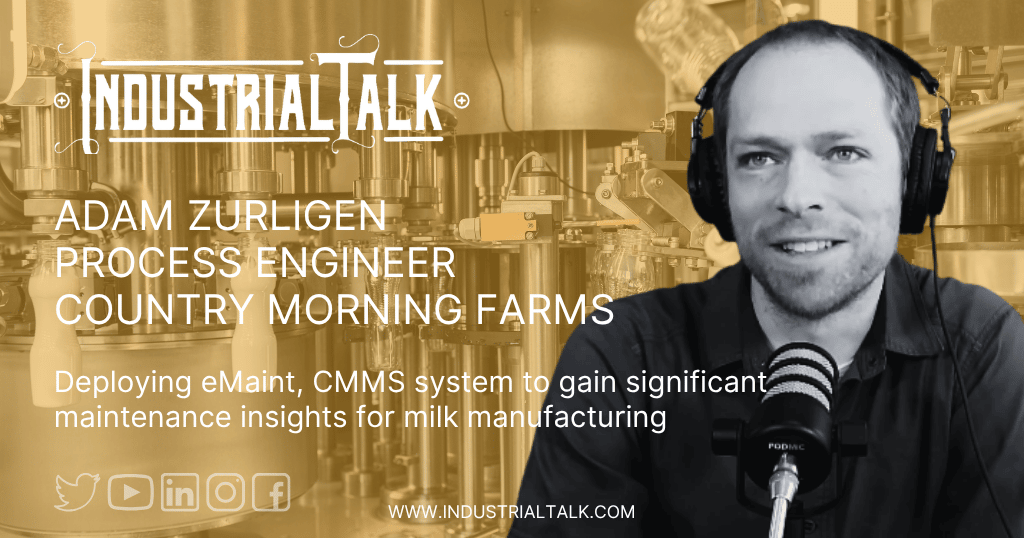
Industrial Talk is onsite at Xcelerate 2026 and talking to Adam Zurligen, Process Engineer at Country Morning Farms about “eMaint and Milk Processing”.
Overview
Adam Zurligen, a process engineer and reliability engineer, discussed his role at Country Morning Farms, a family-owned dairy operation in Warden, Washington. Adam implemented Fluke's eMaint x5 to track maintenance costs, which had doubled in 2025. He highlighted the use of GPS trackers on mobile equipment to automate maintenance tasks and reduce costs. Adam also mentioned the integration of AI-powered capabilities to streamline data entry. Despite a small maintenance team, early results showed improved efficiency and reduced downtime. Adam's story underscores the importance of technology in managing assets and costs in the dairy industry.
Outline
Fluke Xcelerate Event Overview
- Scott introduces the Industrial Talk podcast, highlighting Fluke's Xcelerate event.
- The event featured high-energy keynotes, hands-on predictive maintenance tools, and breakthrough AI diagnostics.
- Fluke Xcelerate is described as a launch pad for smarter, faster, and more reliable operations.
- Listeners are encouraged to visit fluke.com for more information.
Introduction to Adam Zurligen
- Scott welcomes listeners to the Industrial Talk podcast, celebrating industry professionals.
- Adam Zurligen is introduced as a mechanical engineer with experience in manufacturing and tooling design.
- Adam shares his background, including his role as a reliability engineer at a French fry production facility in Eastern Washington.
- Scott and Adam discuss their familiarity with the area and companies like Simplot and McCain Foods.
Adam's Role at Country Morning Farms
- Adam explains his current role at Country Morning Farms, a family-owned dairy operation in Warden, Washington.
- The company farms its own feed, milks cows at two dairies, and operates a bottling plant for milk distribution.
- Adam highlights the unique aspect of having all operations within one business, which is rare in the dairy industry.
- Scott expresses interest in visiting the farm and learning more about the operations.
Challenges and Solutions at Country Morning Farms
- Adam discusses the main challenge of managing maintenance costs, which have doubled in the last year.
- The company lacked a maintenance management system, relying on financial tracking for maintenance costs.
- Adam was brought on board to implement a software solution for work order tracking and inventory management.
- The implementation of eMaint x5 is underway, with initial data entry and setup ongoing.
Implementation of eMaint x5
- Adam describes the early stages of implementing eMaint x5, including adding assets and maintenance tasks.
- The process of manually entering data into the system is time-consuming, but necessary.
- Adam mentions the potential for AI-powered capabilities to automate data entry and import maintenance procedures.
- The company is participating in a beta program to test the new AI features of eMaint.
Impact of eMaint x5 on Operations
- Adam shares early successes with the GPS tracker system, which provides real-time alerts for equipment issues.
- The system allows for quicker response times and prevents catastrophic failures by addressing issues promptly.
- The integration of GPS trackers with eMaint x5 is improving maintenance tracking and reducing costs.
- Adam highlights the importance of having dedicated staff to manage the new system and ensure its effectiveness.
Future Plans and AI Integration
- Adam discusses the company's plans to expand and increase capacity at their dairies.
- The next generation of family ownership is excited about utilizing AI tools to stay competitive.
- Adam is eager to test the new AI-powered capabilities of eMaint to streamline data entry and maintenance procedures.
- The company aims to continue improving their maintenance processes and reducing costs through better tracking and management.
Conclusion and Contact Information
- Scott wraps up the conversation, expressing excitement about Adam's story and the potential of eMaint x5.
- Adam provides his contact information, encouraging listeners to reach out to him on LinkedIn.
- The podcast encourages listeners to connect with Industrial Talk for more stories and to share their own experiences.
- The importance of attending events like Fluke Xcelerate to learn about new technologies and network with industry professionals is emphasized.
If interested in being on the Industrial Talk show, simply contact us and let's have a quick conversation.
Finally, get your exclusive free access to the Industrial Academy and a series on “Why You Need To Podcast” for Greater Success in 2026. All links designed for keeping you current in this rapidly changing Industrial Market. Learn! Grow! Enjoy!
ADAM ZURLIGEN'S CONTACT INFORMATION:
Personal LinkedIn: https://www.linkedin.com/in/adamzurligen/
Company LinkedIn: https://www.linkedin.com/company/country-morning-farms/
Company Website: https://countrymorningfarms.com/
PODCAST VIDEO:
THE STRATEGIC REASON “WHY YOU NEED TO PODCAST”:
OTHER GREAT INDUSTRIAL RESOURCES:
NEOM: https://www.neom.com/en-us
Hexagon: https://hexagon.com/
Arduino: https://www.arduino.cc/
Fictiv: https://www.fictiv.com/
Hitachi Vantara: https://www.hitachivantara.com/en-us/home.html
Industrial Marketing Solutions: https://industrialtalk.com/industrial-marketing/
Industrial Academy: https://industrialtalk.com/industrial-academy/
Industrial Dojo: https://industrialtalk.com/industrial_dojo/
We the 15: https://www.wethe15.org/
YOUR INDUSTRIAL DIGITAL TOOLBOX:
LifterLMS: Get One Month Free for $1 – https://lifterlms.com/
Active Campaign: Active Campaign Link
Social Jukebox: https://www.socialjukebox.com/
Industrial Academy (One Month Free Access And One Free License For Future Industrial Leader):

Business Beatitude the Book
Do you desire a more joy-filled, deeply-enduring sense of accomplishment and success? Live your business the way you want to live with the BUSINESS BEATITUDES…The Bridge connecting sacrifice to success. YOU NEED THE BUSINESS BEATITUDES!
TAP INTO YOUR INDUSTRIAL SOUL, RESERVE YOUR COPY NOW! BE BOLD. BE BRAVE. DARE GREATLY AND CHANGE THE WORLD. GET THE BUSINESS BEATITUDES!
Reserve My Copy and My 25% Discount
Transcript
SUMMARY KEYWORDS
Fluke Xcelerate, predictive maintenance, AI diagnostic, reliability engineer, Country Morning Farms, dairy operation, maintenance management, mobile equipment, GPS trackers, maintenance costs, AI-powered tools, asset tracking, work order tracking, inventory management, family-owned business.
Industrial talk is brought to you by Fluke. We were on site at Fluke's Xcelerate event, where Reliability Reimagined came to life, from high energy keynotes to hands-on predictive maintenance tools to breakthrough AI diagnostic. The event delivered real-world strategies teams can use today. Xcelerate once again proved why it is the launch pad for smarter, faster, reliable operations. Go out to Fluke.com to find out more.
Welcome to the Industrial Talk podcast with Scott Mackenzie. Scott is a passionate industry professional dedicated to transferring cutting edge industry focused innovations and trends while highlighting the men and women who keep the world moving. So, put on your hard hat, grab your work boots, and let's go. All
right, once again, welcome to Industrial Talk. Thank you very much for joining the number one industrial related podcast in the universe that celebrates you, industry professionals all around the world, you're bold, you're brave, you dare greatly, you innovate, you collaborate. You are making the world a better place each and every day. We thank you from the bottom of our hearts. That's why you are the heroes in this story. We're broadcasting from Fluke Xcelerate. Yeah, I've been saying this all day, Fluke Xcelerate, the user conference and go out to Fluke.com you got to go out to Fluke.com find out more, they're amazing. And then, of course, they have a solution called eMaint, amazing, you must, must check it out, it's all good. All right, in the hot seat we have a gentleman by the name of, and you do not help me with that last name. Here we go, as you can see on the video, I'm looking down at my notes. Adam, I got that. Adam Surrogate, Zurich in that's it, Zurligan. Got it. Shut up. Yeah, it's unique. Zerligan, I like that, man. Let's get cracking. All right, yeah. Well, I'm I'm excited about this. I don't know what you guys do, but we're going to find out what you do. I'm just all in. I'm all right for the listeners, my friend, so they understand who Adam Zerlingen is. Give us a little background on who you are,
mechanical engineer by training had a couple different positions in manufacturing and tooling design, manufacturing engineering position, and then had an opportunity to jump in as a reliability engineer for French Fry production facility in Eastern Washington. That's where my wife grew up and where we live now,
Eastern Washington.
Yeah,
so are you familiar with Simplot?
Yes, yeah, we live in Othello. So, McCain and Simplot are the two big French fry production facilities, and I worked at McCain Foods.
Well, I was doing a project up in Idaho for Simplot, and that's another story. I wasn't, I wasn't dealing with any of the, the manufacturing of French fries, but I was taking the waste and creating ethanol out of it, so that's what I was doing long ago. Beautiful country up there in that area, very good.
We love
it. I digress, big time. All right, you're having a good conference. How many times you've been to Xcelerate?
This is my first time,
really.
Yeah,
what's standing out for you?
doubled in the last year, in:heck of a conversation, yeah. Like, here, help me, Adam, I can help you. It's like, there's no, there's no friction there, you can do that. That's outstanding. All right, let's go down. So, here, here is Cone. Country Morning Farms in Country Morning Farms is what,
so they're dairy in Warden, Washington. So they farm the ground to grow the food for the cows, right? Grow their own feed for the cows. We milk cows at two dairies, and we run a bottling plant to process the milk and then distribute the milk, so it's a whole process in house within one business, right. So that's a fairly unique, as I've come to know the dairy industry a little bit better, that's a fairly unique whole situation to have all those operations within one, yeah, family-owned company.
So, okay, so, so outside the fact I've got the couch, so there's cows right there. That's great, that's important, that's all a part of that milk stuff.
Yep,
but then you have your organization is creating also the feed. Are you, are you supplementing that feed with okay nutritionists,
ws, we have one one dairy has:I think that's cool.
Yeah, it's cool, it's fun, exciting, yeah,
yeah. Anything that's dealing with cattle, and, and that, that, that industry is amazing. And thank you, it's, it's so vital. It's just amazing. It is. Is the milk delicious?
It is. Yeah, it's, it's great. I, I honestly feel like there's, there's a flavor difference, like when, when it's, when it's locally produced, and we know right where the feed came from, and it's, it's good. We take good care of the cows. When the cows are happy, the milk is totally better. That's cool. All right,
that is cool. And I have definitely.. I would.. that I would love a tour like that. Check this out anytime. I would love that. All right. Tell us, so we have a problem. We have a problem. There's their maintenance spend is going through the roof. We're not clearly.. we don't, we can't, we didn't, we don't have a handle on this. There's a lot of challenges taking place. How did you with that saying, which, which version of Emate are you on?
x5 we just launched two weeks ago, we just finished implementation, so we're just scratching the surface here.
Yes. Okay, so there you go. Now, now, we can't. We don't have the help, and how long you've been with them? The company, yeah, one year. One year, this is all new. Yes. Oh, amazing. Yeah. All right. So, you're saying, hey, okay. How do you, as a reliability engineer, a professional, go in and say, all right, we're going to look at these assets. They must have some indication of saying we're having a lot of problems with these bearings or that pump or whatever it might be, and then be able to sort of prioritize these assets in a way of saying, okay, we're going to get the greatest bang for the buck over here, do this, that, and the other thing. How did you approach that challenge?
Yeah, so a lot of the equipment involved in our overall total operation is mobile equipment, right? We have a lot of tractors and implements, yeah, and
yeah, it's because you're growing your own float,
and then at the dairies we got a lot of more construction equipment, you got front loaders and side by sides, or and skid steers that were pushing the feet around and pushed like scraping manure, you know, it's a whole whole process. No, it is, and so a lot of the mobile equipment, which it's hard to find, the most all CMS programs that I'm aware of are more
static assets. Yeah, design within parameters, yeah, exactly, which we do have funny that at
the, at the plant, yeah, know that we've got boilers, we've got, yeah, pumps and motors, we've got heat treatment, we got homogenizers,
sure,
centrifuges for separation, a bunch of equipment like that, that does need to be monitored and tracked and and maintained,
right?
So that was the, a lot of the cost seems to be on the mobile equipment side, and it's kind of
because it's getting abused,
abused, yeah, these things are run, those dairies run 24/7 yeah, right, it's a reality all night, they're used all day, they get a few hours of breaks here and there, right, and the people who run them don't expect to have to check the oil and all this stuff, it's like they'd expect it to just run. They jump in, it needs to just work all the time without any hesitation, and so there hasn't been like a dedicated maintenance team or tracking or or planners or anything like that. So we just kind of rely on some of the guys at the at the dairies can do some mechanic work, and they occasionally just need to be like, oh yeah, we should go check the oil and coolant level, and, and stuff, and if that doesn't happen for a while, we cool it runs out, it overheats, we lose an engine like that happened last year. How about
that? Wow, go figure, yeah, that happens, no way, get out of here. Yeah,
so just, just having somebody dedicated to keep track of that, or a system, it's hard to add the staffing to be able to have more people to keep track of that. So, I, that was my suggestion. Hey, we need to implement some software where we can keep track of the hour meter on the engine, that all the maintenance is based on hours on the engine, so we can import that into the software, we can automatically trigger work orders at those intervals when the maintenance is due. Have routine inspection times just to check for leaks and things that pop up in between. And it's interesting
that the, the invert call it, or the interview that I had prior to yours, he just said, "Hey, just just watch the time, and you'll, you'll make an impact in, you know, your maintenance cost. You just watch it.
Yeah.
How are you going to take these mobile assets, and I don't have an answer for it. You probably do. You probably, because you're, you're in the thick of things. Take those mobile assets. How do you take advantage of, of the ability to be able to collect that data automatically, you know. Saying, hey, now I'm collecting the data instead of making it manual, I'm collecting it automatically. It gets uploaded into x5 we're good to go, and we're really tracking it now. I've got the logic in the system notifying me, okay, go out there, take care of the tractor, a or whatever. How are you doing that?
Yeah, so I found a company that has GPS tractor units that we installed on all of our mobile equipment, and that can either clock the hours independently, or it can access the can bus system in the tractor and pull that data automatically as it, as it, as it feeds into, and that can all integrate Emain, is easy to be able to integrate into other platforms, and we can pull that data in, and then we just dedicating certain people to be the ones to have those work orders assigned to at the sites, just establishing the assigned roles and responsibilities is kind of that first step.
Okay, so the question is, how many maintenance personnels do you have? So you got the people going, or is it just you, Adam?
It's not a very big team. So at the plant we have one, he's pretty much you, he's the maintenance man. We have one other guy besides me. He's the maintenance manager and does all the maintenance. We have like a one man maintenance team at the plant, and then we at the farm team, we have a variety of guys that are full time maintenance farm workers, and a couple of them are we got some fabricators that are just doing repairs and things, and a couple of guys that are pretty good, experienced mechanics, so we'll use the farm mechanics to go around and do oil changes, you know, belts, and all the basic stuff, all the other equipment at the dairies, and some stuff at the plant, and as needed, whatever, so it's there's not a lot of really dedicated staff for all for the dairies and farms, we have people who kind of do everything, they'll do farm stuff, and then they'll do mechanic as needed, whenever they can. So,
what results have you tangible results have occurred as a result of just getting a better understanding of these, these assets?
Yeah, just making a more accurate list, just collecting data, installing these trackers, getting better insights. Already, just in the early stages, we've kind of are piloting that GPS tracker system that we're using. The platform is called Track Unit, and just that already we've had a couple of instances where an alarm starts popping up on the tractor, and it's kind of hard to tell on the tractor, the display is off to the side, the operator is not really paying attention, and there's some kind of an error coming up, but it just, or they'll just get in the habit of just silencing it and not paying attention. But now it's flagged, our dairy manager gets an email or notification if he's got the app notifications on, and he can see exactly what kinds of errors or warnings are happening, and he can assign a mechanic. Hey, go check out this tractor. It's got an alarm coming up. The operators haven't said anything, but I can see that it's happening, and we can get that addressed. Somebody gets a man, and now
you're compressing the time. It doesn't have this catastrophic failure. This asset that stays out, at least you have some ability to be able to affect correction. Before it decides that it, it didn't want, and, and I would imagine that, that there has been significant, just, just that alone is a significant change in your operation.
Yeah,
and that's across the board, as that's at the processing facility, as well as the mobile units, as well. Right.
Yep. Yeah, like I said, we're just beginning here, we're on the very, very beginning stages of our journey, but we're already seeing a picture, just in the few weeks, really, that we've been live on all of these things, we're already seeing movement, right, progress in the right direction. So it's real exciting. That
is pretty cool. I like that a lot. All right, so you're here at Xcelerate, first time you're an x5 user, and you're hearing about all the stuff that's taking place. What's peaking your interest there, Adam?
Honestly, as we're launching a new system and adding all of our assets into the database into x5 obviously a big piece of that is adding all of the maintenance tasks for each piece of equipment and the scheduled PMS for each piece of equipment, so that's a lot of data entry, but manually we've only had a few assets that we've added to the system already, but I've added all the tasks and the scheduled PMs manually entered all that into a spreadsheet, import dumb ball at once, and then I was like, this, this takes a while, it'll take me an hour to people,
tap out, read through
the owner's manual, see the service schedule, and it's got detailed procedures. Some, you know, an engineer at Case spent long, long time writing 100 page manual with all the detailed instructions for how to do all the routine maintenance on this side skid steer that we're working on, and it's all there, but adding it, putting it into the system is real time consuming. So I actually asked Cesar, who's our customer success manager for our company, just a week or two ago. Right after we started, I was like, "Hey, is there a faster way to import all this stuff? It takes me a while, as like, and I didn't, looking around, I think I saw on another CMMS company's website that they have some kind of AI thing that they're getting ready to test and launch to be able to import stuff, and he's like, you know, I'm pretty sure we're going to launch one of those, an AI-powered capability to import that information,
yeah,
at the conference, so come check it out, you know, so here we are, and yesterday they presented all that and demoed it on stage, and it's real exciting. So we got into the beta program, it's live on my account, and I'm like itching to go try it. I haven't had a chance to go try it yet, to go plug in some manuals and like extract the whole all the tasks and all of the repair procedures, maintenance procedures automatically, like Getty,
that's just good stuff. That's two
hours of my time turned into 10 minutes. There it is, and that's a great,
that's a great case study. Like, normally we would be, you know, fat fingering this stuff into a spreadsheet and then manually uploading it into, you know, the database or whatever it is, and hopefully I didn't sort of misspell something, or you know, whatever data stays questionable, right? Outstanding.
Yeah, real excited
every time when we used to back back when I was deploying systems, the question was always, How far back do you want to go to clean up the data, because the data was always bad. Always, nobody ever came to me and said, 'Hey, Scott, our data is just great. You don't have to clean any of it. Nope, that's not it. And then they say, 'Okay, we'll clean the data. And then six six days into that effort, everybody's like, 'No, I can't do this. I can't do it. It's just too much AI.
Yeah,
there it is.
Yep,
I like it all right. Where do you see it going? What is your hope? How are the.. how are the owners? Are they saying, "Man, do I like Adam?
Yeah, they.. they just transitioned. The next generation of family took over ownership and operation of the company, so the CEO now is kind of my generation, little older than me, but he's, he's excited, like he's like, 'Yes, let's utilize AI tools, like we're at that point in any industry where we have to jump on the technology or we get left in the dust, so we have to go,
can't ignore it. Yep, all right, if somebody says I want to get a hold of Adam, how would they get a hold of you? What's the best way?
Yeah, I'm on LinkedIn. Shut it, and easiest way, probably.
There it is, right? I want a tour.
Yes,
I want a tour. That whole area up there, that's beautiful.
Just off I 90, if you're past them, just stop on by. All right,
broadcasting from. Xcelerate:You're listening to the Industrial Talk Podcast Network.
e. Dare greatly put Xcelerate: