Bill Kaewert with Stored Energy Systems
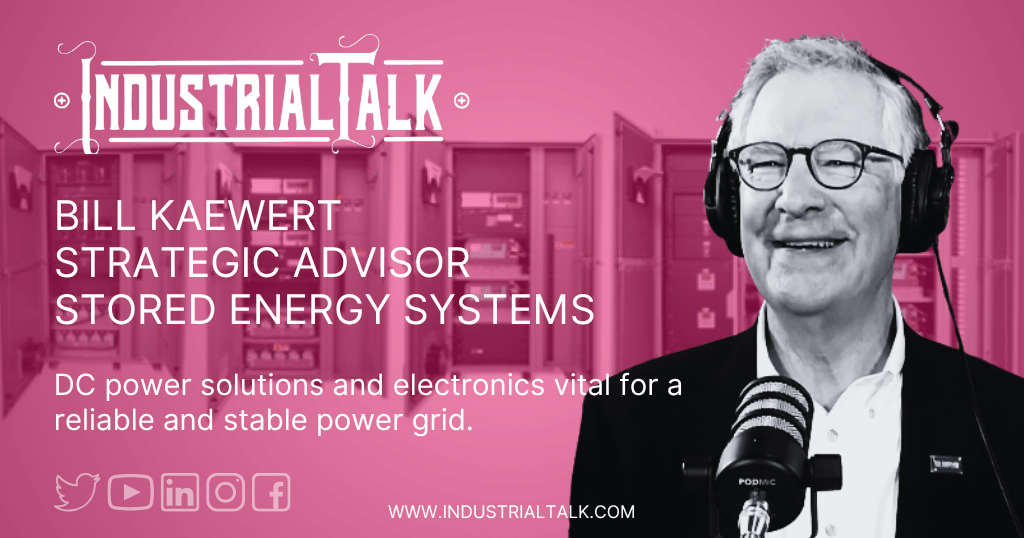
Industrial Talk is onsite at PowerGen and talking to Bill Kaewert, Strategic Advisor/Board Member with Stored Energy Systems about “Data Centers and DC Power Solutions”.
Bill Kaewert, a veteran of the power generation industry, discussed the challenges and innovations in maintaining electric power at the PowerGen conference in San Antonio. He highlighted the significant load growth due to hyperscale data centers, AI, population growth, and electrification, which has led to a 80-gigawatt reduction in dispatchable energy over the past decade. Kaewert emphasized the role of data centers in providing dispatchable power, noting they have 100 gigawatts of generators. He advocated for decentralized energy solutions, including storage and on-site generation, to address these challenges and suggested that individual and commercial entities should invest in their own power assets to mitigate rising electric bills.
Outline
Introduction and Overview of PowerGen Conference
- Scott introduces the episode of Industrial Talk, sponsored by the Propane Education and Research Council, highlighting their commitment to safety training and innovative propane-powered technology.
- Scott thanks listeners for their support and introduces the PowerGen conference in San Antonio, encouraging listeners to attend in 2027.
- Scott introduces Bill Kaewert, a power generation industry professional, and mentions his height as a joke.
Bill Kaewert's Background and Role at PowerGen
- Bill Kaewert shares that he has been attending PowerGen for over 20 years and works for a manufacturing company specializing in power electronics.
- Bill discusses the primary reason for his attendance at PowerGen: the increasing demand for electric power due to load growth, hyperscale data centers, AI data centers, population growth, and electrification of transportation.
- He highlights the issue of retiring dispatchable generation while load growth continues, emphasizing the importance of maintaining uninterruptible electric power.
- Bill mentions his role at Stored Energy Systems LLC, which manufactures power electronics for critical power applications in hospitals, data centers, and government facilities.
Challenges in Maintaining Electric Power
- Bill explains the challenges of maintaining electric power with the increasing demand and the retirement of dispatchable generation.
- He discusses the role of data centers in providing dispatchable power, noting that data centers have around 100 gigawatts of generators ready to rock and roll.
- Bill emphasizes the importance of using data center generators before an outage to prevent serious problems, such as those seen in Texas during the winter storm.
- He mentions the need to readdress EPA and other regulations to allow the use of standby generators before an actual outage.
Innovation and Solutions in Electric Power
- Bill discusses the potential for innovation in electric power, with individuals and businesses using storage batteries and on-site generation.
- He describes the concept of prosumers, who sometimes use grid power and sometimes produce their own power for export.
- Bill highlights the need for experimentation and failure to find the best practices for electric power management.
- He mentions the role of states as laboratories of democracy in finding solutions that work best for different geographic areas.
The Role of Utilities and Market Dynamics
- Bill and Scott discuss the inefficiencies and limitations of the existing grid and the need for more dynamic and efficient management.
- Bill emphasizes the importance of individual experiments and innovations in bringing your own power (BYOP) to address the challenges of the electric grid.
- He mentions the Texas Senate Bill Six, which incentivizes large loads to take responsibility for financing new assets and avoid stranded assets.
- Bill highlights the potential for revolutionizing electric power through BYOP and the role of states in implementing their own regulations.
The Impact of Data Centers and Electrification
- Bill provides statistics from Grid Strategies LLC, showing that 35-40% of demand growth is due to population and economic growth, not data centers.
- He explains that only 20-25% of the demand increase is attributable to hyperscale data centers and AI, with the rest coming from electrification of transportation and other factors.
- Bill argues that data centers are unfairly blamed for rate increases, as they are easy targets and not the primary cause of the demand growth.
- He advises residential and commercial customers to take charge of their electric power and invest in on-site assets to reduce or even zero out their electric bills.
Coordination of Distributed Energy Resources
- Bill discusses the challenges of coordinating distributed energy resources, particularly inverter-based resources, which are becoming a majority of power generation.
- He mentions a massive power outage in Spain last April, where inverter-based resources were a significant factor, and the ongoing investigation into the cause.
- Bill highlights the complexity of managing distributed energy resources and the need for coordination to avoid stability issues.
- He emphasizes the importance of individual commercial enterprises in contributing to the problem or averaging out the impact on the grid.
Conclusion and Contact Information
- Bill provides his contact information, encouraging listeners to reach out to him on LinkedIn.
- Scott thanks Bill for the conversation and highlights the importance of the PowerGen conference for the power generation industry.
- Scott encourages listeners to connect with him and other industry professionals to share their stories and innovations.
- The episode concludes with a reminder to listeners to stay tuned for more conversations and updates from the Industrial Talk podcast.
If interested in being on the Industrial Talk show, simply contact us and let's have a quick conversation.
Finally, get your exclusive free access to the Industrial Academy and a series on “Why You Need To Podcast” for Greater Success in 2026. All links designed for keeping you current in this rapidly changing Industrial Market. Learn! Grow! Enjoy!
BILL KAEWERT'S CONTACT INFORMATION:
Personal LinkedIn: https://www.linkedin.com/in/bill-kaewert/
Company LinkedIn: https://www.linkedin.com/company/stored-energy-systems-llc-sens-/
Company Website: https://www.sens-usa.com/
PODCAST VIDEO:
THE STRATEGIC REASON “WHY YOU NEED TO PODCAST”:
OTHER GREAT INDUSTRIAL RESOURCES:
NEOM: https://www.neom.com/en-us
Hexagon: https://hexagon.com/
Arduino: https://www.arduino.cc/
Fictiv: https://www.fictiv.com/
Hitachi Vantara: https://www.hitachivantara.com/en-us/home.html
Industrial Marketing Solutions: https://industrialtalk.com/industrial-marketing/
Industrial Academy: https://industrialtalk.com/industrial-academy/
Industrial Dojo: https://industrialtalk.com/industrial_dojo/
We the 15: https://www.wethe15.org/
YOUR INDUSTRIAL DIGITAL TOOLBOX:
LifterLMS: Get One Month Free for $1 – https://lifterlms.com/
Active Campaign: Active Campaign Link
Social Jukebox: https://www.socialjukebox.com/
Industrial Academy (One Month Free Access And One Free License For Future Industrial Leader):

Business Beatitude the Book

Do you desire a more joy-filled, deeply-enduring sense of accomplishment and success? Live your business the way you want to live with the BUSINESS BEATITUDES…The Bridge connecting sacrifice to success. YOU NEED THE BUSINESS BEATITUDES!
TAP INTO YOUR INDUSTRIAL SOUL, RESERVE YOUR COPY NOW! BE BOLD. BE BRAVE. DARE GREATLY AND CHANGE THE WORLD. GET THE BUSINESS BEATITUDES!
Reserve My Copy and My 25% Discount
Transcript
SUMMARY KEYWORDS
PowerGen, power generation, electric power, data centers, load growth, dispatchable generation, renewable energy, energy storage, microgrids, prosumers, utility planning, stranded assets, energy innovation, grid stability, energy policy.
-:Welcome to the Industrial Talk podcast with Scott Mackenzie. Scott is a passionate industry professional dedicated to transferring cutting-edge, industry-focused innovations and trends, while highlighting the men and women who keep the world moving. So put on your hard hat, grab your work boots, and let's go!
put this on your calendar for:David. It's been fantastic.
That's
the. Go ahead.
No. How many times have you been to Power Gen?
So I've been coming to Power Gen for over 20 years. See
now, you got to share with us what what kind of changes have you seen?
Oh my gosh! Biggest deal, and the reason, the primary reason I'm here, I work for a manufacturing company, power electronics company, but the primary reason I'm here is we have a big problem in this country. First of
all, start going, baby.
I'm not going to talk about politics. It's not my gig today.
No.
So what do we all depend on every day? 24/7, 365 electric power, uninterruptible. Keeping that on has been easy in the past because we really haven't had any load growth. Yeah. In the past few years, though, we've got hyperscale data centers. You got AI data centers. Everybody thinks they're they're the biggest part of the problem. They're only 25 percent of the problem. We've got a lot of population growth. We've got electrification of transportation and everything else. Heat pumps. Massive load growth is going on in this country, and yet we're retiring dispatchable generation. So I want to talk about that and how important that is. I want to talk about what's likely to happen with electric power over the next few years, and finally, I want to talk about the panel discussion I talked about earlier today.
I'm going to geek out on this conversation. I cannot believe it because you're going to be chirping the language that I want to talk about in a big way, background first. We've got to know who you are. Give us like, if you've been coming here for 20 years, you've been part of the power generation industry.
I've been. I just. I have stepped down recently as CEO of Stort Energy Systems LLC. Sens is in 80% of the hyperscale data centers. We manufacture power electronics. We provide integrated systems that really keep the they power the electrical switchgear. They start the generators. This is critical stuff for hospitals, data centers, government, pretty much anywhere you need critical power. Our products are installed. So the reason I'm here is an outgrowth of that. We have the challenge we've got is keeping the lights on all the time. Wind and solar are great, but the sun doesn't shine at night. Last time I checked, and the wind doesn't always blow. There's something the Germans call Dunkelflout or dark doldrums when you can have days worth of no power, so what do you do in that case when the batteries are exhausted and you don't have enough dispatchable generation? That was the subject of today's talk, huh? And so, what data center the role data centers have to play? There's probably 10 percent of the total dispatch. Matchable power in the United States, installed and sitting around at data centers, say close to 100 gigawatts of generators ready to rock and roll.
Okay, okay. Let me paint this picture. So we're talking about this available capacity that exists at these data centers that are just sort of sitting there, and you're saying 100 gigawatts of capacity. right?
So why is that relevant? Because the U.S. has retired a bunch more dispatchable capacity over the last decade. We have 80 gigawatts less dispatchable energy today, or generation capacity in the country today than we did 10 years ago, why does that matter? Because the load is going up at the same time. We've got all these new loads. We got less dispatchable energy.
Yeah,
that's a train wreck we can see from 10 miles away.
Yeah,
how do we fix that? Nuclear reactors will take too long to come on board. Coal plants are still being retired, so what are we going to do? I
have to ask the question: Why do we have to retire coal-fired plants? Are they just at the end of their life cycle? What I think, or can we retrofit them and make them whatever? What I'm
I'm not an expert in coal, but the public has decided. You know, we want green energy, and I don't want to talk about that. I'm just I'm making a statement about what the facts are. Now you
know I hear you. And
the facts are stuff's being retired in Colorado, my home state.
Yeah,
planning to retire eight times more dispatchable generation than you're even thinking about. But at the same,
just yeah, my my head's going to explode.
It it it may explode, but here's the good news: data center generators have the possibility of being dispatched before the power goes out. So you want to do that because if you have an outage, all of the machinery that's got to run 24/7 takes time to reset it. The servers, you got all kinds of businesses, hospitals, healthcare facilities. Yeah, they have backup generators, but if they don't work, they're serious problems. Lives get lost. Look what happened in Texas when the power failed. There was a lot of big problems here in winter storm. What Yuri was the age?
Yeah, yeah, about a year ago. So you
really want to keep that from happening. The so and and there's a a real drive on to readdress some of the EPA and other regulations that prevent using these standby generators before there's an actual outage. So if you can avert an outage, it's much better than suffering an outage and trying to recover from it. So that was the point of the panel discussion today. And there are, I can tell you that the EPA and the Department of Energy are engaged in looking at this problem. It isn't an easy one at all. It's a big one. Oh, it's
no, I I understand it is a big. It's political,
and so because it's political, there's a lot of resistance to change. But I think everybody, including the data center operators, want to be good, good community members that help out their customers and help out their community to keep the keep the lights on.
So here's the here's the challenge, and I agree with you 100% And and it's it is a it's way above my pay grade. I'm not I'm not going to be shy about that. It's way above my pay grade. My background in utilities is pretty linear. It's it's pretty straightforward. We had we had the peaker units. We could be able to sort of mash load and and and demand and all of or demand and supply. We were able to do that. System operator, clear. I can do it. I can see it. With all of this other challenging, all of this capacity coming online, and all of the how how do we how do we how do we achieve what we need to achieve. Where do we start, or we're just going to miss? I just be, you know, truthful. We're going to miss it. You know, I don't want to.
This is the United States, and thank goodness it is because we do not have currently a centrally planned economy. You've got tremendous innovation all throughout the energy infrastructure by really creative people using technologies that some of which are proven and some of which are brand new. The good news is that there's a kind of a roll-your-own approach that entrepreneurs are bringing to the table. My mental model of what's likely to happen with electric power over the next few years is that individuals, residences, and businesses will use storage, batteries, and on-site generation. There's going to be a sort of a regular cycling of prosumer use. A prosumer is a consumer that sometimes uses grid power and sometimes produces its own power for export as well. Is self-generation, so this this this flow, ebb and flow of electric power moving into and out of the grid by prosumers will mark in the decades going forward a huge difference from the unidirectional flow of electric current today from the utility.
How do you address the inefficiencies and the the lack of capabilities within the existing grid to be able to handle the dynamics, the dynamic nature of what you're talking about.
Winston Churchill said many years ago about Americans that we always do the right thing once we've exhausted all other possibilities, and what that means in this case is there there has to be a lot of experimentation. There are going to be failures, but the faster we fail, the quicker it learns. And so you've got individual homeowners doing things. You've got individual businesses. As time moves on, the solutions will become very clear by you know what is best practice, what works, and one the solution that works in Texas might not work in Massachusetts or California, and what works in Wyoming might not work in Arizona.
I guarantee it it won't. It won't,
and and that's okay. The states exist as laboratories of of democracy. I mean, that's that's what the founders were brilliant in setting up when they created the United States. I
believe there's there's a lot of inefficiencies with the existing grid, the way we manage the grid. I think that if we can be more efficient at that, we are able to be more dynamic in the ability to be able to accept more power and be able to receive it. But we're just-it's sort of that old skirl thinking. We've got to get rid of that.
There might be inefficiencies, and of course there are.
Yeah.
But who should fix
it? That-that's the point. And so once you pay for it,
once you get well, payments I think a separate question. But if you get into the, I think it's a trap to say, well, there's a brain big enough to figure out how to fix mankind's most complicated machine.
Yeah,
that's what the electric grid is. Yeah, there's no brain big enough to fix that. So this is where individual smaller scale experiments bring your own power. BYOP is is actually going to to create a tremendous amount of innovation. Tech we're we're here in Texas. Texas Senate Bill Six really addresses that by saying the we need to incentivize large loads when they before they come online to actually take responsibility for financing of this new asset. Maybe they bring their own. Maybe they buy it from the utility. But the the thing the utility is concerned about is having a stranded asset. All the ratepayers buy this glamming new power plant, and if the data center doesn't show up and spend the money, well, that's a stranded asset. We also the regulators need to have the ability to to control that, and regulators are worried about what's going to happen. So those Texas is is leading the way, but other states are following for their own state regulations, for bring your own power, this this is going to be revolutionize electric power in a way that has never happened in this country.
So, let's let's let's paint the picture here outside of the fact that I haven't heard the term stranded asset in years. That brought back memories. I'm like, oh, what the stranded assets! I remember that. What do we see when we start talking about bring your own power? What what what does that look like? And and and you've you've got you've got companies here at Power Gen. They got small packages, big packages, mid pack. We're talking micro grids. We're talking. Everything is out there on the table for consideration and talking, and everybody's passionate about.
There was a representative of one of the data center companies on the panel with us today, and his answer to that is that all of the above. Some some of the data center operators are-they want wind and solar, but they also want dispatchable generation.
Yeah,
and they and they also want storage, so all of the above is really necessary. If you look at the wide grid, we have power being generated by nuclear, wind, solar, coal, gas, wood, oil. and and other petroleum products. There's a huge diversity. I forgot hydro, of of generation, and the same will happen. A microcosm of that in microgrids, depending on the the geography and the fuel mix. I mean, some areas have no access to natural gas, other areas. Of lots of water and plenty of hydro. Some areas have sun. You know, Seattle-they don't have a lot of sun in Seattle, so their mix will be different.
See, I-it is. You're absolutely right. You paint a complex picture,
and it's one which is able to be implemented in the United States because there's so much entrepreneurial activity, there's so much financial capacity. These are things that will. This is actually a good news story because the the creativity of American companies, individuals, is second to none. There will be some fantastic solutions that come out of this. We just don't know exactly what they are yet.
See, what interests me is is the how rapid things are evolving, and and the demands of the market saying I need power, I need it yesterday, and then of course that just has a rippling effect when it comes to how do you satisfy, and in that stress, in that challenge, what you're saying comes innovation, because you're going to have to do it. What you what you pack up, curl up, you know what? No, you're not going to.
Here's one of the the reasons for your question is that the the utility planning cycle is quite long. It is. We've come off a period of of zero load growth for for some decades. Really, no load growth at all. Now, all of a sudden, or not now, but it's it started almost a decade ago, ramped up slowly, but the pace of electric demand increase is still growing. The utilities had not planned for that, and there, what's happened is we're reacting. We're reacting because the change is happening faster than the planning cycles of the utilities and the regulators. Yeah,
a nimble utility doesn't exist because they they're very pragmatic, and then they've-that's their DNA. That's what they've done, and now you're asking them to yeah be nimble.
And they're-you still have in many areas the monopoly business model, and some areas are still vertically integrated. I would argue the vertically integrated ones are actually more reliable than the than the merchant generator with a company that distributes energy, but I'm out of my I'm out of my comfort zone when I talk about utility policy.
Yeah, the other thing that I always struggle with is that all of this is great. It's happening whether we like it or not. You figure out what does that look like. There's a cost element from a consumer perspective, we already, you know, squawk at the fact that you're asking me to pay more, but, but, what do we do? You know, that's to me is like, yeah, what do we do? It's gonna happen. I don't know. I don't have it.
So I have I have a couple numbers that will be helpful from that. Grid Strategies LLC estimated that of all of the demand growth that is occurring, 35 to 40 percent-that is the majority-is related to population growth and overall economic growth. Has nothing to do with data centers. Right. There's another 25 to 30-5%-that related to electrification, electric vehicles, electric aviation-that which will be coming, and very importantly, heat pumps and electrification of other things.
Right.
That's only leaving 20-5% of the demand increase attributable to both hyperscale data centers and AI, that's a fairly small number, and yet the press, some of the press, are are beating the data centers and saying these guys are responsible for your rate increase. So that that's I think that's an unfair tarring of data center companies. Yeah, but they're easy targets because there aren't many of them. You know, big corporations that that are are are often complained about.
It's it's in in in this this frenzy, this this generation frenzy, this demand for power, which is really an interest. Being, you know, I wish I was younger because it seems like a what the heck? This is going buckle in. I'm having a grand old time. But in this, and because the focus is always on this, the the data centers, right? There's that segment of of the market that we're growing, we need help. We need solutions. What what does that look like? And I think that you know many of the conversations I've had here at PowerGen talk about yeah we're we're doing the data centers, but then there are the companies that are saying no, manufacturing we're we're you know nearshore, reshore, whatever. We're expanding. We don't talk enough about the. Capital expectations, meaning the the money side, it's it's a it's a real it's really quite the unique situation.
If if if I were asked for advice from both residential and commercial customers, my first piece of advice was take charge of your electric power, don't just outsource it to utility. Get involved and get your own assets, because you will get paid for those assets in this future. Imagine electric bills, on average, are are going to quadruple in six or seven years. Yeah,
they are. So that's unsustainable. Yeah, that's just it's like where.
So so rather than just gnash your teeth about it, get involved and play the game. And that game is you recall I mentioned that the tide, the electric power tide is going to come in, go out. Well, most areas of the countries are going to have time of use charges. Demand charges will go up, and so this is an opportunity to use those on-site assets to stop consuming or even export power during periods when that power attracts a high price. So you get paid for these generating assets. What that means is you could you could hypothetically reduce or perhaps even zero out your electric bill. Yeah, I've done that at my house where we have time of use. I have a storage battery. I have solar panels, and and it's it's just it's it's simple math to say you know what if if the cost increase is going to be fourfold in six years, how much is capital can I afford to spend to avert that, or even make money from it?
Yeah. See, what's interesting, you bring it up. This was always from my utility background. You know, I understand the the vertically integrated model. I get it. You know, it's simple. It's like this. It's linear. I get it. Right. When we start talking about distributive energy, and then I think of of the system operator, and I'm thinking that he's this individual needs to balance that, right? He needs to be there, or you get the little brownouts, you get some problems, and and and nobody likes that, and lights flicker or whatever. That to me just is a mind blower because now all of a sudden you're on the the distributive side and you're shoving power the other way and there's supposed to be a meter over there that says okay all right
absolutely right the coordination of distributed particularly inverter based resources is tricky there was a last April of 25, there was a massive power outage in Spain. That we still don't have the definitive answer of what caused it. But at the time of the outage, the inverter-based resources were by far a majority of all power being generated in Spain, and there are questions about did we not have enough stability where the inverter-based resource is not coordinated? This is a very difficult problem to solve.
Yeah,
but we're talking about if we talk about individual entities, individual commercial enterprises. At what point do they all contribute to the problem, or do they all average out? We don't know yet, but that's that's a question for another day, and and one which I'm not qualified to to
qualify for any of this zero. I mean, I with my background, I've had conversations around it, but do I solve problems? No, I don't solve them. I don't have an answer to them. I just like, well, what about this? What about that? And speaking about what about this and what about that, Bill? How do people get a hold of you?
LinkedIn, Bill Kaywert. I am at Stored Energy Systems. LinkedIn. Thanks, man. Thank you, David. It's been a pleasure. Yeah,
my name is Scott. My name is Scott.
Thank you, Scott.
put that on your calendar for:You're listening to the Industrial Talk Podcast Network.
Yeah, how about that conversation with Bill? I got his, I got his LinkedIn stat card. It's chock full of information, and you can get his information out on Industrial Talk. FYI, you want to do that? It's all out there. Bill Keywort, the company is Stored Energy Systems, but they go by cents. So, S E N S. You need batteries. This this world, this power generation world, needs batteries. They've been around for 50 years. They know what they're talking about. You need to reach out to him again. Out on Industrial Talk, his stat cards out there. Reach out. He's he's seen it all. I'm telling you right now, he has seen it all. Industrial talk. I say again, we're here for you. You need to succeed. You need to succeed at telling your story. You, what you do, is very important. It is a big part of the heart of industrial talk. We truly desire a a that you succeed. We just do. We without a doubt. Go out to Industrial Talk, connect with Bill. That's one. But two, connect with me. Let's have a conversation. Let's get that message out. Let's get eyeballs, important eyeballs, on what you do, and you just keep going, and you keep pushing and you keep persevering. That's what this is all about. Tell your story because you are doing cool things. All right, that was Power Gen. We're going to be there again. We're going to be telling that story of Power Generation because it's an important topic that everyone needs to know about. Be bold, be brave, Derek. Greatly hang out with Bill, you will be changing the world. We're gonna have another great conversation Storedly. So as always, stay tuned.