Chad Duty with IACMI – The Composites Institute
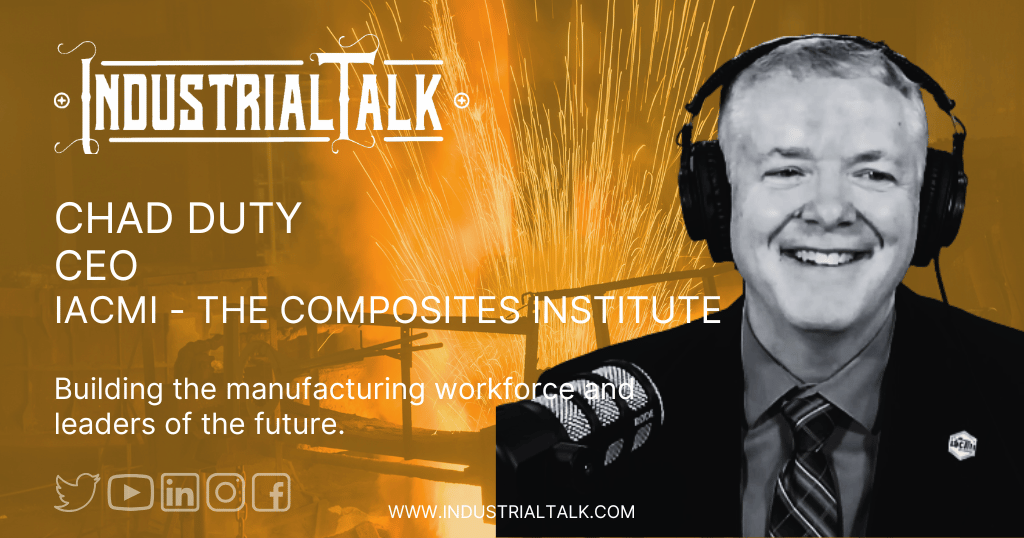
Industrial Talk is onsite at Build Freedom Summit and talking to Chad Duty, CEO of IACMI about “Training the manufacturing future”.
If interested in being on the Industrial Talk show, simply contact us and let's have a quick conversation.
Finally, get your exclusive free access to the Industrial Academy and a series on “Why You Need To Podcast” for Greater Success in 2026. All links designed for keeping you current in this rapidly changing Industrial Market. Learn! Grow! Enjoy!
CHAD DUTY'S CONTACT INFORMATION:
Personal LinkedIn: https://www.linkedin.com/in/chad-duty-52784948/
Company LinkedIn: https://www.linkedin.com/company/iacmi/
Company Website: https://www.iacmi.org/
PODCAST VIDEO:
THE STRATEGIC REASON “WHY YOU NEED TO PODCAST”:
OTHER GREAT INDUSTRIAL RESOURCES:
NEOM: https://www.neom.com/en-us
Hexagon: https://hexagon.com/
Arduino: https://www.arduino.cc/
Fictiv: https://www.fictiv.com/
Hitachi Vantara: https://www.hitachivantara.com/en-us/home.html
Industrial Marketing Solutions: https://industrialtalk.com/industrial-marketing/
Industrial Academy: https://industrialtalk.com/industrial-academy/
Industrial Dojo: https://industrialtalk.com/industrial_dojo/
We the 15: https://www.wethe15.org/
YOUR INDUSTRIAL DIGITAL TOOLBOX:
LifterLMS: Get One Month Free for $1 – https://lifterlms.com/
Active Campaign: Active Campaign Link
Social Jukebox: https://www.socialjukebox.com/
Business Beatitude the Book
Do you desire a more joy-filled, deeply-enduring sense of accomplishment and success? Live your business the way you want to live with the BUSINESS BEATITUDES…The Bridge connecting sacrifice to success. YOU NEED THE BUSINESS BEATITUDES!
TAP INTO YOUR INDUSTRIAL SOUL, RESERVE YOUR COPY NOW! BE BOLD. BE BRAVE. DARE GREATLY AND CHANGE THE WORLD. GET THE BUSINESS BEATITUDES!
Reserve My Copy and My 25% Discount
Transcript
SUMMARY KEYWORDS
Manufacturing, Workforce, IACMI, Innovation, Supply chain, Additive manufacturing, Composites, Training, Education, National security, Economic stability, Industrial base, Skill development, Technology, Boot camps
Welcome to the Industrial Talk podcast with Scott Mackenzie. Scott is a passionate industry professional dedicated to transferring cutting-edge, industry-focused innovations and trends while highlighting the men and women who keep the world moving. So put on your hard hat, grab your work boots and let's go! All
right, once again, welcome to Industrial Talk. Thank you very much for joining the number one and your continued support of the number one industrial-related podcast in the universe that celebrates you, industry professionals all around the world. You're bold, you're brave, you dare greatly, you innovate, you collaborate, you're solving problems each and every day, and you are making the world a better place. That's why we celebrate you. That's why you are the heroes in this story. We're broadcasting at the Build Freedom Summit Number One Numero Uno, and it's never happened before. This is brand new, and you can see if you're out on video. I've got a shirt that says Build Freedom.us. You got to support this organization. It's in Galveston. Well, it's all over the place, but you got to support it because they're building the workforce of the future. They have that passion. They have that purpose. And in the hot seat, we have a gentleman by the name of Chad Duty, IACMI, which is an acronym for something much longer than just what IACMI is. And it's it's if you're looking out of the video, it goes way beyond the the reaches of my video. But anyway, he's in the hot seat, and he was one of the speakers. He is well. What's your title?
I'm the CEO of IAX.
Does it get any better than that? I don't think so. I don't think so at all. Yeah, man, I had to shame him into getting on the podcast. No, I didn't. You were great. You were great. You were nice. I liked your talk, by the way. Yeah,
it was fun. It was a easy story in front of a home crowd. I don't have to convince anybody. Everybody's already on board.
That's right. It was like I don't understand that, Chad. I don't know what you're coming from. I don't. I don't know. No, it it it's a wonderful thing. I've been very fortunate to be able to be a part of a couple of the organizations, primarily ACE and Metal, and there being you know these boot camps at these various universities, and it's it's always nice to see something like that. It's pretty cool. It's geeky, baby.
It's geeky, but it's you know artisan, hands on, and I, you know, this idea of making something. I really think there's this just deep-seated fiber in everybody that just loves to see something that was in their brain a few minutes ago, yes, like become something real that they can hold. I think there's just something very deep down at our core that is just deeply satisfying. So here's
the funny thing. So I'm at one of the universities, Mississippi State. By the way, I was at the their boot camp, and what is was that stood out, which was really phenomenal, is that you could be a student, you could you could be a freshman or a sophomore. It doesn't matter. You you're a student in that program, and you can have a lightning bolt hit you in the middle of the night. Go down to that lab, and then be able to put it into action. Oh yeah! Like it's, it's like, yeah, yeah. I'm all in.
Well, and this is the the old is new again, right? Yeah. I mean, 100 years ago, it wasn't odd to be able to go out to the shed, to the what, and make something. Yeah, I mean that's that's how you got things. So it's it's just great that we're getting back to that in a new with a new spin. A little more. The tools are
the tools are phenomenal. Yeah, good. They're just and you know what I think. And I and I again digress. We'll eventually figure out who Chad is, but right off the bat, I digress. Yeah, we're passionate. Yeah, yeah, that's that's what's great. Yeah, but it's I believe companies if they do this right. If if I'm an existing company and I see what's taking place here in this event, and then I see the youth, and then all of the the technology and the innovation and the the energy that can be drawn from this this youthful, you know, it'll transform your business. It
will absolutely because they they never say no. Yeah, it gives you hope for the future of manufacturing in the country. It really does.
All right, that's great. We're on the same page. We'll just wrap it up right now. Yeah, that's right. It's a love fest right here. Yeah, yeah. Chad, we need to know a little bit about your background. How long you been with IACMI, and and where did you come from?
Yeah, so I joined IACMI in:Tennessee has a really great asset management reliability program. They
do. They really do, and a great mechanical engineering program as well. Well, I don't know. I've been. I'm over. I haven't been there, so I have
nothing to compare it to. You know, I've been at Mississippi State. Is that so good?
No, that's great. And the prior decade before coming to University of Tennessee, I was at Oak Ridge National Lab, and we stood up the manufacturing demonstration facility. And it is just probably well, I'm not going to even say probably. It is the best facility in the world for additive manufacturing research, so it's awesome, fun fun times.
How how come I'm not there? I want to see it because I want to sit down and I want to look at that. Yeah,
you should come by.
Yeah, additive manufacturing.
Additive manufacturing. Have you
been to the the Lincoln Electric?
Oh yeah, yeah. They they work very closely with Oak Ridge National Lab, yeah,
that's cool stuff.
Yeah, they have the facility at Oak Ridge has what we call the Medusa, and so it's got multiple robots on a turntable doing wire arc additive. It's it's outstanding,
and and anything's on the table. Any design is on the table. It's it just it's it's a phenomenal
use it's been in around since:No way. Yeah,
ll no cost. And we've reached:How many universities are involved?
We have it's universities, community colleges, and well over 50 in dozens of states. So we're we're really spreading rapidly, and you know pushing those programs across the country.
There's there's a need, no doubt about it. No doubt. It's it's an amazing time. I think it's a renaissance. I think that if someone is looking for a profession, I'm all in. You know, here's an opportunity. Here's what you can do. This is this is really a bonanza. How does IACMI deal with that growth? How do you then say, "Yep, that community college is doing it right. This one, how do you grade them? Yeah, it's a
multi-variable optimization process, which basically means we rack and stack them according to several different variables. One of which is what's the regional need, like where is you know, where are the companies that need castings and forgings? Where are the you know facilities that have been established over the years? Maybe they're historical. Maybe they're legacy. Maybe they're a brand new area that is growing up out of like around SpaceX or Google or some you know new manufacturing space. So we have a heat map of the country that gives us like where are the hotspots of need. Then you have same you know a similar heat map. Where are the hotspots of capability? Because we can't just go into a place and create something from nothing. So there needs to be some you know community college like university that has some manufacturing background. So then you match that up with where are the workforce needs? Where is industry growing? Like where the people skills, and so you just rack and stack all that in this pretty elaborate ranking profile, and we'd love to fund them all, but you got to make your choices, and so you just you know the the winners we start moving in those areas. Do
you also evaluate the the instructors? You got the students, got to this, but you need. Let's just be real here. They have to have that passion. They have to have that lightning because every every place that I've been through, where I broadcast, one thing that stands out is those those professors are like they're all in. They're
all in. They're all in. That is that is no small part of it. And we have an extensive train the trainer program that that brings in those people who are going to be doing our training and our work work camps and our boot camps and trains them to the standard of you need to be able to hit these core competencies and be able to give this level of training. But the nice thing about it, and what you're talking about, is those people aren't just a baseline people. Like they're like, okay, this is great for my particular region, my particular people. We're also going to do this. We're you know, so that's what I mentioned this morning. Yeah, the workforce need is national. The workforce solution is regional. So you have to take you know key into those hubs that are really driving it locally, so that you can answer the need at the ground level,
that hot map analogy. Let's say I reshore.
All right,
all right, and I'm reshoring over here or whatever it is. I need I need workers over here that might not exist. Is that part of your heat map?
It is, and we're working with a lot of economic development groups as well. So as you're a company wanting to start up and trying to figure out where am I going to put my next site, right? As we were talking with, especially in Tennessee, where I was working, where I've worked for years, the key factors were land, cheap electricity, you know, all those resources. Yeah. Now it's workforce workers, workers, workers. Like it's it's three of the top three.
Okay, so here's the challenge. Yeah. So here's Elon Musk. Elon Musk just said, "Hey, down here in the swamp of Louisiana, we're going to build this massive starport." And all I'm thinking about is, "Okay, great."
Yeah, where your workers come from? Yeah, what's that? And how are you
not pillaging from the existing, you know, industry that's there? I don't know,
and I think that is a legit problem. There's only so much peanut butter to spread, and eventually you're going to have to rob Peter to pay Paul, and that's just you know we need to have the pipeline to feed more people into that area.
Yeah, I I that was the first thing that popped in, and by the way, I'm going to use that peanut butter analogy because that. So, with all of that said, with everything that that you're dealing with, you with your team is dealing with. Where do we see it going? What what is what's what is it? Well, I don't think it can happen fast enough. Let's just it can't.
I mean, that's why we're starting in kindergarten, right? You've got to, as as Dr. Draper mentioned this morning, if you if you don't inspire a kid to to go down this path by the time they're in the fourth grade, you've probably lost them. So, it's not, and it's not just the kids. That's interesting to know that the parents. You have to get change that frame of mind because in the world you grew up in, and I did, it was if you're going to be successful in life, you need to go to a four-year college program. Yeah, and then the kids that just couldn't make the cut seemed to be the culture went to Votech or went to a trade school or something like that. That needs to flip. That needs, and I'm not saying. I mean, I mean, I'm a college professor. I I think college has its place. It's just not the only option. As as Dr. Draper mentioned this morning, it's one. It should be one A and 1b. Like they are equal, great opportunities have a big impact, make a great living. The average salary for manufacturing jobs is in you know 85k. Now regionally specific and things like that, but it can go above six figures pretty easily and no college debt. So there are benefits, right? And I think we need to get the parents and the community, you know, change our culture to where it's not white collar is great, blue collar is not so great. Like we need to make that a level playing field and really encourage those folks because little Johnny Susie that's in kindergarten might be making our submarine in 20 years or 15 years, you know. So
we've done a wonderful job in this country to discourage and and create that situation. How do you at IACMI? How do you deal with the change, the velocity of things that are changing, and these boot? Like, okay, do you stick with just traditional? I'll say it: blocking and tackling type of curriculum, but then when you go to let's say the one I went to, Mississippi, the five axes, they're doing this, and they it's all hands on. What? How do you? What is that?
That's where the real magic in the sauce is, and especially in Acme, we our our DNA is R and D, research and development. We're going for the next greatest thing that highly innovative. But of course, you can't just bring 100% highly innovative into a base level class that you're introducing people to. So that's where we leveraged all of our university professors at that are experts in the world on these particular topics, and we said develop classes that teach the basics. But also, any student who's taking this, if they've never seen composites before in their life, if they've never done forging castings, they can they can digest it. They they can get jump on board and understand what's going on. But the person who's spent their life in composites would probably go through these classes and be like, "Oh, I didn't know about that. That's a new technique. That's interesting." Yeah. And so, keeping the curriculum fresh and new, and as this field is rapidly evolving, making sure that we're pulling that new tech into that curriculum, such that the workers that we're exposing them to are ready to take on that challenge and excited, and and that's what's exciting, right? These this stuff's cool. I mean, we got robots, we got lasers, we got you know pouring molten metal. It's it's outstanding, and so leaning into that is our is is our you know superpower, right? Might as well use it.
How do you and and and because I believe and you probably have a better you know finger on the pulse. I I get concerned that it's not happening fast enough.
It's not.
I sense it, but I you know I'm not in the trenches like you're in the trenches. It requires. It's it's not happening fast. It's not
happening fast enough. But honestly, what are you've got two options? Throw up your hands and be like, "Well, I can't do it." Yeah, right. Right. Or you can get on the rudder and you know push it as hard as you can and hope to turn that ship such that we if we don't start now, now's the time. But I think it's
happening. It is
happening. It is. I do absolutely, and I think momentum is building. I mean, honestly, we've been doing this for
years,
I wish we would have started:we didn't have it. We didn't have any. Right. We just didn't know. Yeah, we just you don't know what you don't know. Yeah. But
now we know, and we've been pushing on that rudder to to change the direction of that ship for years, and now we're gaining momentum. And so you're seeing these big programs start coming up, and it's not like we're just from, you know, starting from the dirt. Like we've actually got programs in place; they've shown success. So we have a plan. We know what we're doing. We just need to keep pushing into that and get more people on board, and that's what the Build Freedom Initiative is. And so, thanks to IBAS and their team for kind of setting that mission, setting those goals, and providing the funding.
That IBAS, I'm trying to tag IBAS. What is IBAS now?
In terms of,
I'm on LinkedIn. All right, I type in IBAS. I can't find it anymore. What is it now?
It is the base and analytics and sustainability. Forgive me if I don't get that acronym right, but we've just called them IBAS for years. They're under the Department of War. There you go. That's what I thought. Right, the Defense Industrial Base, and really what they are tasked with for the government is to say, can we make the things that we need? Should we need them to go to war? Submarines, tanks, rifles, you know, everything.
Everything. Can't do we
have the ability to make that? Because these international supply chains that we've developed, it's a global you know network now, right? In times of war, relationships get strained, supply chains get cut off, and you still have to make bullets or whatever. Yeah. Right. So they're tasked with securing that supply chain, and they're recognizing the situation that we're in. A book that they require reading in IBAS that I just read this past year is Freedom's Forge. It is fantastic. It talks about the manufacturing base and how that manufacturing base really, I think, the case can be made one World War II for us. How you know you got the Rosie River and yeah, yeah, yeah, yeah. How the the automotive plants change from making cars to making tanks and you know whatever. It is absolutely outstanding, and the leadership and the sacrifices and the things that needed to be done. I think is we're seeing that renaissance happening now. Again, I wish it had been 20 years ago,
but it is what it is. You have it today, and I think the focus is is solid. Right, and you've got incredibly
smart and talented people, intelligent people behind this that are pushing it, and we're making headway. And it is, it is like you said, it's an exciting time. This is this is where the fight is, and we're we're winning. We're we haven't won, but we are winning.
I'm optimistic.
Yeah,
but it's easy for me to be optimistic because I'm here, and
I'm you know, I'm drinking the Kool-Aid, and I'm here. It is, yeah. It
is like it's. It makes sense. And then, and then I go out and I talk to other companies, and it's like I can't find. Okay, I got it. You're whining. You can't find it. I hear you. Be a part of the solution. Just here it is. It says, I think. And correct me if I'm wrong. That whole supply chain conversation became really apparent during COVID. Yes, sir. It's like it all fell apart. I can't get that. Right. Like, what? What is that? It's like it's so fragile.
Yes. Yes. And I think that was a wake up call. Yes. For a lot of folks. Yeah. And so, you know, there have been people that have been beating the drum for a while, but it's nice to have the choir all join in, you know.
Like I didn't know that. Yeah, right. Yeah, I I got to tell you that that was that was frustrating. Yeah, because yeah, because
and thank God it was just about toilet paper and not yes freedom. Yes, see, you're
absolutely right, and and you're but you just realize that okay, there's there's a lot of room for, you know, bolstering and strengthening this supply chain. Not be so fragile. It's like, oh, that's it. Can't do it. You're just going to have to do without. But I don't want to do without. You know, I'll figure out. What is the goal finally? What is the goal of what you're? What are you trying? What what's that vision look like?
Well, it's really. I mean, the overall goals are to bolster our economic stability and national security, and you're doing that through manufacturing, securing those supply chains, providing the workforce, providing the innovation. We used to be in a country where it's like, hey, we're going to rely on our innovation, and the rest of the world can make our stuff that we invent. Yeah, yeah. Well, it turns out it's really really hard to innovate if you're not the one, you know, knee deep in the manufacturing and the making. So true. It's just they're just intimately connected, and I think we let that get disconnected for a time. Yeah. And so I think we're recovering that, but that that's the vision is to recover that cycle so that it feeds forward, such that we're inventing, we're making it here, we're innovating to make it better. But then we can actually make the better product, and then innovate and make it better. And so it just feeds forward. It does, and it creates jobs, and it stabilizes our economy, and it increases our natural security.
But you have 50 right now. 50. You said 50-ish.
Yeah.
Whatever. Where do you want to be in, you know, four years or whatever?
Hundreds,:You're living the dream, baby. We
are. I'm telling you,
this is a great purpose. It's a, you know, it's it's a great purpose. That's amazing. See, I'm drinking the Kool-Aid. Yeah,
yeah, yeah.
How do people get a hold of you, Chad?
So iacmi.org, a i c m i.org. We also have America'scuttingedge.org or metalforamerica.org, and of course, as your shirt says, buildfreedom.us.
Right there. Yeah, it's all out there. But you're on LinkedIn, right?
LinkedIn. Yeah, there's we're all over the place. Yeah.
You know what the challenge is for me when I'm doing all the social stuff is tagging you guys. Oh yeah, like my my big old you know banana thumbs are like, okay, what is that thing? It's an acronym again. Yeah, I can't figure that one out. Like, you were fantastic.
Well, I appreciate it. This is a great time. Love
what you do in it at IACMI and your team. Everybody that comes, just want to let you know, everybody I come in contact with IACMI, they're really nice.
Yeah, we've we've got a great team. I'm really really happy with our talent. Yeah, it's
gonna grow. Yeah, gotta grow. You can't you can't. Yeah, if your if your vision is everywhere,
right?
Yeah, it's not going to be. You're awesome, man. Be
everywhere all the time.
Chad is the man. We're going to have all his contact information out on Industrial Talk. Everything that you need to know about Chad will be out there. So reach out to Chad. Be a part of IAC. Don't come to me and say, Scott, I can't find anybody. Here is a solution. Making the difference. All right. Once again, we're broadcasting from the Build Freedom Summit here in Galveston, Texas, and I guess you'll be drinking the Kool-Aid too. So we're going to wrap it up on the other side. Stay tuned. We will be right back. You're listening to the Industrial Talk Podcast Network. Build Freedom Summit, right there. Chad Duty, right there. LinkedIn profile. IACMI. That's I A C M I. The Composites Institute. They're responsible for the Build Freedom Summit medal program, ACE program, and I got to tell you, everybody that I've had a conversation with at that particular event, passionate about that next generation of industrial leaders, they're all in. You know what else was really striking is the fact that every conversation that I had, every single, every single one, it was positive. It was exciting. It was electrifying. There was hope that that next generation will be there, so that we can live this this incredible renaissance in manufacturing, it's all there. I loved it. Galveston, Texas. Not bad. All right. Industrial talk is here for you. Yeah, we're a media company. Yeah, we want to tell your story. Yeah, you need to support organizations like IACMI, Metal, and and of course ACE, and all the other programs that are out there because they are really committed about the future, the workforce. So anyway, go out to Industrial Talk, be a part of the solution, tell your story. I always say that more eyeballs, ears on what you do will make you a success. All right, be bold, be brave, dare greatly. Hang out with Chad, and yeah, you will be changing the world. We're gonna have another great conversation shortly, and as always, stay tuned.