Gary Specter and Jason Penkethman with Limble
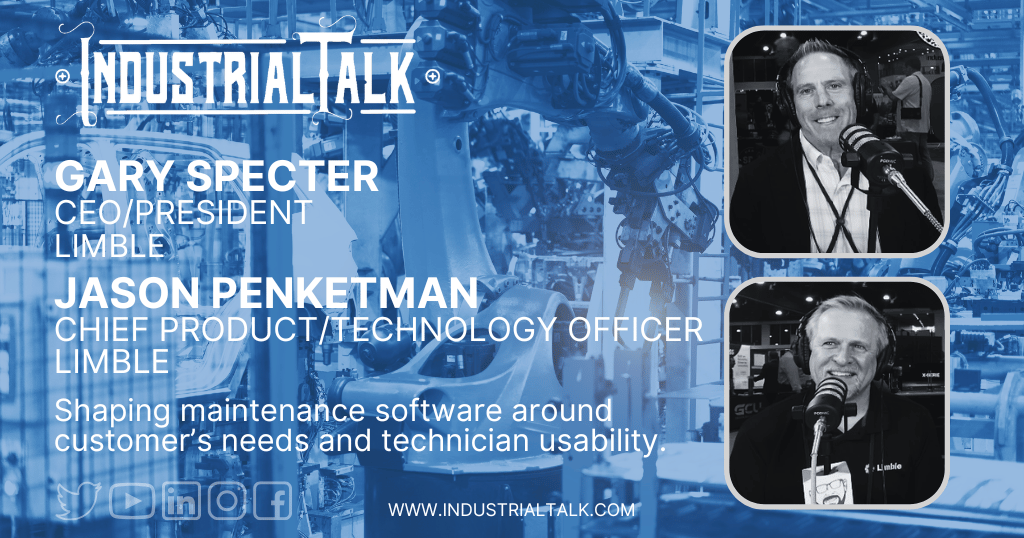
Industrial Talk is onsite at SMRP 2026 and talking to Gary Specter and Jason Penkethman Executive Team at Limble about “Focus on Technology Usability”.
If interested in being on the Industrial Talk show, simply contact us and let's have a quick conversation.
Finally, get your exclusive free access to the Industrial Academy and a series on “Why You Need To Podcast” for Greater Success in 2025. All links designed for keeping you current in this rapidly changing Industrial Market. Learn! Grow! Enjoy!
GARY SPECTER'S CONTACT INFORMATION:
Personal LinkedIn: https://www.linkedin.com/in/gary-specter/
Company LinkedIn: https://www.linkedin.com/company/limble/
Company Website: https://limble.com/
JASON PENKETHMAN'S CONTACT INFORMATION:
Personal LinkedIn: https://www.linkedin.com/in/jpenkethman/
PODCAST VIDEO:
THE STRATEGIC REASON “WHY YOU NEED TO PODCAST”:
OTHER GREAT INDUSTRIAL RESOURCES:
Industrial Marketing Solutions: https://industrialtalk.com/industrial-marketing/
Industrial Academy: https://industrialtalk.com/industrial-academy/
Industrial Dojo: https://industrialtalk.com/industrial_dojo/
Business Beatitude the Book
Do you desire a more joy-filled, deeply-enduring sense of accomplishment and success? Live your business the way you want to live with the BUSINESS BEATITUDES…The Bridge connecting sacrifice to success. YOU NEED THE BUSINESS BEATITUDES!
TAP INTO YOUR INDUSTRIAL SOUL, RESERVE YOUR COPY NOW! BE BOLD. BE BRAVE. DARE GREATLY AND CHANGE THE WORLD. GET THE BUSINESS BEATITUDES!
Reserve My Copy and My 25% Discount
Transcript
SUMMARY KEYWORDS
Asset management, Reliability, Maintenance, Limble, Software, Usability, Technician experience, IoT, AI, Data science, Mobile app, Product development, Manufacturing, Connectivity, Data cleaning
Welcome to the Industrial Talk podcast with Scott Mackenzie. Scott is a passionate industry professional dedicated to transferring cutting-edge, industry-focused innovations and trends while highlighting the men and women who keep the world moving. So put on your hard hat, grab your work boots and let's go!
All right, once again, welcome to Industrial Talk. Thank you very much for joining the number one numero uno industrial-related podcast in the universe that celebrates you, industry professionals all around the world. You're bold, you're brave, you dare greatly, you innovate, you collaborate, you're solving problems each and every day. That's why we celebrate you on Industrial Talk. You are the heroes in this story. We are broadcasting on site, 34th annual SMRP conference, Raleigh, North Carolina, on the floor talking to the best in the world, best reliability, best asset management, best technology. Yes, we're talking to them all. They're all here, and if you have an interest in being in the world of asset management, reliability, maintenance, technology, it's all here. Go out to smrp.org, find out more, and you get to connect with great people. We have two, two in the house, and of course, I violated my my own rule. We have Jason and Gary with Limbo, and they're not on my list right here. Let's get cracking. I'm all distracted by you two. It's your fault, not mine. You distracted me.
This was so good looking. Happens all the time.
Stunning, Absolutely breathtaking flow in your hair. Guys like me who don't have hair play like look at Jason, he's got hair.
He doesn't have much.
Yeah, speak to the hand. I have zero, and that's by choice. Now I'm all caught up now. There, Jason again. You guys having a good conference?
We are absolutely first
time for you, Gary. It
is. It's the first time for me too.
Shut up! Shut up! Is that is that good, Jason? Oh, by the way, I didn't do this in the brief. Normally, I'll say Gary, Jason, and ask a question. I I will probably end up throwing a question out that will hit that light behind you, and then you'll look at each other and you'll say, "Who takes that question?" I will try not to do that. Sorry in advance. Anyway, so what's making this conference? What do you notice, Jason? Ha ha ha ha! You were looking over at Gary. Go ahead, talk to me.
What do I notice?
Yeah.
Well, you know, I actually went to IMTS a couple weeks ago.
Monster.
It's yeah, it's a
monster.
So you know, coming here, I see it's a lot more focused, and I know smaller, but also very focused. And so,
by a factor of 100.
Yeah, yeah. And so, it's actually been a great opportunity to talk to a lot more customers without as much noise around. Yeah. And so, I've really enjoyed spending more time with customers at this this event, and actually Gary and I were on stage at the beginning of the day, and we spoke about the yeah yeah on in lab three.
Oh yeah, yeah,
yeah. I'm in the salt
mine. I have no way of. Oh, you missed it. I don't know. So good. They're getting misty. Yeah,
yeah. Oh,
so that's so emotional. We were
talking about the technician experience and how that's really relevant, and and I think that I mean that that's what we care about at Limbo, and and so we had some good conversations with the audience about that as well. So that's been my experience today, at least. Yeah. What about you, Gary? What's your what's your general feel of what's going on here?
I think what I've really enjoyed about being here is the community that I can see being built.
Big, bing, bing, bing, bing, bing, bing. It onto the bonus round.
I mean, there's so many different players here. There's, of course, a lot of CMMS or asset management vendors and software companies, but they focus on different things. And then there are adjacencies to what we do. Companies that do, you know, I met with one one company, and and they are able to do with glasses. They're able to communicate. They use voice through what they're seeing in order to communicate with their maintenance systems, etc. Is
that is that a like a it's I can't say it's augmented reality because yeah, augmented. It was
it's reality. It's enabling. It's finding. Different way to communicate without forcing a tech to take his hands off an asset. That's how I view it. But you have things like that; these adjacencies to what we do, sensors, different sensor companies, different partners of ours, and it's just great to see everybody sort of coming together, all for the benefit of a potential customer or a tech on the floor, or an operator who runs manufacturing.
Yeah,
they can look at everything, and you can start to dream and think about what does your system of record look like, and what are the different pieces that play into that. And it just feels very communal, and I've been impressed by that.
So here's here's my observation. I've been doing this for many years. I've been working with SMRP. I've been in the asset management world for many years. What makes this event or this group unique is because of that specific reason. There's somebody out here. It's like, hey, I got a problem. I don't know what the problem is, but I guarantee you, you come to an event like this, or even if you're part of the the organization SMRP, you can find somebody and say, "Hey, I've got this," and they're so happy to help you, and they're they're helping you in such a way that you for your success. It's just cool. Okay, Jason, background: what, who are you, and what makes you a great professional, and what's your title?
Well, I'm trying to figure that out. Who I am, but that's the story of life. But I'm an electrical engineer by training, and I've worked in the software industry for a long time. My I cut my teeth on mobile phone technology and automotive, and then I got into IoT, and that's how I ended up in you know where I'm sitting right now. I'm the CTO of Limbo, so I lead the product development.
Yeah, and
with my background in IoT and software development and data, this is kind of the convergence of all of those technologies and the connectedness of things. And and with the connectedness of things, you know, the operation and the maintenance and the reliability, and that's you know where I've been focusing,
Gary. You've been on the podcast before, but we still need to level set because the audience is always growing. Go ahead.
Sure. So I'm the CEO of Limbo. I came to Limbo about nine months ago, and have spent the last nine months really building a team that I think can help us really build a platform that will enable our customers really to drive value for them and improve over the next five to 10 years, based on all of the new technology that's coming out, including AI.
See, Jason, how do you how do you within Limbo as the CTO? How do you keep up with all of the new technologies? This is what's interesting in the world of asset management, reliability, whatever you want to maintenance. It never stops. It's a it's a freight train moving forward. I think. How do you do that?
I think you have a have to have a natural curiosity that is just kind of born with it. I mean, I was pulling things apart when I was like four years old to find out how things worked, and so there is a lot to keep up with. And I think just having a healthy and natural curiosity about all things and a problem-solving mindset, then it becomes maybe a little less effortless because it's the nature of who you are. And so I enjoy that, but yeah, in this this industry, there is so much, and you know, with robotics and AI and the data science behind all of it, it's it can be pretty overwhelming. Yeah, we've got some very bright engineers on our team, and they run run rings around me. And I don't know how they keep up. It's there's there's a lot to consume. the The goal, of course, is that we you have to distill the technology to make it work for you, and that's what we're really focused on. Is you can have the greatest technology and and that's available, but if you if you're not taking advantage of it in the right ways, then it's just technology for technology's sake. And so, really, it's got to focus on what are the problems you're trying to solve, where's the friction, how can we reduce the friction, and and so that's I think that's the real art. If you have the science, then the art is making it work for you.
See, from from my perspective as a technology company, which you guys are, right? You guys are delivering a solution that you know is technology. Gary, how do how do you? I'll back up. I'm Scott, manufacturer. I use your system. You could probably be, you know, sending me a tsunami of all these changes and opportunities that that that I've already have a hard time. I'm still trying to manufacture this. How do you manage that customer relationship with all of the stuff that you, as a technology provider, are being inundated with? That's that's just an interesting.
Well, you know, it's interesting. We in our presentation this morning, it was called you know, slow down to speed up, and the the meaning behind that was that as fast as things change, there's a couple things that remain true. One, the people using the software have to be the center of the world. So whether it's a tech on the floor or an operator or VP of operations, they have to be able to use the technology. So regardless of what new is coming out, there has to be a usability factor to the software in order for it to get adopted. The second thing is that it has to, in order for a system to deliver value, there's got to be data, and if people are not using the system and putting data in, including, you know, the most recent work orders and the most recent information on the assets or whatever it is that they're measuring, without all of those things, it doesn't matter what all the new stuff is. It still has to be grounded in the ability to be usable and the ability to collect data and then report off of that
data.
Those things don't change, and so we focus on our customers at Limbo first, and we are thoughtful and we get information from them on what they believe they need in order to continue to move forward and advance, and that's part of what drives what Jason and his team does and drives our product innovation and direction. Stay grounded with your customer.
Yeah, I I agree with you 100%. I Gary brought up an interesting and and I'm all in on this, Jason. It's usability, limble, striving for that ability to be able to. I'm a technician. I'm out in the field. I'm on the. I'm on the floor. Whatever. Don't make it hard for me to do my work. I'm focused on that pump. I want to repair that pump, but sometimes I see systems that are demanding more of me. I'm not happy with that. Take me through. Take the listener through why Limble is different and and really focuses on that usability.
Yeah, it's a it's a great topic and one that we've wanted to solve, and we actually did that by redesigning our mobile app for the technician with those things in mind, because over time, you know, companies build out software. You just keep adding buttons, right? Adding features, and at some point, you it's like sitting in front of the TV with this giant remote control with 400 buttons on it. You're like, hang on a second. I don't know what this is. I'm gonna just throw this thing away. So we redesigned our app with the technician in mind. We do a day in the life of a technician. What are the tasks they're trying to accomplish? What's the friction? What's getting in the way? Focus on those things. When do I need information? At what point? What notifications do I want at the right time? What information do I need in my hand when I'm, you know, in front of the equipment, not back at wherever? So that was the big part of that task. The other thing too is you have to look at the environment they're in. Are they wearing gloves? Is it? Is there? What's the lighting like? Excellent point. There's a lot of environmental factors, right?
Is it
loud? Exactly. Yeah.
Excellent.
And and heat. You know, some of these plants are pretty warm. You know, they could be 95 degrees outside and 130 inside, depending where you are. If you are up, you know, on a ladder changing lights and stuff like that, it's it's it's crazy. And if you've got a mobile device, those batteries will not operate in that temperature. So there's just a lot of considerations, environmental considerations, as well as the the jobs they're trying they're trying to perform. So you just have to take it back to the basic things. Gary said it. You you know go slow to go fast. You you bring it back to the the workflows, the things that they need, and remove half the friction.
But Gary, with that mind, you painted a picture, Jason. The picture is like the the environment. It's a really important component. Excellent, excellent point. Does Limble step in and say, "Okay, I'll give you a case of point. Carbon black. You ever been to a carbon black facility? Don't. But if you did, you would realize that you have those drum dryers, and they're long, and it's hot, it's miserable, it's dirty, it's it's whatever's on your mind. Multiply by 10. Anyway, so you have all that. Does limbo take a situation like that, look at the environment, and assess the ability, or and be able to sort of work with your platform to satisfy? How do you how do you step in on that without having to say, hey, this is the system we have?
scale, and you'd be creating:Very good.
And if you're going to choose to be a platform that services everybody, the odds are you're not going to service everybody very well, and so for us, you know, we've decided which subverticals within manufacturing, within distribution, we want to focus on, you know, what are the what are the different places where we think we can play well, and and really continue to innovate and fight the good fight for those specific subverticals. And there's some others that we we just won't play in. And you know, when you think about, you know, are we the best for for healthcare? Are we the best for the example that you mentioned? Maybe not.
Yeah.
But my guess is there is somebody else who is a better fit, and we want to help guide people to these places where maybe we're not the best fit. Because signing up a customer who who isn't a good fit for you, it'll bite you down the road. And so we choose to be specific about who we're going to serve.
Yeah, I like that a lot. That makes sense. Okay, about usability again. So I'm a technician. I'm in, and I'm in the the right vertical. You know, which I like that, Gary. There's no doubt about it. I agree with you 100%. So one of the challenges, it's always a challenge, is I'm done repairing. Okay, I'm I'm efficient over here. I'm repairing. Now I have to enter that data, and that data has to be good and accurate and insightful in whatever I did to make sure that I continue to build on that asset and the information around that asset. Is is limbo just? Is there a way of making that easier?
Yeah, there is. It's not easy. There, there's some.
I don't want pencil whipping.
There's some.
It happens.
Nice ways to solve those problems with AI nowadays. You're probably familiar with them too. Just enter freeform text, and AI will take what you have, and then put it into the right fields. So we're focusing on building that into our mobile application, so the technician doesn't have to think about where the information has to go. Let I let AI do that. That's tedious. Let let AI do
it. Yeah.
So that's one area. The other thing is, we want to be able to support voice as well, and so you can take voice notes with our application. So you can speak into it. You don't have to, you know, fat finger it in. You know, when you got gloves on, you just speak into it, and it'll translate that and put that into text and transcribe it, and then go and put the information in the right place. So it's kind of where we were talking about earlier. You you identify the source of friction, and you find is there a technology or an approach you can take to remove that? If it's if it's voice entry, if it's freeform text, these capabilities reduce the need to go menu diving and where do I put this stuff? And so that's that's really the key. And there are great technologies now that we can leverage to to support that.
Yeah, I think that's spot on. Which brings me to the question, and maybe Gary, this I'll direct it to you. But if it's it needs to go to Jason, just hand it over to a handoff. I don't care; it's not a problem because it's my podcast. And the reality is, is that when you go into an organization, and this happens all the time, this is a question that happens all the time. Hey, I have this legacy system. This legacy system has this data. It's all history. I would like that history to be put back into our new system, which is Limbo, but it's dirty, it's filthy, it's whatever. What what's the position on cleaning up that historical data?
Well, it has to be cleaned, and so there's multiple ways to do that. Again, I think AI can help play a role in that. One of the things that we're thinking about as we continue to innovate our product is how we can do data rationalization better.
Yeah. Whether
that is migrating old data into a new system, whether that is two companies coming together that use different syntax for the same thing, how do you rationalize that data so that as the company. Come together, you have one meaning, one definition, you know, one set of initials or whatever you're calling that thing, and so one of the things that we're doing right now is exploring what we can do with the data layer, so that we can make those types of transitions easier for our customers.
Yeah, because Jason, there's gold in that data if you do it right, and if you can, you know, scrub it and get it all into a position that that says, yeah, there it is. Now I'm good, and now now I'm really reaping the benefits of what the system can provide and insights and all of that good stuff. That that that to me is the exciting part about AI because when when I was deploying systems long ago, that question is like, "Hey, let's we got to put that historical data in there," and everybody say, "Yeah, let's do it." And a week after, everybody's like, "No, let's get rid of it." I don't care anymore, just because it is a grind. And with that AI, with that ability, with those tools, I think your your your success is much greater.
100%. And Gary, Gary referred to it. This, this approach is really creating a very defined semantic layer. It's a clear definition layer that all the data in should be put into the right place. And old systems, yeah, can be just full of data that has not been cleansed, and so there's a lot of gold in there. I'm
going to step out and say, all the data has not been cleansed.
Yeah, but now with AI, we can automate a lot of that categorizing and and and find information that was previously hidden and start to make use of it.
See that's that's that's exciting, and and because the objective is to make these companies succeed. You want them to succeed. You want them to be, you know, success. You just do, and and to do that, that there's gold in the data, and then being able to do that effectively is great, Gary. What gets you excited about Limbo? Where are we at strategically? What's what's that like? Yeah, I can't believe this is going to be happening.
Well, I think we are moving incredibly fast in transforming how Limbo thinks about innovation, how Limbo supports our customers, how we find new customers. I think over the last nine months, we've really changed our culture as a company, innovation and customer-driven. I think we are very, very focused on measuring the success of our customers as well as ourselves.
Good,
and we are very focused on building a community, and we talked about that a little bit earlier. But we want to build an ecosystem that our customers can really benefit from, not just on our software, but the adjacencies to our software. Success for me would be, you know, not only being a market leader in the space, but looking at our customers and saying, "Hey, we're the heart of what that customer does," and when you think about all of the systems that our ideal customers need in order to run efficiently and effectively, I want Limbo to be right in the center of
it. Yeah, we're
on our way.
Yeah, I can't poke holes into that. Try to follow that one, Jason. What what gets you excited?
Well, the opportunity is great because we know that there may be what 8% of companies have some form of CMS, but what was astounding to me is that only 39% of them are using them effectively.
Yeah, it's. I think that's even on the high side. Just yeah, it may be.
Yeah, and so what that means is that we can do a lot to increase adoption and and get our customers from reactive to become more proactive, and then preventative, and then predictive, and then prescriptive. This whole journey, this maturation, to get to this, you know, utopia essentially of of keeping their assets running, reducing downtime, and improving efficiency. There's just benefits across the whole spectrum there, and and I see the opportunity. What gets me excited is that we can help our customers improve in that way.
See, I can't blow holes in that. I try. I was listening intently, and I was going, "He's going to stumble. He's going to stumble. I'm going to be able to blow a hole in some." Nope. Gary and Jason didn't didn't stumble one bit. You guys were absolutely spectacular. This conversation didn't stink. It's there. Congratulations. I mean, yeah. I'll send you an email saying this conversation didn't stink.
That's what we look for. That's
it. That's it. Thanks for having us on.
Yeah, no, the pleasure's all on my side. Hey, Jason, how do people get a hold of you?
LinkedIn, best way.
Shut up. There it is. Well coached, Gary.
LinkedIn, or or you can find me on the Limbo website. I think back on the. In the bio somewhere, you can find my my contact.
There you go. Well, quite frankly, I'm going to just have the Lincoln Lincoln Stat Car out on Industrial Talk. Well, again, you guys were just absolutely spectacular. That was a fun conversation, FYI. I really appreciate it. All right, we're going to have all the contact information for these two gents out on Industrial Talk. Reach out to them. They they've got their act together in the world of CMMS. Just FYI, just just being on the outside looking in. Yeah, they got it going on. All right. Once again, we're broadcasting from 30 the 34th annual SMRP conference here in Raleigh, North Carolina. Go out to smrp.org. You need to find out more. You know why you need to find out more? You get to hang with Gary and Jason and have conversations that are meaningful to your success. Woo! I'm worn out. All right, we're going to wrap it up on the other side. Stay tuned. We will be right back.
You're listening to the Industrial Talk Podcast Network.
You know what doesn't stink? Anything dealing with SMRP, anything dealing with asset management, maintenance, reliability, the technology, anything that says, "Hey, we're going to make you a success. We're going to bring forth the solutions that you need as an organization to be a success, SMRP is just that. It is an absolutely amazing organization that you, if you're in the world of anything, I don't know if that is just me. Anything you need to be a part of SMRP. Go out to smrp.org, and then you get to meet Jason and Gary with Limbo that are focused on making things easier from a technology perspective, and saying, "Hey, you need technology, but you need to make it easier and and be able to deliver the solutions that just help you succeed. SMRP, Jason, Gary, Limbo, outstanding conversation. That was a wonderful event. I have a plethora of conversations that are going to be coming from that event. So you know you gotta you gotta hang on and stick to it. All right, we're here for you, Industrial Talk. Our door is open. We have a big heart for your success. We want more eyeballs and ears to be able to say, "Yeah, I know your company." And to do that, you have to tell Your story, industrial talk is definitely in that position. You need to market it. Yes, we're in that position too. You have an opportunity to create really meaningful and engaging content because people, the companies, and the market want to hear what you have to say. It just does. Take that to the bank. So go out to Industrial Talk and say, "Scott, I want to tell my story." You don't have to sound like that. That's just me stupid. But no, nonetheless, you want to tell your story. There are so many reasons why we can have that conversation of why it's important and how you can collaborate with Industrial Talk. All right, be bold, be brave, dare greatly, hang out with Jason and Gary, and you will be changing the world. We're going to have a lot of conversations coming from SMRP. So as always, stay tuned.