
Jim Krochune with APM Steam
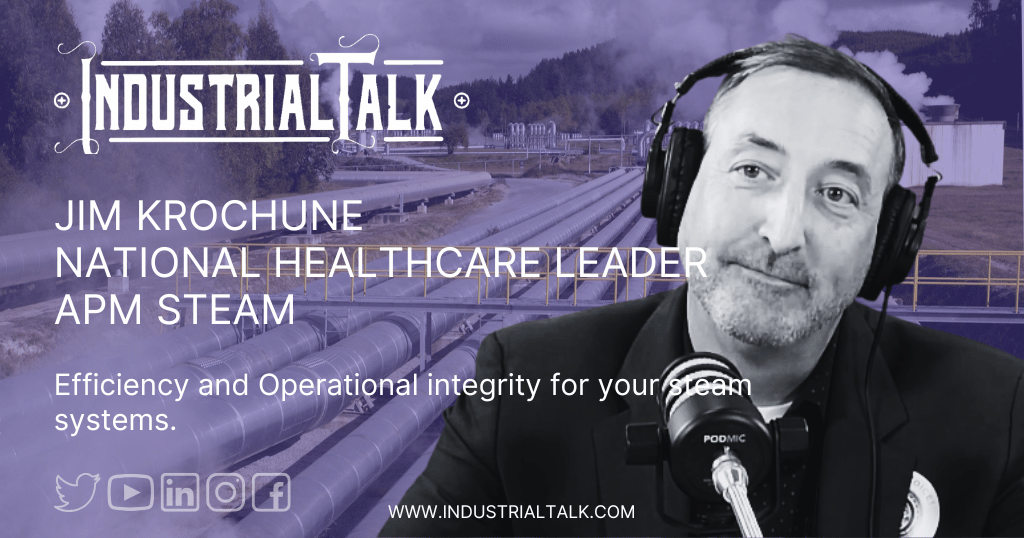
Industrial Talk is onsite at SMRP 2026 and talking to James Krochune, National Healthcare Leader with APM Steam about “Optimizing steam systems”.
Scott Mackenzie from Industrial Talk interviews Jim Krochune from APM Steam at the SMRP 33 conference in Dallas-Fort Worth. Jim discusses the importance of steam in industrial processes and the challenges in transferring knowledge to younger generations. APM Steam specializes in steam and energy efficiency, focusing on steam trap surveys, heat exchanger cleaning, and pressure reducing valve (PRV) installations. Jim highlights significant energy savings, with payback periods ranging from six to nine months, and shares a case where a hospital saved $180,000 annually by fixing a steam trap issue. APM Steam's unbiased approach and skilled technicians are key to their success.
Outline
Introduction and Welcome to SMRP 33
- Scott Mackenzie introduces himself and Industrial Talk, highlighting IRISS technologies for electrical maintenance safety.
- Scott welcomes listeners to the Industrial Talk Podcast and the SMRP 33 conference in Dallas-Fort Worth.
- Scott emphasizes the importance of the conference for asset management, reliability, and maintenance professionals.
- Scott introduces Jim Krochune from APM Steam and mentions the conference's focus on problem-solving and collaboration.
Jim Krochune's Background and Role
- Jim Krochune introduces himself, mentioning his 16 years of experience in the industry and his current role as a national healthcare manager.
- Jim shares his background in computer engineering and his transition to the steam industry.
- Jim explains the historical significance of steam in the industrial revolution and the current challenges in the industry.
- Jim discusses the difficulty in transferring knowledge to younger generations and the use of Navy personnel for training.
Challenges in the Steam Industry
- Jim highlights the inefficiencies in the steam industry and the need for energy efficiency specialists.
- APM Steam focuses on steam distribution, steam trap surveys, and assessments to improve energy efficiency.
- Jim describes the company's approach to cleaning heat exchangers and installing pressure reducing valves (PRVs) to reduce energy losses.
- Jim shares a success story of a project in Rhode Island with a seven-day payback period.
Energy Efficiency and Cost Savings
- Jim discusses the significant energy savings achieved through steam trap surveys and repairs.
- The Department of Energy estimates that 15-30% of steam traps fail every three to five years, leading to substantial energy losses.
- Jim shares an example of a hospital in New York City where a steam trap issue was identified and corrected, resulting in significant cost savings.
- Jim explains the importance of proper steam system design and maintenance to achieve energy efficiency.
Innovations and Future Trends
- Jim mentions the challenges of monitoring steam systems with current technology and the limitations of wireless monitors.
- APM Steam focuses on providing unbiased solutions and cost-effective repairs to improve energy efficiency.
- Jim discusses the importance of skilled individuals in the steam industry and the need for more pipe fitters.
- Jim shares his vision for future innovations in steam system monitoring and maintenance.
Conclusion and Contact Information
- Jim emphasizes the importance of skilled professionals in the steam industry and the need for continuous improvement.
- Jim provides contact information for APM Steam and encourages listeners to reach out for more information.
- Scott Mackenzie wraps up the conversation, highlighting the importance of the SMRP conference and the value of Jim's insights.
- Scott encourages listeners to connect with Jim and other industry professionals to share their stories and experiences.
If interested in being on the Industrial Talk show, simply contact us and let's have a quick conversation.
Finally, get your exclusive free access to the Industrial Academy and a series on “Why You Need To Podcast” for Greater Success in 2025. All links designed for keeping you current in this rapidly changing Industrial Market. Learn! Grow! Enjoy!
JIM KROCHUNE'S CONTACT INFORMATION:
Personal LinkedIn: https://www.linkedin.com/in/jameskrochune/
Company LinkedIn: https://www.linkedin.com/company/apmsteam/
Company Website: https://www.apmsteam.com/
PODCAST VIDEO:
THE STRATEGIC REASON “WHY YOU NEED TO PODCAST”:
OTHER GREAT INDUSTRIAL RESOURCES:
NEOM: https://www.neom.com/en-us
Hexagon: https://hexagon.com/
Arduino: https://www.arduino.cc/
Fictiv: https://www.fictiv.com/
Hitachi Vantara: https://www.hitachivantara.com/en-us/home.html
Industrial Marketing Solutions: https://industrialtalk.com/industrial-marketing/
Industrial Academy: https://industrialtalk.com/industrial-academy/
Industrial Dojo: https://industrialtalk.com/industrial_dojo/
We the 15: https://www.wethe15.org/
YOUR INDUSTRIAL DIGITAL TOOLBOX:
LifterLMS: Get One Month Free for $1 – https://lifterlms.com/
Active Campaign: Active Campaign Link
Social Jukebox: https://www.socialjukebox.com/
Industrial Academy (One Month Free Access And One Free License For Future Industrial Leader):

Business Beatitude the Book

Do you desire a more joy-filled, deeply-enduring sense of accomplishment and success? Live your business the way you want to live with the BUSINESS BEATITUDES…The Bridge connecting sacrifice to success. YOU NEED THE BUSINESS BEATITUDES!
TAP INTO YOUR INDUSTRIAL SOUL, RESERVE YOUR COPY NOW! BE BOLD. BE BRAVE. DARE GREATLY AND CHANGE THE WORLD. GET THE BUSINESS BEATITUDES!
Reserve My Copy and My 25% Discount
Transcript
SUMMARY KEYWORDS
steam maintenance, energy efficiency, steam trap surveys, infrared inspection, ultrasonic inspection, steam distribution, heat exchangers, pressure reducing valves, steam system inefficiencies, steam trap failure, energy savings, industrial revolution, asset management, maintenance professionals
Hey, it's Scott Mackenzie with Industrial Talk. IRISS is the global leader in electrical maintenance safety, delivering technologies that let team inspect energized equipment safely using closed panel condition-based monitoring to reduce risk and downtime. Their patented infrared and ultrasonic inspection windows make it possible to detect issues early, boosting reliability and protect the people who keep the operations running. If improving safety and avoiding unplanned failures is your mission, IRISS has the solution to get you there. Learn more at IRISS.com.
Welcome to the Industrial Talk Podcast with Scott Mackenzie. Scott is a passionate industry professional dedicated to transferring cutting-edge, industry-focused innovations and trends while highlighting the men and women who keep the world moving. So put on your hard hat, grab your work boots, and let's go! All
right, welcome to Windows Real Talk. Thank you very much for your continued support of this platform that celebrates you, industry professionals all around the world. You're bold, brave. You dare greatly. You innovate. You collaborate. You are solving today's problems. As you can tell, I put down a mic, and it all of a sudden made it nice and quiet. How about ever being sharp? And and we are broadcasting here on site. This is the SMRP 33, and it is in Dallas, Fort Worth, and it is a collection of problem solvers. It's if you're in the world of asset management, reliability, and maintenance, and everything in between, you need to be here. You need to be here. Put it. Put it on. Grab a budget and put it on your schedule for next year. All right. In the hot seat, we have a gentleman by the name of Jim Croshun. Krochune. Yes. APM Steam is the company. Let's get cracking with the conversation. Having a good conference? You're right behind me. He's a neighbor.
Yes, I've been watching you all day.
That's right. He he complained about my lights.
They were that was that was the
first time I ever had a conversation with him, and he said, "Okay, can you take that? And you
and you obliged. You actually did. I am. Thank you very much. Because I'm a nice guy. You're a nice
guy. Everybody's a nice guy. No. So it's good. How many times you've been here?
This is my first time at SMRP, actually, but I've been doing this for 16 years. Typically, I'm the national healthcare manager, so I work in hospitals. But the person who was supposed to be here, his appendix blew up, so I have to be filling in. Oh yeah, he's fine. He just he was
septic. His
doctor said you're not allowed to fly,
no kidding. So
that's why I'm here. Well, that's good. Thank you.
Yeah, there's there's a lot of great people here. I I'm always amazed at the quality, the caliber of people, and the and the passion to truly help solve problems. It's great. It's absolutely. It's all whole old home week. All right, for the listeners out there, give us a little background on who you are.
Great, my name's Jim Croshun. I've been with American Plant Maintenance or APM Steam for over 15 years now. I grew up in Massachusetts, and I went to school for computer engineering, and still don't know how I ended up in Steam, but I love every minute of it.
So, why Steam important? I mean, I give us just sort of for the listener out there is like why okay
so steam is what actually built the country I think steam is what actually built the industrial revolution for the United States
Industry 2.0 or yeah textiles and all that kind of stuff yeah there you go steam actually. actually built that industry. Yeah,
but steam is still widely used. But most of the people that know anything about steam are dying or retiring, and I have seen it firsthand over the past 10 or 15 years.
If I had a if I had a $5 bill, which I have a bunch of $5 bills right here, just sort of piling up. If I had a five-dollar bill of every time when somebody talked about how do we, how do we bring in new, new talent? How do we take that knowledge and transfer it to younger people or you? Yeah, I don't have an answer.
I don't have an answer either because we've been trying to do it ever since I've been here. We we actually have our own in-house team that does the training. We like to buy. We like to try to use Navy people. Yes. Yes. And maritimers. Yes. So we pull from the Meba Union out of New York. I actually have a couple of guys that are in the Middle East on LNG tankers right now, and they work 90 days on, and they work 90 days for us when they're shoreside.
See, that is interesting, and that was sort of an aha moment. We were just having a gentleman. His name is Corey. He was just on. He's a Navy guy. Yep. And and and I thought, out of all the conversations that I've had, that was an interesting one because there is a a pool of of talent that exists within just. The military itself, and they're they're trained.
Yes, we're looking for MMs or the previous before nuclear, whereas BTs. So the guy who started our company was actually a boiler tech in the Navy during Vietnam. So that's how he learned about steam, and that's how this company was started.
Have you talked to him before?
Oh yeah.
Oh, I actually worked
for him. He hired me.
Did you have stories to tell about that?
So yeah, he grew up in Gloucester, Massachusetts, as a commercial fisherman. His father, his grandfather, you know, Wicked Tuna, the TV show. That was his family.
No way.
Yes. So come on, man. He Bailey got his GED because they said you're going to Vietnam. You're not coming back, anyways. He got drafted in the army, but then enlisted in the navy because he grew up on boats. But he didn't know how to swim, so when they put him in the pool, he sank to the bottom. So they pulled him out and said, "You're going to be a boiler tech because if the boat goes down, you won't have to swim.
No way.
Absolutely. So yeah, that's he did four pleasure tours in Vietnam, and the only time he ever saw action is when they were coming back from deployment, and the boat caught on fire three miles off of California. So yeah, that's the only action he ever saw.
Man, that'll be just such a great conversation. I
still talk to him all the time. He's a great gentleman. He he really built a really solid company and a very nice process, and now we are seeing the fruits of his labor still to this day. So take us through what inefficiencies can exist within steam, and how do you how do you create how do you just great
how do you analyze this the the that
so APM Steam we are a nationwide steam and energy efficiency specialist, where we focus on the distribution side of steam. We don't do anything with boilers. We're looking at what you're using the steam for and what the piping is. So we're doing steam trap surveys and assessments where we actually can do the recommended repairs as well, because that's where you really start to see the energy and your utility bills drop. Was when you actually implement those repairs, but we're also looking at heat exchangers, shell and tube, or plate and frame that could be losing, you know, lots of inefficiencies there. We clean them in place where the old way is taking them apart. You know, you're down five days or three, you know, 72 hours, where I can actually do it chemically with a biodegradable the scaler and turn that thing back over in three or four hours of what used to take days to do. We do rigid pipe and insulation jackets for steam, hot water, or chilled water piping. And what we've been doing a lot recently is PRVs, which is pressure reducing valves. A lot of mechanical contractors do not understand how those things work, and they don't set them upright, so it's overshooting the pressure down the line, and it's actually causing damage to the the pieces of equipment that are using that steam. So we want to make sure that those things aren't overshooting or having problems. So yes,
it would seem to me that that deploying these solutions, looking at that those assets, would have significant bottom line value.
Our average hour y on some of our projects are six to nine months payback.
Really?
Yes,
that's significant. Yep.
And the best one I ever did was a place in Rhode Island where it was actually a seven day payback, and he said, "When can you show up to start the repairs.
No kidding. Do you ever think about the level of inefficiencies that exist just in in energy?
Yes.
And and when you start to look at not just from from from the electrical perspective, the boilers and all everything that's that deals in energy. If you could remove that inefficiency, how much gain would be achieved?
% you're now talking:It just seemed to me how are there the devices that say, "Hey, you're you're you're you're losing you're losing here. This is inefficient, whatever. Are there devices that that communicate the fact that hey you're doing it or or or are these still a situation where how come we're how come it's costing us so much money what what's going on one
of my favorite ones recently was a hospital in New York City the CFO realized that they were going through their water softening chemicals in three weeks that they normally go through in six months, so they said get APM out here. So we came out and we were talking to the boiler operator, and he had the blowdown on the boiler open at two thirds. And we said, hey, why do you have your blowdown open? He's like, well, I'm getting all this water back. Well, don't you want to know where that water's coming from? Well, I'm the boiler tech. I just watched the boiler. So we went out and found a shell and tube heat exchanger that was losing 1.5 million gallons of water back to the boiler, and he was dumping all of that water down the drain. We calculated out to be like $180,000 that that one thing was losing. Never mind including the chemicals that he was eating up in three weeks that he normally was going through in six weeks or six months, excuse me. So those are the things that we identify and find. And as soon as we isolated that heat exchanger, the boiler cut out because he wasn't having enough water. He's like, "Hey, I don't have enough water in my boiler. Yeah. Well, that's because you have the blowdown open at two thirds, 24 hours a day. You're not supposed to do that. I know some of the things that we find is incredible. I was actually at a hospital in Washington, Seattle, Washington, a couple weeks back, and they had a mechanical contractor install a brand new pressure reducing valve, and they were having all these problems. So we went out there and looked, and my guy looked and said, "Hey, they put the wrong spring. That's a 40 pound spring, not a 15 pound spring, and he was pressurizing their DA tank that's only rated for 50 psi to 44 pounds.
See, it's it's like it's like the circulatory system for you know blood or whatever.
That is the lifeblood of a system: hospital, a pharmaceutical, any of these manufacturing or chemical plants, or these crackers for you know fuel and or beverage, food and beverage. It's in everywhere.
How do you take? Let's say the network is just massive. In some of these places, of course, it's just massive.
Yep.
Pipes everywhere. Steam going everywhere. Yep. Whatever the quality, whatever it might might be. How do you guys look at that? If I if how do you do you guys design that stuff sometimes?
e been around since the early:Yeah, I'm sorry. I
made you speechless. I'm sorry. No, it
did. I, I'm just thinking of the the amount of complexity that can exist. I mean, again, companies can make, because of the the size, can make significant bottom line values. No doubt, we're talking hundreds.
You know, anywhere between 50 to $100,000 easily in energy savings if you just do a steam trap survey and actually do the repairs. And that's really what's unique about APM is that we don't rep any one manufacturer. We work with them all. That allows us to give you an unbiased view of what's really going on in the steam distribution, and then supply you with the most cost-effective solution to save those energy. And that's really where you start to see the the reduction in your utility costs. So,
I mean, why would anybody disagree with that? Not why would anybody say no? I I just I'll continue to waste money. I don't understand because
it's education. They don't know that they're losing money. Most people don't see what do you think about.
What do you do about that? Are you going out there and saying I think you're probably I'm looking at this. Yeah, I think we can. I've
's why we've grown, you know,:Yeah, it just seems like a no-brainer.
Yes.
What What do you see? Let's say, put your future hat on, and is there is there something that sort of wow? That's pretty cool. What what what? Are you still sort of blocking and tackling the same.
Yeah, Steam has been around for 100 years, you know. And everybody said this orifice is going to work, but it doesn't work in all applications, and it gets plugged. That everybody's trying to do monitoring, but it's like you spend all this money for one monitor, where you can bring somebody in for four days and go through everything in your entire and get a third set eyes. See, that's
interesting. Like it's yeah.
They and I've talked to every every manufacturer of a wireless monitor or a wired monitor. We've looked at every single one, and we have never found one that we think is resilient enough to work in a steam. Like steam is
it's hard. Those harsh
electronics start to melt at 180 degrees. What temperature is steam at?
What is it? It's more than 180. No, it's
212, right? Isn't that the boiling point? Yeah. So some of these things are like 230, 300, 400 degrees. You put this little thing on the side of that. What does it do?
It just melts.
Melts.
Yeah.
So you spent $2,000 to put that piece of device on one steam trap. When I can come in and look at 100 steam traps for that same price. Oh, by the way, I'm looking at valves. I'm looking at this. That nipples leaking. Hey, that trip's that. That monitor's not telling you that somebody put the trap in upside down or backwards, or the wrong PMO, or the wrong manuf, or the wrong technology.
So, what kind of maintenance can you do? I mean, they'll say, I work at this place, and I'm just trying to do some maintenance. General, general. I mean, this is blocking the tackling. This isn't.
How do you fix if you don't know it's failed? Yeah. Because looking at a steam trap, you can't tell that it's failed. We use ultrasonic to listen to the the signature of that trap, and then from that trap, I can tell you if it's leaking, if it's fully leaking, if it's fully plugged, or if it's blowing by. And from that, I can calculate what the energy losses are using Napius formula to tell you exactly what those energy savings will be when we actually come back and do the repairs. And most people who do surveys are just trying to sell you a pallet of parts, and that's not who APM is. We're really about getting the repairs done because that's where you really start to see the energy savings.
That's so cool, because you know it flies in the face of all of the stuff that's we've been talking about here at SMRP.
Oh, I know.
It just, yeah. You just it's it's back to people, skilled individuals, skilled people.
And if there were more pipe fitters out there, I'd be hiring them.
There you go.
Thank you so much.
How do people get a hold of you? Apmsteam.com
is our website. We're on LinkedIn. We have a Facebook page, and you're out on LinkedIn. Absolutely, I am personally on LinkedIn. That's James Croshun. James Croshun. Yes. Yeah, I like that. Thank you so much. All right, Scott.
We're gonna wrap it up on the other side. Thank you very much for joining Industrial Talk. We are broadcasting from SMRP. It is a great event. This is this was a great conversation. It's all of a sudden old school, and it works, and it's the right thing to do. Didn't even think about it. That's just brilliant, brilliant, absolutely wonderful. All right, we'll be right back.
You're listening to the Industrial Talk Podcast Network.
Another great conversation coming from SMRP. By the way, SMRP is right around the corner. We had so many conversations, all about asset management, all about maintenance, all about you know you name it, technology reliability, all at SMRP. You're in that profession. You need to be there. Go out to Industrial Talk. Get all the information about when and where SMRP is going to be this year. It's a must. I'll be there. I'll be chirping. I'll be talking to many of the incredible professionals that were there, like Jim. His I'm looking at his stat card. It it he's it's James, but it's Jim. You know, APM Steam. There's so much to industry that we just just don't know. You get people like Jim and and others that just focus in on and making it absolutely do what it needs to do to help you succeed and keep that operation rolling. That's what we need to do. Jim's dedicated to your success. Industrial Talk is dedicated to your success. Go out to Industrial Talk. Yep, you do. Go out to Industrial Talk. You need to connect with me. Your story needs to be told. Industrial Talk is here for you to get more eyeballs on your solution, on your value proposition, whatever it is you need to succeed. And to do that, things have changed. Things have changed. Just so that you know, yeah, you need to tell your story. We market, we do marketing, industrial-centric marketing, so that we get that information out as much as we possibly can. Your success is important. We love you. Yeah, that's why this platform is here for you. You are the heroes in this story. I say it all the time. All right, again, SMRP right around the corner. Put that on your calendar. Reach out to Jim. All the contact information for Jim is out on Industrial Talk. Build that network. Have these conversations. It's all there. You need. Do that. All right. Be bold. Be brave. Derek greatly. Hang out with Jim. Change the world. We're gonna have another great conversation shortly. So, as usual, stay
tuned.