Kristin Coyle with Octave
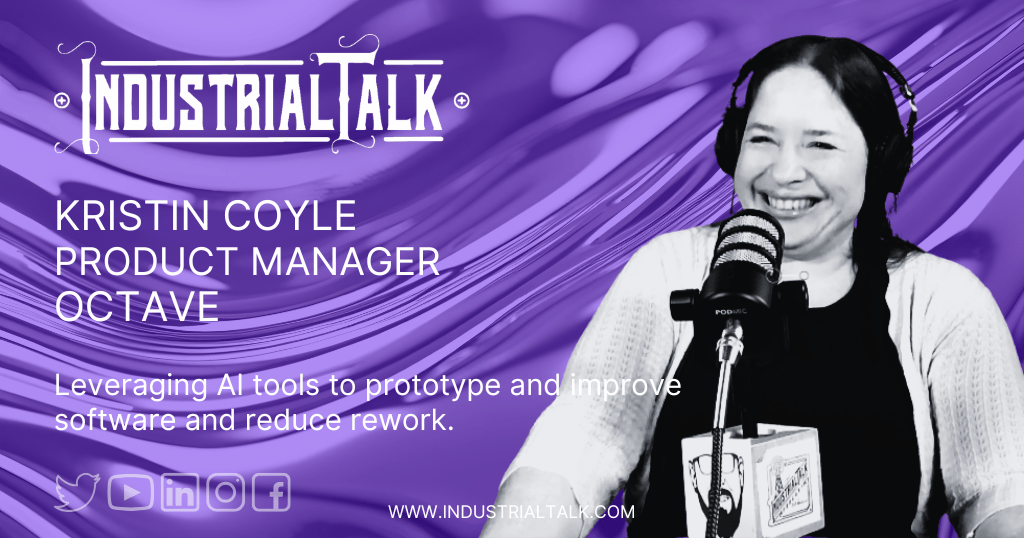
Industrial Talk is onsite at Octave Live and talking to Kristin Coyle, Product Manager, Engineering Analysis at Octave about “Using AI for Prototyping”.
The conversation promotes the Barcelona Cybersecurity Congress from November 3-5, 2023, emphasizing its importance for cybersecurity professionals. Scott Mackenzie hosts the Industrial Talk podcast, celebrating industry innovators. Kristin, a third-generation engineer, discusses her role at Octave, where she uses AI tools like Claude to prototype and improve software for pressure vessel analysis. She highlights the importance of human interaction in AI development, the need for real-time solvers, and the potential for AI to reduce rework and improve efficiency. Kristin also mentions her involvement in API 579 and ASME, underscoring her extensive industry experience.
Outline
Barcelona Cybersecurity Congress Announcement
- Scott introduces the Barcelona Cybersecurity Congress, emphasizing its importance for cybersecurity professionals.
- The event is scheduled for November 3-5 in Barcelona, with networking opportunities and expert discussions.
- Scott mentions their own participation and broadcasting at the event.
- Encourages listeners to mark their calendars and join the conference.
Introduction to Industrial Talk Podcast
- Scott is described as a passionate industry professional focused on innovations and trends.
- Scott thanks listeners for joining the top industrial-related podcast.
- Highlights the achievements of industry professionals, calling them heroes for solving daily problems.
Live Broadcast from Octave Live
- Scott announces the live broadcast from Octave Live, an event for a new company.
- Kristin is introduced as a key figure at Octave, leading innovation.
- Scott humorously mentions meeting Kristin in a bar, adding a light-hearted tone.
- Kristin shares her positive experience at the event, comparing it to Hexagon Live.
Kristin's Background and Family Legacy
- Kristin shares her background, mentioning her family's engineering legacy.
- Her father was a top LNG expert, and her grandfather was a NASA rocket scientist.
- Kristin trained as a violinist with the Houston Symphony but chose engineering.
- Discusses her education at Drexel University in Philadelphia for material science.
Kristin's Role at Octave and Innovation
- Kristin explains her role at Octave, focusing on customer needs and prototyping.
- Uses Claude, a chat-based AI tool, to prototype and demonstrate ideas to customers.
- Describes the process of creating prototypes and refining them based on customer feedback.
- Highlights the importance of real-time solvers and dashboards in their software.
Challenges and Opportunities in AI Implementation
- Kristin discusses the challenges of training AI on customer data while protecting intellectual property.
- Emphasizes the need for continuous interaction with customers to avoid data drift.
- Mentions the importance of beta testing and gathering customer feedback.
- Highlights the potential for AI to reduce rework and improve efficiency.
Impact of AI on Engineering and Collaboration
- Kristin talks about the transformative impact of AI on engineering tasks.
- Describes how AI can free up engineers' time for more creative and strategic work.
- Discusses the potential for real-time collaboration and better product development.
- Emphasizes the importance of human interaction in the AI development process.
Future of AI and Industry Collaboration
- Kristin shares her vision for the future of AI in the industry.
- Highlights the need for continuous training and improvement of AI tools.
- Discusses the potential for AI to revolutionize various aspects of engineering and analysis.
- Emphasizes the importance of collaboration and communication in achieving these goals.
Kristin's Contact Information and Final Thoughts
- Kristin provides her contact information for further discussions and collaboration.
- Scott encourages listeners to reach out to Kristin and engage with the industry.
- Highlights the importance of storytelling and sharing experiences in the industry.
- Concludes the podcast with a call to action for listeners to join the conversation and stay updated with industry trends.
If interested in being on the Industrial Talk show, simply contact us and let's have a quick conversation.
Finally, get your exclusive free access to the Industrial Academy and a series on “Why You Need To Podcast” for Greater Success in 2026. All links designed for keeping you current in this rapidly changing Industrial Market. Learn! Grow! Enjoy!
KRISTIN COYLE'S CONTACT INFORMATION:
Personal LinkedIn: https://www.linkedin.com/in/kristincoyle/
Company LinkedIn: https://www.linkedin.com/company/octaveintelligence/
Company Website: https://www.octave.com/
PODCAST VIDEO:
THE STRATEGIC REASON “WHY YOU NEED TO PODCAST”:
OTHER GREAT INDUSTRIAL RESOURCES:
NEOM: https://www.neom.com/en-us
Hexagon: https://hexagon.com/
Arduino: https://www.arduino.cc/
Fictiv: https://www.fictiv.com/
Hitachi Vantara: https://www.hitachivantara.com/en-us/home.html
Industrial Marketing Solutions: https://industrialtalk.com/industrial-marketing/
Industrial Academy: https://industrialtalk.com/industrial-academy/
Industrial Dojo: https://industrialtalk.com/industrial_dojo/
We the 15: https://www.wethe15.org/
YOUR INDUSTRIAL DIGITAL TOOLBOX:
LifterLMS: Get One Month Free for $1 – https://lifterlms.com/
Active Campaign: Active Campaign Link
Social Jukebox: https://www.socialjukebox.com/
Business Beatitude the Book
Do you desire a more joy-filled, deeply-enduring sense of accomplishment and success? Live your business the way you want to live with the BUSINESS BEATITUDES…The Bridge connecting sacrifice to success. YOU NEED THE BUSINESS BEATITUDES!
TAP INTO YOUR INDUSTRIAL SOUL, RESERVE YOUR COPY NOW! BE BOLD. BE BRAVE. DARE GREATLY AND CHANGE THE WORLD. GET THE BUSINESS BEATITUDES!
Reserve My Copy and My 25% Discount
Transcript
SUMMARY KEYWORDS
Barcelona Cybersecurity Congress, industrial innovation, AI prototyping, Octave Live, engineering dynasty, pressure vessel analysis, Claude chat, real-time solver, customer feedback, intellectual property, geopolitical impact, AI training, industry collaboration, technology advancements, Industrial Talk podcast.
SPEAKERS
All right. Before we get into the conversation, I want you to be aware of a conference that you need to put on your calendar, and you have time. It is the Barcelona Cybersecurity Congress. It is necessary. You need to up your cybersecurity game. You're connected. You need to make sure that you're protected right here. This event, Barcelona Cybersecurity Congress. It is November 3 through the fifth. You have time, November 3 through the fifth this year in Barcelona. And I'm telling you right now, the team at Farah who put this particular Congress on the best. You will not be disappointed, and you know what else you get to do? You get to network with some of the best cybersecurity professionals from around the world. You need to do this. You need to put this one on your calendar. All of the contact, all of the information is out on Industrial Talk. I'm going to be there. I'm going to be broadcasting. I'm going to be talking cybersecurity with the best in the world. So be there. Put this one on your calendar. That is November 3 through the fifth. I'll see you there.
Welcome to the Industrial Talk podcast with Scott Mackenzie. Scott is a passionate industry professional dedicated to transferring cutting-edge, industry-focused innovations and trends while highlighting the men and women who keep the world moving. So put on your hard hat, grab your work boots, and let's go!
All right, once again, welcome to Industrial Talk. Thank you very much for joining the number one industrial-related podcast in the universe that celebrates you, industry professionals all around the world. You're bold, you brave, you dare greatly, you innovate, you collaborate, you're solving problems each and every day. You are the heroes in this story. We are absolutely happy for what you do. That's why we celebrate you on Industrial Talk. We are broadcasting on site, Octave Live. We're right outside the Octave Showcase. People are drinking right now. We're going to be drinking in front of you too, so it's not a big deal. It's just wine. It's just wine. Nothing fancy, and it's really great. It's an exciting time. This is the first live for Octave. They're just a new company from another company, two weeks old. It's an amazing time. Kristin is in the hot seat. She's with Octaves, and she just sort of popped this. I'm I'm leading the innovation.
Well, I'm not I'm not the only
one
leading
innovation. That's amazing. That's a bold statement. So anyway, she's in the hot seat. We're going to be talking about her her Octave Live experience and all that good stuff. So let's get cracking. Yeah, that ain't bad. Ain't bad.
Yeah.
Yeah, she's got a special talent too. I met her in a bar last night. It sort of sounds creepy, huh? That just rolled. That just rolled off my tongue. Like what the heck, man! No, but it is pretty cool, by the way. That that was pretty stunning. You having a good conference?
I'm having a wonderful time. Now
you were you were at Hexagon Live last year, right?
Yes, I was.
This is a little scaled down, but it's pretty doggone focused. Yeah,
it's more technical. I feel like I feel we can really play to the users here.
Yeah, is that what do you? What kind of feedback are you getting back from the users? Like, what's what are they feeling about all the changes that are taking place? Good changes. It's good changes. Good changes.
I think people are more excited. You know, the AI kind of taking into everybody. You know, it's the buzzword right now. No, it
is. But
you know, they want to see what we can do. Just I
hashtag AI just because I can hashtag AI.
Yeah, you get a lot of broad spectrum there.
Yeah. All right. Before we get into the conversation of what you do for Octave, give us a little background on Kristin. Sure. Please don't let us down. Don't let us down.
So I come from an engineering dynasty.
Do you really? I
do. Third generation engineer. So it's in the blood, DNA. There was there was no hope for me. I was trained classically as a violinist. I trained with the Houston Symphony. Shut up. And I still ended up in engineering.
Where'd you go?
I went to Drexel in Philadelphia for material science. Yeah, and then I ended up doing software, complete 180.
What did your dad do? What did they do?
So my dad was actually in his heyday. He's retired now, but he was one of the top LNG experts in the world.
No way.
Yeah, on the process side.
Yeah.
So he was the one talking to Saudi Arabia about $10 billion deals.
Yeah, they're they're they're off the chart. In size, oh yeah, they're grand, yeah. And I highly recommend. I'm pointing at you on the video. If you could ever see an LNG terminal,
oh yeah,
yeah, you will not. You'll stare at it.
So my dad has done all those calculations himself.
See? Yeah,
yeah, and he did it slide rule with a slide rule. Exactly.
And a slide rule.
So he was there when Intergraph first started taking off, and so he's we've kind of known about Intergraph before it was bought out by Hexagon and now Octave, way long ago. It's always been a part of our family's lives. My mom worked at Technique. My dad worked at KBR, and so the dinner conversations were a lot of thermodynamics. But they couldn't talk about certain projects to each other because it was a conflict of interest. Yeah,
never thought of that. Yeah,
that's
what I dug on to. And
then my grandfather was a NASA rocket scientist before it was NASA.
No way, really. Yeah.
Oh yeah, yeah.
Did you ever have stories that did you ever talk to him about his? A
little bit, yeah. I, you know, I was in college the last time I got to see him. So I was going. I was in the middle of it, and I kind of you know wasn't very confident on my engineering at the time, so I didn't know what to ask. I didn't know how cool he was, you know. It's kind of that thing, and I actually had, you know, I wish I'd taken more advantage of of those you know fireside chats when I had the time, or when I you know when I could have done it. But you know, my sister, my twin sister, is actually carrying on that legacy too. She now works at NASA, has an aerospace degree herself. So the whole family. Wow!
See that? How can you not be? That's cool stuff.
Yeah, and so now the dinner conversations are about what me and my sister are doing, and I'm asking my parents, you know, is this something that you wish you'd had? And my dad's going, this is crazy. The things that you're talking about. This is the dream we were talking about in the 80s.
Yeah,
and you're actually making it happen. And now I can prototype with AI and show it to him. It's not just a diagram. It's not just a pretty picture anymore. I can actually show him how it works, and I introduced him into AI. And now he has projects. You know, he he makes clocks out of paper, and now he has 3D printer, and he's making clocks out of that too. And he has projects everywhere, and he's using AI now to help him program some of these things. And my grandma was a programmer too. I mean, it's just it never stops.
Well, yeah, you definitely have the pedigree. My gosh, that is outstanding. I would have loved to just sort of sit back and talk to your grandfather about pre-NASA stuff because that was top secret. That was amazing. I can only imagine the stories he has.
Oh yeah, for for instance, like he did wind tunnel experiments.
Yeah,
and he was doing it not for military capabilities, but then they started asking him to study rifles and things like that. And he was-he's a peaceful guy, so there was some you know ethics debate in his heart about that. But he also worked on the heat shields for the space shuttle. One
of the most amazing things with the space shuttles, where the little bricks, the ceramic bricks, are that he worked on
that.
See, and and I remember seeing them red hot, and somebody's picking them up, and I said, "What's that voodoo? How does that happen? Where where does that come from? And if
you hold one, they are so heavy.
Are they really
so heavy? It's like a blade at a gym. Oh yeah, super heavy.
You know, SpaceX has all of those shears. I would imagine. I just, it's amazing.
Yeah, whole new world. What a time to be alive.
I wish I was younger. I do. I real. I have these conversations all the time. I wish I was younger, just because when I was in the world of technology, we had similar dreams, but we didn't have that capability. We just like, wouldn't that be great? Ah, let's go grab a beer. Well, whatever. You know, you just didn't have the technology. You didn't have that capability. Now, it it just it's going at such a rapid, blistering, fast pace. It's like like like nothing. Everything's achievable.
Exactly, and that's actually how I get into the innovation stuff that that you mentioned. Now I'm leading into it. Segue.
We got a segue. Talk. Talk to us about that.
Okay. So what I do that I well I say I have the privilege of doing. I really enjoy my job. Yeah. It's amazing.
Yeah.
I get to talk to customers about what they need in our software, and now with the capabilities that we have today, I have I can go home and start prototyping, and then once I create a prototype, I can go back to the customers. I can actually do this in real time at this point now too, and go, is this what you mean? You know, because a picture can tell a story, but when you have a prototype, you have all these buttons you can click. You can demo the ideas that are in your head, and they come out almost instantly.
What do you use it? How do you do that? How do you prototype? How do you sit down on a computer and say, "Yeah, here it is. I tell me tell me what you're thinking, and of course it still needs to be ferreted out. You know. Oh well, we had this problem, and then it was just, and then you're you're trying to sort of decode it, you know. They're they're what they're trying to describe. How do you how do you prototype? How do you do that?
Yeah. So okay. Well, another piece of my history is so after I got my material science degree, I I became a developer at Octave for PV Elite, now called Octave Aspect Pressure Vessel. So our pressure vessel analysis software. Basically, we design bombs that don't explode, and that's an easy way to put it. Very highly pressurized pressure, but there's
yeah there's some pictures out there of when they oh yeah when they go wrong it's terrible.
So our software tries to reduce the risk of that happening from a design perspective. So I know how to read code. I was in code for 10 years. That's one hat that I use all the time. I use my SME hat. So not just material science, but now I would say I'm also very capable as a mechanical engineer as well, not just on pressure vessels but on piping. I'm now learning how to do civil engineering for structural analysis. So many different hats on the subject matter expertise there, and then the third hat is this product management, and so I feed all of that into Claude. Claude is my preferred medium. You do. You use
Claude. Okay. Okay. Claude
chat today.
Yeah.
We're still in the process of getting the Claude license, the Claude code licenses, and you know we have to worry about token spend on this, right? And so that's you know they don't just roll that out and and say okay go wilds everybody you know that's how you go into bankruptcy and we don't want to do that out in two weeks right so there we're doing a slow roll out of some of these things but we do have Claude chat licenses and that already is enough for me to do incredible things
again, how? So I'm sitting there and I'm talking to you. I'm a client. I have, and and which is really pretty cool because when because customers they see things that you might not see. You as Octa have to figure out how to prioritize it? Not everything is up, you know. Oh yeah, that's great. That's great too. That's great, and everything's great, right?
You end up with a Homer Mobile if you saw that Simpsons episode. Yeah, that's
exactly correct. So you have to say, okay, I see you. I understand it. Let me ferret it out a little bit more. Let me have that conversation. It's all good, and you have to do that. But you can use Claude and say, "I hear what you're saying. Let me put it on here. Let me do this, and and come up with a
prototype. So what I'll do is I will start
at a at a lower at a lighter weight model, say Sonnet. I won't go into Opus yet when I'm doing one-on-ones with customers because Opus will take a long time. It'll be a more robust prototype, but I start from a from the bird's-eye view and then I drill down, and that gets me a better prototype than trying to lay out all the requirements at once because Claude and maybe you know some of these other tools. If the the more breath you give it, the less dense it's going to be, because it it knows it can only spend so many tokens per chat.
Yeah,
and so so either you get wide and surfacey. Or or deep, and it's not going to be great because it's not going to check. It's going to be buggy. It's going to look weird. So I start from one concept, like let's talk about a dashboard. Let's make one assumption that is not true today in our pipe stress analysis code, for example, product. We don't have a real-time solver yet, and this is just because the legacy code is 30 years old. It's desktop. In what we just released in our latest pipe stress release was a solver. We rewrote the solver, and now it's 10 times faster on desktop, and we expect that when we get it to cloud, it's going to be practically real time. So now, instead of having an analysis button that I have to press, go search through a lot of reports. I can say, okay, skip that part. What if I had a dashboard? And and so I'll say, customer, is this something that you would want? Would you rather not parse through all these stupid reports, you know, and that kind of look like they're still from the
'90s? Right.
What information do you want to see first? And then I'll say, okay, Claude, act as a master pipe stress engineer, master developer, master UX expert. Here's what. Here's the task I want to accomplish. Here's the why. Here's the context. Here's the pain point. Here's the story. The customer is looking at has has just gotten a new design from the designer in the 3D model, and he has told the pipe stress engineer, "This looks like we're going to have deflection. That pipe is going to break if you don't restrain it, and the pipe stress engineer job is to basically clamp this pipe down so that it won't blow up or break or whatever.
Right.
And so, if I'm just looking at this and I've never seen this design before, what's the first thing the pipe stress engineer is going to do? And maybe that's the part of the story I want to explore. Or maybe we're looking at okay. I need to account for seismic wind. I need to account for fatigue. I need to account for vibration coming from the pump. What are all the load cases that I need to have? What are combinations of load cases that I need to look at? And then how am I going to build those load cases in a way that's fast and efficient and gives me the data that I need immediately?
Oh, I got to I got to jump in. How is Claude? How is your your prototype? Where is it pulling the data? Where is it pulling the information? Where is it coming from? To be able to come up with a valid prototype, it
fakes it.
Okay.
So what I do with my subject matter expertise hat on? Yeah. I go that number is funky. That's not a real number, Claude.
Right.
I want you to use a real example if you can find one in your database of knowledge, which should not be based on the internet, I don't want you to do like OpenAI and just capture all of that. That's where the garbage comes out.
Yeah. Okay. So
I asked Claude directly, "Have you been trained on pipe stress engineering? It said yes, and I said, "Use one of those examples here. So therefore, I maintain my ethics as I'm developing these prototypes. The numbers look right. If there's like a, I ask for a graph, and it looks weird. I go, this is what the graph should look like. I'll pull an example, or I'll say, put your pipe stress engineering hat on. This number doesn't look right. Do you agree? And and I'll do it that way, or I'll check its math. And actually, Claude has this cool thing where it will build the behavior that it has with you into its memory if you toggle that on. So over time, Claude learns to do this better and better and better. So I would say, the first month you're training a puppy, and it piddles on the floor a lot. By month three, I've gotten it to behave more appropriately. By month six, it now we are in sync, and it's my bestie.
And and again, from those prototypes, as you continue to learn, as you continue to teach that solution, that tool, it just becomes quicker.
Yeah, it's
just like okay, I could sit down with you know you right now. Be able to come up with something that I feel from a from a confidence level fairly high.
Yeah, and it knows I'm going to check the math, so it'll give me good math the first time around.
What else are you using it on?
So I use it for daily micro learning. Say I want to learn about I don't know. We we just started trading on Nasdaq, right? And so maybe I need to know, you know, some insider trading issues that might come up if I start talking about this. You know, I don't I don't want to give anybody an advantage because that's going to have the SEC come after me.
Yeah, that's right.
So, so what can I say publicly? What does it mean to have public disclosure on something versus not? What can I say? What can I say? So those are the kinds of things I'll ask Claude as well beyond what I do with engineering, but I'll also ask it. You know, what does a board of directors want to know? What kind of numbers and metrics are they looking for to evaluate my product for funding? You know, or if I'm talking to my strategy guys, what's the data that they need in order to make a call on which market to go for? How can I help them do their job better? And then I'll also say, okay, looking at the the geopolitical landscape that's going on right now, because these are things we have to think about, right?
Yeah.
If the Strait of Hormuz is closed, what does that mean for my customers? How can I help? So even though we're in an out in the analysis space, we still have to think about fabrication and where these materials are coming from the raw materials, where they're getting fabricated. Our clients might have to choose a different material and redo their entire analysis based on a geopolitical event.
Yeah,
you know.
Yeah, I I was doing a project, and and and nothing compared to what you're doing or where we're going, all that good stuff. But but I would run the financials, run the budget, run the the to see what the project would cost. Just general stuff, my spreadsheets and spreadsheets and spreadsheets, and quickly realized that the market was changing so drastically. My models were didn't work in a week or in a day or whatever. You're just constantly trying to keep up with all of the challenges and all of the things that are taking place within. That's that's. Where do you see it? I mean, we've been AI specific. Where do you see it going? I mean, do you do you have a team of people that's just training, training and getting it honed in? You you have to keep at it.
You do, and and I would say there's there's a few bottlenecks that are coming up for what we're doing, right? Because one thing that we have to do is protect our customers' IP, intellectual property. So we can't, nor do we want to train on their data. So we have to have in-house sources, right?
Yeah, yeah, yeah. You're spot on there.
So the other thing that has to happen too is, you know, we're kind of limited because we have in-house SMEs, but their knowledge kind of gets scale over time because they're not in the real world working anymore, so that's why we must have this interaction with customers
to
make sure that we're not getting drift on the data training. So, and that's why beta testing is so important. Is we need their input on yes, no, and and maybe perhaps they don't tell us their specific workflows, but we have to make sure that they can configure our software to do their specific workflows.
See, what's interesting, you you pointed it out. It's all great. They're great tools. They're only as good as that human interaction. It just you can't. We need the human in the loop, absolutely. I I was having this conversation with somebody, and I said, "This is, and it's not as sophisticated as what you're doing. So don't even don't slap me upside the head. But what I was saying is that if we don't, if we don't, as a society, as a human race, create content information from the head. Then there is an AI starving because the data is just dry. It's the same stuff. You're pulling the same, you know, analysis or whatever it is. It doesn't. It doesn't. It doesn't grow.
No.
Just starves.
And that was something Matia said earlier in the in the keynote. Was this is there to empower humans? They're only going to get more productive. They're not getting replaced.
Here's a story I was talking. I digress, but I was talking to somebody that they were all in in trying to use AI to deal with the monotony of some work, right, and apply it, and so he had a team of people doing it. What would take that team of individuals eight hours of work, right, was cut down to an hour. It was just like drastic, and and then that left seven hours of creativity. What do you do? How do you rethink that? What? It's it's stunning.
Yeah, absolutely. Amazing
things that can happen as a result of that.
Yeah, we're talking about reducing 70% of rework.
Yes, we're
talking about taking month and a half cycles down to instantaneous results. Yeah,
that's transformative. That's disruptive. That's that is amazing.
And then, and so now it can become a game of instead of just doing this menial restraints and clamps and stuff. Now you can talk about if if we're in this collaborative environment with the other disciplines of analysis. Now it becomes a conversation instead of back and forth emails, handoffs, things like that, and that's not even necessarily AI. That's just let's build a better product in the cloud with these real-time solvers. And what else can we do with that?
Here's my concern, because as as things get faster and faster and faster, results get faster and faster. Do you believe that the human condition, like I'm again, I can be Scott manufacturing. I I'm not that nimble. You guys live in this world of it's like it's it's you know acceleration technology crack. You just you get it, and you could do more, and you could you know you you wake up in the middle of the night saying I didn't realize I could do that too, but I'm I'm just I'm just scott manufacturing. Do you find that maybe the velocity of which you guys are moving forward? How do you drag me along? I I don't know how you do that.
There's there's definitely a migration period. We're not gonna push everybody into the new world instantly, especially engineers. I mean, we are designed to be risk averse. That is the whole point of our job, right? And so we know there's going to be a period of interrogation and qualifying these new tools to make sure that they serve the purpose and that they're meeting the expectations and really high standards. One of the panelists that was in the keynote, for instance, was talking about nuclear regulations,
yeah, you
know. So we need to make sure there's an audit trail. We need to make sure they can, like what we call equation substitution. They can track how our software got that specific answer.
Yeah,
and then that way, if we can do that internally in the software, then they don't have to go ask support. Hey, can you do this benchmark? Support says, Oh, I got the same answer you did, but that's not what the software got. So let me go ask the developers why they got this, and it turns out to be a engineering standard code interpretation. Well, that should be laid out in the software directly, and now you've cut down on support. So now support can focus on things like more training, or focus in on the really tough cases and give really thorough answers that they just can't do today.
See, I I would love an additional conversation. We're running out of time, but I would love an additional conversation of how you internally prioritize new features. I mean, the customer says this is great. Well, you say it's great because it's specific to you. I get it, but is there a broad opportunity to say, "Yeah, that's great, and yeah, they like it over there, and yes, they would like it there too, and so on and so forth. There's there's a whole level of other analysis that has to take place. Just a,
I mean, it's all a bet, right? It's a bet. You're you're betting, yeah, yeah, yeah, yeah, yeah. And and the larger sample size of data you have, the more customers you can talk to, you start seeing these trends.
You're outstanding. Oh, I like that conversation. Yeah. So, Kristin, how do people get a hold of
you. You can find me on LinkedIn.
There it is. All well trained up. We didn't even have to use Claude for that one.
You
know. Well, you can find me
on Claude too.
Yeah, I'm sure you can. Yeah. Look at yeah. A fan. All right. You are absolutely wonderful. Thank you very much for being on.
Thank you. Glad to be here.
That was outstanding. Kristin's her name. We're going to have all contact information for Kristin out on Industrial Talk. So, oh, fear not. This is a must contact, and she'll leave you in the dust, and you'll feel stupid. Not stupid in a good way, but stupid nonetheless. Like I feel right now. I feel more
willing to learn, right? Yeah, you just gotta.
You you do. There's not enough time in the day to. It's just not enough. Octave Live. We're here broadcasting right outside the Octave Showcase, where there's a lot of technology. Sort of, you walk in there, you're bumping into it, and all of that stuff, and you get to beat people like this. But you can't complain about that. All right, we're going to wrap it up on the inside. Stay tuned. We will be right back.
You're listening to the Industrial Talk Podcast Network. There it is,
right there, right. Yeah, you just listened to it. There's her stat card on LinkedIn, and not only is she with Octave, as you can tell, she was at Octa because we were at Octave Live, and also delivering some really insights into AI and what she's doing. Way over my head, however, fun to sort of buckle in and listen to what she has to say. But she's also chair of API 579. Have no idea what that is, but it sounds important. And then, and then on her, and she's like she's ASME, American Society of Mechanical Engineers. She's also that too. Yeah, yeah. Reach out to her. Contact information out on Industrial Talk. Yeah, she'll dazzle you. There's a lot of fun stuff going on in industry because you got smart people like Kristin just just knocking it out of the park. How about that for analogy? All right, you need to put Octave Live. You need to you need to approach these individuals; they're doing a lot. There's a lot of noise out there. There is. It's noisy. I I I listen to it all the time, and and I'm not going to say that I can keep up with it. I'm all buckled in. I'm like on a roller coaster, a technology roller coaster, trying to trying to just make it through, and and I'm all excited and and and you know what the challenge is. This is just me. Outside of all the other challenges, it's just trust. Trying to find those individuals that you can trust as you go down this AI journey in your industry. It has great benefits. It's an amazing tool, but you you definitely people, and you're not. Don't go to an AI to say, "Hey AI, what AI should I use? That makes no sense. I guarantee you, people are doing that. You need people. You're not going to get rid of that. So reach out, Kristin, Octave Live, Industrial Talk again is here for you. We want you to succeed. We want you to tell your story. We want we want to be able to market for you and get some eyeballs on what you do. So reach out, go out to Industrial Talk. Let's have a conversation. I always have conversations. I'm full of conversations. Anyway, go out to Industrial Talk. We're doing a lot of great things out there. We want to celebrate you. That means you got to tell your story. You can't just sit on the sideline and not tell your story. You're doing cool stuff. Let's have a conversation. All right, be bold, be brave, dare greatly. Hang out with Kristin if you can. Try to keep up with her, and you will be changing the world. We're going to have another great conversation shortly, specifically coming from Hock of Live. We'll stay tuned.