Max Cundiff and Doug Ebaugh with Chevon
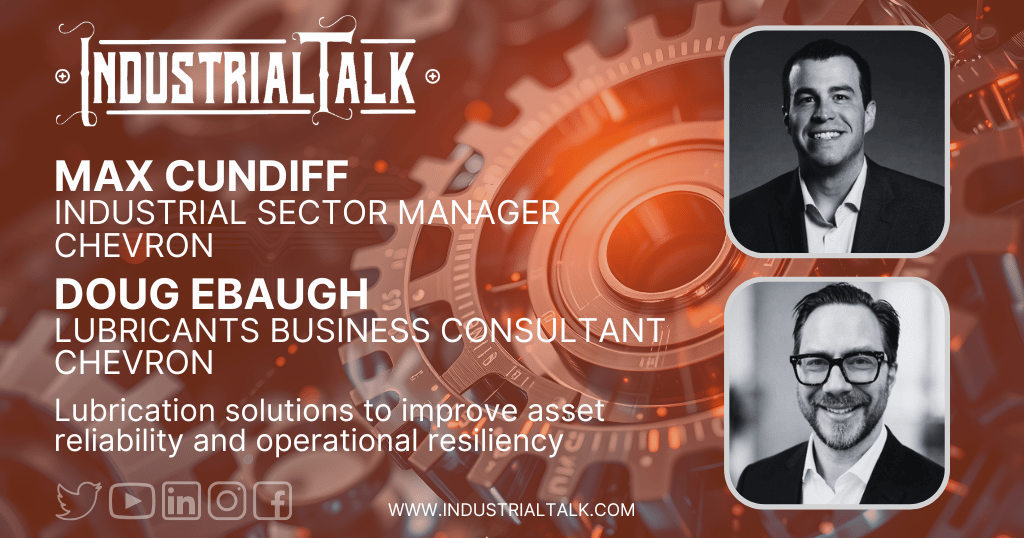
Industrial Talk is talking to Max Cundiff and Doug Ebaugh at Chevron about “Lubrication and maintaining asset reliability”.
Outline
Introduction and Overview of Industrial Talk Podcast
- Scott Mackenzie introduces himself and the Industrial Talk Podcast, emphasizing its focus on industry professionals and their innovations.
- Scott highlights the importance of safety in industrial operations and mentions Iris, a company that provides technologies for safe inspection of energized equipment.
- Scott introduces the guests, Max and Doug from Chevron, and their roles in the lubrication arm of Chevron.
- Scott shares a personal anecdote about a lip injury and transitions to discussing the importance of reliability and upcoming events like SMRP.
Discussion on Marketing and Content Creation
- Scott discusses the challenges of marketing for small to midsize companies on LinkedIn, noting the algorithm's preference for large companies.
- Scott emphasizes the importance of creating a consistent campaign to tell a company's story and the value of repurposing content across different platforms.
- Scott highlights the need for companies to create a content-generating machine to maintain visibility and engagement.
- Scott offers his services for marketing and PR, encouraging companies to reach out to him for help in telling their stories.
Introduction of Max and Doug from Chevron
- Scott welcomes Max and Doug to the podcast and mentions their roles at Chevron.
- Max introduces himself as the industrial sector marketing manager for Chevron Lubricants, focusing on power generation, manufacturing, oil and gas, and petrochemical applications.
- Doug introduces himself as a chemical engineer with a background in various industries, currently serving as a direct industrial business consultant and subject matter expert for lubrication and reliability at Chevron.
- Scott and the guests discuss their backgrounds and experiences, including Doug's transition to Chevron and his previous roles in heavy transportation and logistics.
Challenges and Solutions in Power Generation and Data Centers
- Max and Doug discuss the growing demand for electricity in data centers and the importance of maintaining reliability in power generation.
- Doug explains the role of lubrication in combined cycle power plants, emphasizing the need for good lubrication to prevent equipment failure.
- Max highlights the importance of understanding market needs and working with OEMs to develop products that meet customer requirements.
- The discussion covers the challenges of meeting the increasing demand for power in data centers and the need for reliable lubrication solutions.
Chevron's Approach to Market Demands and Product Development
- Max explains the complexity of meeting market demands for data centers and the importance of collaboration with various stakeholders.
- Doug discusses the importance of understanding oil oxidation and the role of lubrication in preventing equipment failure.
- Max and Doug highlight the use of Vartec technology in Chevron's turbine oils to prevent varnish formation and improve reliability.
- The conversation touches on the importance of oil analysis and predictive maintenance to extend the life of equipment and prevent unplanned downtime.
Future Trends and Contact Information
- Max shares his thoughts on the future of reliability in various industries, emphasizing the importance of continuous improvement.
- Doug provides contact information for listeners who want to learn more about Chevron's lubrication solutions and services.
- Scott encourages listeners to reach out to Max and Doug for further discussions and to attend industry events like SMRP.
- The podcast concludes with Scott reiterating the importance of marketing and storytelling for industrial companies and inviting listeners to connect with him for more information.
If interested in being on the Industrial Talk show, simply contact us and let's have a quick conversation.
Finally, get your exclusive free access to the Industrial Academy and a series on “Why You Need To Podcast” for Greater Success in 2026. All links designed for keeping you current in this rapidly changing Industrial Market. Learn! Grow! Enjoy!
MAX CUNDIFF'S CONTACT INFORMATION:
Personal LinkedIn: https://www.linkedin.com/in/max-cundiff-66865224/
Company LinkedIn: https://www.linkedin.com/company/chevron/
Company Website: https://www.chevron.com/
DOUG EBAUGH'S CONTACT INFORMATION:
Personal LinkedIn: https://www.linkedin.com/in/douglasebaugh/
PODCAST VIDEO:
THE STRATEGIC REASON “WHY YOU NEED TO PODCAST”:
OTHER GREAT INDUSTRIAL RESOURCES:
NEOM: https://www.neom.com/en-us
Hexagon: https://hexagon.com/
Arduino: https://www.arduino.cc/
Fictiv: https://www.fictiv.com/
Hitachi Vantara: https://www.hitachivantara.com/en-us/home.html
Industrial Marketing Solutions: https://industrialtalk.com/industrial-marketing/
Industrial Academy: https://industrialtalk.com/industrial-academy/
Industrial Dojo: https://industrialtalk.com/industrial_dojo/
We the 15: https://www.wethe15.org/
YOUR INDUSTRIAL DIGITAL TOOLBOX:
LifterLMS: Get One Month Free for $1 – https://lifterlms.com/
Active Campaign: Active Campaign Link
Social Jukebox: https://www.socialjukebox.com/
Business Beatitude the Book

Do you desire a more joy-filled, deeply-enduring sense of accomplishment and success? Live your business the way you want to live with the BUSINESS BEATITUDES…The Bridge connecting sacrifice to success. YOU NEED THE BUSINESS BEATITUDES!
TAP INTO YOUR INDUSTRIAL SOUL, RESERVE YOUR COPY NOW! BE BOLD. BE BRAVE. DARE GREATLY AND CHANGE THE WORLD. GET THE BUSINESS BEATITUDES!
Reserve My Copy and My 25% Discount
Transcript
SUMMARY KEYWORDS
Chevron Lubricants, power generation, data centers, lubrication solutions, reliability, predictive maintenance, oil analysis, turbine oils, Vartec technology, combined cycle power plants, asset management, lubrication challenges, oil oxidation, maintenance strategies, industrial talk podcast.
Hey, it's Scott Mackenzie with Industrial Talk. IRISS is the global leader in electrical maintenance safety, delivering technologies that let team inspect energized equipment safely using closed panel condition-based monitoring to reduce risk and downtime. Their patented infrared and ultrasonic inspection windows make it possible to detect issues early, boosting reliability and protect the people who keep the operations running. If improving safety and avoiding unplanned failures is your mission, Iris has the solution to get you there. Learn more at IRISS.com..
Welcome to the Industrial Talk Podcast with Scott MacKenzie. Scott is a passionate industry professional dedicated to transferring cutting-edge, industry-focused innovations and trends while highlighting the men and women who keep the world moving. So put on your hard hat, grab your work boots, and let's go! All
se tears is because I've done:The other step, and I've said it again, I've said it multiple times. You can't just do one. I mean, your solution is is more than one, and and when you do that and you create that campaign and you continue to be diligent about telling that story again and again, no matter if it's like a a racing circuit and you just go round and around, it's still important. It's still relevant. It still gets the eyeballs that are necessary to help you succeed. That's what you need to do. And then you take that content that you chirped out. You got video. You got audio. You got you got graphics. You got you have so much that you can create from that conversation. It never stops. It's it's a content creating machine. Now we've all been. I'll just let's let's look at it right now, so you go to your feed. Okay, there's that. There's that. Do you grow numb with the feed? Because sometimes, oh, let's see what we got. Sometimes it just it looks the same. Everybody starts looking the same. The story starts sounding the same. It it's you just you need to stand out there. Please contact me. We have a big heart. We have a big heart for your success, industry success. I believe we believe that it's an imperative. It's it's it's a non negotiable. You have to succeed. You and that means you have to keep at it. That means you have to market. You have to, you have to, you know, inspire those targets, those those opportunities to be able to create more sales. You have to succeed, and and we're here to help. We do marketing. We definitely help with the PR. We definitely work with you from an industrial perspective. We know what's going on. Just just make that happen. Go out to industrial talk. Reach out to me. Get on the podcast. Tell your story. That's what we want. All right, we're talking talking asset management. We're talking lubrication. We're talking it with Chevron. We're talking, of course, Max and Doug, and it's fun. It's just a fun conversation. They know what they're doing, and it's back and forth, and it's lighthearted, but it's it's important. And you need companies like Chevron to be in your corner to be able to sort of help continue to make your operations run smoothly and effortlessly, you know, to be able to respond to the markets today. So anyway, enjoy this conversation with Max and Doug. Max, Doug, welcome to Industrial Talk. How are you both doing today? It's a twofer. How are you guys doing today, Max?
Doing well, Scott. How are you?
I can't complain, Doug. How are you doing?
I am doing great. I'm excited to be here. Thanks for having
me. Oh, outstanding! You guys are in the same room. You can tell by your backdrop you're in the same room. Seriously, standing next to each other, bumping elbows or whatever you want to call it. Outstanding. I'm glad you guys found time in your busy schedule. It's happening out there. Industry's happening. You guys are in the thick of it, I like it a lot. All right, listeners, we're going to be talking a little bit about power generation reliability, specifically around data centers. That that's one, but we're going to focus in on some lubrication roles with that particular industry market. And I just want to let you know, listeners, if you have not been out to industrial talk, which you should, but if you haven't, we talk a lot about power generation, data centers, and everybody crying about the fact that I can't find more power. So here's here's a solution to these guys. All right, Max. Before we get into that conversation, you need to because he's already been on the show one time at SMRP, which you need to be a part of. If you're not, if you don't have that on your calendar, you need to be a part of it. You get meet great people like Max, but not this year. Max, give us a background.
Yeah, thanks, Scott. So my name is Max Cundiff. I'm our industrial sector marketing manager for Chevron Lubricants. What I do is, you know, basically support our. Marketing strategy across power gen manufacturing, oil and gas, petrochemical, and some off-highway applications, and just spending a lot of time with our customers and equipment experts, reliability professionals, such as a lot of the folks that listen to this podcast, and really understanding what their challenges are, and figuring out how we can work together to to improve their reliability and reducing their downtime, or maybe even just to get more out of their equipment. Do you have customers that say, "Hey, Max, I'm using your product, and
I'm in there, and I'm just-it's a motor, and I'm just using the product. It's on a bearing, whatever product. And they say, "You know what would be great if it was fill in the blank? Do you get comforters like that, and then you have to take that information and say, "I hear you, customer acme, which is great friend. I'm going to go take it back.
Yeah,
yeah. I mean, we we hear that a lot. We hear a lot of requests from from customers. What we try and do though is invest early on in some research to understand what the future looks like, so we can start developing those products sometimes up to a decade in advance. Doug, we're going to get to you, but I,
yeah, see, decades. You back then when you had more hair, you weren't thinking about this future. You were thinking about. I mean, it's just this is moving fast. Whatever this is, how do you how do you check forward and be able to sort of see that future, Max? Yeah,
so I think it's it's understanding the markets we're working working on, working in, I should say. It's really talking to the customers, but also talking to some of the OEMs of the equipment that's running out there to start collaborating on with them on what they're trying to do. So we make sure we have the product that that can meet their equipment's needs.
Yeah. Okay, Doug, don't suck. You got to be able to do this better. Yes. Anyway, and he's boots on the ground, baby. Okay. This was this was the explanation that they gave me at the beginning in our little chit chat before the recording. Is that
Max is 30,000 feet. Doug is boots on the ground. So, background, Doug. That's correct. All right. Well, my name is Doug Ebaugh, and I am a chemical engineer by education. Yes, I have a technical capacity. I've always loved technology, but I have a real genuine heart for people too. Right. So it's kind of that in between there, people and technology, just not all left ran, right? And over the last 25 years, I've had the opportunity to work across a variety of industries. Most of my career has actually been in the energy sector, though, and I've held various roles throughout my career, ranging from engineering to operations, project management, and even in business and commercial roles like sales and sales leadership type roles. Right now, I'm with Chevron. Have been with Chevron for over a decade, all in the lubricants division that we have, and I'm currently serving as a direct industrial business consultant is my title, but I'm also a subject matter expert for all things related to lubrication and reliability, supporting external customers as well as internal business groups.
Through your career, by the way, listener, we're going to have all the contact information for these two gents out on Industrial Talk. Their stat card, and I'm on Doug's stat card right now. Were you using in your prior profession and companies that I'm looking at Chevron Loops, Doug? All right, Max.
Well, we'll let him think on that.
Yeah, just one second. I mean, pause. Yeah, you live by technology. You die by technology. That's the that's that's what we live in today. Some are better than others. And Doug, you got you got that sort of circle of death that went on. But you're back with us. Let me let me rephrase the question that came to mind. So you've been, by the way, your stat card says 10 years, eight months. You're coming up on 11, coming up on 11 years with Chevron lubrication. All right, did you before you joined Chevron? Did you use Chevron products in your other companies,
well, to be perfectly honest, I don't know because I wasn't in you know lubrication type roles in my in my previous Chevron life, so it's it's really hard for me to understand. I very well could have at least been around it, other groups been using it, but I wasn't involved directly with lubrication, reliability, and maintenance in my previous roles. For example, I worked prior to Chevron. I worked for a heavy transportation, heavy lifting, heavy cargo logistics company, and they moved big, heavy things. Right, so they were moving. Yeah, they were serving the oil and gas refinery companies like Chevron by moving you know 1.5 million pound you know reactors going into a refinery. Well, somehow those things have to be transported, lifted, and set on the anchor bolts, right? So I was dealing with and around equipment that used lubricants, but the actual maintenance on the equipment, I wasn't largely a part of that. I was more involved with the project management and the business and commercial type aspects with that.
There you go. Yeah, but it's interesting. You said, "Yep, I'm interested in lubrication, so I'm going to go with Chevron for whatever reason. That's like, yeah, that's where I want to be.
Yeah, yeah, exactly. I had no idea that this industry even existed. Yeah, I mean, I didn't have a
general idea, but I didn't know that it
was as deep as it got. You know, yeah, you
get that stuff on your boot. You're like, what the heck? I got that on my boot. What the heck is that grease on there? Yeah, I don't know what it is, but it's making a mess, and I'm dragging it everywhere, and it's on my carpet. By the way, Max, do you bring in lube at your home? You know, you don't track it in on your carpet, does it? Do you?
No, absolutely not. I've had to throw away some work pants a couple times when I came back from some trips. Wife wouldn't let it in, but got to keep degreaser wipes on hand too.
Yeah, I hear you. All right, now let's get into this this this topic, which is a very important topic because it it it has tremendous attention as we speak, and it's happening fast. And that's data centers. We talked specifically, Max, about you know you guys are planning, and here's Chevron, Lube, and all this stuff, and where you had no idea. I guarantee you had no idea that the demands of this particular data center and the the need for power was going to be this crazy. How how how are you? Like, hey, were you in a room and said, hey, did you know? Hey, check this out. Data centers are happening. They got power generation. Stand by. We better be we better be popping and you know talk to us about that.
d by data centers in the year:Yeah, and here here's the other little shoe to drop. The reality is, is that me being a utility guy from the way back, we've had trouble or challenges of saying, "Hey, our transmission lines, our generation, here's this they have planned it all out. And all and to your point, Max, it's been somewhat, you know, it's not volatile. That's for dog, I'm sure. All of a sudden, now it's rising. You have the infrastructure challenges. You have conversations around that. Doug, with that said,
yeah,
and a lot of the generation that we're talking about are pretty much standby, standby because they're still pulling in power from the utility, how do you? How do you? How? What's that program at Chevron that says, "Hey, we said we need to keep these guys, you know, ready to go, you know, and reliable. You know, you don't want that that you know problem where it doesn't, you know, start up. What are we talking About Doug,
yeah. So, so big picture, you know, one of the stats that you know to spin off of what Max said to just kind of paint the picture what we're dealing with and why needs to be reliable is you know a large data center camp data center campus it requires 100 megawatts up to even 500 megawatts of power, right? Now that's the equivalent of like powering a small city. It's just think about that. It's just
it's insane.
It's insane, and so having to be able to deliver that amount of power without shutting down the data center is really really important. And so how is it? So it really just boils down to how is electricity generated, right? And what is the process of being able to to not just generate electricity, but just you know keep going? And lubrication plays a huge role in that. Take turbine oils for example, right? So I know, yeah, yeah. So you you understand it. You probably know a lot more than I do. Combined cycle power plants, natural gas power plants. No, okay, yep, yes and no. Yeah,
well, I was saying no because I guarantee you, I don't know more than you. I know words and things like that, and I pictures, but no, I no.
Okay, all right. So a combined cycle power plant is largely recognized as the power plant type that's going to be the work course for these in North America these AI data centers right being able to power them and the way that it works is you have natural gas going into this power plant right you need you always need a fuel source when you're going to generate electricity you know and in in a combined cycle power plant, in this case, the natural gas turns a what's referred to as a combustion turbine, right? Gas combustion turbine, and it essentially spins like a it's like a jet engine whose fuel is natural gas, and that turns a generator. Okay, so you have major capital assets, as we refer to them in our industry, generators. You have combustion turbines generating a lot of heat in very precise, you know, metal-on-metal rotating equipment requires good lubrication. But second to that, in these combined cycle plants, because these combustion turbines are generating so much heat, you know, the engineers get together and say, well, how can we capture that energy? Energy is valuable, and maybe we can, you know, apply that to water, generate steam, and run it through a steam generator. So you essentially have two turbine types, you know, generating electricity, both with rotating equipment, very expensive equipment that needs to run reliably because if they shut down, there's no electricity being generated, and the data center doesn't operate. Right?
Nobody wants that.
Yeah, yeah, yeah. Nobody wants that. Nobody wants to be, you know, have the finger pointed. Yeah,
that goes down.
And and lubrication lubrication reliability plays a huge role in that, right? What are the challenges
that I see, Max? And and to Doug's point, yeah, it's happening. Demand, power, it's happening. We need these assets on site. Yesterday, you know, when you're talking to these builders of data centers, by the way, I'm a. I want to see how Elon Musk is going to stick these data centers in the orbit. I just that's one. Yeah. But with that said, you've got these combined cycles. You got reciprocating engine, you know, generating solutions depending on the size, whatever. Blah blah blah. Everybody wants it now. How do you, from a from a market perspective, keep up and and just just not miss out? You you you've got to supply the demands of the market, and and you've got this manufacturing process, but you've got this demand for the product. How how are you approaching this market? You're saying, "Hey, yeah, we're here. We're doing this. How do you do that?
Yeah, it's complex, right? Because there's a lot of parties at play when it comes to actually setting up these data centers, running the the data centers. You've got the actual hyperscalers themselves, like the Metas, the the Amazons, you've got the OEMs of the equipment involved. That could be like GE Vernova for some of the turbines Doug was talking about. It could be Caterpillar for some of the natural gas engines that are used in the gen sets. And then you've got midstream parties and other other stakeholders involved. So you really have to understand and work with these folks to understand what the plans are. I think at current count, there's a little under 300 projects either currently in the works or in queue within the next year for these data centers to be built. So you've got to stay in communications with these folks, understand where they're happening and who the major stakeholders are involved for sure.
How how are you in this? Do you again, Max? How are you maintaining? I mean, again, it's like herding cats. Going to these these events, talking about power generation, that the data center, and then of course, there's it's not just data centers. There's just the typical manufacturing demands, having it, you know, standby, whatever. How do you? What's the team of people that that that works on this, Max? Because it's got to be an army.
Yeah, it's a it's a good point, and that's why we're very fortunate to to work for Chevron. You know, a global company that has a lot of resources and teams, so we've got we've got folks from our OEM support team that that are in communications with these OEMs every day. We've got folks within our products and technology teams, so formulators of our different products that are researching and formulating and running some. Analysis on new products to make sure they're meeting the needs for these OEMs. You've got our sales teams who are involved and with our distributors working with the actual in-use customers and understanding their timelines for wanting to do the project. So I didn't think I would I would relate this to raising a kid, but it takes a village, right? Isn't that the saying? So I think here it takes a village.
There it is, Max. I'm going to run with that. That's going to be on the graphics. It's not.
Print the T-shirts. Yeah.
Hashtag. It takes a village. Yeah. All right, Doug. Here, here's here's a question I have. One, you talked about combined cycle. That's great. That's big. That's big stuff, right? It can be big. It can be. But anyway, the demands. So you got combined cycles. You have smaller reciprocating engines, of course. Diesel, other type of fuel, multi fuel source. Got it all, right? The challenge, and and you don't see any limitations from the Chevron point of view, and being able to satisfy the the needs of the market, right? Lubrication wise,
satisfying lubrication wise. So, if I understand the question you're asking, like as far as supply goes, and being able to provide lubricants and and yeah, you have no
limitation. You have no
sector grows. Is that what you're getting at?
Yeah, just yeah. You have no limitation.
Okay. Well, you know, I'll rely more on Max to answer this question, but I do know that historically, and you know, when it comes to manufacturing lubricants, we're we're the largest, one of the largest base oil manufacturers in North America, right? So there's different levels of quality base oil, and we're the largest, to my knowledge, Group Two premium base oil manufacturer in North America. So, so you know, there's a capacity, and we are positioned very well, you know, for that supply. Next, do you have anything to add to that?
Is no, I mean, and I think the other part to maybe what Scott's getting at as well is I think you know we're staying ahead of the lubricant needs and understanding like how do we need to formulate these products going forward? And I'll give you an example. A few years ago, we took a look at our turbine oil lineup. We understand that varnish is a huge concern, specifically for turbines, right? And maybe even hydraulic applications. So, thought, hey, maybe what should we do here to help the problem from happening in the first place to help prevent varnish? So, we reformulated our our GST Advantage Turban Oils with what we call Vartec technology, which is is simply an additive package we put together for for their products, that's going to help prevent varnish formation in these turbines. So it's hey, not only do we understand your problems and we'll help you when when varnish when you do have varnish, but we're thinking ahead. Okay, well, how do we prevent varnish in the first place?
I like it, and and and and clear. I I just didn't want to have any limitations. It it it really it could be down to small recipes all the way up to large combined cycle and then some. It doesn't really matter. It all requires some solution for dealing with lubrication, Doug, to you, one of the the risks I see, one of the challenges I see, and and Max can speak to this, is the proper application of lubricants within your organization. Now, if you came to me, Scott Mackenzie, and say, "Hey, this turbine needs oil. I would say hey, great. Let's load it up. Let's do it this way. And I wouldn't have any real. Is there a challenge and an education component for applying these lubrication solutions effectively?
So so you're cutting out a little bit. If I understand the question, is what is the education talking point when it comes to lubrication reliability that we use externally? Do I understand that question correctly?
Yes.
Okay. All right. Yeah. So, so we're a community of teachers, really. Okay. So we're a community of teachers here at Chevron when it comes to lubrication and reliability. And one of the things that I've always found is I'm working out in the field with customers is the importance of understanding, like, okay, how does oil break down? You know, how does it oxidize? Right, and all oil breaks down due to heat and stress and just normal wear and tear, right? And this oxidation process-if you can control that, not necessarily stop it, but mitigate it-that's what empowers people to be able to not only extend the life of the lubricant and the life of the asset, but then also get into more of a proactive. Addictive maintenance regime, rather than completely reacting all the time, because you know, let's be honest. As we're powering these data centers, we do not need to be reacting to maintenance because oh, the unit shut down or tripped, right? So as oil oxidizes, it can form byproducts. One of which is varnish that Max hit on earlier, and varnish wreaks all kinds of havoc. Why? Because clearances within these turbine units can be anywhere from one to five micron in clearance. Right. So you have contamination from varnish, contamination from particles, even water can actually clog servo valves, proportional valves, things of that sort, and cause units to trip. Then you're not generating electricity. Then you got some people very high up looking at what's going on, asking questions because it's very expensive. You know, none of these power, 100 megawatt to 500 megawatts, they can generate anywhere from you know 600 to over a million dollars a day in lost you know power gen you know revenue, right? So that's the kind of cost that we're dealing with here. So, so, so being able to mitigate oil oxidation through products like Max, you know, brought up earlier, we have Vartec Industrial System Cleaner, which is a really great system cleaner. Cleans out the varnish very well, cuts, suspends, cleans, and then you can start to use a more a higher premium product that is going to be able to last through these stresses that are induced on turbine oils and any kind of lubricant for that matter, right? So that way you can keep running longer.
Okay, so on my list I'm looking at right now we've got Vartec ISC, great name. I know. This is to you, Max. And then we have Chevron G S Turbo Oil. Okay. And then we have the H DAX. I'm not sure if I'm saying that right, but it's it's all capitalized. H DAX,
Haddix. There's a internal debates on that product name too, Scott.
Good, and then oil analysis. I want to talk about that because that's real key. And I think to Doug's point is to be able to sort of extend, have the information about the quality or the health of that oil, so that I can replace it at the right time and with the right quality, whatever might be, to extend the the asset and the operation of that asset, and therefore I'm not just doing it on a regular basis. I'm looking at data that tells me when hey, it's time got a lot of got a lot of stuff going on in here. We need to change it, right, Max? Yeah,
yeah, yeah. I think you're absolutely right. That's exactly what we're talking about.
Is yeah,
e. It's from hundreds to then:yeah no you're absolutely spot on and I can't help and dog because we're having a little connection issue so I'm gonna be a little slower in my questions, just so that you know, I've been drinking coffee, so I'm pretty geeked up right now. But anyway, I'm going to slow it down a little bit so that you get that question. We talk about data. We talk about oil data. We talk about Chevron's ability, and I and I know you have it. I know you have all of the data, and are you bringing that data together in a in a model of some sort that can even improve the prediction of that asset and the degradation of that oil? Because apparently AI is Out there,
yeah, yeah, and it's awesome. So yes, to answer your question, yes, we have we're data lovers. I'm a data lover, right? But we have tools like AI to help with that. But most importantly, we have an oil and. Program Chevron Lube Watch that we utilize with you know great third party oil analysis labs to collect that data, then we can actually look at it at the trends over time. Right, so we're talking about maintenance strategies here. Really, how do we get away from a reactive breakdown maintenance regime and into a more predictive maintenance regime, right? And oil analysis is one of those keys, and by looking at the rates of change of the variables of the oil, right? Because it's going to give you indicators of oil life that's remaining, additive depletion, and ultimately the viscosity, which is the number one most important metric when it comes to you know ensuring you have a good working lubricant, right? And all of these all of these parameters, including water contamination, if there's any there, and even particle contamination, the microscopic particle contamination that we can't see with the naked eye, you know it's a good indicator to let us know is that occurring in there because those are the types of things, especially when it comes to particle contamination, that causes the most abrasive wear that can lead to equipment breakdowns or acid or excuse me equipment unreliability. Right, so very critical, and the analysis is a big part of it. But it gives you an understanding of of the information of how the fluid is performing and the equipment in order to make cost effective decisions. You know, when it comes to maintenance, scheduling, and planning.
Yeah, Max, Doug touched on something that's just sort of percolating in my cranium right now, and that is you got the the oil, you got the stats on the oil, you've got all the information, you got it. Do you link the the oil quality with the potential of that type of asset, right? GE, whatever Siemens, what whatever the the the asset is, and saying, yeah, this lube performs differently, and to be able to have that in depth in knowledge into the asset as well, and the how the the the solution, you know, works with that. Yeah,
yeah, no, absolutely. You've got to have, you got to understand the applications and equipment it's running in, so that you can formulate it correctly. So things like the the operating temperature, maybe even the ambient temperature, the can the contaminants that could come into play, but also you mentioned a couple of OEMs there. We work with them to understand what they want to see out of the lubricant, and some of them actually set their own approvals or specifications or requirements for the fluid itself. So we we make sure we understand that and and and get the right endorsements that we need that are you know for the equipment that our customers are running. So, yeah, absolutely great point. It's it's important to to make sure you got the right fluid.
Yeah, and and you brought up an interesting point, Max, and that is a turbine down here in Louisiana, which is absolutely hot as can be, is maybe a different. It behaves differently than that turbine. Same turbine, maybe up in Maine. It just it it's maybe different, right? And to be able to have those parameters dug into that analysis just makes it even better. Just like more info, right? Data guy. All right.
Well, I'll speak for Doug there. Maybe he's still stronger in that as well. Yeah, you know, I think it's important. You have you've got to understand the the environment it's it's operating in. Yeah. Because I'll give you an example. The increase in temperature is going to lead to more rapid oxidation of the oil, so you may have to the drain intervals may need to be shorter, and so we need to help an operator understand that if they're working in Louisiana or maybe they have a facility up north. Hey, here's why you're seeing that difference, and or maybe we need to use a different product for that for that environment.
All right, as we wrap this conversation up, and this is to you, Max. Where do you see it going? Put your future hat. Just tell tell us a little bit about what you think is outside of the data centers, outside of the demands of what's taking place in the power generation market.
Yeah,
what do we see?
So I think we see just continued or maybe even escalated of importance of of reliability of whether again that's power generation reliability of any other manufacturing assets. Heck, we even see the reliability of trucks for our on highway fleets continuing to being important. Right to to. Improve the availability of those assets, improve the return on investment for those assets as well, and that's not going to change. So, so folks are really going to want to focus on that, and so our lubricants will be formulated and put in the market to help with that.
All right, yeah. See, I agree with that. It's not going away. Let's put it that way. I don't see it going away anytime soon. All I see are improvements in the lubrication solutions and technology, and get bright minds like Doug and Max on it. So, hey, how does somebody saying, Anna, I'm digging this conversation? Now, this is coming to you, Doug. So move around. It's coming to you. How do people get a hold of you?
Well, one of the best ways, honestly, I'm a big fan of LinkedIn, right? So I'm on LinkedIn. Max is on LinkedIn. Max, tell them about another way they can get a hold of us is through the Chevron Lubricants website, correct?
Yeah, so we've got ChevronLubricants.com or pretty easy emailed address to remember is lubricants at chevron.com. Send us a quick note. We'll reach out to you if you if you want to continue the conversation or have another set of eyes on your your operations. We're happy to do that.
Yeah, I like that. All right, you both were absolutely spectacular. All the contact information for these two gents will be out on Industrial Talk. Reach out. You need to be more reliable. You need to have conversations around your lubrication solutions. These two individuals will not disappoint. All right, we're wrapping up on the other side. Stay tuned. We will be right back.
You're listening to the Industrial Talk Podcast Network.
All right, before we get into the conversation, I want you to be aware of a conference that you need to put on your calendar, and you have time. It is the Barcelona Cybersecurity Congress. It is necessary. You need to up your cybersecurity game. You're connected. You need to make sure that you're protected right here. This event, Barcelona Cybersecurity Congress. It is November 3 through the. You have time November 3 through the fifth this year in Barcelona, and I'm telling you right now, the team at Farah who put this particular Congress on the best. You will not be disappointed, and you know what else you get to do? You get to network with some of the best cybersecurity professionals from around the world. You need to do this. You need to put this one on your calendar. All of the contact, all of the information is out on industrial talk. I'm going to be there. I'm going to be broadcasting. I'm going to be talking cybersecurity with the best in the world. So be there. Put this one on your calendar. That is November 3 through the fifth. I'll see you there, Matt. and Doug Chevron lubrication right there. That was great conversation. Let me let me just sort of highlight something. You live by technology, you die by technology. But you know what you do? You soldier on. We had a little you know Wi-Fi challenge in the conversation with Doug, but not the man. He was there. He was there. He was committed. He didn't. He didn't give up. Don't give up. They didn't give up. They told their story. Great people. You need to reach out to them. You can tell that they. They. They're just high beer factor. I'm going to continue to say high beer factor. You want to have a beer with them? Don't avoid that because they're pretty cool, and they want to help you, and they they know more than me. Probably know more than you. I doubt. I don't know. I don't know. I'll just I'll leave that out there. They know more than me. That's for doggone sure. That's Mexico. All out on industrial talk, so reach out to them. You want to tell your story? You want to do it with with some seriousness and focus? Yeah, you need to talk to me. We have to succeed. Industry has to succeed. It's like herding cats. There's so many messages going on. Let's let's try to sort of wrangle them in and create a a cogent message of why industry is super cool. Get some eyeballs, get some ears listening to it, and just and just crank out that content. Keep that going. Get that attention and nail that attention each and every day. You got to do it. Yeah, you can't. You can't lean back and just sort of rest on your laurels. You need to do that. So go out to Industrial Talk. Reach out to me. It says contact me. I think it says contact me, or let's connect, or some sort of pithy way of saying click on this button. Anyway. There you go. All right, be bold, be brave, Eric Greatly. Remember, SMRP right around the corner. You need to be there if you're in the world of asset management, reliability, or maintenance, or technology. Let's go. See you there. All right, we're going to have another great conversation coming shortly. So, all as always, stay tuned.