Salim Jaffer with Mobius
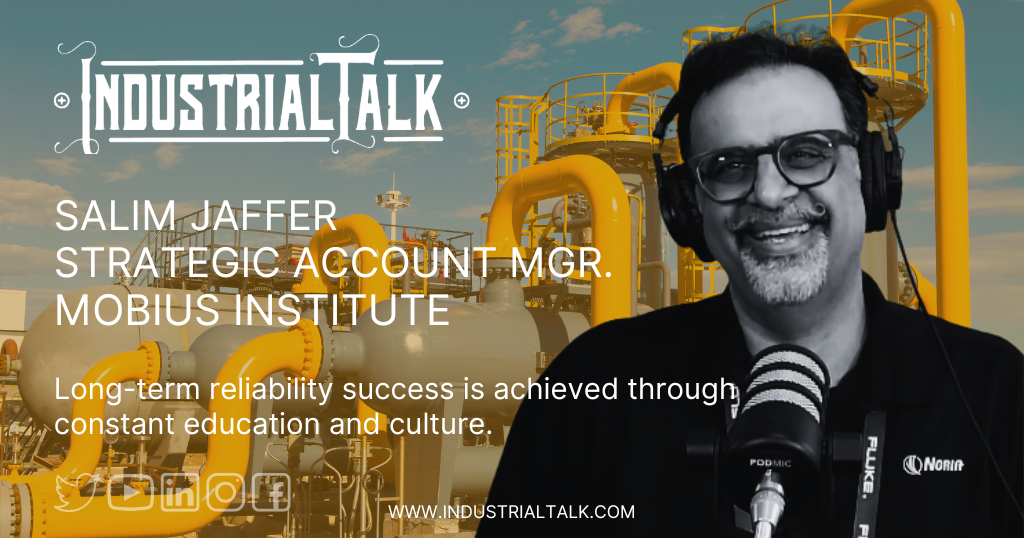
Industrial Talk is onsite at Xcelerate 2026 and talking to Salim Jaffer, Strategic Account Manager at Mobius Institute about “Reliability success = Culture”.
Overview
The conversation features Salim Jaffer, a strategic account manager at Mobius Institute, discussing his extensive experience in the industry, particularly in reliability and root cause analysis (RCA). He highlights his background with companies like Bentley Nevada, GE, Baker Hughes, and Emerson, and his current role in developing partnerships and training in the Gulf Coast region. Jaffer emphasizes the importance of RCA, the need for a cultural shift towards reliability, and the role of data in predictive maintenance. He also promotes Mobius Institute's professional training programs, which cover various aspects of asset management and reliability, including vibration analysis, lube oil analysis, and ultrasound training.
Outline
Fluke Xcelerate Event Overview
- Scott introduces the Industrial Talk podcast, sponsored by Fluke, highlighting the Xcelerate event.
- The event focused on reliability, predictive maintenance tools, and AI diagnostics.
- Scott emphasizes the importance of real-world strategies for teams to use today.
- Fluke is praised for their contributions to smarter, faster, and reliable operations.
Introduction to the Podcast and Salim Jaffer
- Scott reiterates the podcast's mission to celebrate industry professionals and their contributions.
- The event, Xcelerate, is being held in Austin, Texas, and is sponsored by Fluke.
- Salim Jaffer is introduced as the guest, representing Mobius Institute and other organizations.
Salim Jaffer's Background and Experience
- Salim Jaffer shares his extensive experience in the industry, including 30+ years with various companies.
- He details his time with Bentley Nevada, GE, Baker Hughes, and Emerson, focusing on reliability solutions.
- Salim is currently a strategic account manager for Mobius Institute, covering the Gulf Coast region.
- He discusses his role in developing partnerships and representing the Mobius Institute brand.
Root Cause Analysis (RCA) and Human Nature
- Salim explains his three-hour session on root cause analysis (RCA) at the Xcelerate event.
- He emphasizes the importance of RCA and shares personal anecdotes about his instinctive problem-solving nature.
- The conversation touches on the challenges of human nature in plant operations and the need for a collective approach to reliability.
- Salim highlights the importance of training and cultural change to foster a shared responsibility for reliability.
Challenges in Plant Operations and Reliability Culture
- Salim discusses the common issue of plant managers claiming everything is fine, despite obvious problems.
- He shares examples of hidden issues, such as broken sensors and improperly set-up equipment.
- The conversation explores the need for a culture where everyone understands and supports reliability efforts.
- Salim mentions the General Electric (GE) culture change training and its effectiveness in fostering a shared responsibility for reliability.
The Role of Technology and Data in Reliability
- Salim and Scott discuss the evolving role of technology, particularly AI, in predictive maintenance.
- Salim shares his experience with AI and neural networks in the early 2000s, emphasizing the importance of data.
- The conversation highlights the need for clean data and the challenges of working with historical data.
- Salim promotes Mobius Institute's training programs, which include hands-on experience with data and tools.
Mobius Institute's Training and Certification Programs
- Salim provides an overview of Mobius Institute's professional training programs.
- The training covers various aspects of reliability, including vibration analysis, lube oil analysis, and ultrasound.
- Salim emphasizes the importance of the Asset Reliability Professional (ARP) program, which is certified by ISO.
- The ARP program offers training at different levels, from entry to leadership, focusing on improving reliability through systematic methodologies.
Conclusion and Contact Information
- Salim reiterates the importance of education and continuous improvement in the field of reliability.
- He encourages listeners to reach out to him via LinkedIn for further discussions.
- Scott Mackenzie wraps up the podcast, highlighting the importance of human connection and storytelling in the industrial field.
- The podcast concludes with a reminder to visit Mobius Institute's website for more information and to stay tuned for future episodes.
If interested in being on the Industrial Talk show, simply contact us and let's have a quick conversation.
Finally, get your exclusive free access to the Industrial Academy and a series on “Why You Need To Podcast” for Greater Success in 2026. All links designed for keeping you current in this rapidly changing Industrial Market. Learn! Grow! Enjoy!
SALIM JAFFER'S CONTACT INFORMATION:
Personal LinkedIn: https://www.linkedin.com/in/salimjaffers/
Company LinkedIn: https://www.linkedin.com/company/mobius-institute-north-america/
Company Website: https://www.mobiusinstitute.com/mina/
PODCAST VIDEO:
THE STRATEGIC REASON “WHY YOU NEED TO PODCAST”:
OTHER GREAT INDUSTRIAL RESOURCES:
NEOM: https://www.neom.com/en-us
Hexagon: https://hexagon.com/
Arduino: https://www.arduino.cc/
Fictiv: https://www.fictiv.com/
Hitachi Vantara: https://www.hitachivantara.com/en-us/home.html
Industrial Marketing Solutions: https://industrialtalk.com/industrial-marketing/
Industrial Academy: https://industrialtalk.com/industrial-academy/
Industrial Dojo: https://industrialtalk.com/industrial_dojo/
We the 15: https://www.wethe15.org/
YOUR INDUSTRIAL DIGITAL TOOLBOX:
LifterLMS: Get One Month Free for $1 – https://lifterlms.com/
Active Campaign: Active Campaign Link
Social Jukebox: https://www.socialjukebox.com/
Industrial Academy (One Month Free Access And One Free License For Future Industrial Leader):

Business Beatitude the Book

Do you desire a more joy-filled, deeply-enduring sense of accomplishment and success? Live your business the way you want to live with the BUSINESS BEATITUDES…The Bridge connecting sacrifice to success. YOU NEED THE BUSINESS BEATITUDES!
TAP INTO YOUR INDUSTRIAL SOUL, RESERVE YOUR COPY NOW! BE BOLD. BE BRAVE. DARE GREATLY AND CHANGE THE WORLD. GET THE BUSINESS BEATITUDES!
Reserve My Copy and My 25% Discount
Transcript
SUMMARY KEYWORDS
Industrial Talk, Fluke, Xcelerate event, predictive maintenance, AI diagnostic, root cause analysis, reliability, Mobius Institute, training, asset management, vibration analysis, prescriptive analytics, condition-based maintenance, data analysis, human nature.
Industrial Talk is brought to you by Fluke. We were on site at Flukes Xcelerate event where reliability reimagined came to life from high energy keynotes to hands on predictive maintenance tools to break through AI diagnostic the event delivered real world strategies teams can use today. Xcelerate once again, proved why it is the launch pad for smarter, faster, reliable operations go out to Fluke.com to find out more.
Welcome to the Industrial Talk podcast with Scott MacKenzie. Scott is a passionate industry professional dedicated to transferring cutting edge industry focused innovations and trends while highlighting the men and women who keep the world moving. So put on your hard hat, grab your work boots, and let's
go all right, once again. Welcome to Industrial Talk. Thank you very much for joining the number one industrial related podcast in the universe that celebrates you, industry professionals all around the world. Yes, you're bold, you're brave, you dare greatly, you innovate, you collaborate. You're making the world a better place. Take that, bring it into your heart and know that you're making the world a better place. That's why we celebrate you on Industrial Talk. You are the heroes in this story. We are broadcasting here in Austin, Texas. The event is Xcelerate. It's brought to you by those wonderful people at Fluke. Go out to Fluke.com find out more. You will not be disappointed. That's Fluke.com they're great people. They're nice to be hanging with. All right. Salim Jaffer, he's in the hot seat. Mobius is the organization. Of course, he comes, peppering me with all the other organizations that he's in, and I can't keep up with it, so I'm like, I'm gonna fail miserably. Let's get cracking with the conversation. Yeah,
all right,
there you go, man.
Thank you very much for Thank you,
Jeff. I like your stash. That's us.
I keep hearing
fancy stash. I like that a lot. You having a good conference?
Absolutely. I was pleasantly surprised. I was asked by Mobius Institute to present a paper on root cause analysis. So day one, I had a three hour session on that one, and it was very well attended. I was expecting the right people there, and I did end up with right people. Majority of them were plant managers, reliability managers, yeah, so they are interested in RCA.
I'm going to digress. I just have to, because I have a you know, how many times we've talked about ruse cause analysis, you know, you know, I had hair when we were talking about I don't have it now, but we're still talking about it, and still, there's still room to improve
Absolutely. There is, there are tools out there, and I can tell you about my background, which kind of helps,
yeah, because we're gonna get there. It is segway right now. Tell us about your background.
So I, I've been in the industry for about 30 plus years. 21 of those was with Bentley, Nevada, so very well known in rotating machinery, vibration
system.
It was then acquired by GE then got acquired by Baker Hughes, and that was a time when I moved on to Emerson last eight years, seven to eight years I spent with Emerson, where again, responsible as a business development manager, supporting about 18 engineers in various reliability solutions. So I stayed in the reliability game for the longest time. After I completed my work at Emerson, Mobius Institute approached me, and I was like, Oh, this will be a nice way to kind of continue my journey. So yes, currently I am strategic account manager for Mobius Institute, covering the entire Gulf Coast region. Goal is to develop partnership businesses, develop partnerships with manufacturers and so on so forth, and represent them the brand of Mobius Institute, which is a very well known brand. I'm really proud to be part of their system, part of their training opportunities. And being part of Mobius actually allows you to grow with other businesses that are coming in. So you see, I'm wearing a Noria shirt, and, yeah,
I don't know. I know that it has something to do with Mobius. I don't know. Yeah, go for it.
So, so basically, what it is is both Mobius Institute and Noria are part of reliability one as a group of companies, and that's what they're doing. They're trying to grow their portfolio, and I become part of their team, so I'm dual branded, and everything when they acquire will be part of my responsibility to strategically grow and make it available for the for the industry. So most of my practical experience comes from the field.
Yeah.
I've been into nuclear power plants, hydropower plants, you name it. Platforms. Worked in Middle East, Abu Dhabi for about eight years, yeah. And then in United States, in the west coast of us, where I was working, in Phoenix, Arizona, yeah, covered all the power plants, one of the largest.
So you got a power power background?
I do. I
work for Southern California, Edison. And I was a transmission lineman,
one of my customers, Southern coffee, yeah.
What was San Onofre?
Yep, that was one of my plans, yeah. And I was one who put the system one software over there during my tenure with Benny Nevada. So I remember San Onofre very well before they shut
down.
Shut it down. It's a dead shame. I mean, beautiful facility.
It was right at the beautiful
San Clemente, I think it was, yeah,
San Clemente, and there was a Bentley office there in San Clemente.
Oh, yeah, okay, all right, let's talk a little bit about what you're talking about here. You had three, three hour conversation on root cause analysis, right? Tell us a little bit about what that is and anything else that we can find, but I'm just intrigued tell us about that
absolutely no thank you for the opportunity. I think root cause analysis is an innate part of any human being, men, especially. I'll give you an anecdote. Every time my wife or my daughter says, I have this and that problem, either it is a car or something technical. What is my instinct, jumping on and trying to solve that
problem? Solve
the problem? Yeah, that is root cause analysis, because my brain is already telling me, oh, maybe this is wrong or that is wrong. We are doing this already
interesting. It just irritates my wife.
It does. And I was going to go there, my wife and my daughter say, Dad, we just want you. Want you to hear our part of the story. I don't want you to fix it. And I'm still learning. It has been 38 years in my marriage, and I still do that to go roll up my sleeves and try to solve the right
off the bat. You, you jump in, yeah. Just gotta go and I, I'm, I'm in, I'm in action mode,
right? So that is, that is for a very basic understanding root cause analysis. To this day, I remember when I joined Bentley Nevada, one thing they did give me, it was a laminated sheet problem solving techniques, and it had all the tools that I learned later on, which is part of RCA, five wise Fishbone diagrams, yes,
yes, yes, yes,
all of that. And I was like, hmm, so I already know this. And innately, you know, being a friendly guy, you'll go and try, okay. I'm looking at this machine. This is the vibration signature. What are some of the possible problems that this machine is having? So immediately you go with process of elimination. You go, Okay, I think most likely this is a situation. You validate and you go, fix the problem. It sounds very simple. It isn't, yeah,
because we've been talking about this for the when I had hair, I already mentioned that is like, yeah,
system. It may be a Bentley,:How do you know?
Yeah, exactly. So they say this, because that's the human nature. We don't have any problem. Everything is fine. But in reality, when they asked me to, okay, yeah, you can come and see our control room soon as I go there and I see those red lights. What happened there? If you're saying everything is okay? Oh, last time, you know, we broke one of the sensors. The guy stood on it, and it's gone.
Ridiculous.
Wait for that. Or it is outside the spec, because it was a thrust probe, and the way we set it up, after which the rotor came in, after repair, we put it in, somebody didn't do a good enough job. So here it is, showing me red still, although I know that it is going to be okay until the next outage. So things like this happen all the time, and the human nature is to be protective, defensive. So one of the things the way I gave and recommendation to those plant managers was this, that the only way you will have support from people who are working in the field, technicians, control room, people, electrical techs, mechanical techs and engineers, for that matter, is when everybody is on the same page, and the best thing to do that is to get them through the realization that reliability is everybody's job. So I'm not trying to do a root cause analysis, so I can point a finger at you and slack. Hey, you failed. You are the reason why we are having this trouble. So there is a training which is very well known. MRG used to do that. I'm certified by MRG as a reliability game instructor. And what we do is sit people around on a table. They go through the training and they realize that if I'm a plant manager, I'm making a decision to shut down one machine out of four. What are the risks? And there is an operations manager who's talking about that. There's a reliability manager on the third seat, and the fourth one is just, is an accountant is just doing ROI every minute you're you're moving, okay, I'm taking Unit Two out of commissioning. Are you going to do pm there, or what? So that real makes people realize their roles, and then we rotate them. So the idea is for you to recognize that reliability is a responsibility of the entire organization. So that's what I recommend,
how and with that said, it's how do you deal with the individuals? Because it's a people, it's people that just say, we're going through another it's not going to be sustained. I can't, you know, management doesn't really, you know, the whiners, yeah, how do you, how do you deal with that? Because it gets down to that culture, and that culture needs to truly be transformed and stick Absolutely.
So I'll sound like a GE guy again. The reason for that is General Electric used to do one training, which we call it culture change. And that culture change training is a day long process in which you identify those things that you know, the whiners, and this is, yeah, get them to same page. So say we have to change from what we are, because if we continue to do what we are doing, we will not get there. If we our goal is to get into a better quartile of a reliability company, the best way to do that is to have some changes in the way we are operating. And if that is realized, and it's not an easy ask. I can see skepticism on your face, like, Okay, well, just by telling it is not going to change, yeah, yeah, it doesn't. You're right, but I think it is a repeated feeding of this information. Hey, reliability is everybody's responsibility. Let's make sure we had everybody's doing the best that they can. And yes, there will be misses, there will be mistakes. Let's correct those mistakes and then not repeat them again, and you know, next time around. So those are some of the things we talked about. Yeah, and it has to for any, any reliability effort. It has to be sustained. It has to be that culture. It is a human equation. Absolutely,
it has nothing, zero to do with the technology. The technology is fantastic. It's great. It's wonderful. You set it up, and it's all great. It's always the human side,
exactly has been, always going to be there.
Yeah, see it is. So what else is popping in your mind? You're here talk to us a little bit more about your your expertise.
Expertise has been in I don't know how many of the people who are listening would know I started working on vibration when I was in Abu Dhabi.
What, what category area, whatever.
I was not certified.
And
you'll be surprised, because we were talking about training in Bentley, Nevada, before even these category one through four was
Yeah.
So in Bentley, you will have either basic vibration and then advance, and that will qualify you to be able to go do analysis and so on so forth. So I did both, as it was part of my training that prepared me to then switch into the role of not being a vibration analyst, but being in the sales. And I think I found my comfort place in the sales, and I was able to grow the business for Bentley, then grow the business for Emerson, and now I'm here to grow the business for Mobius.
But when we start talking about vibration, that's all condition based, that's it's like, so you're looking at that asset, you're saying, Okay, look at that vibration. Yeah. And, and now with AI, hopefully it's able to sort of take that, those squiggly lines, and be able to just sort of effectively do that and say, Hey, we think the problem's here. And then give it or hand it over to a human being, and then the person says, yeah, yeah, it looks like it is. No, no. It's not that type of thing. So you've been in the business. You've been in the industry for a long time, clearly. And do you see just, just in general, the do you see companies begin to really embrace the principles of asset management reliability, because it's strategic, as opposed to, why are we spending this money here and all that stuff? I think, I think it's, it's critical.
Scott, that's a great question to ask. I would respond by saying, when you talk about. I'll say early 80s and 90s. This was still a sign since, like, I don't need to do that, I'll be fine. I still have my screwdriver. I can listen in if it is making noise, it's high vibration. I think the last five to 10 years, there has been a shift the word reliability. I mean, look how many titles of reliability engineers you will find in various plants. It tells you that it is, it is a thing people are doing, taking notice and understanding. And I think the newer generation, as they come around, they will be able to do more of this. Ai involvement. Now, when you talk about AI, please don't think that this was invented when you know chat GPT came around. I was doing ai 20 years ago, and some of the solutions using neural networks with some of the plants in Arizona, so don't comment. And then some of the tools that we have
hold it, I have to see when you say, Arizona, I worked for Arizona public service. I did a I did the tone, which is a transformer oil analysis notification project,
which plant never,
wasn't it was more substation specific. They had a catastrophic failure of one of their 500 KV transformers. And you know what they did? They weren't taking oil analysis, they weren't looking at the dissolved gasses. They were just letting it go. And it failed. And it failed during summertime, which is not good. And you know, It's as hot as can be there,
118 degrees,
yeah, and so, and I acquired a neural net out of a some masters program out of Virginia Tech to try to deploy it, and used a product called server on, I don't even know if there that would take constant oil makes sense, oil and oil, analyze it,
learn it.
Fine. Good deal. You know. The problem was, it was just data. I had no place to put the data. I was just like data like
then, then it required human intervention to interpret the data. Yeah. And I think we have made a brick progress from that point onwards,
yeah.
So if you're using an Emerson:right
that you can always incorporate in your AI and do what you were saying exactly. So prescriptive analytics has been around for a long time, because people know how a machine is going to behave under certain ambient conditions. Example, you have a gas turbine in Las Vegas, Nevada, the ambient temperature has raised. This is going to affect the way your your efficiency going
to Yeah,
and you can measure that,
yeah, the holy grail at that time was to be able to say, Okay, I'm not doing planned maintenance. And I got I'm not going to, I'm not going to spend the money on taking this, this motor out, doing whatever maintenance on it, and then doing it again. I am going to do something smart and see when I need to, and be able to do the maintenance at the right time so that I can optimize, minimize the impact, but optimize the value of that and then impact my my financials in a positive way,
absolutely. So you're now talking about what you just defined is a difference between break, breakdown maintenance,
yeah,
time based maintenance. This is all old technology. We are moving away from that.
Yeah,
we are doing condition based maintenance, or predictive base maintenance. So we are, we are moving and so here is a proof that people have moved away from that. So reliability is is a new, big thing in industry today.
I think it's critical. I think it's bottom line value. I think it's it's necessary for a business to be resilient. Do you think, do you think we can really get to the point where I'm, I'm pulling data off of that asset, whatever vibration, heat, whatever, whatever I'm pulling, and get it to the point where I can truly have a high confidence of when that asset is going to fail.
This depends on how much data you have. See we are still new in this area we have so I was listening to the person who talked about Fluke condition monitoring, and the reason why they are able to predict some of the machinery failures is because they have a data from Azima DLI, oh yeah, years and years, forever, yeah. So again, it is database. And I think in the past, we did not value this much. Now we realize that this all LLM. Those are based on data. If you have the large language model which it can look at some of the data and interpret it and then come to a solution that is, that is the key,
yeah.
So it will become better as we go forward,
see and that also it. You can't help but have that conversation around, hey, I'm going down this road. I want a more reliability operation, so I'm going to commit and invest in what I need to do. I have a technology stack that exists. It has data. But you know, as well as I do that data stinks, and so you can, you always have to be addressed by the fact that, well, how can I go back in history and and create clean data? Or I just, sort of, now, I'm going to go forward and just just live with that and then build that, that historian.
So this is the time I think I'll plug in my current role, which is obvious Institute training. It's a professional training. It is exceptional than anybody else that is offering today because of the fact that during the training, whether you're a category one through four, you are offered an opportunity to look at some of the animations, some of the tools in which you can actually play with data and see that that's what you were talking about, and that is why Mobius training being accredited. That is your Career Builder as well. With your category three, category four, you can go anywhere and have a job that I can guarantee you right now.
But
other than that, there are so many four other technologies. We also train in lube oil analysis. But yeah,
yeah,
that is MLA as an engine at the highest level of engineer from the technician level. Likewise, we have got Ultrasound Training, yeah, we have got other training in thermography. We also do one of the most important thing, which I will end on the pitch regarding Mobius is, which we call ARP, which is asset reliability, professional training. It is certified by ISO. You can be at the level of engineer. You can be at the level of entry level, where you're just learning the practice. And you can actually be a leader level, ARP person. There is a methodology that we apply from A to Z, in which we apply to say, how are you going to at the end of that last point, your reliability has to have improved, because you're doing all the things in sequence in order to get there. So I emphasize during my training this presentation, I also emphasize ARP a lot, because I could see the plant managers are sitting there, and they are fighting this culture problem, human problem. If you go through that training, you'll be able to understand how to work with those and to be able to get buy in from everybody else in order to move your needle in the right direction.
I like it. And you just go out to Mobius institute.com
Yes,
is that the URL? It's not just mobius.com it's Mobius
Institute. You got it
Salem, how do people get a hold of you?
LinkedIn, I have the profile right there. I sent you a card.
Oh yeah, you were the one I was. All right. Well, I love this conversation.
I enjoyed talking.
You nailed it.
Thank you, sir. All
e in Austin, Texas, Xcelerate:You're listening to the Industrial Talk Podcast Network.
Put that on your calendar for: