Scott Kraemer with Xact Metal
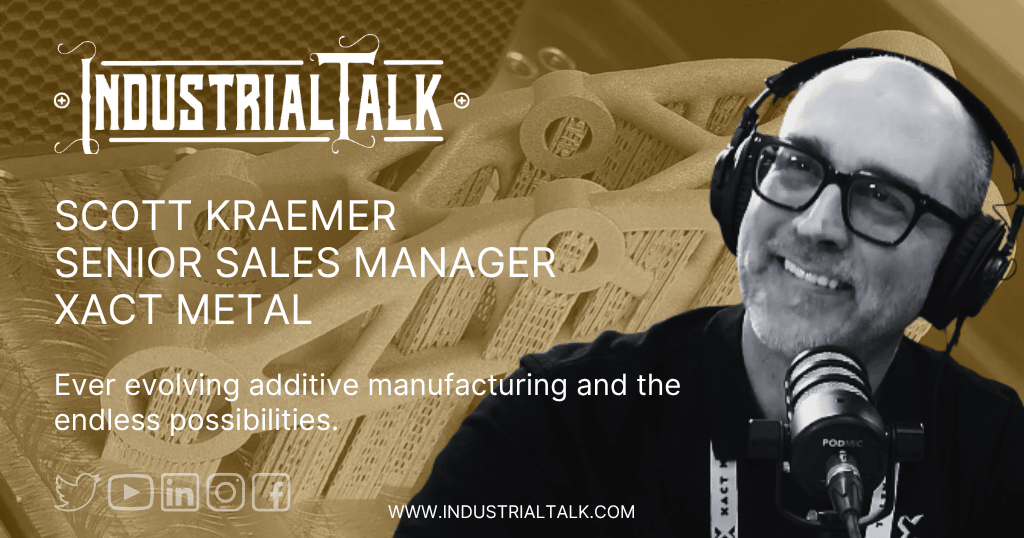
Industrial Talk is onsite at MD&M West and talking to Scott Kraemer, Senior Sales Manager at Xact Metal about “Evolution of Additive Manufacturing”.
Scott Kraemer, a seasoned manufacturing professional with over 35 years of experience, discusses his company, Xact Metal, which specializes in affordable 3D printing of metal parts. Xact Metal's printers, made in the USA, are priced around $160,000 and can handle various materials like stainless steel, Inconel, and titanium. Kraemer emphasizes the importance of educating the youth about manufacturing careers and the potential of 3D printing to revolutionize industries, particularly in tooling and medical applications. He also highlights the company's nimbleness in adapting to industry needs, such as printing with sub-15 micron powders for intricate details.
MDNM West Event Introduction and Welcome
- Scott introduces the episode of Industrial Talk, sponsored by MD&M West and News and Brews, highlighting the event's focus on med tech, automation, packaging, plastics, and design.
- Scott thanks listeners for supporting the podcast and celebrates industry professionals for their boldness, bravery, and problem-solving skills.
- Scott mentions the importance of attending MD&M West in 2027 to meet industry leaders and innovators like Scott Kramer.
Scott Kramer's Introduction and Background
- Scott introduces Scott Kramer, highlighting his role at Xact Metal and the company's contributions to solving today's problems.
- Scott Kramer shares his extensive experience in manufacturing, including plastic injection mold design, sheet metal stampings, and automation equipment.
- Scott discusses his transition to 3D printing in metal about 15 years ago and his efforts to educate the youth about manufacturing careers.
- Scott mentions his current residence in Raleigh, North Carolina, and his background in Metro Detroit.
Xact Metal's Solutions and Market Position
- Scott explains that Xact Metal makes 3D printers for metal parts, making the technology affordable for a wider range of users.
- He describes the company's printers as being made in the USA and sold globally, with a price range starting around $160,000.
- Scott highlights the company's focus on making metal 3D printing accessible and the variety of materials they can work with, including stainless steel, Inconel, and titanium.
- He discusses the company's nimbleness in developing new printers to meet specific industry needs, such as the ability to print with sub-15 micron powders for tiny details.
Challenges and Opportunities in Additive Manufacturing
- Scott addresses the challenges of multi-material printing, explaining the limitations and potential solutions.
- He discusses the preferred materials used in their process and the company's focus on the tooling industry, which has been slow to adopt metal additive manufacturing.
- Scott emphasizes the design freedom and efficiency gains possible with 3D printing, citing examples like lattice structures for bone growth and custom watch designs.
- He highlights the potential for faster production times and cost savings with 3D printing, especially for parts with smaller cross-sectional areas.
Inspiring the Next Generation of Manufacturers
- Scott shares his personal journey of discovering a career in manufacturing through his visualization skills and early job experiences.
- He discusses his efforts to educate students at all levels about manufacturing careers, emphasizing the importance of starting early.
- Scott shares a story about his son's apprenticeship at Superior Tooling, which helped him discover his passion for hands-on work.
- He highlights the need for more apprenticeship programs and better awareness of manufacturing careers to inspire the next generation.
Conclusion and Contact Information
- Scott provides his contact information, encouraging listeners to reach out to him on LinkedIn.
- Scott thanks Scott for his time and insights, emphasizing the importance of inspiring the next generation of manufacturers.
- Scott wraps up the episode, encouraging listeners to attend MD&M West in 2027 and to connect with Scott and Xact Metal for more information.
- The episode concludes with a promotional message about Industrial Talk's media, marketing, and PR services for the manufacturing industry.
If interested in being on the Industrial Talk show, simply contact us and let's have a quick conversation.
Finally, get your exclusive free access to the Industrial Academy and a series on “Why You Need To Podcast” for Greater Success in 2026. All links designed for keeping you current in this rapidly changing Industrial Market. Learn! Grow! Enjoy!
SCOTT KRAEMER'S CONTACT INFORMATION:
Personal LinkedIn: https://www.linkedin.com/in/scott-kraemer-%E2%9A%99%EF%B8%8F-b781481a/
Company LinkedIn: https://www.linkedin.com/company/xactmetal/
Company Website: https://xactmetal.com/
PODCAST VIDEO:
THE STRATEGIC REASON “WHY YOU NEED TO PODCAST”:
OTHER GREAT INDUSTRIAL RESOURCES:
NEOM: https://www.neom.com/en-us
Hexagon: https://hexagon.com/
Arduino: https://www.arduino.cc/
Fictiv: https://www.fictiv.com/
Hitachi Vantara: https://www.hitachivantara.com/en-us/home.html
Industrial Marketing Solutions: https://industrialtalk.com/industrial-marketing/
Industrial Academy: https://industrialtalk.com/industrial-academy/
Industrial Dojo: https://industrialtalk.com/industrial_dojo/
We the 15: https://www.wethe15.org/
YOUR INDUSTRIAL DIGITAL TOOLBOX:
LifterLMS: Get One Month Free for $1 – https://lifterlms.com/
Active Campaign: Active Campaign Link
Social Jukebox: https://www.socialjukebox.com/
Industrial Academy (One Month Free Access And One Free License For Future Industrial Leader):

Business Beatitude the Book
Do you desire a more joy-filled, deeply-enduring sense of accomplishment and success? Live your business the way you want to live with the BUSINESS BEATITUDES…The Bridge connecting sacrifice to success. YOU NEED THE BUSINESS BEATITUDES!
TAP INTO YOUR INDUSTRIAL SOUL, RESERVE YOUR COPY NOW! BE BOLD. BE BRAVE. DARE GREATLY AND CHANGE THE WORLD. GET THE BUSINESS BEATITUDES!
Reserve My Copy and My 25% Discount
Transcript
SUMMARY KEYWORDS
MD&M West, industrial innovation, additive manufacturing, 3D printing, metal parts, Xact Metal, manufacturing careers, tooling industry, design freedom, sub-15 micron powders, multi-material printing, apprenticeship programs, injection molding, News and Brews, Informa.
Hey! This episode of Industrial Talk is proudly brought to you by MD&M West and the incredible News and Brews team. MD&M West delivered big med tech, automation, packaging, plastics, and design. All came together under one roof. The innovation, the energy, the conversation-it was everything that makes this industry extraordinary. I was on the floor capturing the stories, the breakthroughs, and the leaders who are shaping the future. Thanks for tuning in and celebrating the people driving industrial innovation. Industrial Talk, powered by MD&M West and the News and Brews team.
Welcome to the Industrial Talk podcast with Scott Mackenzie. Scott is a passionate industry professional dedicated to transferring cutting-edge, industry-focused innovations and trends while highlighting the men and women who keep the world moving? So put on your hard hat, grab your work boots, and let's go!
aid I'm sorry to hear that in:Good. How you doing?
No, no complaints.
Good.
No, I'm going to complain right now.
All right, go for it.
Yeah, and you're going to listen to it because you you have headphones on. We're just stuck in this salt mine. You know what the problem is? Is that we haven't been to any of the other halls, and there's a ton of incredible stuff out there.
So much to see, so much to learn. It's like
little bubble here, and I want to see more.
Yeah, yeah. I get in typically two hours before it opens, just so I can explore and see what else, see whatever, what else is out there. It's no way, really. Yeah, yeah. There's a lot of cool stuff to see. Granted, a lot of booths aren't open, but just getting an understanding of what other people are doing.
That's putting a finger on the pulse of you know because I would imagine you get to get a sense of saying I didn't know that was a problem.
Yeah, Xactly. Well, I'm looking for things not only that like where whether it's for a business or for ideas or just thinking differently, I'm just always looking for something-not necessarily the next thing, but just trying to understand where people are, what people are doing, where the industry is going. Right, and the best way to do it is to talk to people, walk around, see stuff.
It's true. Well, I'm I'm envious of you. I like that a lot.
All right. Well, I know it's not my hair, but you are having a good
conference, right? You
are having. Oh, I'm having a great conference. Why is it a great
conference?
To be honest, we've I'm learning a lot, learning a lot. Like, even though we're here to kind of educate the people on what we can do, what Xact metal does, or just the industry in general, but I'm also learning a lot, and I think that the to see where people are having problems, and how either whether it's our technology or another technology, we can direct them. Right at the end of the day, we're just trying to help people find solutions for what they're trying to do.
Yeah, and speaking of which, I mean, when well, I will get into it. We're going to jump into I before we jump into that conversation, I want to know who you are. Let the listeners know. Give us a little 411 on who Scott
is. Ooh, that's a tough one. So, so I'm. Is it? It's you, Scott. I know. I know. But it's always like you know, trying to describe yourself is always a challenge, right? So yeah. So I've been in manufacturing for over 35 years. Yeah. So, plastic injection mold design, mold build, sheet metal stampings, automation equipment, et cetera, et cetera, right? And anything having to do with manufacturing. Started printing parts in metal, probably about about 15 years ago. Realized that there's an avenue that that could be another way to manufacture stuff, basically, right? 3D printing, as everybody knows, but you need to know both sides of it, both subtractive manufacturing and additive manufacturing. So I've done a lot over the years working with high schools and colleges, trying to educate the youth. Now that's cool. Now
I'd love to pull on that string for a bit. Just oh yeah, continue.
Yeah. So I spent a lot of time doing that, trying to educate the youth. In that there's other career opportunities besides colleges. Not that college is the wrong thing to go, right? Everybody's got their own thing, but there's a lot of other avenues you can do to create live. Because I know I wasn't the college guy. I wasn't that right. I had I went a different route. I was a kid that was sat in the back of the room and colored all day long, right? And drew drew pictures. So typical career paths weren't my thing. And I've got four kids, and two of them, school was their thing, and the other two, it's not their thing. They're more hands-on learners, right? So everybody's different, and I just wanted to make sure that kids have an option. Explain that, explain to them what careers in manufacturing could be, and where they could go, and you can make six figures, make really good salaries doing it.
Yeah,
yeah.
What do you call home?
Currently, Raleigh, North Carolina. Raleigh. So yeah, born in born in Metro Detroit and moved down. My wife got tired of the snow, so we moved. It's cold up there. It's cold up there. So we moved south about eight years ago. Yeah, love it down there now. Yeah,
many years ago, back in the early '80s, I spent some time in Grosse Pointe, Michigan.
Oh yeah, yeah, beautiful area. It was
yeah in in January when
oh a lot of snow. And it
was not just snow; it was cold.
Yeah, it's a different kind. It's like bone chilling cold. It's a different kind of cold. Beyond
that, man. Yeah, I had my beard back then, and it was just freezing up. And I thought, God, I was born in California, never experienced anything like that. All right, let's get into Xact metals. What what problems are you solving?
All kinds of problems. So basically, we the first problem we solve is making 3d printing of metal parts affordable.
So you're doing a lot of additive type of manufacturing.
Yeah, we actually make the printers.
Yeah. Oh, you make the yeah. We make them here in the
USA and we sell them globally.
Okay, continue.
So, and the nice thing is, I think the biggest gap was being was people being able to understand how to 3d print in metal because it's a big difference. It's a big shift from plastics, but also having an affordable printer in that price range that people can, you know, hey, do I buy a CNC machine or do I buy a 3D printer, right? 3D metal printer, right? So we're in that price range, you know, starting around 160k to give them that idea that hey, you can now start to adopt metal additive into your shop, right? Now things that you're making can either go this direction or that direction depending on what you're trying to do, but so problems we're trying to solve first off was getting the affordable price range. On top of that, we have a multitude of materials that you could do with laser powder bifusion. So the technology's been around for 35 years. It just hasn't been affordable for most shops to be able to adopt. So we've made it easy to think of it like the. I always best way to describe it would be like the Model T, right? Making it affordable for every man to be able to use and you know simple. That's what we've done, right? Right. And the best thing is it's made here stateside. So, but the and one of the things we're doing is we're a small company, so we're nimble. So as we see industries pop up or potential with industries like here at the medical stuff, looking for tiny features. Well, we just developed a printer last month that we finally got it ready last month. That we can go, we can actually flow. It's called sub 15 micron powders, which is unheard of for laser powder bed. So we can get very tiny detail like 5 thou wall stock kind of thing, which is really unheard of for that. So, but we realize here at this industry, right? That's what I'm saying. I'm learning. I'm looking around, walk around, seeing stuff, and like, oh, you know what? I could print that. You know what? I could print that, and let's let's develop the printer to be able to do that kind of stuff. And we've done that.
The I have to ask you because I don't know. Here's here's a question I would have your, and I don't have an answer.
That's okay.
Does your printer can your printers accommodate sort of a multi-speed stock option,
like multi-materials?
Multi-materials. No,
not today. The hard part you have with that there is a company in Belgium that's doing it. They've developed doing multi-material. The downside is, is once I once I start to build a part, think of it like a let's say a five by five square. Right. Once I lay across two materials, and then I come back, I laser them, weld them together, right, and come back across again. That when you go to take those parts out, you're now going to mix those powders together. So now all that powder becomes scrap, right? So that's so while the multi-material is cool, I think there's there's limitations to it, right? And they may have a way to separate it that you know that's beyond me. But but right now we're just a single material. The nice thing is our build chamber is fairly small, so you can you know you can clean it out in about a couple hours to swap materials.
Material. What what is the preferred material used in your process?
You can do. So we do 316L stainless, 174 stainless, Inconel, 625, 718, Hastelloy, right? So rockets, that kind of stuff. Firearms, a lot of that. We could do titanium, aluminum, tooling steel, which is my background with injection molding. I'm really helping us focus on the tooling industry because that's a big market. That honestly, a lot of the metal additive players have looked at and said, "Yeah, I'm not going to bother with it. Who cares about tooling? Tooling's not going away. You look walk around here, and you just see tons of everything that's been injection molded or extrusions, and all of that can be have conformal cooling in it or have better properties, the tooling steel itself, and be printable, right? So now you're taking away this whole, like we talked earlier about, like the careers, right? There's a gap. All of us old timers are retiring from the industry, and not enough young kids care enough about injection molding, let alone know what it even is, right? To be able to replace that, so we have this gap here that we're trying to cover, and with 3D printing, I think just about every kid nowaday in high school is doing 3D printing, or at least they understand it. That's for sure. So if we can 3D print metal parts or or metal tooling itself, and entice those people just from a 3D printing standpoint into our industry, then maybe it kind of opened our eyes to what could be done as far as tooling industry or plastic manufacturing that kind of thing.
With 3D, with 3D printing. We're talking about creating also unique products that push the design envelope to its edge and be able to do it and deliver to create a product that may be more efficient, more you know strong stronger, lighter, whatever it might be.
Yeah. Oh, for sure. Yeah, yeah, yeah. Especially if you see, if you walk around, you'll see some stuff like a lot of stuff for bone growth, osseointegration. Yeah. So you're pruning like a lattice structure in titanium parts or stainless steel parts that allows that helps promote bone growth, right? So it's something you just can't do with standard traditional machining. So there's that. There's I've I'm like I mentioned before. I'm a watch guy, right? So I design my I design and build my own watches in 3D printed metal, and I'm doing designs that just can't. Yeah, I don't have one. I was getting ready. I'm going out. I'm
dropping that. I'm going. What is on his arm? It's
in my backpack and over in the in our booth there. I should have wore it here. I wouldn't realize it, but I'll I'll swing by a little. You have to because I have to see that. Okay. Yeah. So, so that kind of stuff, right? So the idea is it's opening up design freedom, what I'd call it, right, for people to be able to do things differently.
Yes. Yeah. Absolutely, I agree with you 100. There was always the, and and I haven't had a conversation about additive manufacturing, 3D printing, in some time, and it was always there was a are we able to achieve a faster result speed? Like, okay, I got my design that that that.
Yep. Yeah, you can definitely. It's going to be part specific or more so cross sectional area. So what do you mean by that? Is like if you were to take like a 2d planer section through a part, the thicker, the bigger the mass it's going to be, the longer it's going to take to print. The thinner the mass, the the faster it can print. For so, let's see. It's been almost 10 years now. So 10 years ago, I started doing plastic ejection mold inserts that were hollow, right? Which is unheard of because you take a big brick and you machine it back. Right, no, I'm printing them hollow or lattice structures inside. I'm light weighting them. Right, right, right. Stuff the industry just didn't accept 10 years ago. Right, here I am 10 years later, still pushing the envelope, and people aren't adopting it here in America. In Europe, they're adopting it, but not here in America. And that's a whole nother, just a whole different way to look at it. So, so when he talks about speed, that's where I can print faster because I've got a smaller cross section every single layer I print. So, therefore, I could print faster. I use less material, piece price is cheaper, and then on top of that, your tonnage ratings. There's all kinds of stuff. I can go down a rabbit hole and no, no, no, but yeah.
There was a point, or somebody was having a conversation around market acceptability. So I'm in the airline business, right? And I want parts that can be replaced in airlines. There was at that time years ago, the airline industry wasn't really into that at that point in time because it's still sort of, whoa, that's new. We we can't afford that, or we can't. We the risk. Are we getting past that?
Nope. Still still got all those regulations, right? You got just because the insurance reasons alone. Yeah. So for all the fly to there's $1 per. I don't even know what the calculation is, right? For flying for the planes, whatever that calculation is, right? The lighter the better, right? Because it's which makes sense. So you can do a lot of you can do a lot of light weighting apart, geometric you know geometric designs or more organic style designs that could get better. But then it's like okay, what's the impact resistance to it and the potential for you know whatever problems could happen. Same thing with the with all implantables in the bodies. Right, same thing. You can do some crazy cool designs, but at the end of the day, it's the insurance that's going to really override some of that stuff. Yeah, but it's
going to change.
Oh, I agree completely. Completely, it
can't help. It's it's just get with the program. It's going to happen. It's going to change, and it's going to it's going to be transformative, and it opens up whole just a whole plethora of other solutions that can be achieved through that technology. Through that, I want to I want to probe and talk to you about how you are inspiring the next generation of manufacturers. Why are you Why are you pleased? Why why do you want to do that for your for the youth?
To be honest, like like I mentioned before, like you know, school wasn't
my
thing.
Yeah,
right. I had a creative side of stuff. I could best way to describe it. I'll roll back here in history, and we'll roll through that real quick. Right, seventh grade, they have you do these tests to see what you're going to be when you grow up, kind of thing. Right, and the way I not studied the way I whatever finished right when he looked when he looked at the paperwork he said the best way I can describe you is you can look at a 2d drawing of a house and picture yourself walking through the house yeah
yeah
he's like you got this visualization skills that you know I don't even know I don't even know what you do for a career, right? Forward a few years later, I got my first job at a plastic injection molding company because I was an art student, right? So everything was on a drawing board. They hired me because of that,
right?
So I didn't even know that that career existed. I was doing it because I wanted to design cars, so they hired me in to do plastic injection molding, and I just fell in love with the idea. I could look at any part, and in my head I can visualize the entire mold, the entire process that's going to take to make that part. Right, right. So I kind of fell in love with this, and I'm like, I didn't even know it existed. How many other kids are like me that didn't know this stuff existed, and how are they going to know about it?
Yeah.
So I made it a point to start working when I was in Southeast Michigan. I was working with all the schools and high schools, even down to the grade school level, right? Because by the time you hit them in high school, a lot of time it's too late. So trying at the grade school level, going to college level, and just trying to get people to understand that hey, there's careers here. There's some even if you would want to do accounting, there's still mold shops that have accountants, right? Type thing. But the idea was people like to work with their hands. If you like building Legos, chances are you're going to like something to do with manufacturing.
Yeah, my my big passion is is what is that avenue? What is that approach to inspire the next generation of manufacturing and industrial leaders? I believe that we need to be definitely delivering information, delivering training, delivering that passion to to bring that next generation. If we don't do that, then we struggle. All this wonderful stuff that you see out here struggles, and we don't want that because I I think that we need to do that and and kudos to you thank you for being able for doing that and seeing it yeah because I I think it's a wonderful wonderful passion to do that yeah because we need it
agreed agreed my my 19 year old which is my third oldest was one of those kids again he works with his hands he's he's very good at actually. He's like one of these. He's a people person, so I think he'd be really good at sales. But in the meantime, he's really good at working with his hands. And he's like, I don't really know if college is is really for me or not. So he went around. We found a mold shop actually near me. It's called Superior Tooling in Wake Forest, North Carolina, and they had an apprenticeship program. Yeah. Right. So he got an apprenticeship program. He's learning to be a mold maker, and but the biggest thing that turned him onto it was the first day they had like a tour. They had bridgeport set up, and on the bridge port they had a mylar piece of paper on there, and they had just a sharpie marker in the head, and you had to turn the cranks and basically like trace the marker through a racetrack, right? And he's moving, he's turning the cranks, and that's when he realized that I really enjoy doing stuff with my hands, right? And then the next thing over, they had him on a lead, turning some materials, and he's like, "This is what I want to do, right? But how many kids don't even know that exist? They don't, right? That just did, right? And I think
we've done it as a as a society. We've done a disservice because we were always advocating kids to go to college, and we we lost a generation of of really capable individuals to be able to capture that lightning, that that passion in manufacturing, and it's a yeah we we we're behind the eight ball on that because when you start talking about other countries, they got it. They're doing it. They have apprenticeships. I I took. I I was a alignment, so I went through an apprenticeship program, four years.
Yeah.
But you knew what you were doing, and and it was fun.
Yeah.
But we need to do a better job at that.
Yeah.
All right. I I digress. That's good. People get a hold of you there, my friend.
You can get me on LinkedIn, Scott Kraemer, with a little gear next to my name there, or reach out via email.
ck it out. Be here next year,:You're listening to the Industrial Talk Podcast Network.
M D N M West brought to you by those wonderful people at Informa. Scott Kraemer right there, and I'm looking at his stat card, which you need to connect with LinkedIn stat card. See his pedigree. It's amazing. Xact metal is the company. So here's the deal. So he comes on by. We have this conversation at MD&M. Part of news and brews, and it's additive manufacturing. It's amazing. So I go to his booth. It's amazing. They've got all their stuff on the table. Of course, for me, I'm I'm I'm like a little kid in a candy syrup. I'm like, I'm looking around and I'm touching and I'm feeling and I'm picking up and I'm doing all that stuff. And they're amazing solutions. Amazing solutions. And of course, I did go look at that watch that he we talked about in the conversation. Yeah, it didn't disappoint. It was cool. It's cool. I don't know where this is going, but people like Scott and and and you know Xact metal, they're they're going to be blazing the trail for a long time and making things better. And that's what's all about MD and MS. You go walking up and down. It's in concourse with B, C. It's a. It's all over the place, and everyone has incredible solutions that want to solve your problems and be able to. It is. It's a. It's an amazing event. Put it on your calendar. Do not hesitate, and I'm sure it's in Anaheim next year as well. So look out and be a part of that wonderful event. Industrial Talk is a media company, yes, focused on telling your story. Industrial Talk is a marketing company, yes, to be able to take what you tell and your story that you amplify and get it out there in front of a bunch of eyes. That's what we want, as well as we do PR. We do it all from the perspective of industry, from the perspective of manufacturing, power generation. We have in-house all of those skilled individuals ready to help you succeed. Because that's it. You don't succeed, we're not happy. You need to succeed. Go out to Industrial Talk. Reach out. Have a conversation with me. You will not be disappointed. We are here to help you tell your story and get it in front of a bunch of eyes. That's what you need. All right. Be bold, be brave, and dare greatly. Hang out with Scott, X Xact Metal, and you will be changing the world. We're going to have another great conversation coming from MD&M West. So stay tuned.