Ted Pardee with Kognitiv Spark; Industrial Augmented Reality Solution
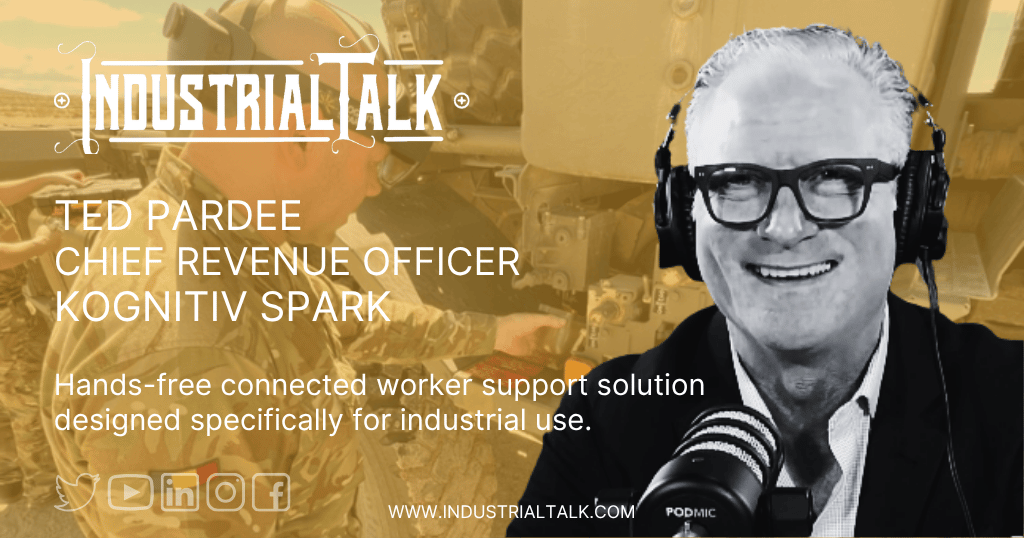
Industrial Talk is onsite at PowerGen and talking to Ted Pardee, CRO at Kognitiv Spark about “Augmented Reality hands-free connected worker solution”.
Outline
Introduction and Welcome to Industrial Talk
- Scott introduces the episode of Industrial Talk, sponsored by the Propane Education and Research Council, highlighting their commitment to safety training and innovative propane-powered technology.
- Scott praises industry professionals for their bravery, innovation, and problem-solving skills, celebrating them as heroes.
- The podcast is broadcasting from PowerGen in San Antonio, Texas, where industry professionals gather to discuss solutions for power generation.
Introduction of Ted Pardee and Kognitiv Spark
- Scott introduces Ted Pardee, the guest, and his company, Kognitiv Spark, which focuses on augmented reality technology.
- Ted Pardee shares his first impression of PowerGen, describing it as an incredible conference with a large number of vendors and attendees.
- Ted emphasizes the importance of presenting new technologies to make businesses more efficient and solve problems.
- Ted provides a brief background on his career, highlighting his experience in the software business for over 30 years, including selling enterprise asset management software in the 1990s.
Evolution of Technology and Augmented Reality
- Ted discusses the evolution of technology from mainframe to client-server to the web, and now to the mobile world.
- He explains how augmented reality technology, combined with AI, will revolutionize business operations by providing workers with headsets that connect them with experts remotely.
- Ted provides examples of how augmented reality can be used in various industries, including power generation and medical fields.
- He shares a personal anecdote about using MapQuest in the past, contrasting it with the current reliance on mobile devices.
Application of Augmented Reality in Power Generation
- Ted describes how augmented reality headsets can help experts remotely assist workers in solving problems, especially in remote locations.
- He explains how the technology can be used in asset management, allowing experts to guide workers through repairs using Teams calls or Kognitiv Spark's remote assistance software.
- Ted highlights the importance of leveraging technology to protect workers and improve efficiency in industries like oil and gas, chemical plants, and manufacturing.
- He emphasizes that the technology is still in its early stages but has the potential to revolutionize how work is done in various industries.
Durability and Market of Augmented Reality Headsets
- Ted compares the durability of augmented reality headsets to cell phones, suggesting that if a headset breaks, it can be easily replaced, similar to replacing a broken phone.
- He explains that the focus should be on the software that runs on the headsets, as the hardware can be replaced.
- Ted discusses the market for augmented reality headsets, mentioning that there are now many manufacturers, including Microsoft, which has exited the market.
- He predicts that in the future, there will be a variety of headsets available, each suited to different use cases and industries.
Use Cases and Integration with Existing Systems
- Ted provides a use case for augmented reality in power generation, explaining how it can help ERCOT assess and solve problems quickly during extreme weather conditions.
- He discusses the integration of augmented reality with existing asset performance management systems, allowing workers to access real-time data and expert guidance.
- Ted explains how Kognitiv Spark's software has open APIs, making it easy to integrate with other systems and enhance existing solutions.
- He highlights the potential for augmented reality to improve maintenance efficiency and reduce downtime in various industries.
Addressing Skilled Labor Shortage and Knowledge Transfer
- Ted addresses the issue of the skilled labor shortage and the “gray tsunami,” where experienced workers are retiring, leaving a gap in expertise.
- He explains how augmented reality can help maximize the expertise of experienced workers by allowing them to remotely assist younger workers.
- Ted provides examples of how companies are using augmented reality to reduce travel for experts and improve efficiency in their operations.
- He emphasizes the importance of leveraging technology to bridge the gap between experienced workers and the next generation of professionals.
Conclusion and Contact Information
- Ted shares his contact information, encouraging listeners to reach out to him on LinkedIn or through Kognitiv Spark's website.
- Scott thanks Ted for the conversation and highlights the importance of the work being done by Kognitiv Spark in advancing augmented reality technology.
- The podcast concludes with a reminder to listeners to visit the Industrial Talk website for more information and to connect with Ted Pardee.
- Scott reiterates the importance of storytelling and marketing for industry professionals to inspire the next generation and ensure the success of their companies.
If interested in being on the Industrial Talk show, simply contact us and let's have a quick conversation.
Finally, get your exclusive free access to the Industrial Academy and a series on “Why You Need To Podcast” for Greater Success in 2026. All links designed for keeping you current in this rapidly changing Industrial Market. Learn! Grow! Enjoy!
TED PARDEE'S CONTACT INFORMATION:
Personal LinkedIn: https://www.linkedin.com/in/tedpardee/
Company LinkedIn: https://www.linkedin.com/company/kognitivspark/
Company Website: https://www.kognitivspark.com/
PODCAST VIDEO:
THE STRATEGIC REASON “WHY YOU NEED TO PODCAST”:
OTHER GREAT INDUSTRIAL RESOURCES:
NEOM: https://www.neom.com/en-us
Hexagon: https://hexagon.com/
Arduino: https://www.arduino.cc/
Fictiv: https://www.fictiv.com/
Hitachi Vantara: https://www.hitachivantara.com/en-us/home.html
Industrial Marketing Solutions: https://industrialtalk.com/industrial-marketing/
Industrial Academy: https://industrialtalk.com/industrial-academy/
Industrial Dojo: https://industrialtalk.com/industrial_dojo/
We the 15: https://www.wethe15.org/
YOUR INDUSTRIAL DIGITAL TOOLBOX:
LifterLMS: Get One Month Free for $1 – https://lifterlms.com/
Active Campaign: Active Campaign Link
Social Jukebox: https://www.socialjukebox.com/
Business Beatitude the Book
Do you desire a more joy-filled, deeply-enduring sense of accomplishment and success? Live your business the way you want to live with the BUSINESS BEATITUDES…The Bridge connecting sacrifice to success. YOU NEED THE BUSINESS BEATITUDES!
TAP INTO YOUR INDUSTRIAL SOUL, RESERVE YOUR COPY NOW! BE BOLD. BE BRAVE. DARE GREATLY AND CHANGE THE WORLD. GET THE BUSINESS BEATITUDES!
Reserve My Copy and My 25% Discount
Transcript
SUMMARY KEYWORDS
augmented reality, power generation, Kognitiv Spark, efficiency, problem solving, technology evolution, AI integration, enterprise asset management, skilled labor shortage, safety, remote assistance, low bandwidth, disconnected worker solutions, industrial innovation, industrial podcast
-:Welcome to the Industrial Talk podcast with Scott Mackenzie. Scott is a passionate industry professional dedicated to transferring cutting-edge, industry-focused innovations and trends, while highlighting the men and women who keep the world moving. So put on your hard hat, grab your work boots, and let's go! All
right, once again, welcome to Industrial Talk. Thank you very much for joining the number one industry-related podcast in the universe that celebrates you, industry professionals all around the world, you are bold, brave. You dare greatly. You innovate. You collaborate. You're solving problems each and every day. You are making the world a better place. That's why we celebrate you on Industrial Talk. This is a story about you. You are the heroes. All right, we're broadcasting from PowerGen here in San Antonio, Texas, and it is, again, a collection of problem solvers. It is an interesting market. If you want to, if you want to pursue a market, look into a market, power generation. It's pretty cool. You got some good stuff. In a hot seat, we have a gentleman. He's in the neighborhood, by the way. He just he's right across the street from me. Ted Pardee. The company is. Let's just sort of have. I, what, what? I can't say that name. What's the name? Kognitiv Spark. Okay, Kognitiv Spark. There you go. See, thank you. I'm looking on my notes here, and I'm going. I can't see that. I know it. Yeah. So anyway, we're going to have a conversation about augmented reality and the use of that technology in the world of power generation and anything else that we want to talk about about augmented reality. So let's get cracking. All right. It's good to see you. Yeah. They were talking about you, talking about you all day yesterday. Oh, you just you just arrived today, and you weren't here yesterday. And boy, they were just chirping about you.
I'm sure they were.
Yeah, not. They weren't. You can rest assured. All right, you just got here. You walked the floor. What do you think? What's your first impression of what we're talking about here at PowerGen?
Well, it's it's an incredible conference. The just the number of vendors, attendees, big
stuff.
It's it's big stuff. It's it's exceeded our expectations. I got to tell you, Scott. I mean, I think that having an opportunity to present, bring new technologies into you know into the workplace. I think that's really what this is all about, and and it helped. You know, every vendor that's here, we're all trying to help business be more efficient. You know that's the bottom line. Find a way to leverage technology that's out there, and and make it work for make it work for your business.
I I like that. I can't argue with that, and I I love the fact that you're focused on efficiency and problem solving. That's always a good thing. Now, for the listeners, back just give us a little background, a little 411 on who you are.
d of cut my teeth back in the:well, whatever. Well,
ad the looming threat of year:And it's also being applied to the medical industry in a big way too. Every industry, you know, industry. Every industry. Yeah. I have to sort of digress a little bit. Your enterprise system was it PeopleSoft?
Well, no, we I worked for I worked for Indus International, and and we were partners with Oracle. So I worked out of the energy office in Houston, and so you know, kind of teamed up with the man, Eugistics guys, and we were we were out there, you know, rolling up our sleeves.
I'm going to blow your mind. I deployed Indus Passport at Oh, there you go, American electric power. So
you know, you know it well, right? So this is the world that we both grew up in, right?
Yeah. Hey, passport was because I was big time. Oh, go! Here's a here's a guy. He just pulled up the Indus side. Absolutely.
Remember that? Hey.
Oh, oh, I remember that. I remember going through the the training session of like, okay, how do we do this? Where do we go? How do we tag? Yeah, that was, yeah,
those were good. Those that was great business. Yeah, and and if you think about what, and and Indus was one of the players. You know, there were so many guys in that space. They transformed the way that work
is done.
Yeah, at the worksite, whether it's a chemical plant, a refinery, manufacturing plant, nuclear plant.
Big time nuclear. You know
what I mean. Think about all of those process industries and how they became so much safer, so much more efficient, all because they decided to leverage that. We've come a long way. Used to be CMMS. Yeah. Then it became enterprise asset management. Right. Yeah.
And and that's where
it's Ali. It has acronyms coming out of everything, and they're just they're doing from that perspective. The systems have just evolved, and with the the the the IoT push and being able to collect that data off of those assets, and and of course, apply the AI. That's right. Analyze the data. That tsunami. Boom. Come up with some tactical approach. Okay, we're
done. Yeah. But but the one thing I think that's important is how do you leverage technology but protect the worker too? Right. Like like we we're not here to replace our our technology needs a human to put the headset on because there still has to be the plant workers, the you know the line workers that are actually doing you know showing up every day, putting the putting the hazmat suits on, putting the you know the fireproof suits on, and going out there and doing the work. If it's if it's at a refinery, those turnarounds don't just happen. Shutdowns and turnarounds don't just happen. Like AI can't come in and do and you know work on your cat cracker. So the reality is, it's guys that that are trying to do their job. And how can I give them a better tool? It's we talk about it all the time. It's like it's the natural evolution of technology. In the old you know in the caveman days, they used rocks to to pound sticks into the ground. Yeah. Then they made hammers, you know, and you know it's a natural evolution, and that's really what we're doing in the technology space. Is we're we're coming up with great tools to help businesses be more efficient.
So let's let's talk about that solution, that augmented reality solutions. So because you're a neighbor, I've looked over the technology is pretty, pretty cool. I like that
stuff. Yeah,
durability,
right?
You you know who's going to be putting those glasses on? There are people like me who are just more more gorilla and Neanderthal than than human being. Well, you got you
got a suit on. So guys, usually wearing it, yeah, they don't have a suit on. Come on, let's be honest.
Yeah, I evolved. You know, here's a testament to evolution right here. But I know what what goes on. Let's talk a little bit about durability.
Well, so I think it's important to look at the market and understand what you're walking into. Again, I'm going to use the cell phone analogy. Yeah. Okay. You and I both have cell phones on. What happens if we walk outside and we drop it on the ground and it breaks? We
cuss.
Yeah, we might cuss for about about five seconds. Maybe maybe we'll we'll really bemoan it for about a minute.
Yeah. But
then we're just going to be like, you know what? I'm just going to go get another
one. Yeah.
You go get another one. Yeah. And and
yeah.
es. You know, this might be a:Absolutely. All
They announced at the end of:so for the listener out there, let's talk a little bit about that use case. Give us a give us a use case from from a power gen perspective, give us a use case.
Sure. You know. By
the way, I interviewed the guy that came up with the term use case. Just FYI,
. I did. It's been around for:funny. This is his story. He just said, "Well, we're coming up with this stuff. We need to provide some sort of user case.
User case. Yeah, that
was it. Okay, there you
go.
Go ahead, give us a use case. Well,
I'm going to use something that's that's going to you know kind of be relevant here in the next week or so. So you know, if you look at the weather forecast, there's going to be some some snow in Texas next week or in late this week, freezing temperatures. So if you if you remember back a couple years ago, snowmageddon, as everybody down here talks about, right? I was
in Louisiana. We got snow and it shut us down, and we were we were frolicking.
There you go. So so what's going to happen when these wind turbines stop spinning? What's going to happen when they've got that it's so cold that you've got problems with your natural gas systems, right? That's
called ERCOT's problem. Well,
but here's the thing: so ERCOT, what ERCOT needs to do is instead of flying these experts out all over all over Texas to figure out how do we get these power gen sites turned back up again so that we can get power to our customers. The maintenance guys should all have an augmented reality headset. As they're going out to do those inspections, they can immediately assess what's happening in real time. They can send the data back to ERCOT in Austin, and they can sit there and have on their on their TVs. They can see 50 different guys with headsets on to see what's happening in order to decide how do we solve problems quickly.
Does your solution interface with the asset performance management APM whatever the systems to be able to for me personally? Look at an asset and get a general health of that asset based off of of you know whatever devices that are communicating the health of that asset. Can I do that?
So we our software has open APIs, and so we built it so that it can integrate with other systems. Yeah, we're really in the version 1.0 of this technology. That's the exciting thing. Yeah, is that we have an. This is so early on in in the evolution of of this technology. Every one of the excuse me, every one of the enterprise asset management guys, they need to be thinking about how do we have augmented reality as a as a feature or as a function of our solution. Yeah, because it's a natural piece of the work management spot, right? It is. It's it's it's. I mean, because I
could see a use cases where I'm walking around. I've got the I got the the glasses. I'm looking at assets. I'm able to pull it up. I don't have the. Let's let's just say I have today. I have a mobile solution. Tomorrow I can just sort of look at it. That's right, and be able to sort of yeah, it's good.
Look at it. The the you know the the lenses. Basically, what you're doing is you're using AI to recognize what they're looking at, right? So that that it can it you know hopefully we get to the point where the the AI will be able to help assess and it will assess whether the equipment is down, whether it's a connectivity problem, what the problem is, just by seeing what the worker sees. Right, that's where it's headed right now. It's it's sort of again 1.0, where you know you put the headset on, you start to do the repair, and you get stuck, just fire up the headset, do a Teams call or do a Kognitiv spark remote spark call. We built, you know, Teams takes a lot of bandwidth, and if you're out in West Texas, there's sometimes you don't have internet connectivity or you got one or two bars. So we built a our own product that that leverages low bandwidth that allows you to still do a Teams-like call using our own software with just two bars. So, so that's the base level. The next generation of what we're coming out with this year is disconnected worker solutions, where if you're a worker and you have no connectivity, that because this headset is really a computer and it has a hard drive on it. Yeah, you can preload videos, and and we have within our system we use AI to create. We can we can record a repair that takes two hours long, and then create what we would consider like a Kognitiv spark, almost like a YouTube video, down to about a two-minute snippet of how to repair something. You preload those on the glasses so that when the worker's working, if he can't make a connection via cell phone or whatever, that he can just he can verbally say, "I need a Siemens pump repair video, and it'll pull it up in the glasses, and then he can do his own repair that way.
Yeah, I would see this would probably, and I'm I'm just spitballing here, so the the objective for any asset management to be able to take the diagnostic, the information that is being pulled off of that asset, and be able to apply some algorithm to be able to determine the overall health, then determine the failure, the potential failure, then provide that sort of automatic work order, whatever, and bring a hammer, a screwdriver, this seal, and be able to optimize that maintenance professionals move. If it's out in the middle of Timbuktu, it'll say, "Okay, go on out there. The ideal situation, once I'm out there and I have the right seal, I have the right screwdriver, I have the right tools, is to be able to have that that instructional capability of saying, now pull this off, do this. That's right. To improve the the success of that, because as we know in asset management, if I crack open a motor, I might be introducing failures into that asset itself. So let's do it right the first time, period, and have the solutions. Am I am I off off base here?
nagement software back in the:Yeah. Oh yeah. Now
you have expertise that is no longer available in the field, how do you how do you maximize that that expertise? So what we are doing with oil and gas companies every day in our business is we hear a common theme, which is you know Bill is our is our expert. He travels 225 days a year. He's 65. He's he's done. Like he doesn't want to do this. He doesn't need to do this anymore.
Right.
But we need Bill to be. We need him because he is a wealth of knowledge. We've got a bunch of young smart techs, but they've never seen that Siemens pump that we're talking about because it was built 35 years ago.
Yeah.
And in many cases, there's not a full inventory of all the equipment that's out at a particular site, we run into this on the, you know, we do a lot of work with folks like BC Hydro. We're talking to others like PG&E. They don't have a full inventory of everything that's, you know, of all the power poles and all the things that are out, that are that are out there in the wild, right?
Oh, I know,
right? So, so what do you do when you send a guy, four guys in a pickup out into into the mountains in California, and their their job is to repair something, and they've never seen that equipment before? What do they have to do now? They're dead in the water. Oh yeah. If if it's if it's preventative maintenance, maybe you'd plan for it, but it's probably not. It's probably break fix. Yeah. And break fix means what do you got to do? You got to shut the line down. Yep. Now you're talking about affecting the business and their ability to you know to to provide the service to their customers. Right. Exactly. And then you're compressing. Yeah, compressing exactly. So so you got to leverage this technology at some point. It's going to happen. I mean, the reality is this is going to happen, and and so it's only a natural evolution of of finding a way to make the workers who are out there today help them do their jobs, help them be more efficient, and help them with the learning curve. Right, that that expert that I'm telling you about. I mean, it's it's a real it's a real use case.
You know, you know, I've been I've been in the utility space for many, many years, and this whole conversation around silver tsunami and that that leaving of that knowledge, especially in the world of utilities, you know how long we've been talking about that.
Well, it's
forever.
We've been talking about it forever. Forever, but it's real. It's real. I mean, the boomers, the boomer generation was way bigger. I'm I'm Gen X, so I'm you know 68. I was born in 68. You know I'm I'm sort of the a little bit smaller generation. But even our the Gen Xers are starting to think about retiring. The big generation was was the Boomers, and they're they're already retiring. They're they're out of here. They're like you know what I don't need to do this. Yeah. So how do you bridge the gap? You got to learn. You got to leverage technology. In that example, I'm giving you it's an oil and gas services company. They've got they've got literally four experts that support 52 locations around the United States that are that are facilities that they have facilities, and this way those guys we can take their travel from that 220 down to less than 100 days. It's just going to happen.
It is, and and of course, with that ability to be able to see that type of information, we're we're talking specifically around having the a focus on safety
too. Exactly.
How do people get a hold of you?
Well, I think the best way is LinkedIn. Check out LinkedIn and Kognitiv Spark online.
Yeah, there you go, you are great. I like it. The good neighbors too, by the way. I'm looking at this stuff. I haven't, I haven't had a chance to look at it because I've been stuck in this salt mine. Yeah, you know, I'll bring you a headset
to to check it out. Yeah,
I, I, I have a good story about that one. All right. Once again, we're broadcasting from PowerGen here in San Antonio, Texas. You get great people like Ted, who knows what they're talking about? Who, who's salt of the earth and sage in sight? There it is. That hour. I'm all exhausted from trying to come up with that verbiage. Right. We're gonna have all his contact information out on Industrial Talk. So fear not. Reach out to him. Find out more. You will not be disappointed. We're gonna wrap it up on the other side. Stay tuned. We will be right back.
You're listening to the Industrial Talk Podcast Network.
All right, that was Ted. Ted Pardee, Kognitiv spark. I'm looking at a stat card over here. You know that's why I'm looking away. If you're out on video, you, I need help. I always need help. PowerGen was the event. Let me tell you. Write this down. You have got to be there this year. I think it's in Salt Lake. It is going to be a barn burner in a good way, because if there is a topic of conversation that is taking place in industry, is power generation. What do we do? How do we satisfy the power demands of the market? And it's just getting more and more and more intense, and we need solutions. And you got people like Ted and others that are coming up with solutions that are making the world a better place. It's a you got to reach out to them. As always, you just go out to industrialtalk.com and you find Ted and you find Ted's conversation and you listen to his conversation and you're better because of that. But right there, there's all his contact information. That's a must. Great, and and and those augmented glasses. Yeah, it's it's it's only going to get better too. It's an exciting time. All right, all right. Industrial Talk is here for you. You need to tell your story. You need to be consistently telling your story. You need to always have a face out there, demonstrating that human component, inspiring the next generation of industrial leaders, you need to do that. You need to do it for the market. You need to do it for your company. I think it's imperative, and I think companies that truly succeed understand that. We want you to succeed. We have a big heart for your success. Go out to Industrial Talk, click connect with us. We're a marketing company. We're a PR company. We're a media company. We want to make sure that you succeed. Again, go out to Industrial Talk, connect with me. We'll have a conversation. All right, be bold, be brave, dare greatly. Hang out with Ted, change the world. We're gonna have another great conversation shortly, as usual. So stay tuned.