Tony Paine with HighByte
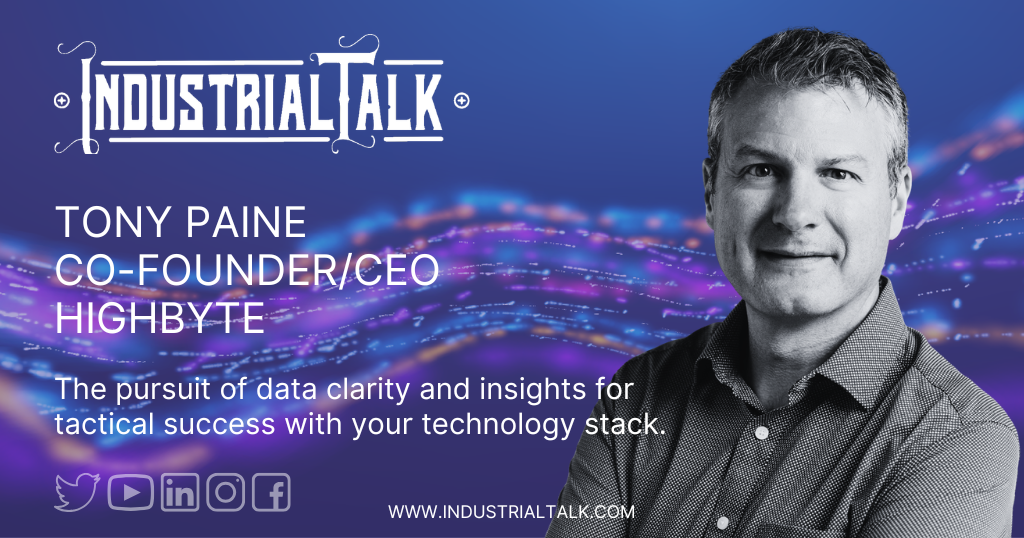
Industrial Talk is talking to Tony Paine, Co-Founder/CEO at HighByte about “Data insights solutions for your operational technology stack”.
Scott Mackenzie hosts the Industrial Talk Podcast, celebrating industry professionals and discussing innovations. In this episode, he interviews Tony Paine, co-founder and CEO of HighByte, a company that specializes in data management and intelligence. Tony shares his 30-year experience in industrial automation, highlighting HighByte's role in standardizing and structuring data across enterprises. He emphasizes the importance of AI in preparing data for consumption and the need for a collaborative approach between IT and OT teams. Tony also discusses HighByte's implementation strategy, focusing on small, proof-of-value projects to demonstrate value and ease subsequent implementations. The conversation underscores the critical role of data in driving efficiency and resilience in manufacturing.
Outline
Introduction and Welcome to Industrial Talk Podcast
- Scott welcomes listeners to the Industrial Talk Podcast, emphasizing the importance of industry professionals.
- Scott praises industry professionals for their boldness, bravery, and problem-solving skills.
- Scott introduces Tony Paine, the guest of the episode, and sets the topic of the conversation: data.
Importance of Data and Technology in Industry
- Scott discusses the significance of data and the need to normalize and bring real insights from it.
- Scott emphasizes the role of technology in pushing boundaries and the importance of perseverance.
- Scott promotes the Industrial Talk Podcast, highlighting its extensive coverage of industry topics.
- Scott stresses the human element in industry success, noting that AI helps humans deliver better insights and solutions.
Challenges in Industry and the Role of Young Leaders
- Scott addresses the challenge of finding and training new industry professionals.
- Scott uses SpaceX as an example of youthful energy and innovative solutions.
- Scott emphasizes the need for industry leaders to tell their stories and inspire the next generation.
- Scott offers to help organizations communicate and inspire their employees and the industry.
Introduction of Tony Paine and His Background
- Scott introduces Tony Paine, co-founder and CEO of HighByte, and provides a brief background on HighByte.
- Tony Paine shares his experience in the industrial automation space for 30 years and his early interest in computers and software.
- Tony Paine discusses his time at Kepware, focusing on data collection and making raw data available to various applications.
- Tony Paine explains the evolution of HighByte, emphasizing the addition of intelligence and context to data.
HighByte's Role in Data Management and AI Impact
- Tony Paine explains the founding of HighByte in August 2018 and its focus on managing and providing insights from data.
- Tony Paine highlights the role of AI in driving the need for prepping and making data available for consumption.
- Tony discusses the challenges of managing data speed and the importance of standardizing data across multiple sites.
- Tony emphasizes the need for a platform like HighByte to tie into existing technologies and make them work together seamlessly.
HighByte's Implementation Strategy and Change Management
- Tony outlines HighByte's implementation strategy, starting with a small use case to prove value.
- Tony explains the importance of a platform like HighByte in tying into existing technologies and making them work as a whole.
- Tony discusses the role of change management and the integration of HighByte with existing DevOps tools.
- Tony Paine highlights the importance of executive support and the role of AI in driving data usability.
Handling Questionable Data and Reporting
- Tony explains the concept of data pipelines in HighByte, which transforms raw data into usable data.
- Tony discusses the use of AI agents to identify and report abnormal data patterns.
- Tony emphasizes the importance of providing visualizations in the platform to see data flow and diagnose issues.
- Tony explains the flexibility of HighByte in handling different data assets and normalizing them for enterprise-wide use.
Overcoming Market Roadblocks and Final Thoughts
- Tony Paine identifies cultural resistance and existing infrastructure as common roadblocks in implementing HighByte.
- Tony explains how HighByte extends the Purdue model to move data effectively between different layers without impacting existing systems.
- Tony emphasizes the importance of adapting existing systems without disrupting their functionality.
- Scott concludes the conversation by encouraging listeners to connect with Tony Paine and HighByte for more information and solutions.
If interested in being on the Industrial Talk show, simply contact us and let's have a quick conversation.
Finally, get your exclusive free access to the Industrial Academy and a series on “Why You Need To Podcast” for Greater Success in 2026. All links designed for keeping you current in this rapidly changing Industrial Market. Learn! Grow! Enjoy!
TONY PAINE'S CONTACT INFORMATION:
Personal LinkedIn: https://www.linkedin.com/in/tonypaine/
Company LinkedIn: https://www.linkedin.com/company/highbyte/
Company Website: https://www.highbyte.com/
PODCAST VIDEO:
THE STRATEGIC REASON “WHY YOU NEED TO PODCAST”:
OTHER GREAT INDUSTRIAL RESOURCES:
NEOM: https://www.neom.com/en-us
Hexagon: https://hexagon.com/
Arduino: https://www.arduino.cc/
Fictiv: https://www.fictiv.com/
Hitachi Vantara: https://www.hitachivantara.com/en-us/home.html
Industrial Marketing Solutions: https://industrialtalk.com/industrial-marketing/
Industrial Academy: https://industrialtalk.com/industrial-academy/
Industrial Dojo: https://industrialtalk.com/industrial_dojo/
We the 15: https://www.wethe15.org/
YOUR INDUSTRIAL DIGITAL TOOLBOX:
LifterLMS: Get One Month Free for $1 – https://lifterlms.com/
Active Campaign: Active Campaign Link
Social Jukebox: https://www.socialjukebox.com/
Industrial Academy (One Month Free Access And One Free License For Future Industrial Leader):

Business Beatitude the Book
Do you desire a more joy-filled, deeply-enduring sense of accomplishment and success? Live your business the way you want to live with the BUSINESS BEATITUDES…The Bridge connecting sacrifice to success. YOU NEED THE BUSINESS BEATITUDES!
TAP INTO YOUR INDUSTRIAL SOUL, RESERVE YOUR COPY NOW! BE BOLD. BE BRAVE. DARE GREATLY AND CHANGE THE WORLD. GET THE BUSINESS BEATITUDES!
Reserve My Copy and My 25% Discount
Transcript
SUMMARY KEYWORDS
Industrial Talk, Scott Mackenzie, Tony Paine, HighByte, data normalization, AI integration, industrial automation, data pipelines, change management, enterprise visibility, manufacturing efficiency, data transformation, usable data, digital transformation, industrial renaissance.
Scott, welcome to the industrial talk podcast with Scott Mackenzie. Scott is a passionate industry professional dedicated to transferring cutting edge industry focused innovations and trends while highlighting the men and women who keep the world moving. So put on your hard hat, grab your work boots
orld. I say it once. I say it:There's nothing you can't do, you
know, there's nothing. If you put your mind to it, and you say, Yeah, I'm gonna do it, and you stick to it, persevere, and you because the technology is there. It's just, that's your heart push. That's why you we just need you. That's, that's exactly Tony Paine, great conversation, paper and pencil, definitely. But before we get into that conversation, I have, again, a pump for industrial talk. Here's the deal. So you know, if you follow industrial talk, you know that I have a ton of conversations in the world of industry, tons covering all topics, everything under the sun, been doing it for years, and it's been a absolute joy of my life. I mean that with all due respect, it's been a absolute joy of my life. Because what I find is that industry at its core is people. It's just people having conversations, solving problems, doing that and doing that effectively. And the technology today is at a place where pretty much anything's possible. You just got to think through it. You got to do it. And it's always, again, a human equation. So when somebody says, Hey, I was going to take the place? No, AI is not. AI is going to help humans, the human part of the human equation, do a better job at delivering success, delivering insights, delivering solutions all the time. So that's one thing, but two, because it's a human equation, here's what I what I hear all the time, and you hear it too. Don't tell me, you don't. You're wondering, as an owner, as a company, and you hear everybody's struggling challenge. How do we find backfill? Bring in new people? Yeah, we can automate over here. We can leverage technology to sort of minimize that pain. But the reality is, is that you're going to have to bring people in. You're going to have to figure out how to train them, inspire them, bring them in, and get them to be a part and of your organization and rowing in that same direction. I again, use SpaceX. You watch a space SpaceX launch, and what you see is just youth. You see that energy. You see solutions. You see what they're doing. And that is, that's what's exciting about that next generation. I'll lay it all out there. That's what's exciting. It's because of that different way of looking at challenges. That's what young, youthful, next generation of leaders bring to the table. That's what you want to bring into your organization. To do that, to do that, you're gonna have to tell your story. You're gonna have to figure out and paint that picture of why industry is exciting. You do it for yourself, but you do it for industry. You need to be able to tell that story, and you need to be able to inspire that next generation of industry leaders. It's. A must. We need to be able to do that. And organizations that I work with are all on board to figure out how to do that. And you need to do it too, and all you have to do. And I am here to help, because I believe it's, it's it's a big threat to industry, the success of industry, it's all wonderful to be able to say, hey, here's a bunch of capital. Bring in, you know, and expand this line in manufacturing. But if you don't have the people to be able to make that new line of success, you're challenged. Yeah, there are some real challenges. So I think it's a real critical element of success and being able to do that in such a way to tell your story, that's what you need to do. Go out to industrial, talk click, talk to me. Let's figure this out. I'll tell you what you on. Tik Tok. I guarantee you're saying no, you need to be there's eyeballs There you are. You committed to your Instagram platform again. Eyeballs, attention. We have got to do a better job at communicating and do a better job at inspiring.
Yeah, industrial talk. Be a part of it. Talk to me. Let's, let's, let's bring success to industry. On to the old conversation. One Tony Paine, hi, bite and again, another outstanding conversation about data, about looking at that data, about being able to take that data and turn it into actionable results. It's really pretty cool, and to be able to do it, the technology is absolutely and the people are doing it are absolutely wonderful. The technology, oh, it's just great. Tony, pay Hi. Bye. Tony, welcome to industrial talk. How are you doing today?
Doing well, Scott, glad to be here
with you. I am so glad that you are on industrial talk. I'm looking forward to this conversation listener, so that you understand the parameters here. So as I go over to my website, industrial talk.com, there's a plug for you right there. And and I interviewed John Harrington, which he's the co founder and Chief Business Officer. I'm assuming that that's what the graphic says. I haven't kept up with old John and I interviewed high by a number of years ago, and at that particular time, they were leading the way, specifically in the world, of being able to manage data and getting it there and getting some insight. So they're a leader. And here's Tony, so full circle sort of, sort of for a circle. But anyway, there you go, Tony. You having a good day? Did you have a good weekend? By the way,
that's what's key. Absolutely. Got a chance to spend some time with family this holiday weekend and catch up on stories and conversations, and now we're back at it.
Yeah, you got jackets on what? Where are you at?
I'm actually at in Portland, Maine, and little bit of spring snow right now, it's not collecting, but it's coming down harder than I would have liked to have seen today. Tell you I haven't
been up to Maine. It's a bucket list. I just think it's probably beautiful, right?
It's beautiful, beautiful country. Definitely come up and stop then you're not running into many
people, are you? I mean, it's not, I mean, you're in Portland, that's pretty busy town, yeah,
relative to the rest of the state, yes.
Yeah. Anyway, all right, for the listeners out there, we need a little level set here. Tony. Give us a little background on who you are and why you're such an incredible professional.
Yeah. Scott So Tony Paine, co founder and CEO of Hi, bite. I've been in this industrial automation space for 30 years this fall, actually, so I've put some time, pretty much, I would say that early on in life, back in like, middle school, I did get sucked into wanting to learn more about computers, how they interacted, and then developing software to control things, and that really set the path for, you know, sort of my education and really my professional career. So everything I've done in the professional world has been has has revolved around data. Spent about 20 something years at a company called Kepware, where we were focused on, you know, data collection, making raw data available to a variety of applications that would sit on prem. The interesting thing about that setup is that the domain experts were there. They understood the whole technology stack, meaning they understood the raw data and what to do with it. Fast forward to high bite, and we're putting a little bit more intelligence on that data the context we call it. So in addition to structuring it and making it look like it comes from, you know, a site that was standardized across an entire enterprise and. And getting the data to actually flow in applications so business stakeholders who aren't domain experts can actually make use of it.
Yeah, you've seen a lot of changes. How long has high bite been been around?
find the company in August of:yeah, yeah, you've seen a lot of changes. A lot of things that definitely blistered at an incredible play pace and and I just want some clarifications, H, I, G, H, b, y, t, e, it sounds like bright, but it's bite, right? High bite. Yeah. Want to make sure that everybody understands it's high bite as opposed to bright. So just put that on your notes.
Little little computer geekiness there, I guess you will in the old days manipulating bytes that was a very important macro.
Yeah. So before we get into the conversation about what you what you're doing, what has been that decisive or that, that significant change in the world of data, and I'll lay this out. I've been very fortunate to be able to be a part of system implementations. And data has always been like the Holy Grail, getting it right, making sure it's clean and scrubbed and accurate and all of that stuff. But back then, we didn't have the tools. We just had people grinding it out, quite frankly. But what, what have you seen that has been such a significant change in the world of data?
Yeah, I mean, I'd say recently, in the last few years, AI has really driven the necessary necessity for, you know, prepping data and making it available such that anything or anyone can understand it. You know, that basically brings in sort of a brand new part of the business that never really cared about the plant floor so it, you know, used to run sort of, you know, by itself, you know, supporting the rest of the business, not having to reach into the shop floor that's changed dramatically over the last few years, and so that's what's really been driven, driving the need to be able to prep data and make it available for consumption.
See. What I struggle with is, how do you and team high by manage the speed at which this change is happening?
Yeah. So we basically, you know, recognize that companies have a lot of data that they've been collecting for years. They've got data. It's bad data. It's good in the context of maybe a single site or a particular, you know, solution stack, but when you think about it, you know, enterprise wide, it's bad data. And, you know, unfortunately they're just there never were standards on how sites were deployed. Sometimes sites came, you know, were brought into the fold through acquisition. And so you really need to kind of level set and figure out, how do you go and standardize this, but make it available, make it make it such that a user can scale the solution very quickly once you get one site up and running. If that takes, you know, several months to kind of prove out test and pilot, you can't, you can't make it three months for the next site and so on. You've got to be able to go and take what you've learned, what you've developed at one site, and basically propagate that through so that you can get you know, value quickly across the entire chain. Are you
agnostic to technology stacks like you brought it up. You're saying, Hey, I threw this acquisition. We've got this. And then, of course, over here, we did this. And then, and you know, that exists out there, and by the way, we have this spreadsheet which still exists. Blows my mind. It still does. But are you sort of agnostic to that way we
are, and we have to be. I mean, I think, you know, companies have made an investment. They're not going to rip and replace technologies that you know work, you know, perhaps, you know, at a smaller scale, to solve a particular problem, we need to be able to, you know, jump in and allow people to go and create the bridges, if you will, of, you know, connecting points, A, B and C. But it's more than just the movement of data. It's the movement of data with context and structure so that it's self describing.
Yeah, yeah. So if I came to
high bite and I said, hey, I'm interested. I've got, I've got all of this technology, and I have businesses all over the United States. There's one over in, you know, Europe, whatever it is. And I want to be able to sort of bring all that together, bring context to that information and that data, to be able to make tactical decisions quicker. What is your implementation strategy associated with your solution.
Yeah, you know. So one thing that we advocate is, you know, start small, identify a single use case, a problem that you know is going to provide some value if it's solved properly, and basically use our solution to prove it out. And you know, if someone's telling you that. Digital transformation is all about ripping and replacing and starting from scratch. You know, run the other way. You know, we you need a platform like a high by intelligence hub to come in, be able to tie into existing technologies, to tie into new technologies, and essentially make that, you know, work as if it was built all at the same time.
And I would imagine, once you have that, I don't want to say proof of concept, I don't want to do that POC thing, I would say, well, but once you have that in place, and you've sort of ferreted out all of the challenges, and it also is a change management world out there, because you're going to say, hey, now you get your data this way. Now you get to see it this way, and this is where you need to be able to sort of make those decisions. I would imagine that subsequent implementations are are a little easier, for lack of a better term, once you get the first one sort of ferreted
out, they really are. And I kind of chuckled when I heard you, see you say proof of concept. You know, most of our customers today have kind of moved beyond that, and they're talking about proof of that. About proof of value. Thank you, basically, really jumping in and saying, Hey, look, we've got something that we've been it's been a pain point for years. We've applied some technology. We've solved it. Here's the value. Let's get buy in from the business, and let's, let's move
I like that, because the reality, Tony, is that this is here, and I think companies who have a greater understanding of what's taking place from a data perspective, and have that tactical information being pushed to them have a better opportunity for a resilient business. I mean, it just is, and making making their operations more efficient? Does that sort of make sense? I mean, I
just Yeah, absolutely. Efficiency is driving all of this, you know, I think it's easy to kind of look at high bite in isolation and say, Well, what problems do you solve? But at the end of the day, you know, we're much we're part of a much larger problem set within a manufacturing environment. How do we run more efficiently? Because, you know, cost or cost are increasing everywhere, and we've got to figure out how to go and become more profitable without, you know, cutting, cutting things. And just
like any operation Tony, there's, let's say I've, I've deployed your platform. There it is, it's right, and it's, it's pulling data off of that line, whatever that manufacturing line. But the reality is, is that sometimes in that manufacturing line, I have updates, I have changes, I have, you know, things that are, is your platform, flexible, nimble enough to be able to say, oh, yeah, I got something new right there, because that's what the customer wanted, and be able to just like, Oh, there you go.
Yeah, absolutely, very dynamic. I think, you know, we both remember the days where industrial software usually had a configuration mode and a runtime mode, right? And, you know, fast forward today, you know, everything sort of real time. Go in, make some changes. You know, basically create your own little internal sandbox in the platform, do some diagnostics, troubleshoot, get something working, roll it out, and rinse and repeat.
Yeah, I like that, yeah. See, it's a it's an exciting time being an old, old, salty dog. I remember, I remember when creating interfaces was heavy lifting. Like you want that system to talk to that system, and then that system be able to spit, oh, my, my, my, my, my, no, that's lifting heavy stuff. All right, take us through what this high bite, intelligence hub. What? What is that?
Yeah, so high by intelligence hub is. It's a it's a product that, really, you know, understands that in order to be able to get data from the shop floor, especially when you're thinking about multiple sites, locations across the globe, they're all disparate. They're all standalone silos. The ability to move data is nothing new. I mean, we've been doing that as an industry for quite some time, but typically, what we're doing is we're moving the data into something where we expect that the person who's going to work with the data understands it. That falls down real quick when you start thinking about enterprise visibility and efficiency. And so, you know what we do is we've we've created a product that says, look, there are two sides of the business. There's it who's basically controlling sort of enterprise standards, how data should flow across multiple sites, the security models, the structure of the standards, however, you know, they're not the experts. They need to be able to go and basically push that set of rules, if you will, down to the site, what people call the edge, and allow the domain experts to say, hey, take your world and map it into what we expect from an enterprise wide connectivity play. And we've, we've made that easy. I think, you know, I'd say a lot of products have tried to, tried to do this, and they've either rotated so heavily, such that they were very ot focused, didn't really put a. It's perspective in play, or they were very it centric, and really didn't understand sort of the nuances of the shop floor.
That's where it goes to die. If you're exactly it
centric, those ot people are saying, Yeah, whatever, it's got to be collaborative.
That's That's what hybrid intelligence hubs brings breakfast.
So, so with that collaborative reality. How does HighByte deal with change management? Because you go in saying, Yep, I see it. Yep, I'm going to bring IT/OT together, and we're going to have this kumbaya experience, and we're going to demonstrate our ability to be able to pull the data and get it to the point where it makes sense. How does high by deal with change management, which is the people equation. It's just, it's just the people equation and sustain it, right?
Yeah, well, we, we've taken integration beyond just connectivity and context, right? So we recognize that change manager, you know, most certainly, probably already exist in some form in an organization, it typically handles that there's some sort of DevOps, type tooling that's already in place. We just tie into that existing infrastructure. So if you already have a solution that allows people to go and track, you know, how a user interacts with an application, the changes that are made over time, so that you can actually roll them back, change control, you know, we basically just, you know, layer ourselves right in and work with your existing infrastructure. Again, it goes back to the, you know, if you've got something that works and is rolled out and is functional, you know, we're there to basically bridge the gap and make things work as a whole.
Are you getting executive support?
Yeah, absolutely. I mean, I think, you know, AI has been driven by the C suite, you know. I think, you know, I think there's the running joke of it, and ot have never really wanted to work together. And now, when just
a joke, it's a reality.
Yeah, it is. I mean, I feel like we've seen a shift in the last couple years where people recognize that, hey, look, you know, the CEO is asking why we can't get this to work. And it comes down to, basically, you know, usable data. You have to work together and figure out, how do we bridge the two worlds together? And, you know, hi, bite is, you know, as is a platform that makes that very easy and very scalable,
usable data, you pointed out real quick, and that's that's key. But in that usable data, how do you deal with questionable data, ugly data that needs to be scrubbed? What is your what's your strategy behind that? Let's say you come on in and you know that data is questionable, and therefore it's going to spit out some sort of questionable results. How do you, how do you deal with with that?
Yeah, so within the product, you create what's known as a data pipeline, right? So it's basically saying, how do we, what are the inputs to this data pipeline that I need to get, which might come from various sources. It could come from equipment, you know, could come from a software system. But at the end of the day, the data pipeline isn't just taking it and saying, Okay, I'm going to take the data as is and just move it somewhere else. I mean, again, that problem's been existed, you know, existed for years. Solutions for that problem have existed for years. So there's, there's the ability to go in and transform it. So take that raw data, you know, find, you know, repeating data, remove it, filter it, transform it, scale it, you know, structure it, and then basically say, now we have a payload that's, you know, self describing that we basically can move into multiple systems. And so that's the concept of what we call data pipelines within the product.
You still have to just have that. How do you do you programmatically say, hey, that's sort of unusual data. Do you have your algorithms that saying, this is, this is where we're at, and anything that's sort of statistically outside of those, those, whatever that parameter
may be questionable.
So, I mean, there's so much we can do with the person that's, you know, responsible for setting up the product, configuring it through, you know, putting in sort of, what I would say, you know, the first lens of cleaning up the data and validating it. I'd say one of the things we've done with high by intelligence hub is we, you know, plugged into different AI technologies. So, you know, allow AI agent, AI agents to make, you know, calls on the product, be able to look at the data over a period of time, look for, you know, differences or trends or patterns, what's abnormal, and then basically feed that back into the system. So again, you know, we're feeding that to the tools that know how best to look for certain patterns and report them back.
So when we start talking about reporting, right, that's always a a source of contention. It's like, you know, I want to see this. No, I want to see this. I want to have all of them together and then produce this, whatever it is. How do you how do you deal with the dynamics that exist with you? The Human Side of saying, hey, you know, how do I display what is relevant? How do you come to me?
Yeah, and again, that's, you know, one of the best features of the product is that different solutions are going to require more granular data. Some are going to need high level data. You don't want to basically treat this as sort of, you know, ad hoc point to point solution, because if you someday need to go and pull in new data, you're going to go change it in five or six different places. So what we're able to do is, we're bill we allow, you know, our users, to structure the data in a way that basically say, you know, here's, here's the information we've collected it. How do we go and transform that down to the most minimal data set that's, you know, important to this particular role, this use case, this application,
yeah, I I would suspect that, and I've been there, done that, that there is this, like an artist. And I always sort of equate like these, this, these data, people, they don't know when to stop. It's like an artist trying to back away from a picture or painting and say, yeah, it's done. It's always like a little tweak here, a little tweak there. I would imagine, and I could be completely wrong, that the high by solution allows for those artists to keep on tweaking
Exactly, exactly they really are. I mean, I think, you know, historically, when you want to get the same data or similar data into another application, you're going back and saying, Well, how did we connect to it? What was the source of the data? How do we actually get it? How do we actually get it in a format that we can ingest? Now, it needs to just basically be looking we already have the data. We know it lives in an industrial data ops platform. We just have to go and basically tweak it a bit, as you'd say, to be able to get in a format that's usable for this
particular use case. Is it a matter of having a dashboard? You know, everyone is like, red, bad, green, good, yellow, attention, right? Is that how it's displayed? And it's or, or is it just sort of this incredible flexibility with configuration? Anyway, you get the picture, you get the question,
yeah, I think it's, I mean, so it's kind of twofold. I mean, you know, so, so we ourselves aren't necessarily the dashboard that's going to, you know, show you your operational intelligence metrics. I mean, we're going to feed those dashboards. What we do, though, is we recognize that it's very important to have visibility into, you know, the source of data, the flow of data, how it's transformed. And so we've, we've spent a lot of time figuring out how to provide visualizations in the platform that allow you to see that data flow in real time, diagnose it, tweak it, and see how things actually impact the system before they actually flow into another application.
How does high by deal with different assets? Case in point, there's motor one, motor one is a GE. There's motor two, motor twos and Siemens. They operate differently. They might deliver the same sort of value, you you know, moving a belt, or whatever it might be. How does, how does, how do you know what data's, you know? How do you normalize that?
Yeah, again, that's, that's a typical use case of the park where, you know, you might say, at an enterprise level, or across multiple factories, we want to go in and monitor, and, you know, our motors, and we recognize that each plant might be using different vendor specific motors. We're going to create sort of what we would call sort of an enterprise motor standard, if you will, that defines the key parameters that we know that regardless of vendor is going to support these. We're going to basically drive that down to the factory, and then those who actually are working with the processes and the equipment can say, this is how I go and Map My GE motor to this enterprise standard so that it actually gets up in there, and at that point it becomes agnostic to the rest of the enterprise.
Okay, that's cool. I'm trying to blow blow holes in it. Not ever so carefully. I'm trying to blow holes now, I would imagine that there are roadblocks. What are typical market roadblocks that exist? I hear what you're saying. What I see is a solution that is nimble, strong, able to capture the data, able to sort of bring context to the data. I get it, it makes sense, and it's the right thing to do. If I'm in the world of manufacturing, I want that. I need that, and I probably would like it yesterday, right, whatever. And what are some of the roadblocks?
Yeah, I mean, I mean, there's a cultural aspect to it, right? Our industry doesn't typically move fast, you know? They like things that are hardened. They work. 24/7, they produce the outputs the quality that we expect, and life is good. And so, you know, trying to figure out, how do we go and adapt, you know, existing systems without impacting them, so that we can actually allow other parts of the business to basically run more efficiently? You know, requires change, and I'd say existing. Infrastructure is one of those, you know, we talk about the Purdue model being a very sort of layered architecture, where different layers are controlled by different people really geared towards, you know, control of a process and making sure that nothing can interfere with that. One of the roadblocks is people trying to take an existing infrastructure and saying, How can we now make that thing move data effectively between different layers? Well, it wasn't designed for that, and you're not going to go and rip and replace your existing, you know, technology stack, but what you can do is you can, you can layer and extend it with a product like highlight. So we think of ourselves extending like the Purdue model for instance, where when you want to move data between, you know, layer zero and layer four. You don't have to go and manipulate products that actually are live within layers one, two and three. So we're able to kind of sit on the side, pull information from the different layers and make that move much more effectively.
Yeah, I just think it's a no brainer. I think that people are getting
my my,
my sense is always around potential confusion, right? Not really understanding, not knowing. And if I'm a confused mind, I'm not going to make a decision. But I believe that we're at a point today in the market where, where it's vital. You just need it data's there's gold in the data, and you got to be able to get that data, and you got to be able to trust that data, and you got to be able to put some meaning around that data. And I just think that, especially now, I think you just got to bite the bullet and do it. You got to be able to do it in effectively. All right, with that said, we're closing out, Donny, if I'm dazzled by what you said, and I'm saying, I gotta get a hold of Tony, how do I get a hold of you? What's the best way?
Yeah, check us out@highbite.com on the web. You know, we have some great user case stories studies that are available for viewing to see how people are successfully solving real world problems with our products. I've got a lot of knowledge base, articles, blogs, and our whole team is there that you know with contact information to
reach out. Are you on LinkedIn?
I am as well, personally on LinkedIn. So yep, you look for me. Tony Paine with HighByte, and you'll easily find me. I can make that.
It's an easy link to include on my website.
It is. I was an early LinkedIn user, so I got a great URL,
absolutely wonderful. I really am excited about what has happened with HighByte and again. Listener, it's H, I, G, H, E, y, t, e, make a note of that. That's, that's, and it all be out there on industrial talk. So you don't, don't come to me and say, I can't, I can't find them now, they'll be there. It is again. Tony, you were absolutely wonderful.
Well, I appreciate Scott. This was a great opportunity. Thanks for having me. Oh, I was
looking forward to this conversation. All right, listeners, we're gonna wrap it up on the other side. Stay tuned. We will be right back.
You're listening to the industrial talk Podcast Network.
Outstanding conversation with Tony.
You know all His contact information is out there. You just need to you can tell here he comes up with his wheelbarrow of knowledge and just sort of says, This is what I got, mad, absolutely mad skills, a must connect, go out to industrial talk, connect with them over LinkedIn. And yeah, you will not be disappointed. They have tremendous high bite has tremendous solutions for you. It's just have a conversation. It's a must. Tony, great guy, great company. Yeah, they're passionate about your success. I say it all the time. All right, back to my soapbox of the the monolog one. You need to tell your story. You need to inspire that next generation of industrial leaders. You do it. You do it because it's important for industry, but you do it because it's important for your business. You have to do it, and you have to get past the fact that nobody really know you. What you do is important, and what you do needs to be told it's just the bottom line. And I will make it as easy as possible for you to be able to do that. And it's just, you just have to do it. The second reason why you have to do it, you have a company, that company, that company needs to know that you're out there and you're talking about what you're doing, right back to SpaceX. You have the leaderships, really, it's Elon Musk, but you have that talk, talking about what's taking place at SpaceX. It's exciting. People are all on board with the purpose and the vision taking place at at SpaceX, you need to do the same thing. You. Again, it comes through communication. Go out to industrial talk. Click, connect with me. Let's have a conversation. It's not that difficult. And And 15 minutes of your time, that's it. You got 15 minutes? Yeah, reach out all right. I want you to be bold, brave, and I want you to dare greatly, yeah, tell your story. Be bold. Be brave. Here, greatly, tell your story, but then also hang out with Tony. Reach out to him on LinkedIn. Changing the world. We are at an incredible industrial renaissance right now. We are impacting in a positive way the world it is. It's that, it's that noble. All right. Again, hang out with Tony. All right. Thank you very much for joining industrial talk. We're gonna have another great conversation shortly. So stay tuned.