
Trevor Perrott with Censys Technologies
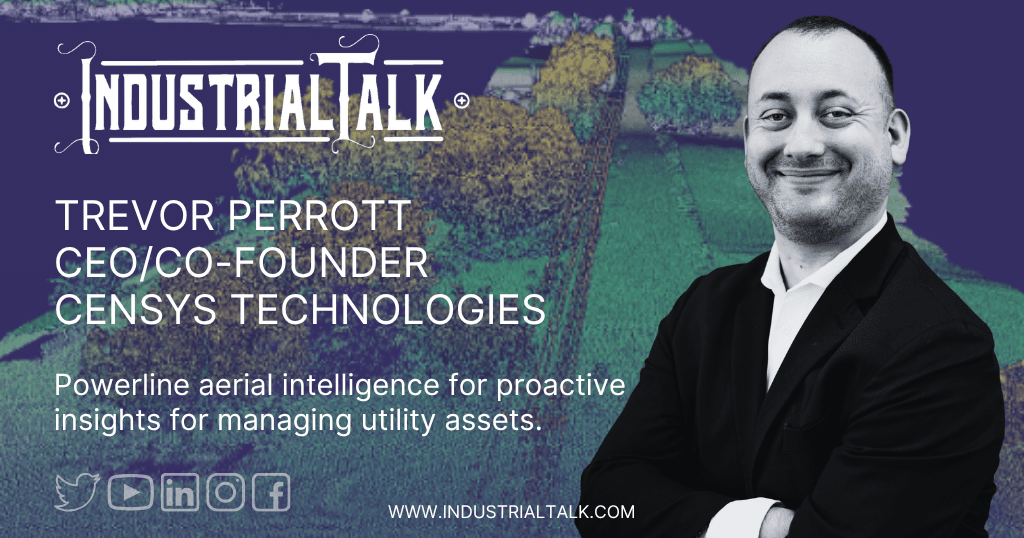
Industrial Talk is talking to Trevor Perrott, President and CEO at Censys Technologies about “Powerline Aerial Intelligence and Insights”.
The conversation highlights the importance of the Barcelona Cybersecurity Congress from November 3-5, 2023, and the need for industry professionals to enhance their cybersecurity measures. Scott Mackenzie from Industrial Talk emphasizes the significance of storytelling and marketing strategies for industrial companies, urging them to leverage platforms like Industrial Talk for content amplification. Trevor Perrott from Census Technologies discusses their aerial intelligence solutions for power lines, emphasizing the use of lidar sensors and AI to improve efficiency and safety. The discussion also touches on the challenges of vegetation management, the impact of wildfires on insurance rates, and the potential for data-driven risk mitigation in the utility sector.
Outline
Barcelona Cybersecurity Congress Announcement
- Scott introduces the Barcelona Cybersecurity Congress, emphasizing its importance for cybersecurity professionals.
- The event is scheduled for November 3-5 in Barcelona, with Speaker 1 planning to attend and broadcast.
- Scott highlights the opportunity to network with top cybersecurity professionals from around the world.
- Contact information and details about the event are available on Industrial Talk.
Introduction to Industrial Talk Podcast
- Scott thanks listeners for their support and celebrates industry professionals solving daily problems.
- Scott shares personal experiences as a lineman, drawing parallels to modern aerial intelligence technology.
- The conversation sets the stage for discussing aerial intelligence and its impact on the industry.
Importance of Storytelling in Industry
- Scott emphasizes the necessity of telling one's story consistently and authentically.
- The conversation highlights the need for a strategic approach to storytelling, involving human interaction rather than AI-generated content.
- Scott encourages companies to leverage platforms like Industrial Talk for marketing and content generation.
- The discussion includes the importance of amplifying messages and the challenges of maintaining a strong social presence.
Introduction of Trevor and Census Technologies
- Scott introduces Trevor from Census Technologies, focusing on aerial intelligence for power lines.
- Trevor shares his background, including his fascination with aviation and robotics.
- Census Technologies uses drones to collect high-resolution data for asset intelligence, including power lines, roads, and beaches.
- The conversation touches on the importance of data-driven decision-making in the industry.
Challenges in the Power Line Industry
- Scott and Trevor discuss the challenges of finding and retaining linemen in the industry.
- Trevor explains the use of lidar sensors and AI to create digital twins of power lines and assess vegetation encroachment.
- The conversation highlights the need for customized software solutions to meet the specific needs of different utility companies.
- Trevor shares insights into the economic impact of wildfires and the role of data in mitigating risks.
Innovations in Asset Intelligence
- Trevor discusses the potential for using drone data to identify and address wildfire risks, potentially reducing insurance costs for utilities.
- The conversation explores the future of asset intelligence, including the integration of satellite data and drone data.
- Trevor emphasizes the importance of continuous innovation and the potential for new use cases in the industry.
- The discussion touches on the challenges of maintaining accurate GIS data and the role of human validation in the process.
Future of Asset Intelligence and Grid Modernization
- Trevor shares his vision for the future of asset intelligence, including the potential for comprehensive data collection and analysis.
- The conversation highlights the importance of grid modernization and the role of data in driving efficiency and reducing costs.
- Trevor discusses the potential for using drone data to address a wide range of industry challenges, from vegetation management to infrastructure maintenance.
- The discussion concludes with a focus on the importance of collaboration and innovation in driving industry success.
If interested in being on the Industrial Talk show, simply contact us and let's have a quick conversation.
Finally, get your exclusive free access to the Industrial Academy and a series on “Why You Need To Podcast” for Greater Success in 2026. All links designed for keeping you current in this rapidly changing Industrial Market. Learn! Grow! Enjoy!
TREVOR PERROTT'S CONTACT INFORMATION:
Personal LinkedIn: https://www.linkedin.com/in/trevor-perrott-211234b0/
Company LinkedIn: https://www.linkedin.com/company/censystech/
Company Website: https://censystech.com/
PODCAST VIDEO:
THE STRATEGIC REASON “WHY YOU NEED TO PODCAST”:
OTHER GREAT INDUSTRIAL RESOURCES:
NEOM: https://www.neom.com/en-us
Hexagon: https://hexagon.com/
Arduino: https://www.arduino.cc/
Fictiv: https://www.fictiv.com/
Hitachi Vantara: https://www.hitachivantara.com/en-us/home.html
Industrial Marketing Solutions: https://industrialtalk.com/industrial-marketing/
Industrial Academy: https://industrialtalk.com/industrial-academy/
Industrial Dojo: https://industrialtalk.com/industrial_dojo/
We the 15: https://www.wethe15.org/
YOUR INDUSTRIAL DIGITAL TOOLBOX:
LifterLMS: Get One Month Free for $1 – https://lifterlms.com/
Active Campaign: Active Campaign Link
Social Jukebox: https://www.socialjukebox.com/
Industrial Academy (One Month Free Access And One Free License For Future Industrial Leader):

Business Beatitude the Book

Do you desire a more joy-filled, deeply-enduring sense of accomplishment and success? Live your business the way you want to live with the BUSINESS BEATITUDES…The Bridge connecting sacrifice to success. YOU NEED THE BUSINESS BEATITUDES!
TAP INTO YOUR INDUSTRIAL SOUL, RESERVE YOUR COPY NOW! BE BOLD. BE BRAVE. DARE GREATLY AND CHANGE THE WORLD. GET THE BUSINESS BEATITUDES!
Reserve My Copy and My 25% Discount
Transcript
SUMMARY KEYWORDS
Barcelona Cybersecurity Congress, aerial intelligence, power line, Census Technologies, industrial talk, lineman, vegetation management, lidar sensor, AI, data collection, grid modernization, wildfire risk, insurance fraud, asset intelligence, marketing strategy.
All right. Before we get into the conversation, I want you to be aware of a conference that you need to put on your calendar, and you have time. It is the Barcelona Cybersecurity Congress. It is necessary. You need to up your cybersecurity game. You're connected. You need to make sure that you're protected right here. This event, Barcelona Cybersecurity Congress. It is November 3 through the fifth. You have time, November 3 through the fifth this year in Barcelona. And I'm telling you right now, the team at Farah who put this particular Congress on the best. You will not be disappointed, and you know what else you get to do? You get to network with some of the best cybersecurity professionals from around the world. You need to do this. You need to put this one on your calendar. All of the contact, all of the information is out on Industrial Talk. I'm going to be there. I'm going to be broadcasting. I'm going to be talking cybersecurity with the best in the world. So be there. Put this one on your calendar. That is November 3 through the fifth. I'll see you there.
Welcome to the Industrial Talk podcast with Scott Mackenzie. Scott is a passionate industry professional dedicated to transferring cutting-edge, industry-focused innovations and trends while highlighting the men and women who keep the world moving. So put on your hard hat, grab your work boots, and let's.
All right, once again, welcome to Industrial Talk. Thank you so much for your continued support of this platform. This platform that celebrates you, industry professionals all around the world. Yes, you are bold and you are brave and you dare greatly. You're solving problems each and every day. That's why we celebrate you on the number one industrial related podcast in the universe. That's right, right here, industrial talk. We have a great conversation. This is this always brings back memories of when I was a lineman and what I had to do to go check the lines and do the do the lineman stuff. We have a gentleman by the name of Trevor. The company is Census Technologies, and what they do, they're able to do aerial intelligence for power line, and they just do it. They can see it with their eyeballs. So let's just get a cracking and do that justice. Aerial intelligence. I'll just leave it at that. It's cool technology, cool time, and I I share in the conversation some of my past past experience as a lineman, going around rightaways, patrolling lines with my eyeball and a truck, and you know repairing things and doing stuff, but it's it was very manual, and here we are, aerial intelligence. Boy, life has changed. It's good, you know. There's there no other way of getting around it. It's an exciting doggone time to be in industry, and I and I want to make sure that that we're all on the same page. You need to be a lineman if you're thinking about getting into a great profession. Line work, that's good. Yeah, I've got some stuff coming up on line work, and I'm pretty excited, pretty geeky about the whole thing, just because that's sort of you know where I came from, my roots anyway. All right, here's a beef. It's it's a it's a little beef. It's not it's not a big beef. It's just a beef. We we hear an industrial talk, and as I continue to continue to have these conversations, and over and over again, and recognize this necessity, this necessity to, of course, tell your story, and I say it all the time. Tell your story, but that necessity to continue to tell your story is not a one and done type thing. So there has to be a program. There has to be a strategy around telling your story to be able to say, "Hey, this is what we do. Hey, this is how we're impacting our customers. Hey, this is our customer. He's he, she, it, really enjoys our solutions. You have to do that, and it can't be just generated by an AI bot. It just can't do it. It has to be human, and I think as we continue to go down this AI road, I think there's a hunger for more human stuff. So, with that said, you need to tell your story, and you need to do it consistently, and you need to feel comfortable about it, and you you need to just sort of persevere and and soldier on, because I think companies that do get that, and I want you to get that, will succeed, will succeed, and and do great. Things and and again, you're in industry. You need to do great things. You're already doing great things, but the the reality is is that you got to get your story out. Now, here's some strategies. Here's here's an idea. One, you get on Industrial Talk right here. Go out to IndustrialTalk.com. Click. You get to chirp with me, and we have a great time. And and you get all of the generated content for your marketing and all your strategies, and and we can have that conversation too as well. But you know, I know other people, I know other influencers, and there is an opportunity to get on their show. Why wouldn't there? Because the reality is, we need to amplify your message. We need to amplify and get more eyeballs on what you do. There's a strategy here. You just need to talk to me, and I can definitely help you through that painful reality of being able to do that. And and these individuals that I'm speaking of and myself make you feel good. You can, you can, you can do it.
It's not uncomfortable, but but because of the way things are happening so quickly, I think it's imperative that you continue to tell your story. No one and dones, none. This is a marketing strategy that you. Okay, one last beef. So many of the companies, many that I interview, don't do this to me. Many of the companies that I interview, I give them everything. I give them a Dropbox link of all of the content. The majority of the time, nobody takes advantage of it. That's a that's a gap. That's a challenge. You need to take advantage of it, and you need to run with it, and you need to slice it up. It's all there, hand delivered. But many don't. That's a problem. We need to up our game there. The other thing. Many of these companies, of course, I have to go out there. I have to. I have to look. I do my part. Don't don't have a real strong social presence. One that always jumps out is, you know, if you have technology, if you have solutions, you have things moving around. Why aren't you, you know, videoing that and getting it out on YouTube, many, and I mean many, they they they start a channel. I'm not pointing at you, but they start a channel, but they never follow through. You're missing out. You're just missing out. Consistency. You just keep pushing. Soldier on. Nobody's gonna. Nobody sits there and says, "Ah, it's just not a word. No, it makes sense. You need to do it, please. Just please deal with my anxiety of not being able to help you more. Just just go out to Industrial Talk and say, "Scott, give us a hand. Sure, sure. I, I, I, I want that. Let's make it happen. I've got a team of marketing individuals that can help out. I've got all of this stuff. I just, you know, I I don't want you to not do well. There, that's my beef. Beef for the morning. Beef for this particular podcast. Seven minutes of beef. All right, Trevor's in the house. We're going to be talking about that doggone aerial intelligence. Very cool stuff. Mad technology must a listening to it. Anyway, and oh yeah, he's with Census Technologies. Yeah, census. Don't. It's all out on industrial talk. You're starting. You're gonna. You gotta listen to the conversation. You're gonna say, "Oh man, I need. I'm in that world. I need this information. I want. There he is, Trevor. Team census, make it happen. All right. Here is the conversation. Trevor, welcome to Industrial Talk. Thank you very much for a Friday, and you're on Industrial Talk. Thank you very much for your time. How are you doing today?
I'm doing grand, Scott. How are you? Happy Friday.
Yeah, thank you very much, and I'm doing well. Thank you for asking. Absolutely, it's hot here in Louisiana. I'm not. I'm not. I'm not going to lie. It's hot.
Yeah, the ton of beach is not much colder.
That's right. That's where you guys are. You guys, you get you get more humidity over there, don't you?
That's right. We've got Devil's front porch with water added until about October.
Jeez. jeez, but it is pretty cool. It's it's historic Daytona Beach. It's Daytona Beach.
Oh yeah, yeah. Daytona's a thin town. You got aerospace, NASCAR, and beach life all slammed into one little ecosystem here.
That that whole NASCAR thing. That's pretty cool. Have you ever been to the Daytona 500
Oh yeah, yeah. It's you know not to make anybody too too upset, but watching NASCAR on TV no fun. Watching the Daytona 500 live definitely entertaining,
but you can see the full track, right? You got it. So you could see them. You could see the whole thing. This would be different than f1 because f1 is going around a neighborhood. You you always hear and go go by ever so fast. So you can see the whole landscape, right?
Yeah, I would absolutely say watch f1 on TV and NASCAR in person.
Yeah, there you go. Yeah, well done. Yeah, that's that is the solution. That's
yeah,
next level. All right, before we get into the conversation about census technologies, Trevor, we need to know a little bit about you, a little bit of background. Let us know who you are.
Ah, a little bit about me. Well, I am from a small town Midwest. Grew up in corn country. I fell in love with aviation, watching crop dusters. And if you've never been on that ride, it is world class. And
did you say you you you went on a crop duster?
Oh yeah, absolutely. You know, may get me in trouble with the FAA, but I'm not quite sure me me riding that was legal. But nonetheless, it was so much fun.
Yeah, I have to digress. We have sugar here, and I was always enamored by when I'm going down the the interstate, and I would see the crop dusting going on, and it it it's special. It's a special skill.
It's a ride for sure. But then you know, kind guy went on with there. Had the inks that I had to scratch. Went and became an aerospace engineer, so you know learned how to design them. And then I've always been pretty fascinated with robotics. So you know, what's a flying robot? We call those drones nowadays. And you know, we've kind of built a business around that for asset intelligence on things like power lines and roads and beaches. You know, really, Census is a physical AI company that happens to use drones to get it done. So we collect you know huge swaths of high res data, and then turn that into something useful for our customers. So, you know, even though I've got the the aerospace background, you know, the the company is really all about that intelligence profile.
Yeah, pop beaches. What do you mean by that? Yeah, I get the line. I get the typical, but when you popped in beach, I'm going like, what?
Yeah, so you don't think about it, but you know, tourism's a huge industry here in Florida, in particular, and you know, a hurricane washes away 10s of millions of dollars of sand, so straight up being able to get a scan of the beach before and after a storm, so you can quantify how much sand washed away. You know, really important to get these tourism communities back online.
Okay, I I know I'm, you know, going off on a tangent here, but so you do it before and after, and then the after says, "Yep, you lost a lot of sand. Then what? But how do you how do you?
Yeah, so so like a county government will then go to the state of Florida, or to a federal monetary source, and get basically paid to restore the sand.
And then again, I have to ask because I'm I'm intrigued. Where do they get the sand? They just dredge it? Do they dredge it out of the the ocean? And so
they're kind of getting beyond my understanding, but yeah, I think they literally dredge it. They also straight up mine it, you know, from inland Florida, and they get to the coast. Yeah, yeah, that was a fascinating. The damage of economics are definitely something I'd love to understand a little better than I do.
Yeah, because then I'm I'm already into the the what about the quality? Here's the beach sand. It's it's a certain type. You're not going to just go to some inland quarry and say, "Hey, I need dirt, and then of course you just bring the dirt. There's got to be a quality. QC component there.
Wow, we like our boujee sand. You know that
you do. Yeah, I'm not going to walk around on nothing but sand, right? Sand. That's interesting. Wow, didn't know that. Technology's fantastic. All right, you touched upon it. We've got census technology. Clearly, it is a technology data collecting service, and and I think we're going to. I'd like to talk about the power line component, just because being an old lineman myself, I used to drive those lines. We didn't. We didn't have drones. We had eyeballs in a truck.
Brief side step. Have you made a decision? Are we going to do round two of this at the Lyman College?
Yeah, but I haven't heard anything. I want to. I want to in a big way. In fact, what was that? So I. And again, I'm going off on a tangent, I was in Austin this week. I was sitting with practitioners in the in the in the world of utilities power generation. So we were sitting together having dinner, and we couldn't help but address the fact that well, we need linemen. Where do we get linemen? And and I know utilities are struggling to find, you know, people.
Yeah, I I think I read the other day 30% of all linemen are going to retire in the next three years.
Yeah,
and so so you could argue that is part of the problem that we are trying to address, which is getting the the data right so that the linemen that we have can be very efficient. You know, so
yeah,
kind of two sides of the problem, right? Can you increase the number of linemen? You know, is one half, but then can you also raise the productivity of the linemen we do have? And generally speaking, data-driven assignment of alignment we have is you know big opportunity to kind of make it solve.
And the the the lineman equation is a little bit more challenging than you know that individual that's in a manufacturing process and he's got this tribal knowledge of how they operate. You can't just bring them back as a consultant. They've already sort of. I'm not climbing any more towers. I'm not climbing any poles. So it's hard to. You need people. You're just never going. So here we are. Here's the sort of the use case. Utilities need to patrol their lines. That's it. We need to. I need to look at it. Got to make sure that trays are trimmed. Whatever the the material, the equipment are is in good condition. Your solution sort of takes into consideration what that human. Let's say I was a patrolman and I would look. Does it have that analytic capability to be able to say, "Yep, tree, yep, yep, yep, and yeah,
yeah, you can argue it's it's superior to the idea of a human sitting on the ground looking up at it. You know, you lose a lot of that depth perception just from from the angle looking on the ground. But you know, hypersimplification of what we do for the vegetation is we use a lidar sensor, which you know the way lidar works. You've seen them on Waymo's and some other different use cases, but the way we use it is we are bouncing you know millions of points off of everything in the field of view, and that allows us to make a digital twin of these 3d points for where the power lines are, where the poles are, where the trees are, and then the AI side of it can compute the distance between the tree and the line, for example, or the tree depending on what you're interested in, and you know, I'll tell you about a mistake we made. So, so the mistake we made when we were first building this was we are going to build a one-size-fits-all software tool. So, in other words, you know, any encroachment that met these criteria, then we're going to fly it. All our customers kind of chewed that up and spit it back in our face very quickly. And what we found is like FPL's needs in Florida are materially different than say Entergy's needs. In New York, they're different than New York Power Authority's needs up there. They're different than Pacific Gas and Electric. So we had to go back and you know make it where individual company inside of an individual geography can actually customize the settings for what? What does a serious encroachment mean? Kind of back to your earlier point about how you know there's alignment shortage. You know, one of the things that our customers say to us is, you actually cannot tell us about every problem that we have, because there's no way that we can deal with all of it.
Black and white, you got you got it on paper now.
You got to help it. Well, it's not not even so. So I'll touch on that here in a minute for why that that. But they need to prioritize. You know they they've got to write advertised. What are the biggest threats? What are the biggest issues? We're going to go after those first, and then work backwards. And from starting position, I mean, it it's going to take 10 years of conviction, I would say, to really get this issue put to bed. It's going to take a while, and the reason it does is, you know, first of all, you got to build the infrastructure to collect all the raw data. Second of all, you got to get the software infrastructure where it can handle that kind of data volume, and then you've actually got to have the physical solution to go out there and actually mitigate it all at that, you know. The U.S. power in 7 million miles, so you know it's not like it's a small issue. Now you were you were talking about you know the notion of you know now that it's known it's a problem that that was put to bed several years ago. So if you remember the big campfire out in California,
yeah, oh yeah.
So so the the economic impact of that downstream was that utilities lost the ability to buy wildfire insurance, and you know, if you're like me, you know you're looking at your electric bill. Your VR just keeps going up and up and up. And you know, a big part of that is because the utilities don't have a choice but to hold a huge amount of cash on their balance sheet as insurance because they can't actually buy insurance. You know, nobody's really sat back and thought about how wildfire links straight to your you know per kilowatt price you pay, but that that linkage is tight. You know, we think data centers are driving our rates up. It will take a lot more than that to do what the loss of wildfire insurance has done.
Here's here's a question, and you're absolutely right. No insurance. I mean, we're we're just we're not on the utility level here down in Louisiana. Of course, you get the hurricanes. You're in you're in Daytona. You get the hurricanes. It's hard to, you know, insurance companies understand, and they they're they're they're in the business of making money, and and that's a that's a tough tough call, you know. Yeah,
the you know the the reason we have put so much of our legwork into vegetation. Is the the Edison Institute says a third of all outages are because of that?
I thought it was. I really thought it was higher. It
very well could be, but I think for for that stat to be seen fairly, you got to understand that that includes the plains of Texas and the mounds of West Virginia in the center staff.
Yeah.
So, so you are going to have some non-veg environment skewing the staff.
Yeah, and and again, I think it's what 70% of your maintenance spend too, as well, or something ridiculous. It's if you can manage your vegetation in your service territory effectively and not have outages, and you know, I and and have some intelligence around the vegetation, like that's a slow-growing tree. That's a fast-growing tree. That you know, and and have some wow, that really moved. You know, some real insights. I think I think you've got something pretty powerful. But I have to ask this question. So I'm I'm going back down to me. Patrolling, so you have this this tool, this drone, this this advanced camera that's flying everywhere. When you run a line, when you run through a a right away, does does your solution take in consideration looking up at the top, going to the left, going to the right, seeing the full picture of that, let's say that transmission asset, that tower. So you're able to see the left, the right, but you have to move and see it because maybe maybe an insulator's broken on this side, but you can't see it from on top.
So most transmission corridors, we can get the entire right of way in a out and back workflow. So you fly a little bit right center going out, and a little bit left center going back.
Yeah, and
that'll give you everything you need to know.
Yeah. Okay. Okay. Yeah. I just, I, I just know when sometimes the skirt is cracked. I mean, it's just it's hard to tell, and from the ground, me eyeballing it, I can't see the skirt being a crack, but that's a problem,
right? And then you know the other thing to keep in mind is you know our drones aren't huge, but they're not tiny either. You know, so we're we're scanning about 100 miles per swing, and that that number is not arbitrary. You know that that makes it very competitive with sending a manned helicopter to do the same job, but the drone it frees you up from being linked to humans to fly the helicopter. It gives you independence from airports. You know there's a lot of real gains for scale that that the drone brings to the equation,
can you program them? You know, let's say if it's comparable to a helicopter, which been there, done that, and you're just zipping across in a helicopter. You're trying to eyeball the assets, but you have to have a pilot, and that's an expensive piece of equipment that you're flying. Are your drones programmable in the sense? Okay, we have this right away. This right away is whatever you know. And I have I have the the ability to say go down, come back, I'm fine.
So I so let let me tell you two two different things. The first is asset based mission planning as opposed to waypoint based mission planning, and the second is GIS corrections. So bouncing back, the first most utilities, not all, but most, have some GIS mapping of where their infrastructure is located, and usually they'll look like a KML or KMZ. You know that indicates you know where their poles and where their lines are. So what we did is we built software that will ingest that data, and it'll automatically program flight plans to go scan those assets, and it will optimize for the most efficient way to cover all the assets. Now, the funny part is a lot of that input GIS data today is wrong, like hundreds of feet wrong.
I have I've writing a note down, and again, because I've been in the field, I know those maps are wrong.
Right. So, so that's where the the second part of the answer comes, which is actually doing GIS corrections. So there's actually a feedback loop here between you know go execute a flight plan. Oh, we didn't actually see the target we want, but the drone found the target. Here's the actual position. Correct the input data, so the next time you go around the the loop, you've got the right target, and that phenomena has got to be done on 7 million miles. You know that that's a big to do list. From a you know you sit back and think. If you did that one time, you know it's like 10 petabytes. You know,
that's massive. Yeah. To me, when when you have your flight plan, you take the mapping that. That is semi correct. Then all of a sudden, your solution says, "No, it's not. Some of it's correct. Some of it's not. Let's make it correct. What does what does that link look like? How do I ensure that my my maps are updated. How do how do we do that to ensure that okay? So I've taken this time. I got to get it up. I want to get it correct for the next time.
Yeah. So right now, I would. So first of all, even though that that initial GIS data is wrong, it is understandably treated as sacred for version control's sake. Okay, you understand what I'm saying. Meaning you don't want to go changing it willy nilly. You want to have a very tight control process on it so that you're not compounding junk. You know what I'm saying,
you see, you have to have a human component to validate that. Yeah. So
right now, until the confidence interval and automated approach, you know, to to create these corrections, the computer kind of proposes a correction, and then the hearing goes. Yeah, that that's
perfect. That's exactly what you want. When I was doing patrol, we would just have our single line maps, and we would just drive it and say, "Well, there's a pole there now. There's no pole here, and then mark it. This is where it falls apart. So you mark the single line maps. You stick it into planning, and then they don't do anything with it. It's stuck. Doesn't do anything. Let me let me add to this. So you mentioned briefly that okay, FPNL is different than New York, which is different than Midwest, and they are. They just are, but the greatest, from my perspective, the the greatest difference is the construction standards. How how how does your system nimbly deal with the construction standards? Saying, oh, that's a you know that's a suspension, whatever you know, the one that comes to mind is this is Addison T O 95 no T T O T O something. Anyway, it's a standard. We're going to build that. How how how do you deal with sort of those standards?
Yeah. So so it depends. You know what? What data deliverable the customers after, right? So, you know the the veg data is a little less sensitive to that, right? We're looking for you know tree branches that are too close or touching, and we're looking for defects that would let a line drop happen. You know that that's pretty cut and dry. The the nuance that you're asking about, you know, doing a as built comparison versus design. Yeah. The you know I think the the easiest way to to go about it is you take the scan of the as-built, and you deposit that in your CAD environment against your design, and you just very quickly get to compare. Hey, I designed the conductor to be, you know, this hyperbolic function position in 3d space. Where is it actually? And ironically, in transmission, there's a lot of tolerance for that, right? You have a nice big clear cut right away, so you know you can shift a couple of feet, and what do you do? It doesn't really matter.
Yeah.
But of the 7 million miles, about half 1,600,000 miles or so is transmission, and the rest of this distribution. Yeah, I
want to touch on distribution just because that's a unique challenge there.
Yeah, it is, and yeah, yeah, we can shift gears and talk about distribution. The
reason I have it down just because okay, I get transmission. Get it? Tower, suspension, dead ends, whatever, whatever the construction. It is what it is. Broken insulators, bad is skirt, whatever. The patrolling of the distribution system. system is far more complex because you have more equipment hanging off of that pole. Different types of equipment, and and you can you can also talk about you know substations. Same thing. That's
yeah. So you know there there is a inflection point of what we call mileage density. So whenever you look at a square mile of land, how many linear miles of power line are inside the square mile? And then when it's over that threshold, we actually switch it up. No longer we actually scan the line. You just scan the entirety of the square mile. And from from our point of view, our revenue streams actually diversify whenever we do that. So yes, you have the utility as a customer, but then say you've got insurance company is a stakeholder in the roofs of the houses, you know that that are near the power lines.
Yeah, yeah.
So that becomes a new opportunity for that, and that actually goes the other way for the consumer as well. So you know, I I won't waste all our time on this, but I was on the receiving end of hurricane insurance fraud, meaning my insurance company defrauded me for a legitimate claim that should have been paid, but they bent me over the table temporally, where I just had to settle, or else I was going to go broke.
Right, right,
and you know the the knee jerk reaction is talking about how villainous the insurance company is, but the truth of the matter is they are paying a shit ton. Excuse my French of insurance fraud. You know, 8% of the dollar they pay out of fraud. Wow! So it's really truly a two-way street in property insurance. The consumer needs to be able to defend themselves from the insurance company trying to be a jerk. But similarly, the insurance company has has a right to only pay legitimate claims. And by the way, every dollar in fraud they pay out, trust me, you and I pay for that with a profit margin on top. Oh yeah, make no mistake.
Don't don't come to me, insurance company, and say, "Woe is me. No, I, I, I, I truly understand. It's a, that's a, that's a challenging business. Now, put your future hat on, Trevor. You know, you. How long have you guys been in business?
So, coming up on our 10th birthday in January,
and I, I guarantee you, you've seen a lot of changes that have taken place with your solutions and opportunities to be able to do more. What are you looking at? What's that new future look like? What's getting you excited too?
So, and what keeps me excited, I think, is that it is nearly daily, nearly daily. There is a new use case that I've never heard of before. You know, for the kind of data that we collect, and it just truly seems to be an evergreen well. Of the more questions that we can answer, the more that frees us up to ask new questions, and that question to answer is actually a revenant opportunity for us. And I would just say fundamentally, like you know, like one of the things that I've heard this year that I'm in it just threw me back in my chair. Was being able to count wildflowers among interstate highways because the contractors that hold contracts with the state are defrauding the state by claiming there's wildflowers there, and therefore they can't mow because of the EPA regulation. So, for example, they're billing the same for 100 miles of work. They're actually only mowing 20 miles, and they're saying the other 80 had wildflowers. When in reality, maybe 20 of that 80 hat wildflowers.
Yeah,
so they're really patting their profits on simple stuff like mowing grass next to an interstate, and you know stuff like this that you would just never think about. But that's a question you're never going to answer from space either, and you know that that's where it's just it's very intriguing to me that there's going to be humongous cooperative data fusion between satellite data and drone data and. You know, robotic data from the ground. You know, all this stuff is going to come together in a really fun ecosystem.
Yeah,
over the next decade,
absolutely agree with you. And I, I want to see because I've been there, done that. You know, we'd go out and we'd see a broken arm, and then we'd have to go back, and then we have to get the broken, you know, the the equipment. What's the standard? Then we go back out, and there's just time wasted. Ideally, you take all of the the data that you're pulling, satellite ground, whatever, all together, and be give give me linemen the hey pull number five broken arm. Get this piece of equipment. Insulators crack. Shoe is whatever. Yeah, whatever. All the details. Put it in your truck. Go out there, fix it. And here's the and and here's the work order. And
it yeah. One of these days we're going to be using sat data to go. Hey, look, we have the they they use the term fuel scape? You know, we we have an enormous wildfire fuelscape in this area. There's a lot of dead vegetation. Yeah, that if a fire lights, it's going to be bad. Yeah. Then you overlay the drone data on that and say, show me all my defects that are a risk for a line draw, and boom, you have an 80, 90% solution to mitigate your wildfire risk. And my my world view is that if you can take that back to the insurance industry and show this risk mitigation, they can return to a world where they can buy insurance again.
Yeah, see, yeah, that's beautiful. Yeah, I agree with you.
If we do that, it's going to free up a trillion dollars of capital for these utilities. Now, it's a huge amount of capital we're talking about.
Whoa. Whoa, and that that addresses the challenges that we have today with grid modernization and where do we get the money? We're a regulated company. We don't want to raise rates, but it's there. It's just it's embedded in the inefficiencies that exist within the way we we manage our our grid,
right? If they if they could reallocate the capital they're having to hold,
yeah.
From a risk mitigation perspective,
yeah, it
it would have so many second and third order effects in the economy, yeah, it would be really good.
That's pretty doggone cool. Yeah, yeah, I like that a lot. All right, Trevor, how do people get a hold of you as we wrap this up? They're saying I like what he's saying.
People get a hold of me. Well, forgive myself this danger for not giving out my number. There are go do that. You you are on LinkedIn, right? I'm on LinkedIn. You can get you know just straight up show show up the office in Daytona Beach. Happy to say hi, and you have
a dotgon website. It's all right there. It's all attached.
Hi, everything's there. Yeah, you know I'd love to hear from the audience if anybody cared to give us a listen.
Well, I know what I'm going to do is that that group of individuals that I had been playing with and and talking to and having dinner with, they'll get this recording. I'll make sure that they get it for sure, because I it would be interesting to hear what they have to say because they we we were it's a it's a challenging problem, you know it
is, and the fun part the fun part I think is that the same so so we talked a lot about the the power lines you know which is thematic show, but the same technology stack can solve many problems. Many, and you know, it's almost it becomes a piece of infrastructure all to itself, and you know that's really the way that that we're looking at it as a company is, you know, we see this as what if you could, what if you could become omniscient about something that is 7 million miles in stature?
Yeah,
it's a really fun you know kind of brain exercise to really unlock this. Oh, you could never be quote omniscient, you know, about that. But you
have to strive. I I believe that's a incredible vision for the future. I think it's going to happen to some extent, whatever that looks like. I I believe so.
And you know, at some point, you get close enough to omniscience that it's good enough, right? It is, meaning that you know, not all trees grow like bamboo, right? So if you can see it once a quarter, it's probably enough. You'll need to see it every day. But when you unpack, okay, if I saw the entire power in every three months. What else do I see? Yeah, you know, in between there, and what other problems can you solve and address while you're there?
Yeah,
that's where there's a there's a network effect to asset intelligence. You know. that is going to make all this kind of. You ask me, what? How do I see the future? This is going to follow a curve, kind of like telecom. You know, you used to buy cell phone minutes, you paid 10 cents per text message, that kind of thing, and then now we just pay a certain dollar amount per month, and you get eliminated call, text, and data. Same kind of thing is going to happen for you know this physical domain. You know it's going to become you know so available, so commoditized, and yet all at the same time so foundational to everything else we do.
Outstanding, Trevor. This is this is an exciting technology and an exciting time. Really, thank you very much for being on Industrial Talk,
Scott. It was a pleasure. Great thanks to the Industrial Talk audience for giving us some time.
Oh, that's nice. All right, we're going to have all the contact information for Trevor out on Industrial Talk, so fear not reach out to him. You can tell he, we're just scratching the surface of his noggin. He he knows a lot more. All right, stay tuned. We will be right back.
You're listening to the Industrial Talk Podcast Network.
Yeah, that was mad technology, Trevor. Census technologies, check them out. Everything, everything, again, everything is out on industrial talk. I've opened the door for you to connect with Trevor. All you need to do, if you're out on on on the video, you can see my fingers going. All you need to do is just walk through the door, reach out to Trevor. He's a nice guy, and he'll help you. That's what we're about. We need that network of Sherpas to be able to help us along on this journey, this industrial journey. You need, you need to, you need to bolster that. You just can't constantly reach out, find these individuals that are truly passionate about your success. Trevor, eight one. Sensus Technologies is the company out on industrial talk. Click, reach out. As I always say, you won't be disappointed. All right, I'm I'm sorry I had a beef in the beginning. I still have that beef. It's mostly anxiety. It's anxiety because I want you to succeed. I believe, looking at it from a macro perspective, I believe that your success is so important that it needs that attention. I I just can't. Um, you know, you want your kids to succeed. You're not my kids, by the way, but you want your kids to succeed. And I agonize. I want you to succeed, and that means to continue to tell your story. That means you got to market. You got it. Means is to take the content that is generated, every bit of content that's generated, and be able to amplify it. Now, beef up your YouTube channel, please. I am here. All you have to do is just reach out. Oh, you know, I'll make it painless, but sort of painless. You got to do. You got to tell that story. So don't worry about it. We make it less painless if you need to. If you're a little, I don't like to tell my story. You have to tell your story, please. You need to market it, and you need to take that content, and you need to roll with it, and you need to do it again, and then again, and again. It's your competitive future. Boy, did I have I had a lot of pent up information and stuff inside of my noggin. Ah, I can't believe it. All right. As always, I'm really thankful that you guys watch. That's cool, or listen to it, or whatever you're doing. I'm really thankful for that. But I appreciate your continued support. This is important. Industry is important. You're important, and we need to continue to celebrate you. All right, be bold, be brave, Derek Greatley. I say it all the time. Hang out with Trevor. You're gonna change the world. We're gonna have another great conversation shortly. So as usual, stay.