Victor Okhuysen with Cal Poly Pomona
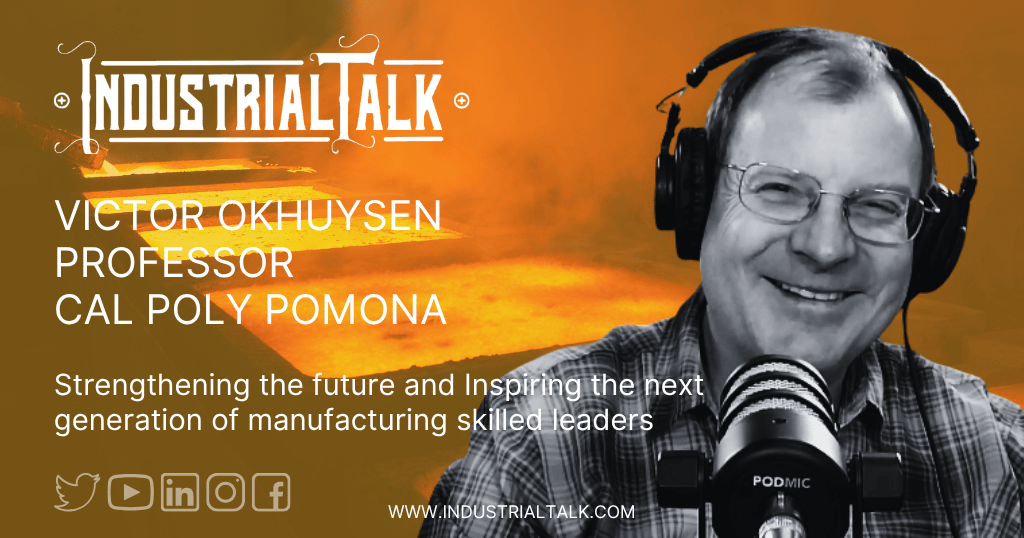
Industrial Talk is onsite at Penn State and talking to Victor Okhuysen, Professor with Cal Poly Pomona about “Strengthening the future of manufacturing”.
Overview
Scott Mackenzie from Industrial Talk discusses the importance of training the next generation of industrial leaders with Victor Okhuysen from Cal Poly Pomona. The Penn State Erie campus hosts the METAL program, which aims to inspire and educate students in metallurgy and manufacturing. Victor, a principal investigator, highlights the program's hands-on approach, including boot camps and workshops, to expose students to potential careers. The program has conducted four boot camps and ten workshops, using a system called Foundry in a Box. Victor emphasizes the need for skilled workers in an increasingly automated industry and the role of community colleges in providing relevant training.
Outline
Introduction to Industrial Talk Podcast and IRISS Technologies
- Scott Mackenzie introduces himself and the Industrial Talk podcast, emphasizing its focus on industry professionals and innovations.
- Scott highlights IRISS Technologies, a global leader in electrical maintenance safety, and their patented infrared and ultrasonic inspection windows.
- IRISS Technologies' solutions help in detecting issues early, boosting reliability, and protecting workers from unplanned failures.
- Scott encourages listeners to learn more about IRISS Technologies at their website.
Introduction to the METAL Program and Victor Okhuysen
- Scott welcomes listeners to the Industrial Talk podcast and highlights the importance of celebrating industry professionals.
- Scott introduces the METAL program at Penn State Erie, an acronym for Metallurgical Engineering Trade Apprenticeship Learning.
- Victor Okhuysen from Cal Poly Pomona is introduced as a key figure in the METAL program, focusing on exchanging ideas to improve curriculum and delivery.
- Victor explains his role as a principal investigator at Cal Poly Pomona, working on a curriculum developed by Penn State.
Discussion on the Importance of Training the Next Generation
- Scott and Victor discuss the critical need for training the next generation of industrial leaders.
- Victor emphasizes the importance of having a trained workforce despite advancements in automation.
- Scott shares his personal experience of being inspired by educational films about manufacturing during his childhood.
- Victor explains the current state of manufacturing, noting the increase in automation and efficiency, and the need for skilled workers.
Victor's Background and the METAL Program at Cal Poly Pomona
- Victor provides a brief overview of his background, including his role as a professor at Cal Poly Pomona and his expertise in metal casting and manufacturing.
- Scott praises the quality of instructors in the METAL program, noting their extensive experience and passion for their fields.
- Victor explains the purpose of the METAL program, which is to expose students to potential careers in metallurgy and related fields.
- The program includes boot camps and workshops, using a system called Foundry in a Box to engage students in hands-on activities.
Challenges and Opportunities in Manufacturing Education
- Scott and Victor discuss the challenges of keeping up with the rapid changes in manufacturing technology.
- Victor highlights the need for continuous training and education to maintain professional currency.
- Scott emphasizes the importance of employers investing in their workforce to stay competitive.
- Victor mentions the issue of skilled workers leaving for better opportunities, which can be a challenge for employers.
The Role of Community Colleges and Apprenticeship Programs
- Scott and Victor discuss the role of community colleges in providing manufacturing education and training.
- Victor explains that community colleges offer programs in welding, machining, and metallurgical technician, among others.
- Scott shares his positive experience with an apprenticeship program, which provided hands-on training and real-life education.
- Victor notes the decline in apprenticeship programs and the need for individuals to be proactive in pursuing their career goals.
The Importance of Hands-On Training in Manufacturing
- Scott and Victor discuss the importance of hands-on training in manufacturing education.
- Victor shares an example of a boot camp where students were given the opportunity to pour their own molds, providing a valuable hands-on experience.
- Scott emphasizes the need for students to see and experience the practical aspects of manufacturing to understand its importance.
- Victor highlights the benefits of hands-on training in making students more knowledgeable and skilled.
Future Plans for the METAL Program at Cal Poly Pomona
- Victor outlines the future plans for the Metal program at Cal Poly Pomona, including expanding the program and reaching more people.
- The program aims to attract more high school and college students, as well as industry professionals.
- Victor mentions the potential for the program to include more boot camps and workshops to provide additional exposure to students.
- The program also aims to strengthen the manufacturing base by educating more people about the industry.
Conclusion and Call to Action
- Scott wraps up the conversation by emphasizing the importance of supporting the next generation of industrial leaders.
- He encourages listeners to connect with Victor and the METAL program at Cal Poly Pomona for more information.
- Scott highlights the role of Industrial Talk in promoting industry professionals and their stories.
- He encourages listeners to support the METAL program and other initiatives aimed at training the next generation of industrial leaders.
If interested in being on the Industrial Talk show, simply contact us and let's have a quick conversation.
Finally, get your exclusive free access to the Industrial Academy and a series on “Why You Need To Podcast” for Greater Success in 2026. All links designed for keeping you current in this rapidly changing Industrial Market. Learn! Grow! Enjoy!
VICTOR OKHUYSEN'S CONTACT INFORMATION:
METAL Website: https://www.metalforamerica.org/
LinkedIn Profile: https://www.linkedin.com/in/victor-okhuysen-26bb0423/
Company LinkedIn: https://www.linkedin.com/school/cal-poly-pomona/
Company Website: https://www.cpp.edu/
PODCAST VIDEO:
THE STRATEGIC REASON “WHY YOU NEED TO PODCAST”:
OTHER GREAT INDUSTRIAL RESOURCES:
NEOM: https://www.neom.com/en-us
Hexagon: https://hexagon.com/
Arduino: https://www.arduino.cc/
Fictiv: https://www.fictiv.com/
Hitachi Vantara: https://www.hitachivantara.com/en-us/home.html
Industrial Marketing Solutions: https://industrialtalk.com/industrial-marketing/
Industrial Academy: https://industrialtalk.com/industrial-academy/
Industrial Dojo: https://industrialtalk.com/industrial_dojo/
We the 15: https://www.wethe15.org/
YOUR INDUSTRIAL DIGITAL TOOLBOX:
LifterLMS: Get One Month Free for $1 – https://lifterlms.com/
Active Campaign: Active Campaign Link
Social Jukebox: https://www.socialjukebox.com/
Industrial Academy (One Month Free Access And One Free License For Future Industrial Leader):

Business Beatitude the Book
Do you desire a more joy-filled, deeply-enduring sense of accomplishment and success? Live your business the way you want to live with the BUSINESS BEATITUDES…The Bridge connecting sacrifice to success. YOU NEED THE BUSINESS BEATITUDES!
TAP INTO YOUR INDUSTRIAL SOUL, RESERVE YOUR COPY NOW! BE BOLD. BE BRAVE. DARE GREATLY AND CHANGE THE WORLD. GET THE BUSINESS BEATITUDES!
Reserve My Copy and My 25% Discount
Transcript
SUMMARY KEYWORDS
Industrial Talk, electrical maintenance, safety technologies, closed panel monitoring, infrared inspection, ultrasonic inspection, METALlurgical engineering, apprenticeship program, manufacturing engineering, foundry in a box, skilled labor shortage, community colleges, hands-on training, professional currency, workforce training.
Hey, it's Scott Mackenzie with Industrial Talk. IRISS is the global leader in electrical maintenance safety, delivering technologies that let team inspect energized equipment safely, using closed panel condition-based monitoring to reduce risk and downtime. Their patented infrared and ultrasonic inspection windows make it possible to detect issues early, boosting reliability and protect the people who keep the operations running. If improving safety and avoiding unplanned failures is your mission, IRISS has the solution to get you there. Learn more at IRISS.com.
Welcome to the Industrial Talk podcast with Scott Mackenzie. Scott is a passionate industry professional dedicated to transferring cutting-edge, industry-focused innovations and trends, while highlighting the men and women who keep the world moving. So, put on your hard hat, grab your work boots, and let's go. All
right. Once again, welcome to Industrial Talk. Thank you very much for joining the number one industrial related podcast in the universe that celebrates you, industry professionals all around the world. If you're out on video, I'm pointing at you, because you're bold, you're brave, you dare greatly, you innovate, you collaborate, you're solving problems each and every day. That's why we celebrate you on Industrial Talk. You are the heroes in this story. And if you're out on video, and if you're looking at it, you can tell that we're surrounded by industry. It's right here. We're at Penn State Erie campus, and we are highlighting the wonderful program called METAL. It's an acronym. Don't go out to LinkedIn and say type in METAL, because you're going to get a bunch of METALs. This one is specific, and always have to look up is METALlurgical engineering trade apprenticeship learning, and if you know the first letters of each one of those things, it spells METAL. That's what we're here for. It is a program that is around just METALlurgy, the science behind it, and inspiring the next generation of of industrial leaders, and that's what this program, it's a boot camp, and in the hot seat, in the hot seat, his name is Victor, he's with Cal Poly Pomona, he is looking into, I would imagine bringing, bringing this program out in California. Right,
well, we already have it over there. What we're doing here is we, the METAL program wants us to exchange ideas to improve the curriculum, improve how we deliver the material, how we excite people more into coming into the industry.
I think I think personally, and it's just Scott thinking, which has zero weight, zero, I think, in the world of industry, and I, and I'll use industry as a whole as a broad macro blanket, is finding teaching, and inspiring that next generation to fulfill these roles is absolutely critical. You can only automate so much, you can only, you still need people, and you still need a trained workforce, and we, we need to do that.
We, and that's what we're about.
Okay, so you calc, why are you here?
Why am I here? The I am one of the PIs for the program at Cal Poly Pomona,
PIPI, private investigator,
principal investigator, the guy who writes the grant, very good, along with my well, the I am a co-PI. The PI is actually Dr. Winnie Dong, and I am here. Essentially, Penn State developed a curriculum for the program, so we're here learning how to deliver it better, and potentially providing some feedback on the things that we have done that have worked well for us that they may be able to incorporate.
How long has been out in Cal Poly?
We're in our first year.
First year,
yeah, we've done a bunch of boot camps and a bunch of workshops. And
when you say a bunch, like how often are you doing boot camps and workshops,
we've done four boot camps so far.
Yeah,
and workshops, I don't know, probably 10, and the workshops are essentially there. There's a system called Foundry in a Box, where basically you have everything that you need to make a little casting, a little piece METAL size, and we essentially take it to elementary schools, to
see high
schools, community events, those types of things.
Here I go off on a tangent. I think that we have to think young, inspire them to keep. Them keep them engaged and keep that going, because I'll give you an example. Growing up, you know where I live, growing up in Barstow, we would always have in elementary school, we would have these, these films, and the films that we would watch as students, second grade was how does how does bread get to the store, it was manufacturing, it was here, here's a truck, here's this, this is that, you know, and and we've lost that,
yes or no,
oh, talk to me about the no,
no. Well, let's talk about the yes first. Yeah, okay. You see the news, you see offshoring happening, you see news of layoffs and those types of things. No part is that we're currently manufacturing more than we ever have.
It's not because of people, is it? Or is it because of
ompared to agriculture in the:going through the roof. Yeah, right.
So it's a similar thing in manufacturing. There's been improvements, whereas before you had 10 smaller shops, now you have a couple of larger shops that are more efficient that produce what the 10 smaller shops produced even more, but and they employ less people than the 10 shops used to, so, so that's the no part. That's
an interesting one,
but the yes part is, yes, there's a lot of offshoring, and that's that's an issue,
even with this, this improved optimization and yield, and all, whatever, that, whatever the stat, the statistics are proven. Is there still a growing? Is there is the demand growing, and the need for people growing with that.
The demand that's growing is a demand for skills, so you need to have people that are skilled, because with all this automation, with additional mechanization, it is not - you can't just grab somebody off the street and say, "Okay, start, start working here. Can't, yeah, so you need to have more training, you need to have more education, and then you'll be ready to pursue that, but the flip side of that is that those are also better paying jobs.
How do we start, Victor? I'm sorry. See, I'm already into it. Nobody knows who Victor is. Yeah, give me a little 411 on Victor, or where you came from. Sure,
I am currently a professor at Cal Poly Pomona. I am the METAL casting guy, and I do manufacturing in general, but METAL casting is my specialty, but I also do welding, machining, plastics, CAD, cam, those types of things that are related to all around manufacturing, the and prior to that I was an engineering manager in a company in Pennsylvania for a few years, and prior to that I had done my schooling,
see, and this is, I digress here, what I'm finding, which is encouraging, is that the quality of instructors at this program, everyone has that that gravitas, that that incredible skills and abilities, that years and years of being able to say I can talk with authority here, and and where it's going, and it's because I find the the the individuals are passionate about what they do,
yep,
yeah, see
this within the foundry educational within the foundry network, there's an educational network that is very close and essentially that's how we all know each other, and we are primarily the people that are doing this program, not exclusively, and anybody's welcome to this program. If there's a school that's looking at this and says, "Hey, I would be interested in running this program at my place, contact us, contact anybody of the people that you have interviewed.
See, that's that's wonderful. I like that, that, and that brings me to this point of when I was young and I was become an alignment and I had an approach. Apprenticeship program. Now I'm not just being hired off the street to go climb a tower and to do that work. There has, there was four years of, you know, education, real-life education. How do you address, got this program, this boot camp? It's five days, we need more.
Yes,
we need more training. We need more that going forward.
Well, the purpose of this program is primarily to expose people to areas potential careers that they may not have thought of, that they may find interesting, and it's an exposure to that you come to this program and then from here you see what this METALs manufacturing is about and then you decide whether or not you want to continue or if it's not for you and if you want to continue then you pursue the training in your education in many areas many locations
but see the let's say Cal Poly. If I, if I decide that I'm in, I'm interested in this, is a great opportunity. I like it. Great thumbs up, all good. I feel comfortable knowing that Cal Poly has that track, has that ability to be able to sort of take me through that.
Correct. Yeah, you would essentially come to our manufacturing engineering program.
What about other universities?
Well, the many.. there's many manufacturing-related programs. You just have to find them, and you have safe in a lot of places, for instance, you will not have a separate manufacturing engineering degree like we do.
Yeah,
but it will be embedded in other programs, like at Penn State Main Park, as part of the industrial engineering program. If you go to, in most other places, it will be either within the METALlurgical or materials engineering program, or even within the mechanical engineering program. So, they, the tech manufacturing components tend to be there, so that's that's where you would look for that, and there's also a lot of programs that are engineering, technology, and manufacturing that are perfectly that are great.
Okay, so here we are. We have the, the this, this connection between manufacturing and and engineering programs at these universities. What about that individual that, hey, I want to get into manufacturing, but I'm not here in this university setting. What, what do we have available for
them? The, that's typically the realm of community colleges, and there are a lot of great programs you can do, welding, machining, I mean, even though those are not necessarily what METAL is about, but you can do welding, machining, METALlurgical technician, but essentially you would look at your local community college, and these programs exist, and there's a lot of them,
there are a lot of them, yeah, there are a lot of them, over in my area, I can think of about five six different community colleges that would have these programs, so they are not rare. Yeah, so it's important to be able to get that message out, and it's still like it's down to the point of the inspiring that next generation, there are avenues for everybody to take to achieve that manufacturing or finding their role in that manufacturing market, whatever it might be.
Correct, correct. And, but, but the real key is you need it. You need to become skilled, and the skill could be a four year degree, it can be a two year apprenticeship, it can be many things, it can be graduate school and becoming a researcher in the area of manufacturing, but you do need to be skilled,
define, define that, do we do we have in this country a robust apprenticeship program?
I'm not that familiar with the apprenticeship programs. From what my understanding is, that they have declined, like you were mentioning, you went through for your apprenticeship program, and as a translator, I happen to have met somebody who just went through a lineman training,
they get, they yell at you a lot.
Yeah,
safety thing, yeah. Listen to them, yeah.
They don't want you to fry and fry them along with you, yeah.
They don't,
but. There appears to be a lot less apprenticeships, so it seems like now it's more dependent on the individual to pursue what they want to do, so you need to be savvy as to what jobs are out there, but generally speaking, there's a right now there's a significant shortage in skilled manufacturing labor,
my concern is, as the are we as a country, as an education system, nimble enough? Now you've got METAL, you got that stuff, and I think you guys are on it, but nimble enough to really take into consideration, train them, give them the skills that they need in a market manufacturing market that is is changing dramatically all the time, it's there's a speed of velocity. Yes, do we have that education capability to be able to be nimble enough to just say no?
Well, it's not just the education capability, the education programs exist, and the problem becomes when somebody finishes training of some type, and then they go to work. Well, the technology around the workplace is changing dramatically all the time, all the time. The question is, How do you keep skilled and relevant in that environment
going forward,
correct.
Yes,
in that, and there's two sides to that coin. The first one is the environment changes, and you need to just become better, more knowledgeable, and so on and so forth. And there are programs. I, you ask, how good are we at it? I don't know, but there are programs that exist to maintain that professional currency, and when I say I don't, I don't know how many there are, how good they are, where they are, are they located with it, where they are needed. The flip side of that coin is that some jobs simply become obsolete, they disappear, and so that's where somebody would need to go ahead and get retrained. The problem that we have there is that then we lay it all on the individual, and if the individual doesn't have work because their skills became, because their job became no longer necessary, then you have that's where a gap exists.
It's interesting, because if I was a business owner and I, I've got my fingers on the hole, so I know what's going on in the market, I see what's changing in the market, I hear, and I know it would seem to me that there is a financial benefit to ensure that my workforce is properly engaged, properly educated, whatever, upskilled, reskilled, whatever, because it just makes good business sense, and to be able to, and it's I believe it's incumbent upon the employer to do that, and to have that ability to do it.
Yes, it is to their, to the benefit of the employer to be the employer of choice.
Yeah,
and that could mean better training, better working conditions, better salaries, all of those things. One issue that has been mentioned to me by employers is I can spend a lot of money upskilling somebody, and then they'll go work for somebody
for 25 cents an hour,
or they go someplace else where they will pay them better, because that other individual is not investing in their people.
Yeah,
and so that if the floor has to be uniform, and if it's not uniform, you're going to have those things happening. Yeah, there's people that, yeah, we'll switch for 25 cents an hour, but for the most part, I think once people have done a couple rounds of jobs, once they find a good one, they won't move for 25 cents an hour, they'll prefer to have a good job, a good environment, a good
good culture, good whatever. Because I'm, I'm just keen on the necessity, because I have, I have fond memories of my apprenticeship, and I was prepared, and you know, there was no doubt about it. I, you know, I was prepared, but I have to attribute it to a very robust apprenticeship program, correct? The same thing has to exist in all elements. There should it just.. and, and for me, I can appreciate the old salty dogs that were, you know, yelling at me, but they knew their stuff, right? Yes, do it this way, don't do it this way, too, you know, whatever it is, then I can appreciate that that same, that same mentality needs to exist within, let's say, the foundry business,
correct?
You know, how are how are the just the market of foundries, just in general, how, how. They receptive to this, are they saying I get
it? Pretty much anybody that we have mentioned that we're participating in this program has been very happy, very supportive. They say, yeah, we do need the people. It's there's a lot of concern that the next generation will not be, will not be there to continue, so and again I agree, so they are very happy to see this, like on this particular boot camp, we went to a couple of foundries, and it was excellent exposure, and everybody there was very happy, I don't think the students, the participants in the boot camp, understand how much effort the companies put to have the students have the experience that they had. It was a lot, I mean, so they are committed to helping us.
That's a good point, because I was, I was, I was pleasantly pleased from yesterday's site visits, because especially you're pouring, you're doing it, you're seeing it, you're smelling it, you're healing, feeling it, you're here, all of this stuff is right there, you're in the middle of it, you see what's going on, and I really appreciate that,
and typically when you, when you take a class in a planter like that, you would watch them pour.
Yeah,
what they did here is they said, "We'll set up your molds.
Yeah,
you will. We will set up the students to come in to pour themselves their own molds. And that's that's a big step. That's a very big step.
I get
credit to the funders that
I think it's critical. I think it's one thing to be able to just sort of have this conversation in theory in a classroom with paper and books and folders and you know, whatever, three ring binders, that's one thing, but to be able to say, okay, I get it now, go out to the field
to actually do it, do it,
and, and, and hear the stories of why this is critical, why this is important. One
of the really great things about the program is that it's very hands on, you're not just being lectured at, but you're actually going and doing things, or forging things, or casting things, or making molds, you're doing all sorts of different things, so you get that sense, and that is closer to reality than just sitting in a room being lectured at,
and I agree. Now, when I was going through my apprenticeship, yeah, I was out in the field, I was, you know, now I'm a first step, now you get to climb a pole, yikes, yeah, but there you are, you got to do it, you're out there in the field, do you do something similar to what they're doing out here? Because my only example is, of course, Erie, and what this out in Cal Poly,
we generally speaking, yes, we may do, because our setup, our equipment is different, we have our equipments in two different buildings, so we, we essentially run the same program, we run the same software, we run the same simulations, we make the same parts, report the same parts, but we adhere, for instance, one of the things that they do is that it, because of their layout, it makes sense to do to have small groups of people rotating, because we have equipment that's laid out in a different manner. Yeah, it makes sense for us to treat it as a small class.
Everybody at the same time, are you looking at getting a forger forge?
Yeah, we have ordered one, we haven't installed it, but it's right before I came here, I saw the last of the components,
see, see, that's pretty doggone cool. So, where do you hope that Cal Poly program, where do you see it going? What, what, what do you hope for that? What's vision
part of what we're looking at is how do we, what we want to do is, we want to enhance, we want to attract people into the field,
yeah,
or at least expose them, and if they're interested, that now they know they can come in. Yeah, this is not about forcing anybody into this, no, but, but most people that are participating already have an interest, a little bit of an interest, or at least are curious. So one of the things is we want to reach out to more people, grow the program. Yeah, do more boot camps.
Yeah,
so that would be one part of it. The other part of it is also to reach out to other people. Right now, we're largely concentrating on high school students and college students. The, we would like to attract more people, like for instance, in this camp you see people that are actually working in industry, not necessarily in the production side, but on. Controlling side logistics side, so it helps them to know what goes on, so they can do their jobs better, and in that manner strengthen our manufacturing base.
I got to tell you, I had a great conversation with Kayla, and and it's it's all around the sourcing of the raw materials, and when you do it, costing it out and doing it right, because you could theoretically get upside down really quickly, deliverable. So I can truly appreciate that. And then, of course, she shared with me just the market dynamics that exist, you know, getting an ingot here. I quite honestly, I was salivating, because I just.. I thought, what the heck, Victor? How does somebody get a hold of you? They're saying, I want to know more about your program at Cal Poly. I live out in California, I want to know more about that.
Okay, probably the best way to contact me is through my email, yeah,
V F O K H U I S E N cpp.edu
I'll have that. You out on LinkedIn?
Not really.
Okay. and I won't tag you. Yeah, well, we'll have his contact information.
I'm all right. I don't do those things very well.
Well, you're in the business, you better get that message out and leverage those platforms. I'll just recommend that to you, all right. We're gonna have all the contact information for Victor out on Industrial Talk. We'll have his email, reach out to him, find out more. If you're in the.. if you want to, you want to talk to him, and you're in Cal Poly off the 60. If I remember,
no, after 10,
it's up to 10.
What's up the 10?
Yeah, it's off the 10, not the 60. Sorry, spend some time, all right. Once again, we're broadcasting from Erie, Pennsylvania. We're a part of the METAL program, brought to you by those wonderful people at Penn State Erie. It's a wonderful program to get people like Victor and others telling about the wonders of manufacturing. We're going to wrap it up on the other side. Stay tuned, we will be right back. You're listening to the Industrial Talk Podcast Network. Yeah, that was Victor. He knows a lot. That was a great event, METAL Penn State Erie. That was an absolutely wonderful event, and it is in line with what industrial talk is all about. We want to, we just want to inspire that next generation of industrial leaders. We need to be able to present that in a way that brings that excitement to that next generation, and, and Victor, and the rest of the METAL team, outstanding, they're passionate about definitely making that happen, it really was, and while I was there, we, we went to a couple of foundries, it was hot, it was, it was fantastic, it was exciting making things, and there's a lot of science, a lot of knowledge, Victor's just one of many at at this organization METAL, he's Cal Poly, but anyway, bringing that, bringing that just manufacturing passion to more people. It just, it just has to happen. You need to support them and support this, this effort to train that next generation, we need skilled individuals to support them. All right. Industrial Talk. Speaking of support, Industrial Talk is a media and marketing company. It is all just focused on your success. We've been at it for a long time, and we want you to succeed, you have to succeed. It's incumbent that you succeed. You need to tell your story. There is no other way of getting around it. You can't just depend on AI to be able to do your, your marketing and your, your sales. You just, it makes you more efficient, but you need to have put a face to that. That's what that's what the young people want, man. They want to see true individuals just, just be able to tell that story. You need to do that. Go out to industrial talk, connect with me. Let's have a conversation, because we need to have that conversation. You're doing cool stuff. Let's just not. let's not just sort of skip across, across that it's, it's, you're doing cool stuff, all right. Be bold, be brave, Derek. Greatly support METAL, support Ace. This is the other program that's with it. Support Penn State Erie in their efforts to do that and change the world. We have another great conversation shortly, so you know. Stay tuned.